
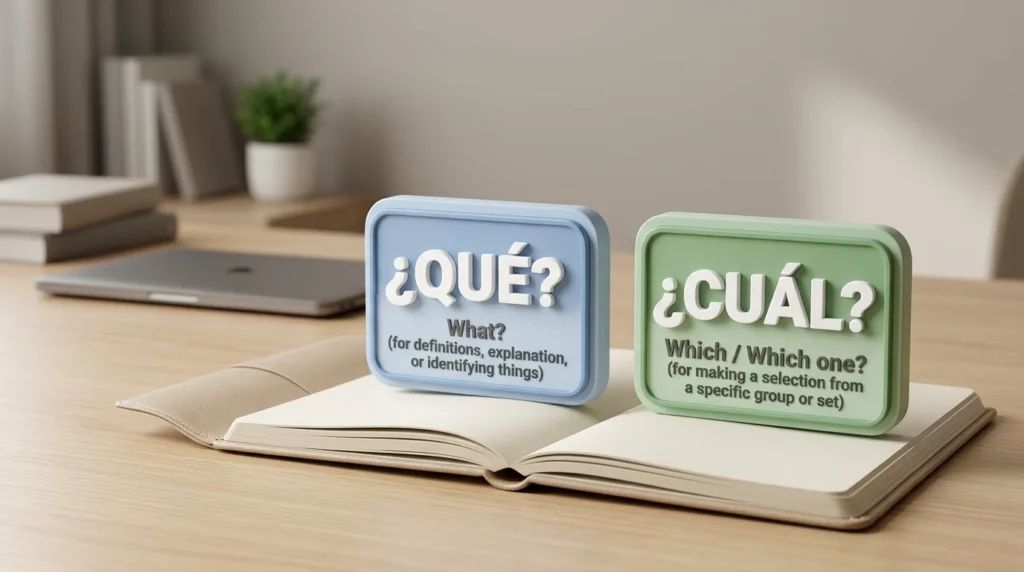

Use qué for “what,” definitions, explanations, and questions where it comes directly before a noun: ¿Qué es esto? and ¿Qué libro quieres? Use cuál for “which one” or for identifying a specific answer: ¿Cuál prefieres? and ¿Cuál es tu nombre? Use cuáles for plural choices. In questions, write qué, cuál, and cuáles with accent marks.
What Is the Difference Between Qué and Cuál?
Qué and cuál are Spanish interrogative words. An interrogative word is a word used to form a question.
English makes this confusing because what and which do not always map neatly onto qué and cuál.
For example:
- ¿Qué libro quieres? = Which book do you want?
- ¿Cuál quieres? = Which one do you want?
- ¿Qué es un libro? = What is a book?
- ¿Cuál es tu libro favorito? = What is your favorite book?
Notice that English may use what or which, while Spanish chooses the question word according to the structure and meaning of the question.
A useful way to think about the difference is:
Qué usually opens the question. Cuál usually identifies or selects an answer.
This is a useful starting point, but it is not a rule that works simply by translating every English “what” as qué and every “which” as cuál. The words around the question matter.
Why Does the Difference Matter?
Choosing the wrong word can make a Spanish question sound unnatural or change what kind of answer the listener expects.
Compare:
¿Qué es un teléfono?
This asks for an explanation or definition of what a telephone is.
¿Cuál es tu teléfono?
This asks for a specific piece of information, such as your phone number or, depending on context, which telephone is yours.
Another important contrast is:
¿Qué color prefieres?
This means “What/which color do you prefer?” The noun color comes immediately after qué.
¿Cuál prefieres?
This means “Which one do you prefer?” The noun is understood from the previous context.
Learning this distinction helps you avoid translating English question words word-for-word.
Read More: Whit vs Wit: What’s the Difference?
The Core Rule
Use qué before a noun and when asking for a definition, explanation, or broad piece of information. Use cuál or cuáles when identifying or selecting a specific answer, especially when the noun is not stated.
The most useful patterns are:
- qué + noun
¿Qué película quieres ver? - qué + verb for many open-ended questions
¿Qué haces? - qué es for definitions or explanations
¿Qué es la fotosíntesis? - cuál + verb when the answer is an identified choice
¿Cuál prefieres? - cuál es for a specific identifying answer
¿Cuál es tu dirección? - cuál de + noun/group when choosing from a defined group
¿Cuál de estos libros quieres? - cuáles for plural selections
¿Cuáles prefieres?
These patterns reflect the main distinction described in current Spanish-learning references.
How to Use Qué
Use Qué Before a Noun
One of the easiest rules to remember is that qué normally comes directly before a noun.
Examples:
- ¿Qué libro estás leyendo? — Which book are you reading?
- ¿Qué película quieres ver? — Which movie do you want to watch?
- ¿Qué comida te gusta? — What food do you like?
- ¿Qué ciudad visitaste? — What/which city did you visit?
- ¿Qué color prefieres? — What/which color do you prefer?
Even when there are several known choices, qué + noun is the standard pattern in careful, neutral Spanish.
For example, if you are looking at five shirts, you can ask:
¿Qué camisa quieres?
You do not need to say cuál simply because there are multiple choices. The fact that a noun follows the question word is important.
Use Qué for Definitions
Use qué when you want to know what something is or what a concept means.
Examples:
- ¿Qué es un eclipse?
- ¿Qué es la democracia?
- ¿Qué significa esta palabra?
- ¿Qué es una metáfora?
- ¿Qué es el aprendizaje automático?
These questions seek an explanation, definition, or general understanding rather than one selected item.
Compare:
¿Qué es una metáfora?
You want a definition.
¿Cuál es la metáfora del poema?
You want to identify a specific metaphor in the poem.
Use Qué for Open-Ended Questions
Qué is also common when the possible answer is not limited to one known set.
- ¿Qué quieres comer?
- ¿Qué haces después del trabajo?
- ¿Qué estudias?
- ¿Qué necesitas?
- ¿Qué pasó?
The answer could take many forms.
For example:
¿Qué quieres comer?
Possible answers include:
- Quiero pizza.
- Quiero arroz.
- Quiero una ensalada.
- No tengo hambre.
The question does not require the speaker to choose one item from a previously established list. (Progress with Lawless Spanish)
How to Use Cuál
Use Cuál for a Specific Identification or Choice
Cuál commonly asks the listener to identify one particular answer.
Examples:
- ¿Cuál prefieres? — Which one do you prefer?
- ¿Cuál quieres? — Which one do you want?
- ¿Cuál es mejor? — Which one is better?
- ¿Cuál es tu dirección? — What is your address?
- ¿Cuál es tu nombre? — What is your name?
The English translation may contain what, but Spanish can use cuál because the expected answer is a specific value or identity.
Use Cuál With “De” for a Defined Group
When you want to select something from a clearly identified group, cuál de is especially useful.
Examples:
- ¿Cuál de estos libros quieres?
Which of these books do you want? - ¿Cuál de las dos opciones prefieres?
Which of the two options do you prefer? - ¿Cuál de estos teléfonos es tuyo?
Which of these phones is yours? - ¿Cuál de tus hermanos vive aquí?
Which of your siblings lives here?
The phrase cuál de makes the selection relationship clear: one item is being identified from a group. (Hola Cards)
Use Cuáles for More Than One Choice
Cuál has a plural form: cuáles.
Use cuáles when you expect multiple answers.
Examples:
- ¿Cuáles son tus libros favoritos?
- ¿Cuáles prefieres?
- ¿Cuáles de estas respuestas son correctas?
- ¿Cuáles son tus planes?
- ¿Cuáles de estos documentos necesitas?
Remember:
cuál = one
cuáles = more than one
Qué does not change to a plural form.
Read More: Blowed vs Blew: Which One Is Correct?
Qué Es vs. Cuál Es
This is one of the biggest problems for Spanish learners.
Both structures can translate into English as “what is”, but they do not normally ask the same kind of question.
Qué es = What is it? What does it mean?
Use qué es when asking for a definition, explanation, or description of the nature of something.
¿Qué es la fotosíntesis?
You are asking for an explanation of the concept.
¿Qué es un sustantivo?
You are asking for a definition.
¿Qué es esta máquina?
You are asking what the machine is.
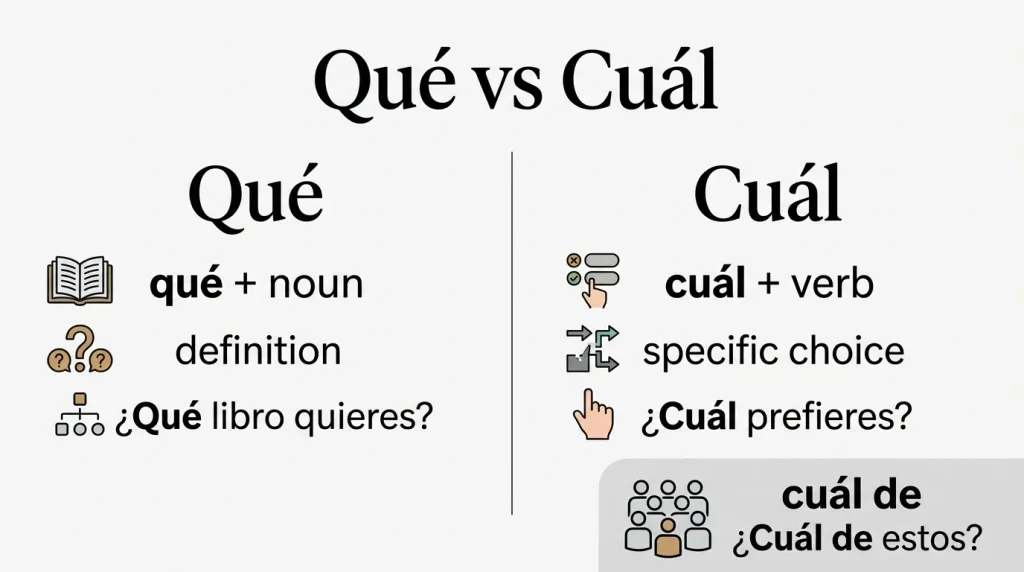
Cuál es = Which one is it? What is the specific answer?
Use cuál es when you want a specific identifying answer.
¿Cuál es tu nombre?
Answer: Mi nombre es Ana.
¿Cuál es tu dirección?
Answer: a particular address.
¿Cuál es tu número de teléfono?
Answer: a particular number.
¿Cuál es la capital de Perú?
Answer: Lima.
The distinction is not simply “qué means what and cuál means which.” Both can translate as what, depending on the sentence. The type of answer being requested is more useful than the English translation alone. (lingokeyboard.com)
Correct Examples
Here are examples covering everyday conversation, school, work, email, social communication, and academic contexts.
| Situation | Correct Spanish | Meaning |
|---|---|---|
| Conversation | ¿Qué quieres hacer? | What do you want to do? |
| Café | ¿Qué café quieres? | What/which coffee do you want? |
| Choice | ¿Cuál prefieres? | Which one do you prefer? |
| School | ¿Qué asignatura estudias? | What subject do you study? |
| Definition | ¿Qué es un adjetivo? | What is an adjective? |
| Workplace | ¿Cuál es tu opinión? | What is your opinion? |
| ¿Cuál es la fecha límite? | What is the deadline? | |
| Travel | ¿Qué tren vas a tomar? | Which train are you taking? |
| Group choice | ¿Cuál de estos hoteles prefieres? | Which of these hotels do you prefer? |
| Social media | ¿Qué canción estás escuchando? | What/which song are you listening to? |
| Academic | ¿Qué significa este término? | What does this term mean? |
| Personal information | ¿Cuál es tu dirección? | What is your address? |
Incorrect vs. Correct
| ❌ Incorrect | ✅ Correct | Why |
|---|---|---|
| ¿Cuál libro quieres? | ¿Qué libro quieres? | In standard neutral Spanish, qué is normally used directly before a noun. |
| ¿Qué prefieres? | ¿Cuál prefieres? | If the context is a defined set and you mean “which one,” cuál is appropriate. |
| ¿Qué es tu nombre? | ¿Cuál es tu nombre? | The normal question asks for your specific name, not a definition of “name.” |
| ¿Cuál es un verbo? | ¿Qué es un verbo? | This asks for a definition of a grammatical concept. |
| ¿Qué de estos libros quieres? | ¿Cuál de estos libros quieres? | Cuál de identifies one choice within a defined group. |
| ¿Qué es tu dirección? | ¿Cuál es tu dirección? | The expected answer is a specific address. |
| ¿Cuál película viste? | ¿Qué película viste? | Qué normally comes directly before the noun. |
| ¿Qué de estas opciones eliges? | ¿Cuál de estas opciones eliges? | The question asks you to select from a specified group. |
| ¿Cuál color prefieres? | ¿Qué color prefieres? | Standard neutral usage places qué before the noun. |
| ¿Qué son tus favoritos? | ¿Cuáles son tus favoritos? | Cuáles is plural because several items are being identified. |
| ¿Cuál quieres comer? | ¿Qué quieres comer? | Without a defined choice, qué asks openly what you want to eat. |
| ¿Qué es la capital de España? | ¿Cuál es la capital de España? | The question seeks one specific geographical answer. |
The central pattern is more reliable than translating what = qué and which = cuál mechanically.
Why People Make This Mistake
English Uses “What” Very Broadly
English speakers can say:
What is your name?
What is your address?
What is a noun?
Spanish distinguishes these situations more clearly.
That means a learner may naturally translate every English what as qué, even when Spanish normally requires cuál.
English “Which” Creates Another Problem
English can ask:
Which book do you want?
Spanish normally uses:
¿Qué libro quieres?
A learner may think “which” automatically means cuál, but that is not how the Spanish structure works when the question word comes directly before a noun.
Translation Interference
Translation interference happens when a learner transfers a pattern from one language into another.
English:
Which color do you prefer?
Spanish:
¿Qué color prefieres?
The English word which makes learners expect cuál, but Spanish grammar uses qué directly before color.
Overgeneralizing “Cuál = Which”
It is tempting to memorize:
qué = what
cuál = which
That shortcut works sometimes, but it breaks down quickly.
For example:
¿Qué libro quieres?
means “Which book do you want?”
And:
¿Cuál es tu nombre?
means “What is your name?”
The sentence structure matters more than the English translation.
Forgetting the Accent Marks
Another common mistake is writing que or cual in questions when the interrogative forms require accents:
¿Qué quieres?
¿Cuál prefieres?
The accent is not decorative. It distinguishes interrogative/exclamatory forms from the corresponding unaccented forms in many contexts.
Common Mistakes Checklist
Mistake 1: Using cuál directly before a noun
Wrong for standard neutral usage: ¿Cuál libro quieres?
Better: ¿Qué libro quieres?
Remember: qué + noun is the normal pattern.
Mistake 2: Translating “what” as qué every time
English: What is your name?
Spanish: ¿Cuál es tu nombre?
The question asks for a specific personal value, not a definition.
Mistake 3: Translating “which” as cuál every time
English: Which movie did you watch?
Spanish: ¿Qué película viste?
Because película follows the question word directly, qué is the standard choice.
Mistake 4: Forgetting cuáles
If you expect multiple selected items, use cuáles.
¿Cuáles prefieres?
Not:
¿Cuál prefieres?
when the question clearly expects several answers.
Mistake 5: Ignoring context
¿Qué quieres? and ¿Cuál quieres? can both be grammatical, but they can ask for different kinds of information.
¿Qué quieres? = What do you want?
¿Cuál quieres? = Which one do you want?
Read More: Revocable vs Irrevocable: Key Differences Explained.
Mistake 6: Forgetting accents
Write:
qué
cuál
cuáles
when they are interrogative words.
Qué vs. Cuál in Real English
Grammatically correct but not automatically interchangeable
¿Qué libro quieres? and ¿Cuál quieres? can both be correct, but they are not identical structures. The first names the category, libro, while the second leaves the noun understood from context. A natural conversation may use both in sequence: ¿Qué libro quieres? — No sé. ¿Cuál recomiendas? The second question works because the relevant group of books is already understood.
The natural everyday choice before a noun
When Spanish speakers ask a question with the question word immediately followed by a noun, qué is the normal neutral pattern: ¿Qué película viste?, ¿Qué comida quieres?, and ¿Qué ciudad visitaste? This remains true even when the speaker has a limited number of choices in mind. The important structural point is that qué is functioning with the noun.
The natural choice for a specific personal value
Questions such as ¿Cuál es tu nombre?, ¿Cuál es tu dirección?, and ¿Cuál es tu número? request a particular answer rather than a definition. English uses “what” in these questions, which is why learners often expect qué. In Spanish, cuál helps identify the specific value being requested.
Qué es and cuál es are not simply interchangeable
¿Qué es esto? asks for an explanation or identification of what something is. ¿Cuál es este? would instead identify a particular item in a known group. The distinction becomes especially clear when you imagine the expected answer: if the answer sounds like a definition, qué is usually appropriate; if the answer is one specific item, name, number, or other value, cuál is often the natural choice.
American vs. British English
The difference between qué and cuál is a Spanish grammar issue, not an American-versus-British English difference.
American and British English may differ in vocabulary or usage in other situations, but that does not change the basic Spanish distinction explained here.
For English learners, the important point is that both varieties of English can translate Spanish qué and cuál as what or which, depending on context.
Formal vs. Informal Usage
The core distinction between qué and cuál does not disappear in formal writing.
In school, professional writing, academic Spanish, and careful communication, the safest approach is to follow the standard structural patterns:
- ¿Qué + noun…?
- ¿Qué es…? for definitions
- ¿Cuál es…? for specific identifying answers
- ¿Cuál de…? for selection from a defined group
- ¿Cuáles…? for plural selections
You may encounter regional spoken patterns that differ from the textbook rule, particularly forms such as ¿Cuál libro…? in some areas of Latin America. Regional usage exists, but learners seeking broadly accepted standard written Spanish should generally use ¿Qué libro…?.
Comparison Table
| Feature | Qué | Cuál / Cuáles |
|---|---|---|
| Main idea | What; what kind; general information | Which one; which ones; specific identification |
| Before a noun | Yes | Normally no in standard neutral Spanish |
| Definition | Yes | Usually not |
| Selection from a group | Sometimes through qué + noun | Yes, especially cuál de |
| Singular | qué | cuál |
| Plural | qué remains unchanged | cuáles |
| Example | ¿Qué libro quieres? | ¿Cuál quieres? |
| With “de” | Not for ordinary selection | ¿Cuál de estos…? |
| Specific personal information | Often not | ¿Cuál es tu nombre? |
| Definition with ser | ¿Qué es…? | — |
| Specific answer with ser | — | ¿Cuál es…? |
The key is not to treat the English translations as fixed equivalents. Spanish chooses the form according to the question’s structure and the type of answer being requested.
What About Que vs. Cual Without Accent Marks?
This is a separate but important part of the topic.
qué and cuál are interrogative forms.
que and cual without accent marks generally have other grammatical functions.
For example:
El libro que compré es interesante.
Here, que is not asking a question. It introduces a relative clause and can mean something like “that” or “which.”
Similarly:
El hotel en el cual nos alojamos era tranquilo.
Here, cual is a relative pronoun, not the interrogative cuál.
Compare:
¿Cuál prefieres?
Which one do you prefer?
with:
El libro, el cual compré ayer, es interesante.
The book, which I bought yesterday, is interesting.
The accent helps distinguish the interrogative/exclamatory form from the corresponding unaccented relative form.
Read More: Composed vs Comprised: Which Is Correct?
What About Indirect Questions?
Accent marks are still required when qué, cuál, cuáles, and other interrogative words introduce an indirect question.
For example:
No sé qué quieres.
I don’t know what you want.
No sé cuál prefieres.
I don’t know which one you prefer.
Ella preguntó qué libro compraste.
She asked which book you bought.
No sabemos cuál de los dos es correcto.
We don’t know which of the two is correct.
There is no question mark around the entire sentence in these examples, but the words are still functioning as interrogatives, so the accents remain.
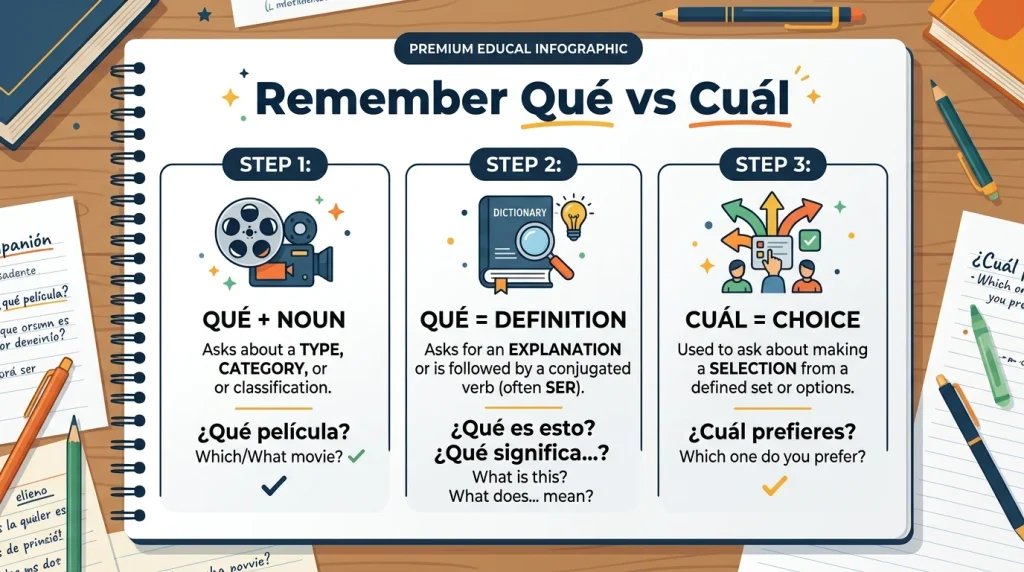
Memory Trick
Use this simple N-D-S test:
N = Noun → Qué
D = Definition → Qué
S = Selection → Cuál
Ask yourself:
- Is a noun immediately after the question word?
→ Use qué. - Am I asking “What is it?” or asking for an explanation?
→ Use qué. - Am I identifying or selecting one from a group?
→ Use cuál. - Am I selecting several?
→ Use cuáles.
For example:
¿Qué película…? → noun → qué
¿Qué es…? → definition → qué
¿Cuál prefieres? → selection → cuál
¿Cuáles prefieres? → multiple selections → cuáles
Real-Life Situations
In a Conversation
Friend: ¿Qué quieres comer?
You: Quiero pasta.
Later:
Friend: Hay pasta y pizza. ¿Cuál prefieres?
You: La pasta.
The first question is open-ended. The second asks you to select between known choices.
In a Restaurant
Waiter: ¿Qué bebida quieres?
Customer: Quiero agua.
The noun bebida follows qué.
In a Classroom
Student: ¿Qué es un pronombre?
Teacher: Es una palabra que puede sustituir a un sustantivo.
The student wants a definition.
In an Office
Manager: ¿Cuál es tu número de teléfono?
Employee: Es 555-0182.
The manager wants a specific piece of information.
In an Interview
Interviewer: ¿Qué experiencia tienes en ventas?
The question is open-ended and asks the candidate to provide information.
In an Email
¿Cuál es la fecha límite para entregar el informe?
The writer wants one specific date.
In a Text Message
¿Qué película quieres ver?
The noun película makes qué the natural choice.
During Travel
¿Cuál de estos trenes va a Madrid?
The speaker is identifying one train from a known group.
During Shopping
¿Qué talla necesitas?
The question asks what size the person needs.
During a Test
¿Qué significa esta palabra?
The student is asking for meaning or definition.
Expert Tips
Do Not Start With the English Translation
Instead of thinking:
“Which means cuál.”
Think:
“What structure am I building?”
For example:
Which book?
Do not translate “which” first. Recognize the Spanish structure:
qué + noun
→ ¿Qué libro…?
Look at the Next Word
When you are unsure, look immediately after the question word.
If a noun follows:
¿Qué libro…?
¿Qué color…?
¿Qué película…?
qué is normally the correct starting point.
If the noun is already understood:
¿Cuál quieres?
¿Cuál prefieres?
cuál may be appropriate.
Use “Cuál de” for Clear Selection
If you are choosing from an explicitly identified group, cuál de is an excellent structure to learn:
¿Cuál de estos…?
¿Cuál de las opciones…?
¿Cuál de los dos…?
Separate “Definition” From “Identification”
This is especially useful with ser.
¿Qué es…?
Think: “Explain or define it.”
¿Cuál es…?
Think: “Give me the specific answer.”
That distinction helps with many questions that English translates using the same phrase, “What is…?”
Learn Complete Patterns
Instead of memorizing isolated vocabulary, memorize useful chunks:
- ¿Qué es…?
- ¿Qué significa…?
- ¿Qué quieres…?
- ¿Qué + noun…?
- ¿Cuál es…?
- ¿Cuál prefieres…?
- ¿Cuál de…?
- ¿Cuáles son…?
Pattern-based learning makes the choice faster in real conversation.
Quick Summary
The difference between qué and cuál becomes much easier when you stop translating English question words one by one. Use qué when asking for a definition, general information, or when it comes directly before a noun: ¿Qué es esto? and ¿Qué película quieres? Use cuál when identifying or selecting a specific answer: ¿Cuál prefieres? and ¿Cuál es tu nombre? Use cuáles for multiple selections. For a defined group, cuál de is useful: ¿Cuál de estos libros quieres? Also remember the accents: qué, cuál, cuáles are used as interrogative forms, while que and cual have different grammatical functions in statements.
FAQ
Is qué the same as what in Spanish?
Not always. Qué often translates as “what,” but English “which” can also translate as qué when it appears directly before a noun, as in ¿Qué libro quieres?
Is cuál the same as which?
Often, but not always. Cuál commonly means “which one” or “which,” but English “what” can also translate as cuál in questions such as ¿Cuál es tu nombre?
Should I use qué or cuál before a noun?
In standard neutral Spanish, use qué directly before a noun: ¿Qué libro quieres?, ¿Qué color prefieres?, or ¿Qué película viste?
Why is it “¿Cuál es tu nombre?” instead of “¿Qué es tu nombre?”
¿Cuál es tu nombre? asks for your specific name. ¿Qué es un nombre? asks for a definition or explanation of the concept “name.”
Can qué and cuál both mean “what”?
Yes. Their English translations overlap. The correct Spanish word depends on the grammatical structure and the kind of answer being requested.
Why is “¿Qué color prefieres?” correct if I am choosing between colors?
Because color is the noun immediately following the question word. Spanish normally uses qué + noun, even when the question involves several possible choices.
When should I use cuáles?
Use cuáles when you are identifying or selecting multiple items.
For example:
¿Cuáles prefieres?
¿Cuáles de estas respuestas son correctas?
Is “¿Cuál libro?” ever used?
You may hear cuál + noun in some regional varieties of Spanish, particularly in parts of Latin America. However, ¿Qué libro…? is the broadly useful standard pattern for learners and careful writing.
What is the difference between qué es and cómo es?
¿Qué es…? asks what something is or requests a definition.
¿Cómo es…? asks what something or someone is like, focusing on qualities, appearance, or characteristics.
For example:
¿Qué es tu trabajo? asks about the nature or definition of the work.
¿Cómo es tu trabajo? asks what the work is like.
Do qué and cuál need accent marks in indirect questions?
Yes, when they function as interrogative words.
For example:
No sé qué quieres.
No sé cuál prefieres.
The absence of a question mark around the complete sentence does not remove the accent.
What is the easiest way to remember qué vs cuál?
Remember:
Qué + noun
Qué = definition or open information
Cuál = specific selection
Cuáles = multiple selections
If you can identify the structure rather than translating the English question word, the choice becomes much easier.
Mini Quiz
| # | Question | Answer | Explanation |
|---|---|---|---|
| 1 | ___ libro estás leyendo? A) Qué B) Cuál | A) Qué | Qué normally comes directly before a noun. |
| 2 | ___ prefieres, el rojo o el azul? A) Qué B) Cuál | B) Cuál | The question asks you to select one of known choices. |
| 3 | ___ es una metáfora? A) Qué B) Cuál | A) Qué | This asks for a definition. |
| 4 | Complete: ¿___ es tu dirección? | Cuál | The question requests a specific address. |
| 5 | Correct the sentence: ¿Cuál película viste? | ¿Qué película viste? | Qué normally comes directly before a noun. |
| 6 | ___ de estas opciones prefieres? A) Qué B) Cuál | B) Cuál | Cuál de identifies one option from a defined group. |
| 7 | Complete: ¿___ son tus canciones favoritas? | Cuáles | Several songs are being identified. |
| 8 | Correct the sentence: ¿Qué prefieres de estos dos? | ¿Cuál de estos dos prefieres? | The question clearly selects one from a defined group. |
| 9 | Complete: ¿___ significa esta palabra? | Qué | Qué is used when asking for meaning or explanation. |
| 10 | Which is correct for “What do you want to eat?” A) ¿Cuál quieres comer? B) ¿Qué quieres comer? | B) ¿Qué quieres comer? | The question is open-ended rather than asking the listener to select from an established set. |
Final Rule to Remember
If you remember only one thing, remember this:
¿Qué + noun?
¿Qué libro?
¿Qué película?
¿Qué color?
But:
¿Cuál + verb?
¿Cuál prefieres?
¿Cuál quieres?
¿Cuál eliges?
And when you have a defined group:
¿Cuál de…?
¿Cuál de estos libros…?
Finally, with ser, ask yourself what kind of answer you want:
¿Qué es…? → definition or explanation.
¿Cuál es…? → specific answer or identification.
That framework covers the most common uses without forcing you to translate every English “what” or “which” literally.



Pingback: Slew vs Slough: What’s the Difference?