


Composed of and comprised of are often used to express the idea that something is made up of parts. However, they do not have the same status in formal usage. Composed of is the safest construction: “The committee is composed of five members.” With comprise, use the whole as the subject: “The committee comprises five members.” Although is comprised of is widespread and recognized in some modern dictionaries, composed of or comprises is usually the safer choice when precision matters.
What Is the Difference Between Composed and Comprised?
The basic difference is the grammatical pattern.
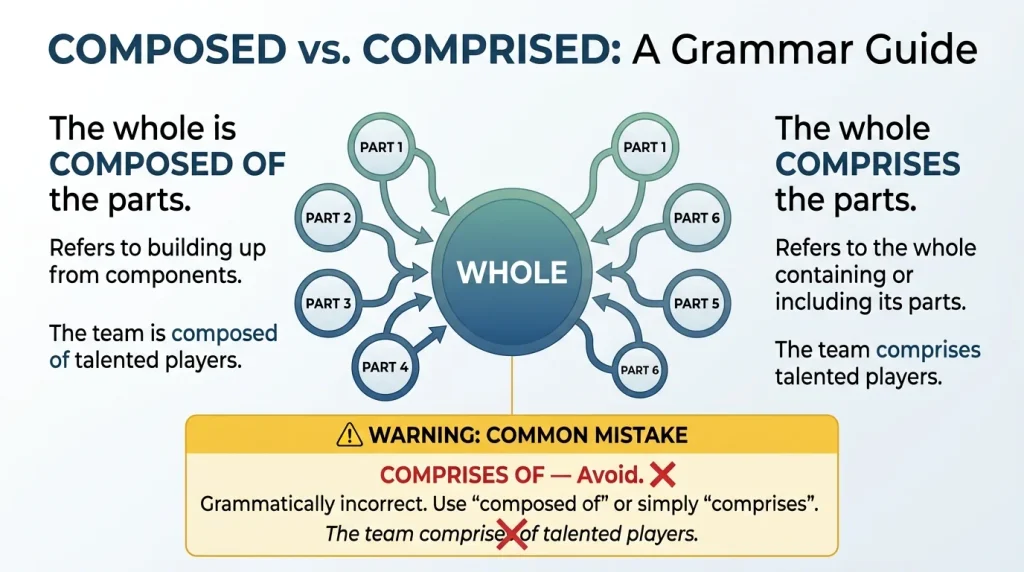
Composed of means that a whole is made up of particular parts.
The course is composed of six modules.
Here, “the course” is the whole, and “six modules” are its parts.
Comprise means that a whole includes or consists of its parts.
The course comprises six modules.
Here, “the course” is again the whole, but the sentence uses comprises directly without of.
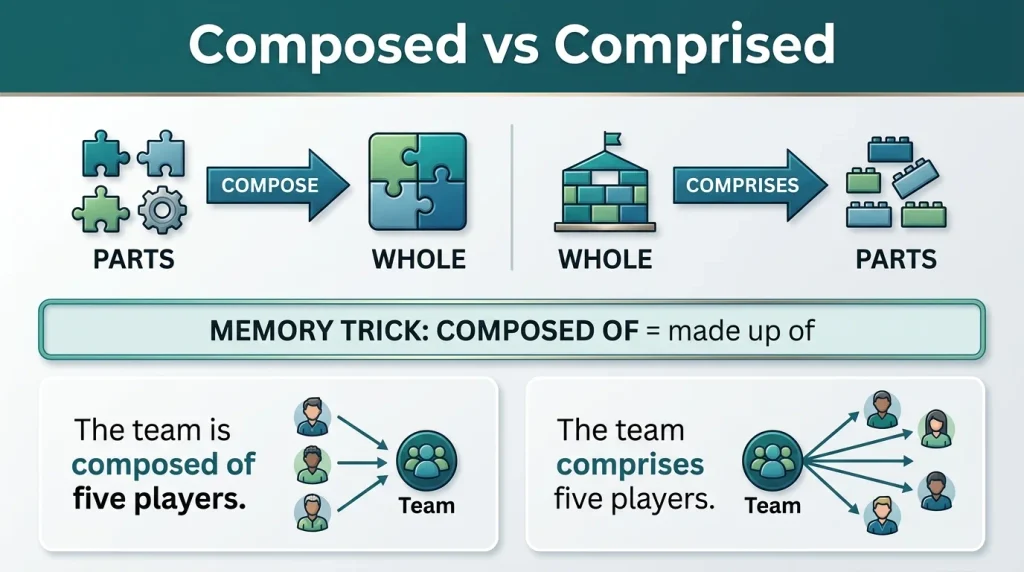
The easiest way to see the relationship is:
- The whole is composed of the parts.
- The whole comprises the parts.
- The parts compose the whole.
The confusion becomes greater because comprised of is widely used in present-day English. Some dictionaries recognize this construction, while traditional and house-style guidance often recommends replacing it with composed of, consists of, or comprises.
Why It Matters
This distinction matters most when you are writing something that will be carefully edited or evaluated.
A casual reader may not notice:
The department is comprised of four teams.
But an editor, teacher, examiner, or professional reader may prefer:
The department is composed of four teams.
Or:
The department comprises four teams.
Using the more established construction can also make your sentence easier to analyze. Instead of making the reader wonder whether you are using comprise in a disputed way, you can choose a construction whose pattern is immediately clear.
This is particularly useful in:
- Academic papers
- Business reports
- Formal emails
- Technical documentation
- Government and institutional writing
- Essays and examinations
- Professional editing
- ESL writing
The issue is not that every occurrence of comprised of will confuse a reader. It is that the construction has a history of criticism, so avoiding it can remove an unnecessary style question.
Read More: Cant vs Cannot: Which Is Correct?
The Core Rule
Use “is composed of” when the sentence means “is made up of.” Use “comprises” when the whole is the subject and is followed directly by its parts.
Compare:
The team is composed of ten players.
The team comprises ten players.
Avoid:
The team comprises of ten players.
If you want the simplest everyday alternative, use consists of:
The team consists of ten players.
A useful three-way pattern is:
Whole + is composed of + parts
Whole + comprises + parts
Whole + consists of + parts
How to Use Composed
Composed is the past participle of compose, and in the expression composed of, it describes what forms a whole.
The usual structure is:
Whole + be + composed of + parts
Examples:
The committee is composed of six members.
The building is composed of three connected sections.
The report is composed of five main chapters.
The mixture is composed of several chemical compounds.
The construction works with singular and plural subjects:
The team is composed of experienced engineers.
The teams are composed of engineers from different departments.
The important point is that composed of puts the whole first and then identifies what makes up that whole.
Composed Can Have Other Meanings
Do not assume that every use of composed relates to parts.
Composed can also mean calm or emotionally controlled:
She remained composed during the interview.
It can also relate to creating music or writing:
Mozart composed the piece.
In the target construction composed of, however, the meaning is “made up of” or “formed from.”
How to Use Comprise
Comprise is normally used with the whole as its subject.
The basic structure is:
Whole + comprises + parts
Examples:
The committee comprises six members.
The course comprises eight units.
The report comprises four sections.
The collection comprises more than 200 paintings.
The key point is simple: do not add “of” after comprise in the standard construction.
Comprise of Is Different From Comprised Of
This distinction is extremely important.
Comprises of is generally considered nonstandard:
❌ The committee comprises of six members.
Use:
✅ The committee comprises six members.
However, comprised of is a different usage question:
The committee is comprised of six members.
That form is widely used and is accepted by some modern dictionaries, but it remains controversial in edited English.
So do not treat these two expressions as identical:
- comprises of → avoid
- is comprised of → widely used, but disputed in formal style
- comprises → standard and safe
- is composed of → standard and safe
Correct Examples
Here are examples across everyday, academic, professional, and digital contexts.
Conversation
My family is composed of five people.
This is grammatically correct, although “My family has five people” may sound more conversational.
The project team is composed of members from three departments.
This works well in professional writing.
Workplace
The committee comprises representatives from finance, marketing, and operations.
The whole, “the committee,” comes before comprises.
School Writing
The essay is composed of three main sections.
This clearly identifies the parts of the essay.
Academic Writing
The sample was composed of participants from four age groups.
This construction is common in formal academic prose.
Technical Writing
The system is composed of several independent modules.
The sentence explains the components of a larger system.
Business Report
The board comprises seven directors.
The whole is the subject, so comprises is used without of.
Social Media
Our group is composed of people from different countries.
The sentence is grammatical, although a shorter phrase such as “Our group includes people from different countries” may sound more natural online.
Presentation
The training program comprises four sessions.
This is concise and formal.
General Description
The meal is composed of rice, vegetables, and grilled chicken.
The whole is identified first, followed by its components.
Read More: SMO Meaning in Text: What Does It Mean?
Incorrect vs. Correct
| ❌ Incorrect or Avoidable | ✅ Correct / Preferred | Why |
|---|---|---|
| The team comprises of five people. | The team comprises five people. | Comprise normally takes the parts directly, without of. |
| The team is comprised of five people. | The team is composed of five people. | Is comprised of is widely used, but composed of avoids the usage controversy. |
| The committee comprises of experts. | The committee comprises experts. | Do not use comprise of. |
| The report comprises of six chapters. | The report comprises six chapters. | Comprises already expresses the whole-to-parts relationship. |
| The department is comprised of three units. | The department is composed of three units. | Composed of is the safer formal construction. |
| The course comprises of ten lessons. | The course comprises ten lessons. | Remove of after comprises. |
| Five members comprise the committee. | The committee comprises five members. | The whole-to-parts pattern is the clearest choice for learners. |
| The book comprises of several sections. | The book is composed of several sections. | Use composed of when you want the “made up of” structure. |
| The system is comprised from several parts. | The system is composed of several parts. | The established expression is composed of, not comprised from. |
| The organization comprises of local branches. | The organization comprises local branches. | Comprises does not need of. |
The second row deserves special attention. Calling is comprised of simply “wrong” would oversimplify modern English. It is widely established and recognized by some dictionaries. However, because major editorial traditions still object to it, is composed of remains the safer choice when you want to avoid criticism.
Why People Make This Mistake
1. The meanings overlap
Both compose and comprise can describe the relationship between a whole and its parts.
That makes the distinction harder to remember than a simple vocabulary difference.
Compare:
The parts compose the whole.
and:
The whole comprises the parts.
The concepts are closely related, but the direction of the relationship changes.
2. “Composed of” sounds similar to “comprised of”
This is probably the biggest source of confusion.
Once someone learns:
The team is composed of five people.
it is easy to substitute comprised because the two words look and sound related.
3. “Comprise” sounds formal
Many writers associate comprise with formal writing. They may therefore assume that replacing composed with comprised makes a sentence sound more sophisticated.
It does not necessarily improve the sentence.
In fact, if the writer uses comprises of, the attempt at formal language creates a grammatical problem.
4. People learn “comprised of” from real-world writing
Search results, reports, websites, academic papers, advertisements, and professional documents contain many examples of comprised of.
Because the expression is genuinely common, learners naturally assume it must be universally accepted.
The more accurate explanation is that usage has changed and remains divided by style tradition.
5. Spellcheck cannot settle the issue
Grammar and spelling software may recognize comprised of without treating it as an error.
That does not mean every editor or style guide recommends it.
Software can identify patterns, but it cannot always determine the editorial standard appropriate for your audience.
6. Translation can interfere
Some languages express “be made up of” and “comprise” through a single construction. Learners may therefore transfer the same sentence pattern into English.
Learning the whole structure is more useful than memorizing the words separately.
Common Mistakes Checklist
Mistake 1: Writing “comprises of”
Problem:
The company comprises of four divisions.
Better:
The company comprises four divisions.
How to avoid it: Remember that comprise already works as the main verb in the whole-to-parts construction.
Mistake 2: Automatically changing “composed” to “comprised”
Problem:
The team is comprised of ten specialists.
Safer:
The team is composed of ten specialists.
How to avoid it: If your sentence already contains is/are + ___ + of, composed of is the uncomplicated choice.
Mistake 3: Reversing the whole and parts
Consider:
The committee comprises five members.
The committee is the whole.
The five members are the parts.
For clear formal writing, do not casually reverse this relationship.
Mistake 4: Assuming “more formal” means “better”
A formal word is not automatically a better word.
If consists of or is made up of communicates your meaning more directly, use it.
Mistake 5: Treating all dictionaries as identical
Usage dictionaries do not always give exactly the same advice about comprised of.
Some describe it as established usage. Others continue to label it nonstandard or recommend avoiding it.
For important writing, your audience and style guide matter.
Read More: LGH Meaning in Text: What Does It Mean?
Composed vs Comprised in Real English
Grammatically safe and widely accepted
The committee is composed of five members.
This is the least controversial option. It clearly means that the committee is made up of five members and works well in formal writing, academic prose, and professional communication.
Grammatically standard and concise
The committee comprises five members.
This is also a standard construction. It places the whole first and uses comprises directly with the parts. It can sound somewhat formal, but it is concise and precise.
Grammatically possible but potentially controversial
The committee is comprised of five members.
This sentence is extremely common in modern English, and some dictionaries recognize be comprised of. However, traditional editors and some institutional style guides still recommend avoiding it. If you are writing for an audience that expects conservative formal English, choose is composed of instead.
Natural everyday alternative
The committee has five members.
For ordinary communication, this may be the most direct version. It avoids the entire compose/comprise issue and sounds less formal.
The best sentence is not always the one with the most specialized grammar. Sometimes the clearest sentence is simply the shortest one.
American vs. British English
There is no major American-versus-British difference in the core distinction that requires separate grammar rules.
Both varieties use compose and comprise in whole-and-part relationships.
The main difference you will encounter is not geographic but editorial and usage-based. Different dictionaries, style guides, institutions, and editors have different levels of tolerance for be comprised of.
In British-oriented guidance, you may encounter a strong recommendation to avoid comprise of and, depending on the source, caution around comprised of. In American usage, comprised of is also common, and some dictionaries describe the passive construction as established usage.
Therefore, do not memorize this as “British = composed, American = comprised.” That would be an inaccurate simplification.
Read More: TMO Meaning in Text: What Does It Mean?
Formal vs. Informal Usage
For formal or carefully edited writing, the safest choices are:
- is composed of
- comprises
- consists of
- is made up of
For general modern English, you may encounter:
The team is comprised of experienced professionals.
This is common enough that many readers will consider it ordinary English. Nevertheless, it can still attract criticism from editors who follow stricter traditional usage.
For business, academic, examination, or professional writing, there is little practical benefit in choosing the disputed form when an uncontroversial alternative is available.
Comparison Table
| Feature | Composed of | Comprised of | Comprises | Consists of |
|---|---|---|---|---|
| Basic meaning | Made up of | Made up of | Includes / consists of | Is made up of |
| Typical structure | Whole + is composed of + parts | Whole + is comprised of + parts | Whole + comprises + parts | Whole + consists of + parts |
| Uses “of”? | Yes | Yes | No | Yes |
| Formal safety | Very high | More controversial | Very high | Very high |
| Common in modern English | Yes | Yes | Yes | Yes |
| Example | The team is composed of five members. | The team is comprised of five members. | The team comprises five members. | The team consists of five members. |
| Best for cautious formal writing | Yes | Usually avoid | Yes | Yes |
Memory Trick
Remember this:
COMPOSED OF = made up OF
COMPRISES = contains, with no OF
Or use the direction test:
Parts → compose → whole
Whole → comprises → parts
For example:
Five departments compose the organization.
The organization comprises five departments.
And:
The organization is composed of five departments.
If you see comprises, stop yourself before adding of.
Real-Life Situations
Job Interview
You are describing a department:
“The department comprises three teams, each specializing in a different area.”
This sounds professional and concise.
Business Meeting
You are explaining a project:
“The project team is composed of designers, engineers, and analysts.”
The whole comes first, followed by its members.
Formal Email
“The attached report is composed of four sections.”
This is grammatically safe, although “The attached report contains four sections” may be even more direct.
Text Message
“The group has five people.”
For casual communication, there is no reason to use a complicated construction simply to sound formal.
Academic Exam
“The study is composed of three major parts.”
This is a safe choice for formal academic writing.
Technical Documentation
“The software system comprises several independent components.”
This is concise and appropriate when describing system structure.
Presentation
“The training program comprises six sessions.”
The construction clearly identifies the program as the whole and the sessions as its parts.
Mini Quiz
| # | Question | Answer | Explanation |
|---|---|---|---|
| 1 | Choose the correct form: “The committee ___ five members.” A) comprises of B) comprises C) is comprise | B) comprises | Comprises takes the parts directly. |
| 2 | Fill in the blank: “The course is ___ of eight lessons.” | composed | Is composed of is the safest standard construction. |
| 3 | Correct the sentence: “The company comprises of three divisions.” | The company comprises three divisions. | Remove of after comprises. |
| 4 | Which is safer in formal writing? A) is comprised of B) is composed of | B) is composed of | Comprised of is widely used but remains disputed by some style authorities. |
| 5 | Fill in the blank: “The report ___ four main sections.” | comprises | The whole, “the report,” is followed directly by its parts. |
| 6 | Correct this sentence: “The team is comprise of six engineers.” | The team is composed of six engineers. | After is, use the established phrase composed of. |
| 7 | Which sentence is standard? A) The course comprises of five units. B) The course comprises five units. | B | Comprises of should be avoided. |
| 8 | Fill in the blank: “The panel consists ___ seven experts.” | of | The standard expression is consists of. |
| 9 | Which is most direct for casual English? A) The committee comprises five people. B) The committee has five people. | B | “Has” is simpler and more conversational. |
| 10 | Complete the relationship: “The parts ___ the whole.” A) comprise B) compose | B) compose | In the traditional whole-part distinction, the parts compose the whole. |
Expert Tips
1. Use “composed of” when you want zero controversy
If you are unsure what your editor, instructor, or organization prefers, write:
The system is composed of three components.
There is little reason to choose a disputed alternative when this works perfectly.
2. Use “comprises” when you want a concise formal sentence
Instead of:
The system is composed of three components.
you can write:
The system comprises three components.
This is shorter without changing the basic meaning.
3. Never write “comprises of” just because you learned “composed of”
The two patterns are not interchangeable.
composed of
but:
comprises
not:
comprises of
4. “Consists of” is an excellent fallback
When comprise feels confusing, use:
The committee consists of five members.
It is clear, familiar, and standard.
5. “Has” can be better than all three
For everyday writing:
The team has ten members.
This is often more natural than:
The team comprises ten members.
or:
The team is composed of ten members.
Good writing is not about choosing the most formal expression. It is about choosing the clearest one for the situation.
6. Do not call every “comprised of” sentence simply ungrammatical
Modern English usage is more complicated than the traditional rule suggests. Be comprised of is widely established and is recognized by some dictionaries. The practical issue is that it remains unacceptable or undesirable to many formal editors.
That distinction matters if you are teaching English or editing professionally.
7. Remember that “comprise” is not limited to people
You can use it with:
- Teams
- Committees
- Organizations
- Reports
- Courses
- Systems
- Collections
- Groups
- Programs
- Structures
For example:
The collection comprises 500 photographs.
FAQ
Is “composed of” correct?
Yes. Composed of is a standard construction meaning “made up of” or “formed from.”
The team is composed of ten players.
It is a safe choice in academic, professional, and formal writing.
Is “comprised of” grammatically correct?
Its status is disputed. Comprised of is widespread in modern English and is accepted by some dictionaries, but many editors and formal style guides still recommend avoiding it. For maximum editorial safety, use composed of, consists of, or comprises instead.
Is “comprises of” correct?
No, not in standard usage. Write:
The company comprises five divisions.
not:
The company comprises of five divisions.
Should I use “comprised” or “composed”?
If your sentence means “made up of,” composed of is the safer choice.
The committee is composed of six members.
Use comprises if you want the active whole-to-parts structure:
The committee comprises six members.
Can I say “the team is comprised of”?
You will see and hear this construction frequently. It is established in modern English, but it remains controversial in formal edited English. If you are writing for school, academia, business, or a strict editor, the team is composed of is safer.
What is the difference between “comprise” and “compose”?
In the traditional distinction, comprise goes from the whole to the parts:
The team comprises five players.
Compose goes from the parts to the whole:
Five players compose the team.
The passive form is:
The team is composed of five players.
Can “comprise” be used in the passive voice?
Modern dictionaries recognize passive constructions such as be comprised of, but many style guides continue to discourage them. If you want to avoid the debate, use be composed of or consist of.
Is “consists of” better than “comprises”?
Neither is universally “better.” Consists of is very clear and familiar, while comprises is concise and somewhat formal. Choose based on your audience and the tone of the sentence.
Is “composed of” formal?
It can sound somewhat formal, especially compared with simpler alternatives such as “has” or “contains.” It is completely appropriate in academic, professional, technical, and explanatory writing.
Can “comprise” mean “make up”?
Yes. Modern dictionaries record a sense of comprise meaning “to form or constitute,” as in:
Several smaller units comprise the larger system.
However, this reversed pattern can be less familiar to learners. The whole-to-parts pattern — “The system comprises several smaller units” — is often easier to use safely.
What is the easiest way to remember composed vs. comprised?
Remember:
The whole is composed of the parts.
The whole comprises the parts.
And never turn comprises into comprises of.
Quick Summary
Composed of and comprised of both appear in English when writers describe what makes up a whole, but their usage is not equally straightforward. Composed of is the safest choice for formal and carefully edited writing. Comprise is normally used with the whole as the subject: “The committee comprises five members.” Do not write “comprises of.” The phrase is comprised of is very common and accepted by some modern dictionaries, but many editors and style guides still discourage it. When you want to avoid the disagreement completely, use is composed of, consists of, or a simple verb such as has. The easiest rule is: the whole comprises the parts; the whole is composed of the parts.



Pingback: Revocable vs Irrevocable: Key Differences Explained