


If you mean the negative form of can, the correct choices are cannot or can’t. Cant without an apostrophe is a different word, usually meaning insincere or conventional talk, or specialized language used by a particular group. Cannot is the standard full form, while can’t is its contraction. For example: “I cannot attend” and “I can’t attend” are both correct. “I cant attend” is incorrect when you mean “I cannot attend.”
What Is the Difference Between Cant, Can’t, and Cannot?
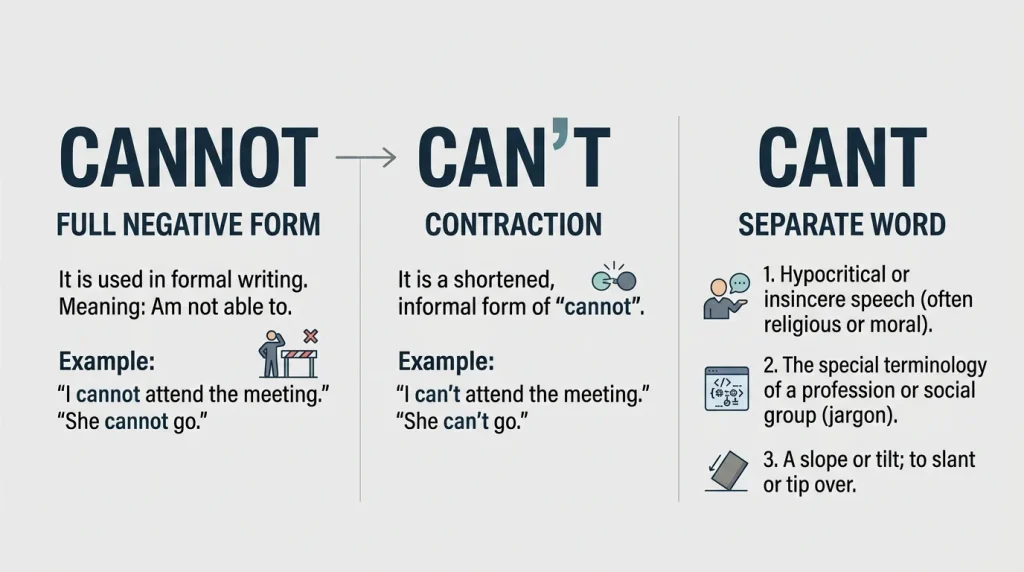
The confusion comes from three forms that look and sound very similar:
- cannot — the standard full negative form of can
- can’t — the contraction of cannot
- cant — a separate English word with its own meanings
The most important point is that cant and can’t are not the same word.
When you want to say that someone is unable to do something, something is impossible, or someone does not have permission to do something, use cannot or can’t.
For example:
I cannot come to the meeting.
or:
I can’t come to the meeting.
Both sentences express the negative of can. The second uses the contracted form. Cambridge defines can’t as the short form or contraction of cannot, while cannot functions as the negative form of can.
By contrast, cant without an apostrophe is a noun or verb with unrelated meanings. It can refer to insincere or conventional language, specialized language used by a particular group, or certain styles of speech.
So the basic distinction is simple:
cannot = can’t
cant ≠ can’t
Why It Matters
An apostrophe can completely change a word.
Writing “I cant help you” when you mean “I cannot help you” is not simply a casual spelling variation. The missing apostrophe changes the written form into cant, a different word.
This matters especially in situations where accuracy affects how your writing is understood:
- A school assignment
- A business email
- A résumé or cover letter
- A report
- An academic paper
- A professional message
- A website or article
- Formal correspondence
In casual texting, readers will often understand “cant” as a missing-apostrophe version of “can’t.” But that does not make the spelling standard.
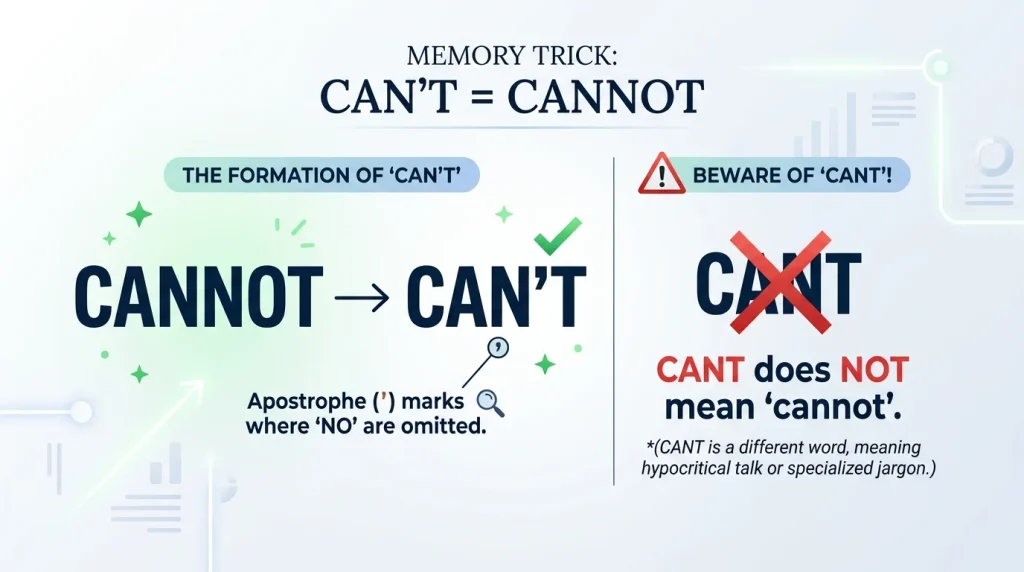
Apostrophes are used in contractions to show that letters have been omitted. In can’t, the apostrophe marks the shortened form of cannot.
Read More: SMO Meaning in Text: What Does It Mean?
The Core Rule
Use “cannot” or “can’t” when you mean the negative of “can.” Use “cant” only when you mean the separate noun or verb.
A useful way to remember it is:
can + not → cannot → can’t
But:
cant → a different word
Examples:
- I cannot attend.
- I can’t attend.
- Cant is a word, but it does not mean “cannot.”
Cambridge specifically notes that standard English writes cannot as one word.
How to Use Cannot
Cannot is the full, non-contracted negative form of can.
It can express several related ideas, including inability, lack of permission, and impossibility.
1. Inability
Use cannot when someone is unable to do something.
I cannot lift this box.
This means the person is not able to lift it.
She cannot drive at night.
This means she is unable to drive at night.
2. Lack of Permission
Cannot can also indicate that someone is not allowed to do something.
Visitors cannot enter this area.
The sentence means visitors are not permitted to enter.
You cannot use your phone during the exam.
Here, the meaning is about a rule or restriction.
3. Impossibility
Cannot can express something that is impossible or logically inconsistent.
That cannot be true.
The speaker is saying that the statement is impossible or cannot reasonably be true.
This cannot be the correct address.
The speaker believes the address is not possible as the correct one.
These uses are consistent with the broader functions of can and its negative form.
How to Use Can’t
Can’t is the contraction of cannot.
A contraction is a shortened form in which letters have been omitted and an apostrophe marks the omission.
So:
cannot → can’t
Examples:
I can’t stay late.
We can’t afford a new computer.
She can’t hear you.
You can’t park here.
They can’t attend the meeting.
The meaning is essentially the same as the corresponding sentences with cannot.
The main difference is usually one of style, tone, and emphasis rather than basic grammatical meaning. Cambridge identifies can’t as the short form of cannot and gives examples involving inability, permission, and possibility.
How to Use Cant
Cant, without an apostrophe, is a genuine English word. It is not the contraction of cannot.
One meaning of cant is insincere, conventional, or hypocritical language.
For example:
The speech was full of political cant.
Here, cant refers to language that sounds morally or socially appropriate but is regarded as insincere.
Another meaning refers to specialized language or slang associated with a particular group.
For example:
The thieves used a private cant that outsiders could not understand.
This use is much less common in everyday conversation than can’t.
The word cant can also have other dictionary meanings, including meanings related to a slope, tilt, or angled position. The exact meaning depends on context.
Therefore, if your sentence is about being unable to do something, cant is almost certainly not the word you want.
Correct Examples
Here are examples showing how cannot and can’t work naturally in different settings.
- Conversation:
“I can’t stay for dinner tonight.” - Text message:
“Sorry, I can’t make it today.” - Workplace:
“I cannot approve the request without the required documents.” - Email:
“Unfortunately, I cannot attend the meeting on Friday.” - School:
“Students cannot use calculators during this section of the exam.” - Academic writing:
“The results cannot be interpreted without considering the sample size.” - Social media:
“I can’t believe how quickly this year went.” - Rules and instructions:
“Visitors cannot enter through this door.” - Everyday speech:
“I can’t find my keys.” - Professional communication:
“We cannot guarantee delivery before Monday.” - Logical conclusion:
“That cannot be the answer because it contradicts the information given.” - Informal conversation:
“I can’t remember where I put it.”
Notice that both cannot and can’t can express the negative meaning of can. The choice often depends on context and style.
Incorrect vs. Correct
| ❌ Incorrect | ✅ Correct | Why |
|---|---|---|
| I cant come today. | I can’t come today. | Can’t needs an apostrophe when it means cannot. |
| She cant drive. | She can’t drive. | Cant is a different word. |
| We cant attend the meeting. | We cannot attend the meeting. | Cannot is the standard full form. |
| You cant enter this room. | You can’t enter this room. | The negative contraction requires an apostrophe. |
| He cant understand the instructions. | He can’t understand the instructions. | Can’t means cannot here. |
| I cant help you with that. | I can’t help you with that. | The missing apostrophe changes the written word. |
| They cant finish on time. | They cannot finish on time. | Cannot is appropriate as the full negative form. |
| She said she cant stay. | She said she can’t stay. | Can’t is the contraction of cannot. |
| I cant believe it. | I can’t believe it. | The intended meaning is I cannot believe it. |
| Employees cant use this equipment. | Employees can’t use this equipment. | Can’t expresses prohibition here. |
There is an important distinction in the first column: these sentences are generally understood by readers as spelling errors because the surrounding context makes the intended meaning obvious. But the standard spelling for the contraction is can’t, not cant.
Why People Make This Mistake
Phonetic Similarity
In ordinary speech, can’t and cant sound alike or nearly alike in many varieties of English. Because the apostrophe is not pronounced, a learner may know the sound without remembering the spelling.
This is one reason the error is especially common when people move from spoken English to written English.
Spelling Overlap
The visual difference is tiny:
- cant
- can’t
Only one punctuation mark separates them.
That makes the error easy to make while typing quickly.
Overgeneralization
English has many contractions:
- do not → don’t
- is not → isn’t
- are not → aren’t
- will not → won’t
- cannot → can’t
Learners sometimes remember the sound of a contraction without remembering exactly where its apostrophe belongs.
Autocomplete and Spellcheck
Digital tools can sometimes correct obvious spelling errors, but they should not be treated as grammar teachers. A sentence may still look understandable even when the apostrophe is missing.
A writer who depends entirely on automatic correction can therefore miss a context-sensitive mistake.
Translation Interference
Learners whose first language does not use contractions or apostrophes in the same way may naturally have difficulty remembering that can’t is not simply a different spelling of cant.
The solution is to learn the relationship:
cannot → can’t
rather than memorizing can’t as an unrelated word.
Common Mistakes Checklist
Mistake 1: Writing “cant” for “can’t”
Problem: The apostrophe is missing.
Why it happens: The writer hears the same sound and types what they hear.
Fix: Remember that can’t is a contraction.
❌ I cant go.
✅ I can’t go.
Mistake 2: Thinking “cant” is an informal spelling of “can’t”
It is not a standard alternative spelling of the contraction.
Cant is a separate word.
❌ Cant = informal can’t
✅ Can’t = contraction of cannot
Mistake 3: Assuming “cannot” is two words
In the ordinary negative construction, standard English writes cannot as one word.
✅ I cannot attend.
not:
❌ I can not attend.
There are specific constructions where can and not remain separate, discussed below.
Mistake 4: Adding “to” after cannot
After the modal verb can, the next verb normally appears in its base form.
❌ I cannot to attend.
✅ I cannot attend.
The same rule applies to can’t:
❌ I can’t to swim.
✅ I can’t swim.
Mistake 5: Confusing can’t with couldn’t
Can’t is the negative form of present-tense can.
Couldn’t is the negative form of could.
I can’t swim.
I couldn’t swim when I was five.
The tense and meaning are different.
“Can Not” vs. “Cannot”
This is a more subtle issue.
For the ordinary negative form of can, the standard spelling is:
cannot
For example:
I cannot attend the meeting.
However, can not can appear when not has a separate grammatical role.
One important example is the construction:
She can not only sing but also compose music.
Here, not belongs to the expression not only … but also …. It is not simply the ordinary negative form of can.
Compare:
She cannot sing.
This means she is unable to sing.
But:
She can not only sing but also compose music.
This means singing is one of two abilities.
The position of not changes the grammatical structure and meaning.
A useful practical rule is:
If you simply mean “is not able to,” “is not permitted to,” or “is impossible,” use cannot or can’t.
Do not automatically replace every instance of can not with cannot, because constructions such as can not only … but also … have a different structure.
Read More: LGH Meaning in Text: What Does It Mean?
Cant vs. Can’t: A Real-World Meaning Difference
Consider these two sentences:
I can’t understand the article.
The article contains political cant.
They may look similar on the page, but they have completely different meanings.
In the first sentence, can’t is a contraction of cannot.
In the second, cant is a noun referring to a type of language.
That distinction is why the apostrophe matters. It is not merely decorative punctuation.
Cant vs. Cannot in Real English
Grammatically correct and natural
I can’t come tonight.
This is normal everyday English. The contraction is common in conversation, messages, and many forms of ordinary writing. Cambridge gives can’t as the short form of cannot and uses it extensively in natural examples.
Grammatically correct and more explicit
I cannot come tonight.
This is also completely grammatical. It uses the full form and can sound more formal, deliberate, or emphatic depending on context.
Grammatically correct but different in meaning
The article contains cant.
This is grammatically correct, but cant is not being used as a negative modal. It is a separate noun. Because the word is relatively uncommon in everyday conversation, the surrounding context is especially important.
Incorrect for the intended meaning
I cant come tonight.
If the writer means I cannot come tonight, the standard spelling requires the apostrophe:
I can’t come tonight.
The key lesson is that the difference is not simply “formal versus informal.” Cannot and can’t belong to the same negative construction, whereas cant is a separate word.
American vs. British English
There is no major grammatical difference between American and British English in the basic distinction discussed here.
Both varieties use:
- cannot as the full negative form
- can’t as the contraction
- cant as a separate word
Pronunciation can differ between varieties. Cambridge lists different UK and US pronunciations for can’t, but this does not change the spelling rule.
Therefore, you do not need a different spelling rule for American and British English.
Read More: TMO Meaning in Text: What Does It Mean?
Formal vs. Informal Usage
Both cannot and can’t are grammatically correct, but they can create different stylistic effects.
Use “cannot” when:
- Writing formal correspondence
- Preparing an academic paper
- Writing official instructions
- Making a statement sound more deliberate
- You want the full form for emphasis
Examples:
We cannot accept incomplete applications.
The results cannot be considered conclusive.
Use “can’t” when:
- Writing casual messages
- Having a conversation
- Writing dialogue
- Communicating informally
- Using a conversational tone
Examples:
I can’t make it tonight.
I can’t believe you remembered!
It is not accurate to say that contractions are always grammatically wrong in formal writing. Contractions are used in many kinds of modern written English. The choice is primarily a matter of register, tone, and the conventions of the particular document.
Comparison Table
| Feature | Cannot | Can’t | Cant |
|---|---|---|---|
| Basic role | Negative form of can | Contraction of cannot | Separate English word |
| Apostrophe | No | Yes | No |
| Means “cannot” | Yes | Yes | No |
| Used for inability | Yes | Yes | No |
| Used for prohibition | Yes | Yes | No |
| Used for impossibility | Yes | Yes | No |
| Common in conversation | Yes, though less conversational | Very common | Uncommon in this sense |
| Formal writing | Often useful | Context-dependent | Only when its own meaning is intended |
| Example | I cannot stay. | I can’t stay. | The speech was full of cant. |
Memory Trick
Use this simple three-part memory trick:
CAN’T has a T and an apostrophe because something has been taken out.
Think:
cannot → can’t
The apostrophe tells you that letters have been removed.
Then remember:
CANT without the apostrophe is another word.
If you are trying to say “I cannot,” the safest choices are:
I cannot.
or
I can’t.
Never choose I cant when you mean I cannot.
Real-Life Situations
In an interview
If you need to explain a limitation:
“I cannot relocate at the moment, but I am available for remote work.”
The full form gives the answer a professional tone.
In a workplace meeting
“We can’t finalize the schedule until the client responds.”
The contraction sounds natural in spoken workplace English.
In an email
“Unfortunately, I cannot confirm the delivery date yet.”
The full form works well in professional correspondence.
In a text message
“Sorry, I can’t make it tonight.”
The contraction is natural and concise.
In an exam
“The proposed explanation cannot account for all the observed results.”
The full form fits formal academic writing.
Read More: LGH Meaning in Text: Full Form & Examples.
Mini Quiz
| # | Question | Answer | Explanation |
|---|---|---|---|
| 1 | Choose the correct form: “I ___ attend tomorrow.” A) cant B) can’t C) cant’ | B) can’t | Can’t is the contraction of cannot. |
| 2 | Fill in the blank: “We ___ approve this request.” | cannot | Cannot is the standard full negative form of can. |
| 3 | Which word is a separate noun? A) can’t B) cannot C) cant | C) cant | Cant has meanings unrelated to the negative form of can. |
| 4 | Correct the sentence: “She cant drive.” | She can’t drive. | The intended meaning is “She cannot drive,” so the apostrophe is required. |
| 5 | Choose the correct sentence: A) I cannot understand. B) I cannot to understand. | A) I cannot understand. | A modal verb such as can is followed by the base form of the verb. |
| 6 | Which is the contraction of cannot? | can’t | The apostrophe marks the contraction. |
| 7 | Correct the sentence: “You cant enter without permission.” | You can’t enter without permission. | Here, the sentence expresses prohibition, so can’t is correct. |
| 8 | Which sentence uses cant correctly? A) I cant swim. B) The speech was filled with cant. | B) The speech was filled with cant. | In B, cant is used as a noun referring to insincere or conventional language. |
| 9 | Complete the sentence: “She can ___ only sing but also dance.” | not | The construction is can not only … but also …, where not belongs to the larger expression. |
| 10 | Which is more suitable for a formal report? A) We can’t confirm the result. B) We cannot confirm the result. | B) We cannot confirm the result. | Both can be grammatical, but the full form is often a better stylistic fit for formal prose. |
Expert Tips
1. Use the substitution test
When you are unsure whether to write cant or can’t, replace it mentally with cannot.
I cant attend.
Ask:
I cannot attend.
If that is the intended meaning, you need can’t or cannot, not cant.
2. Look at the apostrophe as a signal
The apostrophe in can’t tells you that the word is contracted.
It is not optional punctuation.
can’t
and
cant
are different written forms.
3. Choose cannot when you want the full form
If you are unsure whether a contraction fits a formal document, cannot is a straightforward choice.
We cannot accept the proposal.
4. Do not call “cannot” a contraction
This is an easy terminology mistake.
Cannot is the full negative form.
Can’t is the contraction.
5. Do not treat every “can not” as an error
Most ordinary negative statements use cannot:
I cannot help.
But structures such as:
She can not only sing but also dance.
have a different grammatical structure.
6. Remember that punctuation can carry meaning
An apostrophe can distinguish a contraction from another word.
Compare:
can’t
with:
cant
The difference is only one mark, but the words have different grammatical identities and meanings.
FAQ
Is “cant” ever correct?
Yes. Cant is a real English word. It can refer to insincere or conventional language or specialized language associated with a particular group. It is correct only when that meaning is intended.
Is “can’t” the same as “cannot”?
Yes. Can’t is the contraction of cannot. They express the same basic negative meaning, although the contraction can sound more conversational and the full form can sound more formal or emphatic.
Is “cannot” one word or two?
In the ordinary negative form of can, cannot is written as one word. Cambridge’s grammar guidance specifically identifies cannot as the standard spelling.
Is “can not” ever correct?
Yes, but it is not normally the spelling used for a straightforward negative statement. It can occur when not has a separate grammatical function, such as in can not only … but also ….
Is “I cant” grammatically correct?
Not if you mean “I cannot.” In that situation, write I can’t or I cannot. Cant without an apostrophe is a different word.
Is “I can’t go” correct English?
Yes. Can’t is the standard contraction of cannot.
Is “I cannot go” better than “I can’t go”?
Neither is universally “better.” Both are correct. Cannot may suit formal or deliberately emphatic writing, while can’t is especially natural in conversational English.
Why does “cannot” have two n’s?
The standard spelling is cannot, with two n’s in the middle. The contraction is spelled can’t, not cann’t.
Can I use “can’t” in formal writing?
Yes, although some formal contexts favor the full form cannot. The choice depends on the style and conventions of the document. Contractions are not inherently grammatically incorrect.
Does “cant” mean “cannot” in texting?
It is commonly understood in informal digital communication as a missing-apostrophe version of can’t, but it is not the standard spelling. If you mean cannot, write can’t or cannot.
How do I remember the difference between “cant” and “can’t”?
Remember:
Can’t = cannot.
The apostrophe marks the contraction. Cant without an apostrophe is a separate word.
Quick Summary
Cannot and can’t are two forms of the negative of can. Cannot is the standard full form, while can’t is its contraction. Both can express inability, lack of permission, or impossibility. The form cant, without an apostrophe, is different: it is a separate English word with meanings such as insincere or conventional language and specialized language used by a particular group. Therefore, if you mean “I am unable to,” write I cannot or I can’t, not I cant. Remember the simplest rule: cannot = can’t, but cant ≠ can’t. The apostrophe matters because it identifies can’t as the contraction.



Pingback: Composed vs Comprised: Which Is Correct?
Pingback: Revocable vs Irrevocable: Key Differences Explained