
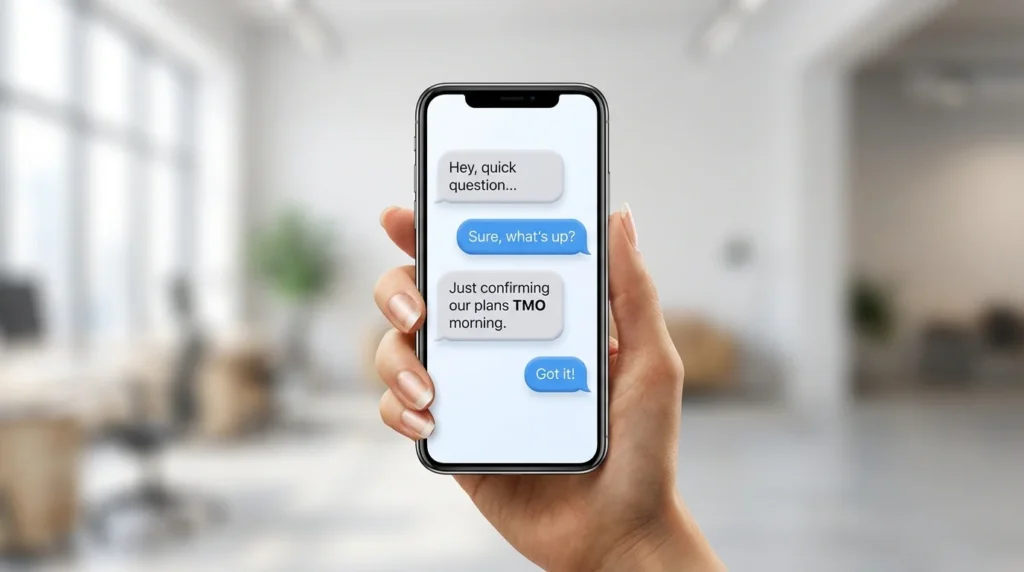

If someone sends you “TMO” in a text, chat, or social media message, the meaning can depend on the conversation. TMO is not one universally fixed texting abbreviation, so context is important. In informal online communication, people may use it as shorthand for different phrases, while in some cases it can simply be an acronym specific to a conversation, community, or subject.
Because TMO has multiple possible expansions, you should look at the surrounding words before assuming what the sender means. Below, we’ll cover the likely texting interpretations, social-media use, relationship context, tone, examples, and other legitimate meanings.
TMO Meaning & Definition
In texting, TMO is an abbreviation whose meaning depends heavily on context. Unlike common shorthand such as LOL or BRB, TMO does not have one universally accepted slang definition that applies to every conversation.
The correct interpretation usually comes from the words around it, the topic being discussed, and the relationship between the people texting.
What Does TMO Mean in Text?
TMO in text does not have one definitive universal meaning. It can be used as an abbreviation for different phrases depending on the conversation or community. If someone sends you “TMO,” check the surrounding message for clues rather than assuming it automatically means one particular slang phrase.
For example:
“Are you coming tmo?”
In this context, the sender may be using TMO as shorthand for “tomorrow.” This is one of the most straightforward interpretations when the abbreviation appears alongside plans, dates, or future events.
However, other contexts can give TMO completely different meanings.
What Does TMO Stand For?
In casual texting, TMO can stand for “tomorrow” when someone uses it as a shortened form of the word.
For example:
“Can we talk tmo?”
Here, “tmo” naturally refers to tomorrow.
You may also encounter TMO as an acronym for unrelated phrases in professional, technical, organizational, or specialized contexts. Therefore, the meaning cannot always be determined from the three letters alone.
A useful rule is:
If TMO appears in a casual conversation about plans or time, “tomorrow” may be the intended meaning. If the conversation is about a specific subject, organization, or technical topic, another expansion may apply.
Origin of TMO in Texting
There is no single well-established origin story for TMO as a texting abbreviation.
If it is being used as a shortened version of “tomorrow,” it follows the general pattern of internet shorthand: people shorten longer words to make typing faster and more convenient.
Texting abbreviations often remove vowels or parts of words while keeping enough of the original spelling for the reader to understand the intended word. Similar shortcuts include forms such as:
- tmw
- tmrw
- tom
- tmr
- tmo
These variations are not necessarily used consistently by everyone. One person might type “tmr,” another might type “tmrw,” and another might use “tmo.”
It is therefore better to interpret TMO from its actual conversational context rather than treating it as a universally standardized abbreviation.
Read More: LGH Meaning in Text: Full Form & Examples.
TMO Meaning in Different Contexts
When discussing plans, appointments, school, work, or future activities, TMO may be used as shorthand for tomorrow.
TMO in Texting
Example:
“I’ll send it tmo.”
Meaning:
“I’ll send it tomorrow.”
TMO in a Chat
In a casual chat, the abbreviation can make a message shorter and faster.
“You free tmo?”
The sender is most likely asking whether you are free tomorrow.
TMO in a Group Chat
Group chats often contain shortened words because people type quickly.
“Meeting tmo at 6?”
Here, the context strongly suggests that TMO means tomorrow.
TMO in DMs
A person may use TMO in a direct message when discussing plans with a friend, acquaintance, or romantic interest.
“Wanna hang out tmo?”
Again, the surrounding context makes the intended meaning clear.
TMO in Informal Communication
TMO is more appropriate for casual conversations than formal writing if it is being used as texting shorthand.
For a professional email, it would generally be clearer to write:
“I will send it tomorrow.”
rather than relying on an abbreviation that the recipient might interpret differently.
TMO on Social Media
TMO can appear on social media when people communicate casually, particularly in comments, direct messages, and short posts. However, its meaning does not automatically change simply because it appears on a particular platform.
TMO on WhatsApp
On WhatsApp, TMO may be used as quick shorthand in conversations about future plans.
“I’ll call you tmo.”
This can naturally mean:
“I’ll call you tomorrow.”
TMO on Snapchat
On Snapchat, users often communicate with short, informal messages.
“See you tmo?”
When the conversation is about meeting later, TMO can reasonably mean tomorrow.
TMO on TikTok
In TikTok comments or messages, TMO may appear as casual shorthand. Its interpretation depends on the surrounding comment or conversation rather than TikTok itself.
TMO on Instagram
In Instagram DMs, someone might use TMO while discussing plans:
“Can we talk tmo?”
The likely interpretation in this context is tomorrow.
TMO on Facebook Messenger
Messenger conversations can also contain texting abbreviations. If TMO appears alongside a future event or appointment, “tomorrow” may be the intended meaning.
The platform itself usually does not determine the meaning. Context does.
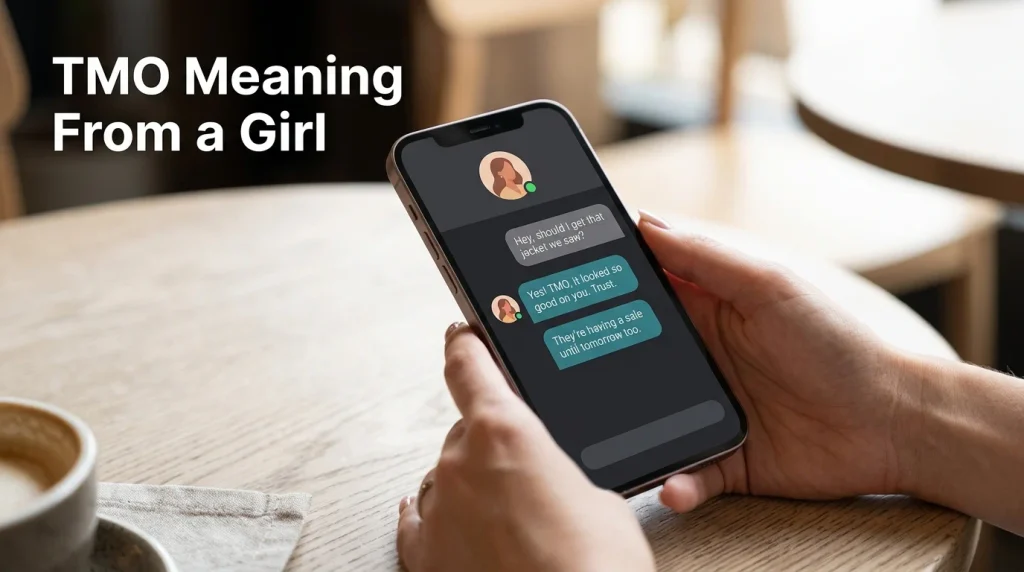
TMO Meaning From a Girl
If a girl sends you TMO, there is no special female-specific definition of the abbreviation.
If she says:
“Are you free tmo?”
she may simply mean:
“Are you free tomorrow?”
The meaning can change based on what you were discussing, but gender does not create a different dictionary definition.
Example 1
Her: “Are you free tmo?”
You: “Yeah, why?”
Here, TMO most likely means tomorrow.
Example 2
Her: “I’ll tell you tmo lol.”
The abbreviation again most likely refers to tomorrow.
Example 3
Her: “Can we finish this tmo?”
This is simply a reference to the following day.
If you’re wondering whether her use of TMO means she likes you, look at the broader conversation rather than the abbreviation itself.
TMO Meaning From a Guy
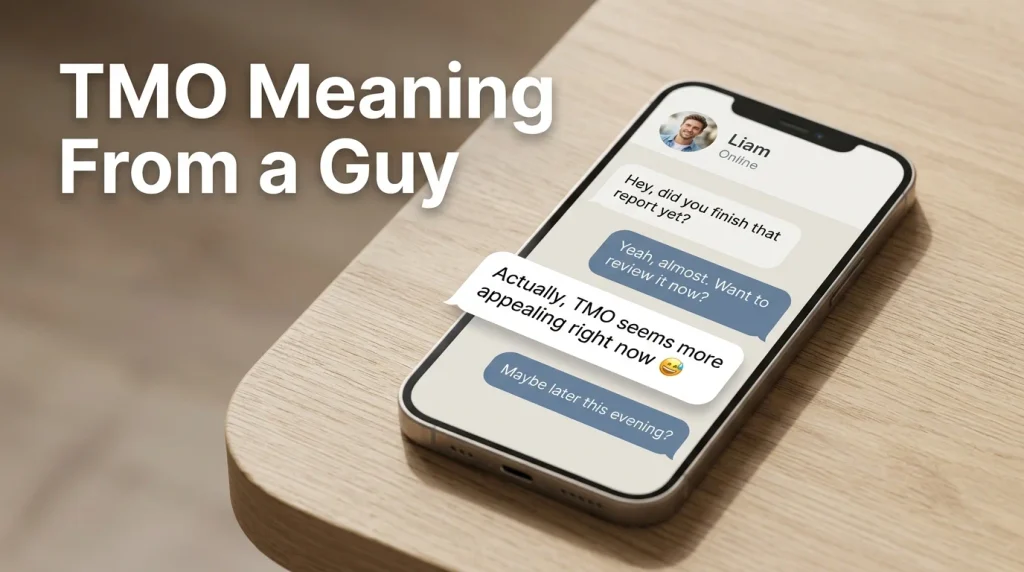
A guy using TMO does not automatically give it a different meaning either.
For example:
“I’ll send you the details tmo.”
This most likely means:
“I’ll send you the details tomorrow.”
Likewise:
Example 1
Him: “You wanna go tmo?”
You: “Sure.”
TMO likely means tomorrow.
Example 2
Him: “I have work tmo.”
Again, it refers to tomorrow.
Example 3
Him: “Let’s talk about it tmo.”
The meaning remains context-dependent, not gender-dependent.
Is TMO Flirting?
TMO itself is not inherently a flirting abbreviation.
If someone sends:
“Wanna see me tmo?”
the message could be friendly, romantic, or completely practical depending on your relationship.
A message becomes more suggestive when the overall conversation contains romantic language, teasing, compliments, invitations, or other signs of interest.
Compare:
“Can you send me the file tmo?”
This is clearly practical.
With:
“So… wanna hang out with me tmo? 😉”
The surrounding wording gives the message a more playful or potentially flirty tone.
The abbreviation TMO does not create the flirtatious meaning by itself.
TMO in Dating & Relationships
TMO can appear naturally in dating conversations, especially when people are making plans.
For example:
“Are we still meeting tmo?”
This simply means:
“Are we still meeting tomorrow?”
On a dating app or in a talking stage, you may see:
“Wanna grab coffee tmo?”
Here, TMO refers to tomorrow, while the invitation itself provides the romantic or social context.
In an established relationship:
“I’ll call you tmo after work.”
Again, TMO is simply shorthand for tomorrow.
TMO From a Crush
If a crush uses TMO while making plans, the abbreviation itself should not be treated as proof of romantic interest.
Instead, consider the complete message:
- Are they suggesting a date?
- Are they trying to continue the conversation?
- Are they making plans to meet?
- Is the conversation playful or romantic?
- Have they directly expressed interest?
Those details provide much more context than the abbreviation alone.
TMO Tone & Context
TMO is generally associated with casual, informal communication when used as shorthand for tomorrow.
Neutral
“I’ll do it tmo.”
Straightforward and practical.
Friendly
“See you tmo!”
Casual and positive.
Playful
“Okayyy, tell me tmo 😂”
The surrounding language creates the playful tone.
Flirty
“So are you finally taking me out tmo?”
The flirtatious element comes from the invitation, not TMO.
Rude or Passive-Aggressive
TMO itself is not inherently rude or passive-aggressive. However, it can appear in a message that has that tone.
For example:
“Whatever. We’ll talk tmo.”
The attitude comes from “Whatever” and the overall context, not from TMO.
Examples of TMO in Text Messages
Example 1: Making Plans
Alex: “Are you free tmo?”
Sam: “Yeah, after 5.”
Meaning: TMO means tomorrow.
Example 2: School
Alex: “Did you finish the assignment?”
Sam: “No, I’ll do it tmo.”
Meaning: The person plans to complete it tomorrow.
Example 3: Work
Alex: “Can you send me the report?”
Sam: “Sure, I’ll send it tmo.”
Meaning: The report will be sent tomorrow.
Example 4: Friends
Alex: “Movie tmo?”
Sam: “I’m down.”
Meaning: The person is asking about watching a movie tomorrow.
Example 5: Dating
Alex: “Want to grab dinner tmo?”
Sam: “Yeah, what time?”
Meaning: TMO means tomorrow, while the dinner invitation provides the dating context.
Example 6: Family
Alex: “When are you visiting?”
Sam: “Probably tmo.”
Meaning: The person expects to visit tomorrow.
Example 7: Delayed Conversation
Alex: “Can we discuss this later?”
Sam: “Yeah, let’s talk tmo.”
Meaning: They want to talk tomorrow.
Example 8: Social Media DM
Alex: “You going to the event?”
Sam: “Yeah, tmo.”
Meaning: If the event is scheduled for the following day, TMO means tomorrow.
Read More: IGH Meaning: Texting, Slang, Dating & More.
How to Respond to TMO
Your response depends on what the sender is actually saying.
Casual Replies
If they mean tomorrow:
“Sure, sounds good.”
“Yeah, I’m free.”
“Okay, what time?”
Friendly Replies
“Yep, see you tomorrow!”
“Sounds good. Let me know when.”
Funny Replies
If the conversation is playful:
“Tomorrow already? Time is flying.”
“I’ll try to survive until then.”
Playful Replies
“Only if you promise not to be late.”
“Deal. You better be ready.”
Flirty Replies
If the surrounding conversation is clearly romantic:
“Tomorrow works for me.”
“I was hoping you’d ask.”
The important thing is to respond to the whole message, not just the abbreviation.
Read More: YM Meaning in Text: Slang, Chat & Examples.
Common Misconceptions About TMO
TMO Always Has One Meaning
Not necessarily. TMO can represent different phrases or acronyms in different contexts.
TMO Always Means Tomorrow
In casual texting about plans, “tomorrow” can be a natural interpretation. But TMO can have other meanings outside that context.
TMO Is a Flirting Acronym
No. TMO itself is not inherently romantic or flirtatious.
Read More: SYFM Meaning in Text: What Does It Mean?
A Girl Using TMO Means She Likes You
The abbreviation cannot establish romantic interest. Her broader words and behavior provide the relevant context.
A Guy Using TMO Means Something Different
There is no general male-specific definition of TMO. The surrounding conversation determines the meaning.
Similar Terms & Alternatives
Several shorthand forms can be used when someone wants to refer to tomorrow.
TMW
TMW is commonly used as shorthand for tomorrow.
TMR
TMR can also be used informally for tomorrow.
TMRW
TMRW is another recognizable abbreviation for tomorrow.
Tom
Some people shorten “tomorrow” to tom in casual messages.
Tomorrow
Writing the complete word is the clearest option, particularly when there could be confusion.
Difference Between TMO and Similar Expressions
| Expression | Meaning | Tone | Common Context |
|---|---|---|---|
| TMO | Can mean tomorrow in some texting contexts | Casual | Texts, chats, DMs |
| TMW | Tomorrow | Casual | Texting and social media |
| TMR | Tomorrow | Casual | Texting and chats |
| TMRW | Tomorrow | Casual | Texts and online communication |
| Tom | Shortened form of tomorrow | Informal | Casual messages |
| Tomorrow | The following day | Neutral | Formal and informal communication |
Because TMO can have multiple meanings, TMW, TMR, and TMRW may sometimes be clearer when the intended meaning is specifically tomorrow.
Other Meanings of TMO
TMO is not exclusively an internet abbreviation. The letters can represent different terms in specialized contexts.
Depending on the field, TMO may be used as an acronym for a particular organization, job title, technical term, business expression, or other specialized phrase.
For this reason, you should not automatically interpret every occurrence of TMO as texting slang.
How to Identify the Meaning
Look at the surrounding information:
- Plans or dates: “tomorrow” may be intended.
- Business conversation: it may be an organizational or professional acronym.
- Technology: it could refer to a technical term.
- Sports or entertainment: it may have a specialized meaning.
- Casual texting: a shortened word is more likely.
If the message is simply:
“See you tmo.”
the conversational context strongly points toward tomorrow.
Is TMO Formal or Informal?
When TMO is used as shorthand for tomorrow, it is informal.
It can work well in:
- Text messages
- Group chats
- DMs
- Casual conversations
- Informal social-media communication
It is generally better to write “tomorrow” in:
- Business emails
- Academic writing
- Official documents
- Formal letters
- Professional reports
For example:
Informal:
“I’ll send it tmo.”
More formal:
“I’ll send it tomorrow.”
Writing the full word removes ambiguity and is more appropriate in professional communication.
FAQs About TMO Meaning in Text
What does TMO mean in texting?
TMO can mean “tomorrow” when it is used as casual shorthand in a conversation about future plans or events. However, TMO has other possible meanings, so context matters. If someone says “see you tmo” or “are you free tmo?”, the surrounding conversation makes “tomorrow” the natural interpretation.
What does TMO stand for in text?
In some casual texting contexts, TMO is used as a shortened form of “tomorrow.” It is not a universally standardized texting abbreviation, though, and the same three letters can represent different phrases in other contexts. Look at the surrounding words to determine what the sender intends.
What does TMO mean from a girl?
A girl using TMO does not have a special gender-specific meaning. If she writes something like “Are you free tmo?”, she may simply be asking whether you are available tomorrow. Whether the message is friendly or romantic depends on the rest of the conversation, not the abbreviation itself.
Is TMO flirting?
TMO is not inherently flirty. It can appear in a flirtatious conversation, such as “Want to see me tmo?”, but the flirting comes from the surrounding message and relationship context. If someone simply writes “I’ll call you tmo,” there is no inherent romantic meaning in the abbreviation.
How should I respond to TMO?
First, determine what TMO means from the surrounding conversation. If it means tomorrow, you can respond naturally with something like “Sure, what time?” or “Yeah, I’m free.” If the conversation is playful or romantic, you can match that tone while responding to the actual message.
Conclusion
TMO meaning in text depends on context, but in casual conversations about plans or future events, it can be used as shorthand for “tomorrow.” For example, “Are you free tmo?” can naturally mean “Are you free tomorrow?”
However, TMO is not a universally standardized texting abbreviation, so it should not automatically be assigned one definition in every situation. The subject of the conversation, surrounding words, and relationship between the people involved can help determine the intended meaning.
On WhatsApp, Snapchat, TikTok, Instagram, and Facebook Messenger, the meaning generally comes from the conversation rather than the platform. TMO is also not inherently flirty, rude, funny, or romantic. Those tones come from the rest of the message.
If you’re trying to understand a particular TMO message, read the words before and after it. Context is the most reliable way to determine what the sender means.


Pingback: LGH Meaning in Text: What Does It Mean?
Pingback: Cant vs Cannot: Which Is Correct?