
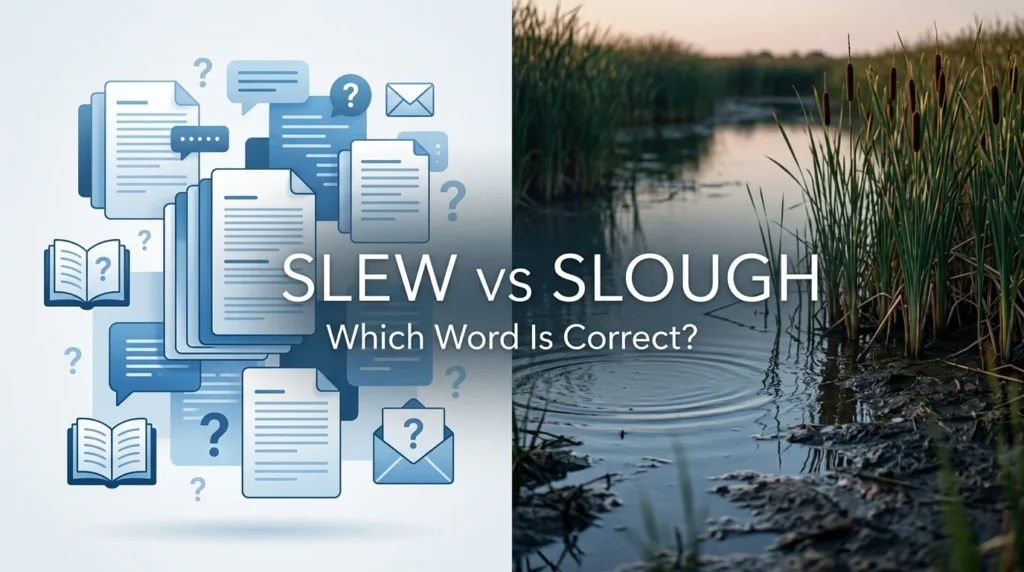

Slew and slough are different words with different meanings, although some meanings of slough can sound like slew. Use slew when you mean “a large number or amount,” as in “a slew of questions.” Use slough for a wet, muddy area or when talking about shedding skin or tissue. Slew is also the past tense of slay, as in “The hero slew the dragon.”
What Is the Difference Between Slew and Slough?
The simplest way to distinguish slew and slough is to look at the meaning you need.
Slew is commonly used as a noun meaning a large number or amount:
We received a slew of applications.
It can also be the past tense of slay:
The warrior slew the enemy.
As a verb, slew can also describe turning or moving suddenly sideways:
The car slewed across the icy road.
Slough has several unrelated meanings. As a noun, it can mean a soft, wet area of land:
The hikers carefully crossed the slough.
As a verb, slough means to shed or remove a layer, especially dead skin:
Snakes slough their skin as they grow.
The important point is that these are not interchangeable spellings. The correct choice depends on what you are trying to say.
Why It Matters
Choosing slew or slough incorrectly can change the meaning of a sentence completely.
Consider these two sentences:
- The company received a slew of complaints.
- The company crossed a slough of muddy ground.
The first sentence means the company received many complaints. The second describes a wet or muddy area.
The difference also matters in academic writing, business communication, journalism, and everyday English. A spelling mistake involving these words may not be caught by a reader immediately because some pronunciations of slough overlap with slew.
The problem becomes even more confusing because slough does not always have the same pronunciation. Its verb meaning “to shed” is pronounced differently from the wetland noun in many varieties of English.
The Core Rule
Use “slew” for a large number or amount. Use “slough” for a wet or muddy area or for shedding/removing something.
Remember these basic patterns:
- a slew of + plural noun = a large number of something
- slough + wetland meaning = a soft, wet area
- slough + verb meaning = shed or remove
- slew + past-tense meaning = killed, as the past tense of slay
- slew + movement meaning = turned or moved sideways
The most common writing mistake is using “a slough of” when the intended meaning is “a large number of.”
For that meaning, write:
a slew of questions
not:
a slough of questions
How to Use Slew
Slew Meaning “A Large Number or Amount”
This is the meaning most people are looking for when they search slew vs slough.
Slew is often followed by of:
a slew of questions
a slew of problems
a slew of emails
a slew of new products
It usually means a large number or amount, similar to many, a lot of, or a large number of.
For example:
The manager received a slew of applications.
This means the manager received many applications.
The construction is especially common in phrases such as a whole slew of, which adds emphasis:
We encountered a whole slew of technical problems.
This noun use is generally informal or conversational in tone, so a more formal alternative may sometimes be preferable in highly academic or official writing.
Slew as the Past Tense of Slay
Slew has another completely different meaning: it is the past tense of slay.
The knight slew the dragon.
Here, slew does not mean “many.” It means killed, in the context of slay.
This use is often associated with literary, historical, biblical, fantasy, or dramatic language.
Compare:
The hero slew the monster.
with:
The hero faced a slew of monsters.
The first sentence uses slew as a verb. The second uses slew as a noun meaning a large number.
Slew as a Verb Meaning “Turn”
Slew can also be used as a verb meaning to turn, pivot, or move sideways, sometimes suddenly or awkwardly.
The truck slewed across the road.
This is a separate verb from the past tense of slay. The meaning is determined by context.
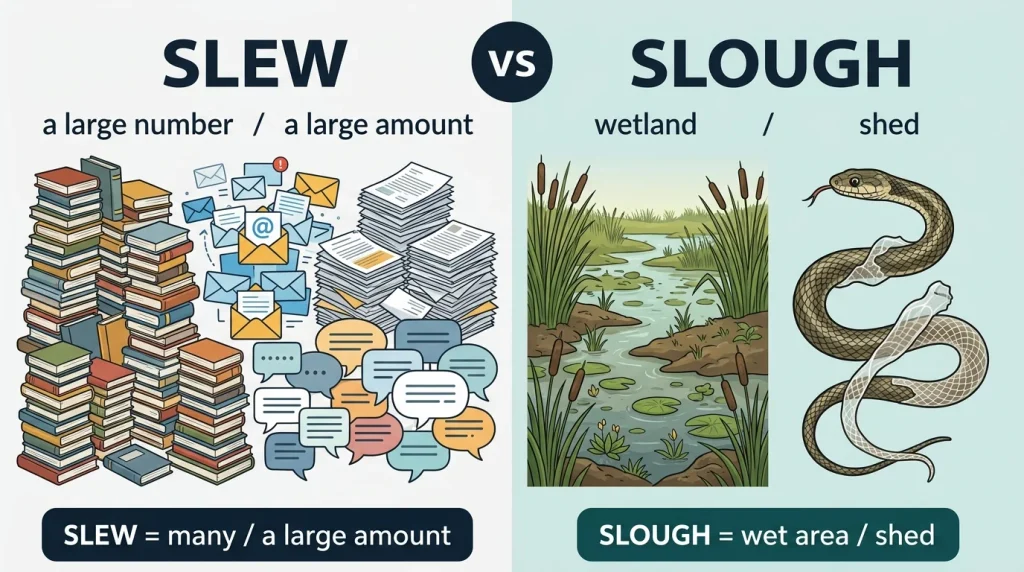
How to Use Slough
Slough as a Wet Area
As a noun, slough can refer to a soft, wet area of land, such as a marshy or muddy area.
The birds gathered near the slough.
This meaning appears particularly in geographical and environmental contexts. Dictionaries also describe a slough as a wet or marshy area and, in some contexts, a channel or body of water associated with wetlands.
Slough as “Shed”
As a verb, slough means to shed or lose a layer of skin or other material.
Snakes slough their skin.
It can also appear as slough off, meaning to shed, discard, or get rid of something.
The snake sloughed off its old skin.
This verb is pronounced /slʌf/, roughly like “sluff,” rather than like slew.
Slough as a State of Despair
There is another noun use that appears mainly in literary or formal contexts.
A slough can describe a state of deep sadness, hopelessness, or despair.
For example:
She struggled to escape a slough of despair.
This sense is less common in ordinary conversation but is still a legitimate English use.
Correct Examples
Here are examples showing the different uses in realistic contexts.
- Conversation:
“I have a slew of errands to finish today.” - Email:
“We received a slew of questions from customers after the announcement.” - Workplace:
“The new policy created a slew of administrative tasks.” - School:
“Our teacher assigned a slew of reading exercises before the exam.” - Academic writing:
“The study raises a slew of questions about the reliability of the results.” - Social media:
“That post received a slew of comments within an hour.” - News writing:
“The company is facing a slew of legal challenges.” - Historical or literary writing:
“According to the legend, the warrior slew the invading king.” - Driving:
“The vehicle slewed sideways after hitting the patch of ice.” - Nature writing:
“Several species of birds were nesting around the slough.” - Biology:
“The snake sloughs its skin as it grows.” - Figurative writing:
“After months of setbacks, he finally escaped his slough of despair.”
Incorrect vs. Correct
| ❌ Incorrect | ✅ Correct | Why |
|---|---|---|
| I received a slough of emails. | I received a slew of emails. | Slew means a large number or amount here. |
| She asked a slough of questions. | She asked a slew of questions. | The intended meaning is “many questions.” |
| We faced a slough of problems. | We faced a slew of problems. | Slough does not normally mean a large number in this construction. |
| The snake slew its skin. | The snake sloughed its skin. | The verb for shedding skin is slough. |
| The warrior sloughed the enemy. | The warrior slew the enemy. | Slew is the past tense of slay. |
| We crossed a slew of wetland. | We crossed a slough. | A slough can be a wet or marshy area. |
| The company slew off unnecessary procedures. | The company sloughed off unnecessary procedures. | Slough off can mean discard or get rid of. |
| The car sloughed across the road. | The car slewed across the road. | Slew can describe sudden sideways movement. |
| The report contains a slough of useful statistics. | The report contains a slew of useful statistics. | Slew is the appropriate quantity noun. |
| The snake slew off its old skin. | The snake sloughed off its old skin. | Slough off is the appropriate verb phrase for shedding. |
Why People Make This Mistake
Phonetic Similarity
One major reason for confusion is pronunciation.
Slew is pronounced roughly like “sloo.”
The wetland noun slough may also be pronounced like “sloo” in some varieties of English. This creates a genuine sound-based spelling problem.
However, the verb slough, meaning “shed,” is pronounced roughly “sluff.”
Similar Spelling
Both words begin with sl- and contain the letters l and u/o sounds in related-looking patterns. When someone has mainly encountered the words through speech, it is easy to assign the wrong spelling.
Overgeneralization
A writer may learn that slew means “a lot” and then assume slough is simply an alternative spelling. It is not.
Likewise, someone familiar with slough as a wetland may incorrectly use it in phrases such as “a slough of problems.”
Spellcheck and Autocomplete
Spellcheck tools can identify misspellings, but they cannot always determine which correctly spelled word matches the intended meaning.
Both slew and slough are legitimate English words. A sentence containing the wrong one may therefore pass a basic spelling check.
Translation Interference
Learners translating directly from another language may choose a word based on the general idea of “many,” “shed,” or “swamp” without noticing that English uses different words for those concepts.
The safest approach is to learn each word together with its common sentence pattern.
Common Mistakes Checklist
- Using “slough of” to mean “many of”
Use a slew of when referring to a large number or amount. - Assuming “slew” only means “killed”
Slew also commonly means a large number or amount and can function as a verb describing sideways movement. - Assuming every “slough” sounds like “sluff”
The pronunciation depends on the meaning. The wetland noun can have a different pronunciation from the verb meaning “shed.” - Confusing “slough off” with “slew off”
The standard verb phrase for shedding or discarding is slough off. - Treating “slew” as a synonym for “slough”
They overlap only in specific pronunciation or variant forms, not as general replacements. - Ignoring context
Ask whether the sentence describes quantity, killing, movement, wetlands, shedding, or despair.
Slew vs Slough in Real English
“A slew of questions”
This is natural, everyday English when someone wants to emphasize that there are many questions. It is common in conversation, journalism, business communication, and general writing. The phrase is somewhat informal, so “many questions” or “a large number of questions” may be better in highly formal contexts.
“A slough of questions”
This is not the normal modern expression when the intended meaning is “many questions.” A reader will generally expect slew in this construction. The similarity is understandable because the words can overlap in pronunciation, but that does not make the spellings interchangeable.
“The snake sloughed its skin”
This is grammatically correct and natural, especially in biology, nature writing, and descriptive contexts. In everyday conversation, shed its skin may be more familiar and simpler. Slough gives the sentence a more specialized or precise vocabulary choice.
“The car slewed across the road”
This is grammatically correct and natural in contexts describing sudden sideways movement. It is particularly useful in technical, descriptive, driving, aviation, or mechanical writing. In ordinary conversation, people may more often say that the car skidded, slid, or swerved, depending on the exact movement.
Read More: Whit vs Wit: What’s the Difference?
“A slough of despair”
This is grammatically possible and established, but it is literary rather than everyday conversational English. If the goal is a natural modern sentence, a state of despair or deep despair is often more straightforward.
American vs. British English
There is not a simple American-versus-British spelling rule that says one variety uses slew while the other uses slough.
The important distinction is meaning and pronunciation.
Slew is used in both American and British English, including the noun meaning a large number or amount. Dictionaries also recognize its verb uses.
Slough also occurs in both varieties, but its pronunciation can vary according to its meaning. The wetland noun has pronunciations that include a sound like slew in American English, while the verb meaning “shed” is pronounced differently.
There is therefore no reliable rule such as “Americans use slew and British speakers use slough.” Context is more important than nationality.
Formal vs. Informal Usage
The noun slew meaning “a large number or amount” is generally more conversational or informal than alternatives such as:
- many
- numerous
- a large number of
- a substantial number of
- a considerable amount of
For example:
More conversational:
The company received a slew of applications.
More formal:
The company received a large number of applications.
Both are grammatically correct. The best choice depends on the tone of the writing.
The verb slough is more specialized in some contexts, especially biology, medicine, and technical writing:
The damaged tissue began to slough away.
In ordinary conversation, shed or come off may be more familiar.
Slew vs Slough Comparison Table
| Feature | Slew | Slough |
|---|---|---|
| Main quantity meaning | A large number or amount | Not normally used for quantity |
| Past tense of slay | Yes | No |
| Meaning “shed” | No | Yes |
| Wetland meaning | Not normally | Yes |
| Meaning “turn/move sideways” | Yes | No in the standard comparison |
| Common phrase | A slew of questions | Slough off dead skin |
| Pronunciation | Usually “sloo” | Varies by meaning and variety |
| Formality | Quantity sense is relatively informal | Depends on meaning and context |
| Example | A slew of complaints | A snake sloughed its skin |
What About “Slue”?
A third word can make this comparison even more confusing: slue.
Slue is used as a verb meaning to turn, rotate, or move sideways. It can overlap with the movement-related sense of slew. Some dictionaries recognize slew as an alternative form in this context.
For ordinary writing, however, the important distinction remains:
- slew of problems = many problems
- slew the enemy = killed the enemy
- slewed across the road = moved or turned sideways
- slough the skin = shed the skin
- slough = a wet area
Read More: Blowed vs Blew: Which One Is Correct?
Memory Trick
Think:
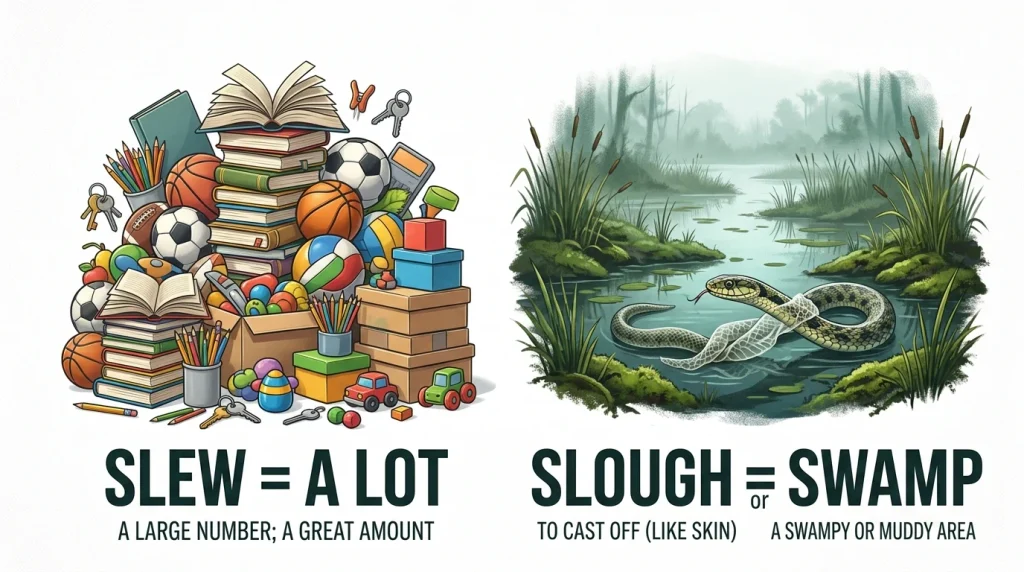
SLEW = a LOT
SLOUGH = SHED or SWAMP
The easiest sentence to remember is:
A slew is a lot; a slough can be wet or shed.
You can also connect slough with shed because both involve something being removed or cast off.
If you mean many, choose slew.
If you mean shed, choose slough.
If you mean a wetland, choose slough.
Real-Life Situations
In a Job Interview
“I handled a slew of customer requests during my previous role.”
Here, slew means a large number. It works naturally in a conversational professional setting, although “a large number of” would sound more formal.
In a Business Meeting
“We have a slew of issues to resolve before launch.”
The speaker means there are many issues.
In an Email
“We received a slew of responses after sending the survey.”
The word emphasizes the high number of responses.
In a Text Message
“I have a slew of things to do today.”
This is understandable and conversational, although “a ton of things” may sound even more casual.
In an Exam
“The king slew his enemy.”
Here, slew is the past tense of slay, not the noun meaning “many.”
In Biology Class
“Some reptiles slough their skin as they grow.”
Here, slough is the verb meaning to shed.
In Environmental Writing
“The wetland contains a shallow slough that provides habitat for birds.”
Here, slough is a geographical/environmental noun.
Read More: Revocable vs Irrevocable: Key Differences Explained.
Mini Quiz
| # | Question | Answer | Explanation |
|---|---|---|---|
| 1 | We received a ___ of complaints. A) slough B) slew | B) slew | Slew means a large number or amount. |
| 2 | The snake ___ its old skin. A) slew B) sloughed | B) sloughed | Slough as a verb means to shed. |
| 3 | The warrior ___ the dragon. A) sloughed B) slew | B) slew | Slew is the past tense of slay. |
| 4 | The birds gathered near the ___. A) slew B) slough | B) slough | A slough can be a wet area or wetland. |
| 5 | Correct the sentence: “She received a slough of emails.” | She received a slew of emails. | Slew of is the standard expression for a large number. |
| 6 | Which word means “shed” as a verb? A) slew B) slough | B) slough | Slough can mean to shed or remove a layer. |
| 7 | Complete the sentence: “The car ___ sideways on the ice.” | slewed | Slew can mean to turn or move sideways. |
| 8 | Which sentence is correct? A) “a slough of questions” B) “a slew of questions” | B) “a slew of questions” | Slew is used for a large number of questions. |
| 9 | Correct the sentence: “The snake slew off its skin.” | The snake sloughed off its skin. | The phrasal verb is slough off. |
| 10 | Which word can describe a state of deep despair? A) slough B) slew | A) slough | Slough has a literary noun sense referring to deep sadness or hopelessness. |
Expert Tips
1. Learn the phrase, not just the word
Instead of memorizing slew = many, memorize:
a slew of
This makes the correct spelling much easier to retrieve when writing.
2. Connect “slough” with “shed”
If you see:
slough off
think:
shed off / get rid of
That connection helps separate the verb from slew.
3. Look at the word after “slew”
When you see:
a slew of + plural noun
you are almost certainly dealing with the quantity meaning.
Examples:
a slew of questions
a slew of complaints
a slew of options
4. Do not rely only on sound
Pronunciation can mislead you because the wetland noun slough can sound like slew in some varieties of English. When writing, identify the meaning first.
5. Check whether the word is a verb or noun
Compare:
a slew of books
with:
He slew the enemy.
The first is a noun. The second is a verb.
6. Use simpler alternatives when appropriate
If you are writing highly formal academic material, a large number of may be clearer than a slew of.
If you are writing ordinary conversation, however, a slew of can sound natural and concise.
7. Remember that correct spelling depends on meaning
This is not simply a spelling preference. Slew and slough can represent completely different meanings, so replacing one with the other can change the sentence.
FAQ
Is “a slew of” correct?
Yes. A slew of is a standard expression meaning a large number or amount of something.
Is “a slough of” ever correct?
Not when you mean “a large number or amount.” In that situation, use a slew of. Slough has other legitimate meanings, including a wet area and the act of shedding.
Is slew the past tense of slay?
Yes. Slew is the past tense of slay.
For example:
The warrior slew the beast.
Does slough mean shed?
Yes. As a verb, slough means to shed or lose a layer, especially skin or other material. Slough off can also mean to discard or get rid of something.
Is slew a noun or a verb?
It can be both. As a noun, slew can mean a large number or amount. As a verb, it can be the past tense of slay or describe turning or moving sideways.
Why does slough have different pronunciations?
English spelling does not always provide a reliable pronunciation guide, and slough represents different words and meanings that developed separately. The verb meaning “shed” is pronounced roughly “sluff,” while the wetland noun can have a pronunciation like “sloo” in some varieties of English.
Is “slew of” formal English?
It is standard English, but the quantity sense of slew is generally more conversational or informal. In highly formal writing, a large number of or a substantial number of may be a better choice.
Can slough mean a swamp?
Yes. A slough can refer to a soft, wet, marshy, or muddy area of land.
Can slew and slough sound the same?
Yes, depending on the meaning of slough and the variety of English being spoken. This is one reason the words can be confusing in writing.
Which is correct: “slew of people” or “slough of people”?
Slew of people is correct when you mean a large number of people.
A slew of people attended the event.
Is “slough off” correct?
Yes. Slough off is a standard phrasal verb meaning to shed, remove, or discard something.
What is the easiest way to remember slew vs slough?
Remember:
Slew = a lot. Slough = shed or swamp.
If the sentence is about quantity, use slew. If it is about shedding or a wet area, use slough.
Quick Summary
Slew and slough are not interchangeable words. Use slew when you mean a large number or amount, as in “a slew of questions.” Slew is also the past tense of slay and can describe turning or moving sideways. Slough has different meanings: it can describe a soft, wet area of land, a state of deep despair, or the act of shedding skin or another layer. Its pronunciation varies according to its meaning. The most useful rule is simple: slew = a lot; slough = shed or swamp. When you are writing, always choose the word based on the intended meaning rather than pronunciation alone.



Pingback: Superseded vs Superceded: Which Spelling Is Correct?