
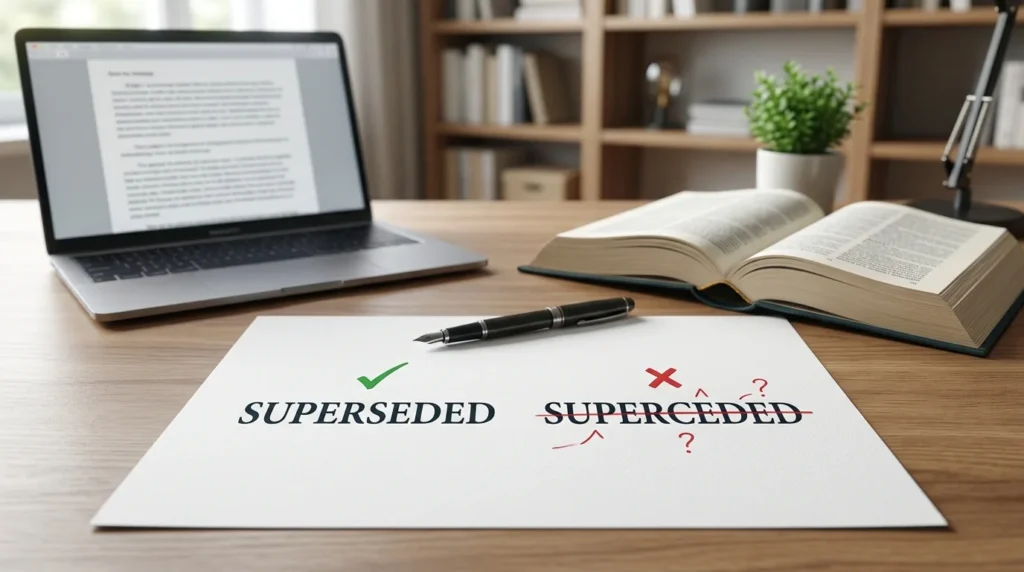

Superseded is the standard spelling. Superceded is a commonly encountered nonstandard or disputed spelling. Superseded is the past tense and past participle of supersede, meaning to replace or take the place of something older or previous. For example: “The new policy superseded the old one.” Remember the unusual middle s: super-seded, not super-ceded.
What Is the Difference Between Superseded and Superceded?
The main difference is spelling, not meaning.
Superseded is the standard modern form:
The old software was superseded by a newer version.
Superceded is a form you may encounter in older material, informal writing, or as a spelling error. Modern dictionaries generally direct readers toward supersede as the standard form, although some dictionary sources acknowledge that supercede has a history of actual usage.
So if you are writing an email, report, essay, article, contract, application, or academic paper, choose:
superseded
not:
superceded
The distinction matters because the two spellings sound the same in normal pronunciation. You cannot reliably hear the difference, so you have to remember the spelling.
Why Does Superseded Matter?
Choosing the correct spelling is especially important when you are writing in situations where accuracy affects how your work is perceived.
You might need the word when discussing:
- an old law replaced by a new law
- an outdated company policy
- an older software version
- a previous edition of a book
- an old scientific method
- a previous contract or agreement
- a former procedure
- an earlier technology
- someone taking another person’s position
- information that is no longer current
A spelling mistake in an ordinary text message may not matter much. In a business report or academic paper, however, repeated spelling errors can distract readers and make otherwise strong writing look less polished.
Read More: Slew vs Slough: What’s the Difference?
The Core Rule
Use superseded when you mean “replaced by something newer, different, or more appropriate.”
The base verb is:
supersede
Its common forms are:
- supersede — base form
- supersedes — third-person singular present
- superseded — past tense and past participle
- superseding — present participle
Examples:
- The new policy supersedes the old policy.
- The new policy superseded the old policy.
- The new policy is superseding the previous one.
- The new policy will supersede the existing rules.
The spelling keeps sede:
super + sede = supersede
supersede + ed = superseded
Cambridge identifies superseded as the past simple and past participle of supersede, meaning to replace something, especially something older or more old-fashioned.
How to Use Superseded Correctly
Use Superseded When Something Replaces Something Else
The word normally describes a replacement relationship.
The updated regulations superseded the previous regulations.
The important idea is that the newer regulations took the place of the older ones.
Use “Was Superseded by” for Passive Sentences
This is one of the most common structures:
Old thing + was/were + superseded + by + new thing
For example:
The original design was superseded by a more efficient model.
You can also use the active form:
A more efficient model superseded the original design.
Both sentences communicate essentially the same replacement relationship.
Use “Has Been Superseded” When the Replacement Happened and Still Matters
The present perfect form is useful when an older thing has been replaced and that fact remains relevant now.
The previous version has been superseded by a newer release.
This is common in technical, business, legal, and academic writing.
Do Not Use Superseded Simply to Mean “Improved”
Something can be improved without being superseded.
For example:
The software was improved.
does not necessarily mean:
The software was superseded.
Superseded specifically suggests that something else has taken its place or replaced its previous role, status, function, or use.
Correct Examples of Superseded
Here are examples across different types of writing.
- Conversation:
“That old phone model has been superseded by a newer version.” - Email:
“Please use the revised form, as the previous form has been superseded.” - Workplace:
“The company’s old attendance policy was superseded last month.” - School:
“The earlier theory was eventually superseded by a more comprehensive explanation.” - Academic writing:
“The original method has been superseded by more reliable techniques.” - Technology:
“This operating system has been superseded by a newer release.” - Legal writing:
“The amended agreement superseded the original contract.” - Social media:
“That trend was quickly superseded by a newer one.” - Everyday writing:
“The printed timetable was superseded by the digital schedule.” - Professional report:
“The preliminary figures were superseded by the final audited results.”
Notice that the word works best when there is a clear relationship between an earlier thing and something that replaces it.
Incorrect vs. Correct: Superseded vs Superceded
| Incorrect | Correct | Why |
|---|---|---|
| The old policy was superceded by a new one. | The old policy was superseded by a new one. | The standard spelling is superseded. |
| This version has been superceded. | This version has been superseded. | The past participle comes from supersede. |
| The old system was superceded last year. | The old system was superseded last year. | The middle s must be retained. |
| The previous contract was superceded. | The previous contract was superseded. | Superceded is not the standard modern spelling. |
| Her role was superceded by a new position. | Her role was superseded by a new position. | Use the standard form in professional writing. |
| The old method was superceded by a faster method. | The old method was superseded by a faster method. | The verb is supersede, not standard modern supercede. |
| The first edition was superceded by the second. | The first edition was superseded by the second. | The correct past form is superseded. |
| The outdated rule has been superceded. | The outdated rule has been superseded. | Keep -sede- in the spelling. |
| The old technology was superceded by digital technology. | The old technology was superseded by digital technology. | The standard spelling uses s, not c. |
| The earlier report was superceded by the final report. | The earlier report was superseded by the final report. | Superseded is the form recommended for standard contemporary writing. |
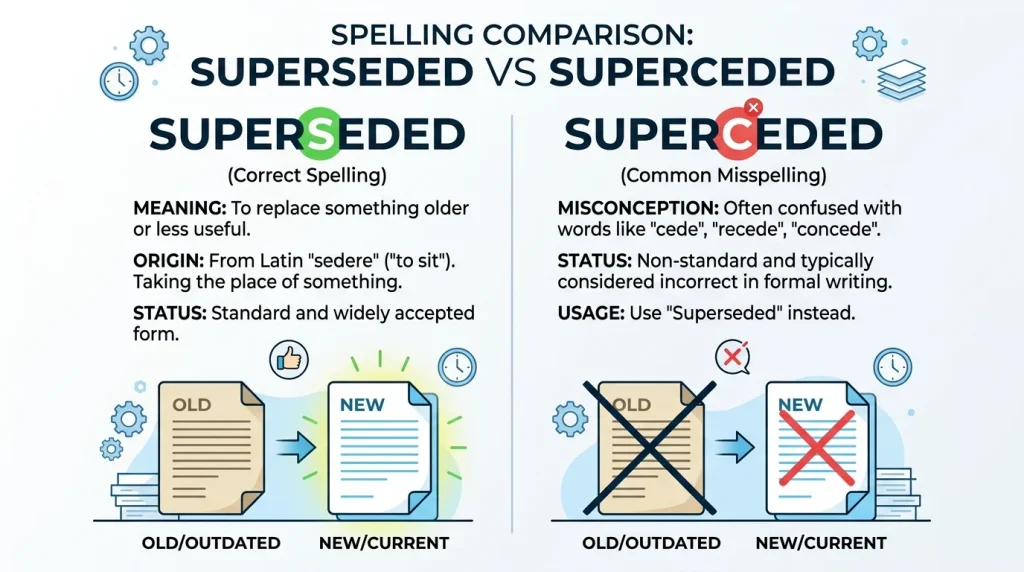
Why Do People Spell It Superceded?
The mistake is unusually easy to make because the pronunciation does not provide a useful clue.
Phonetic Similarity
Superseded and superceded are normally pronounced the same way.
That means you cannot simply sound the word out and discover whether the middle letter should be s or c.
When a spelling cannot be distinguished by pronunciation, memory and visual recognition become more important.
Familiar Spelling Patterns
English has many words containing -cede:
- precede
- concede
- recede
- intercede
- accede
Because -cede is a familiar spelling pattern, superceded can look perfectly reasonable.
But supersede follows a different spelling pattern.
The Word Has an Unusual History
The spelling makes more sense when you know the word’s origin. Supersede comes from Latin supersedere, formed from super (“above”) and sedere (“to sit”). The modern meaning developed from the idea of something being placed above or taking the place of something else.
That history helps explain why the standard form contains -sede- rather than the more familiar -cede- pattern.
Autocomplete and Spellcheck Can Hide the Problem
Modern writing tools can sometimes correct spelling automatically. That can help, but it can also prevent you from learning why a spelling is correct.
If you regularly type superceded and your software silently changes it to superseded, you may continue making the same mistake when writing somewhere without automatic correction.
Translation Interference
Learners of English may also encounter difficulty because spelling patterns do not always transfer neatly from another language.
A word may look as though it should follow the same pattern as another familiar English word, but English spelling contains many historical exceptions and irregularities.
The safest approach is to memorize supersede → superseded as a single word family.
Common Mistakes Checklist
Mistake 1: Writing Superceded
What happens: You replace the middle s with c.
Why it happens: Words such as preceded and conceded make -ceded look familiar.
How to avoid it: Memorize supersede → superseded.
Mistake 2: Writing Superceeded
Some writers add an extra e or another syllable because the pronunciation feels complicated.
Correct:
superseded
Not:
superceeded
Mistake 3: Confusing Supersede With Succeed
These words can both involve taking a place or position, but they are not interchangeable.
Succeed can mean to achieve something successfully or to follow another person in a position.
Supersede means to replace, displace, or make something previous no longer current or applicable.
Mistake 4: Assuming It Always Means “Better”
Superseding something does not automatically mean the replacement is objectively better.
It means that the new thing takes the place of the old one or makes the old one less applicable.
Mistake 5: Assuming Superceded Is a Completely Invented Word
This is a subtle point.
It is common to see superceded described simply as a misspelling, and for modern standard writing that is useful advice. However, historical and dictionary evidence shows that supercede has existed as a spelling variant. Collins, for example, describes it as a disputed spelling and notes its historical usage.
So the most accurate practical rule is:
Use superseded in modern standard English.
Superseded in Real English
Grammatically Correct and Natural
“The old software was superseded by a newer version” is both grammatically correct and natural. The sentence clearly identifies an older system and a replacement. Supersede is especially natural in contexts involving technology, rules, procedures, policies, documents, methods, and systems where one version takes the place of another.
Grammatically Possible but Less Everyday
“I was superseded by my colleague” is grammatically possible, but the wording can sound formal or institutional depending on the context. In ordinary conversation, a speaker might more naturally say, “My colleague took over my role” or “My colleague replaced me.” The choice depends on whether the writer wants a formal or everyday tone.
Natural Everyday Alternative
In casual English, replace is often simpler than supersede. For example, “The new model replaced the old one” sounds more conversational than “The new model superseded the old one.” Both can be correct, but supersede is particularly useful when discussing formal rules, systems, policies, procedures, or older versions.
American vs. British English
There is no meaningful American-versus-British spelling difference in this pair.
The standard form is:
superseded
in both American and British English.
The pronunciation can be represented slightly differently in pronunciation dictionaries because of differences in accent, but the spelling remains the same.
Examples:
American English:
“The previous regulation was superseded by the new law.”
British English:
“The previous regulation was superseded by the new law.”
You do not need to change superseded to another spelling when switching between these major English varieties. Cambridge lists supersede in both its British and American English material.
Formal vs. Informal Usage
Supersede is more formal than replace, although it is not restricted to highly technical writing.
In a business report, contract, academic paper, legal document, policy, or technical document, supersede can be a precise and useful choice:
The revised agreement supersedes all previous versions.
In casual conversation, replace will often sound more natural:
The new version replaced the old one.
Neither is automatically better. Choose supersede when you want a formal or precise description of one thing taking the place of another, and choose replace when simple everyday wording is more appropriate.
Read More: Whit vs Wit: What’s the Difference?
Superseded vs. Superceded: Comparison Table
| Feature | Superseded | Superceded |
|---|---|---|
| Standard modern spelling | Yes | No |
| Meaning | Replaced or taken the place of | Usually intended to mean “superseded” |
| Base verb | Supersede | Supercede |
| Past tense | Superseded | Superceded |
| Past participle | Superseded | Superceded |
| Professional writing | Recommended | Avoid |
| Academic writing | Recommended | Avoid |
| British English | Superseded | Not the standard form |
| American English | Superseded | Not the standard form |
| Historical usage | Established standard form | Historical/variant usage exists |
| Best choice today | Superseded | Do not use it in standard edited writing |
The important nuance is that superceded is not simply a meaningless collection of letters. Historical usage exists, and some dictionaries acknowledge the form. But that does not make it the preferred spelling for modern standard English.
Memory Trick
Use this simple mnemonic:
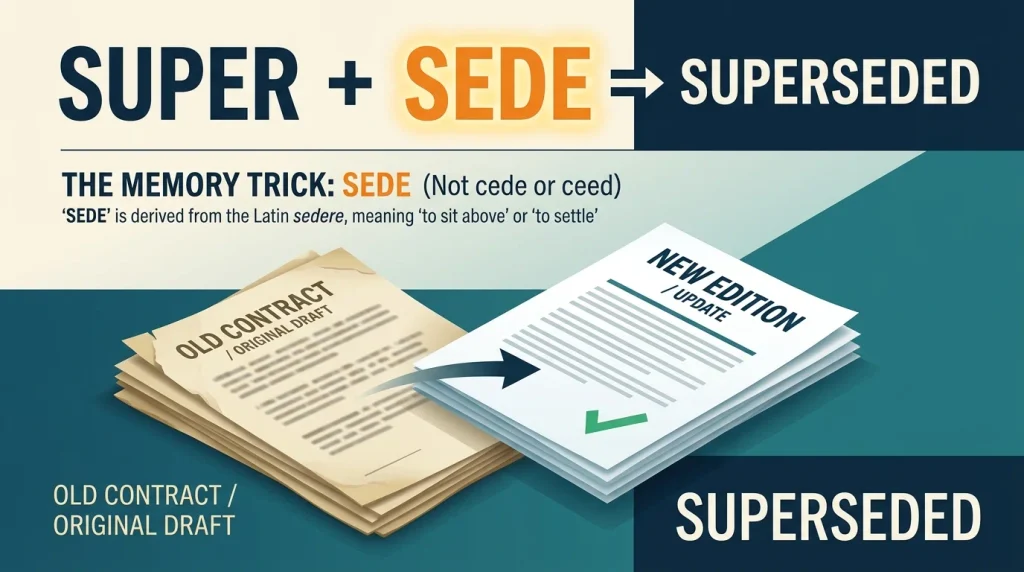
Supersede has “SEDE” inside it: super + SEDE.
Think:
superSEDE → superSEDEd
The final -d is added to the correct base word:
supersede → superseded
If you remember SEDE, you are much less likely to switch to the familiar -cede spelling.
Real-Life Situations
In a Job Interview
If you are discussing changes in your industry:
“Digital systems have superseded many traditional paper-based processes.”
This sounds professional and appropriate.
In a Workplace Meeting
If a new procedure replaces an older one:
“The revised procedure supersedes the previous process.”
The formal wording fits a professional setting.
In an Email
If you need to tell someone that an older document should no longer be used:
“Please note that the attached version has superseded the document sent earlier.”
Even more naturally, you could write:
“Please use the attached version instead of the earlier document.”
In a Text Message
In casual communication, simpler language is usually better:
“The old version got replaced by the new one.”
There is nothing wrong with using superseded in a text, but replaced may sound more natural.
In an Exam or Essay
If the subject is history, science, technology, or law:
“The earlier theory was eventually superseded by a more comprehensive model.”
This is an appropriate academic use.
When Should You Use Superseded?
Use superseded when:
- Something has been replaced by another thing.
- You are describing an older rule, system, version, method, or document.
- The replacement relationship is important to your meaning.
- You are writing in a formal, professional, technical, or academic context.
- You want a more precise alternative to the general word replaced.
When Should You Avoid Superseded?
You may want to choose a simpler word when:
- you are writing for a very casual audience
- “replaced” communicates the idea more clearly
- the reader may not know the word
- the sentence is already complex
- you are trying to keep your writing conversational
For example:
“The old phone was replaced by a new one.”
is often easier for a general reader than:
“The old phone was superseded by a new one.”
Both can be grammatically correct.
Expert Tips
Learn the Whole Word Family
Instead of memorizing only superseded, memorize:
supersede → supersedes → superseded → superseding
This makes it easier to recognize the correct spelling regardless of tense.
Remember the “S” Before the “E”
The difficult part is the middle:
super-S-E-de
Do not let the familiar -cede pattern take over.
Use Replace If You Are Unsure About Meaning
If you are unsure whether supersede fits the sentence, temporarily substitute replace.
For example:
“The new policy replaced the old policy.”
If that is the intended meaning, superseded may also work:
“The new policy superseded the old policy.”
This is a useful editing technique, although the two words can differ slightly in tone and context.
Do Not Treat Spellcheck as Your Teacher
If a writing tool corrects superceded, take a moment to remember the rule instead of simply accepting the correction.
The goal is not merely to produce one correct sentence. It is to learn the spelling so you can reproduce it independently.
FAQ
Is superseded the correct spelling?
Yes. Superseded is the standard modern spelling and is the past tense and past participle of supersede.
Is superceded ever used?
Yes. The spelling superceded can be found in historical and contemporary texts, and some dictionaries acknowledge supercede as a disputed or variant form. However, superseded is the standard choice for modern edited English.
Read More: Blowed vs Blew: Which One Is Correct?
What does superseded mean?
Superseded means replaced, displaced, or made less current or applicable because something else has taken its place.
Is superseded a verb or an adjective?
It is the past tense and past participle of the verb supersede. It can also function adjectivally in sentences such as “superseded information” or “a superseded policy.”
What is the base word of superseded?
The base verb is supersede.
The forms are supersede, supersedes, superseded, and superseding.
Why is supersede spelled with an s instead of a c?
Its spelling reflects its historical origin in Latin supersedere, from super meaning “above” and sedere meaning “to sit.” It did not develop from the same Latin root associated with words such as concede and precede.
Is superseded the same as replaced?
They are often interchangeable, but superseded can sound more formal and can emphasize that something previous has been displaced by something newer, more current, or more appropriate.
Is superseded a formal word?
Yes, it is generally more formal than replaced. It is especially common in business, legal, technical, academic, and policy-related writing.
Can I use superseded for a person?
Yes, depending on the context. For example, someone can be superseded in a position or role. However, in everyday conversation, replaced or someone else took over the role may sound more natural.
Is there a difference between supersede and superseded?
Yes. Supersede is the base verb, while superseded is its past tense and past participle.
The new policy will supersede the old one.
The new policy superseded the old one.
Is supercede acceptable in academic writing?
It is best avoided. Even though historical or variant usage exists, supersede and superseded are the standard forms expected in contemporary edited English.
What is the easiest way to remember superseded?
Remember:
super + SEDE = supersede
Then add -d:
supersede → superseded
Do not change the s in sede to c.
Quick Summary
Superseded is the standard modern spelling, while superceded is a disputed or nonstandard form that you should generally avoid in contemporary edited English. Superseded is the past tense and past participle of supersede, meaning to replace something older, previous, outdated, or no longer appropriate. The unusual spelling comes from the word’s history: supersede ultimately derives from Latin supersedere, associated with the idea of sitting above. The spelling does not follow the familiar pattern of words such as precede or concede. For professional, academic, technical, and formal writing, always choose superseded. The easiest memory trick is super + SEDE → supersede → superseded.
FAQ
Is “superceded” completely wrong?
For practical modern writing, treat superceded as a spelling to avoid. Historical and dictionary evidence shows that the form has existed, so calling it a word that has “never existed” would be unnecessarily absolute. Superseded is the standard modern choice.
Does superseded mean outdated?
It can imply that something has become outdated because another thing has taken its place, but superseded fundamentally means replaced or displaced. Something can be superseded without being completely useless.
Can a law be superseded?
Yes. A newer law, regulation, or legal provision can supersede an earlier one when it takes its place or makes the earlier provision no longer applicable.
Can technology be superseded?
Yes. Technology is frequently described as being superseded when a newer system, device, standard, or method takes its place.
Does superseded always mean replaced by something better?
No. Superseded describes replacement, not necessarily superiority. The newer thing may be more current or simply different.
What is the opposite of superseded?
There is no single perfect opposite in every context. Depending on the sentence, possible contrasts include current, active, retained, continued, or still in use.
Is “superseded by” the correct phrase?
Yes. Superseded by is a standard construction:
The old procedure was superseded by a revised procedure.
Is “superseded with” correct?
Usually, superseded by is the clearer construction when identifying what replaced something.
The old system was superseded by a new system.
Is supersede pronounced like “super-seed”?
Yes. The word is commonly pronounced approximately soo-per-SEED in both major English varieties, although accent affects the exact pronunciation.
Should I use superseded or replaced?
Use superseded when you want a more formal or precise word for replacement, particularly with policies, systems, rules, methods, documents, technology, or standards. Use replaced when simpler everyday English is preferable.
Mini Quiz
| # | Question | Answer | Explanation |
|---|---|---|---|
| 1 | Which spelling is standard: superseded or superceded? | Superseded | Superseded is the standard modern spelling. |
| 2 | Fill in the blank: “The old policy was ___ by a revised policy.” | superseded | The passive construction is “was superseded by.” |
| 3 | Which is correct? A) superceded B) superseded | B) superseded | The correct form retains the s in -sede-. |
| 4 | What does superseded mean? | Replaced or displaced | It describes something being replaced by another thing. |
| 5 | Correct the sentence: “The old system was superceded by new technology.” | “The old system was superseded by new technology.” | The standard spelling is superseded. |
| 6 | Which base verb produces “superseded”? A) supercede B) supersede | B) supersede | Superseded is the past tense and past participle of supersede. |
| 7 | Fill in the blank: “The new agreement ___ the previous agreement.” | supersedes | The subject “agreement” is singular, so the present-tense form is supersedes. |
| 8 | Is “superseded” appropriate in academic writing? | Yes | It is a standard word and is suitable for formal and academic contexts. |
| 9 | Which is usually more conversational: “superseded” or “replaced”? | Replaced | Replaced is more common and straightforward in everyday English. |
| 10 | Complete the memory trick: “super + ___ = supersede.” | SEDE | Remembering SEDE helps prevent the common supercede spelling. |



Pingback: Responsibility vs Responsability: Which Is Correct?
Pingback: Ten vs 10: Which One Should You Use?