


“Ten” and “10” represent the same number, so neither is grammatically wrong. The choice depends on the writing style and context. In many professional and academic styles, numbers from 10 onward are written as numerals, so 10 is preferred. However, some styles, including common book and humanities conventions, spell out numbers through 100, making ten correct. Always follow the style guide required for your writing and stay consistent.
What Is the Difference Between Ten and 10?
Ten is the number written as a word, while 10 is the same number written as a numeral, or digit.
They have the same numerical meaning:
- ten students
- 10 students
Both expressions tell the reader that the quantity is ten.
The difference is therefore not one of grammar or meaning. It is mainly a matter of number style.
A writer might choose ten because the surrounding prose uses spelled-out numbers. Another writer might choose 10 because the document follows a style that uses numerals for numbers of 10 and above.
This is why asking “Is ten correct or is 10 correct?” does not have one universal answer. The better question is:
Which form does the writing context require?
For ordinary prose, many commonly used styles follow a basic pattern: spell out small numbers and use numerals for larger ones. Under that pattern, ten is the point where 10 becomes the preferred form. But other major styles use different thresholds.
Why It Matters
Choosing between ten and 10 may seem minor, but number formatting affects the consistency and professionalism of a document.
Imagine a business report that says:
The company received ten applications and 10 interviews were scheduled.
The sentence is understandable, but the mixed treatment may look inconsistent if there is no stylistic reason for switching forms.
Compare it with:
The company received 10 applications and 10 interviews were scheduled.
If the document uses numerals for quantities, the second version is visually consistent.
In another context, however, spelling out the number may be perfectly appropriate:
Ten years later, the project is still operating.
The important point is not that one form is always superior. The surrounding context determines which form works best.
Number style becomes especially important in:
- Academic papers
- Business reports
- News writing
- Technical documentation
- Books and essays
- Data-heavy documents
- Presentations and reports
- Professional emails
A consistent number system makes information easier to scan and prevents readers from wondering whether a change in format has some special meaning.
Read More: Responsibility vs Responsability: Which Is Correct?
The Core Rule
There is no universal rule that says you must always write “ten” or always write “10.” Choose according to the applicable style guide, context, and consistency.
For many everyday, professional, and technical contexts, a useful default is:
- zero through nine: usually words
- 10 and above: usually numerals
However, this is a style convention, not an absolute grammar rule.
For example, APA generally uses words for zero through nine and numerals for 10 and above, with several exceptions. MLA commonly spells out numbers that can be written in one or two words when numbers are not frequent. Chicago’s general approach traditionally spells out whole numbers from zero through one hundred in ordinary nonfiction prose.
So if someone asks, “Should I write ten or 10?”, the safest answer is:
Check the style guide first. If there is no required style guide, choose a sensible convention and use it consistently.
How to Use Ten and 10
Use “ten” when your style calls for a spelled-out number
In ordinary prose, ten can be appropriate when the writing style spells out relatively small numbers.
Examples:
She bought ten books.
Ten people attended the meeting.
The novel contains ten chapters.
This is particularly common in styles that spell out numbers that can be expressed in one or two words.
Use “10” when your style calls for numerals
Many professional, academic, journalistic, and technical contexts use numerals for 10 and above.
Examples:
The survey included 10 participants.
The company opened 10 new locations.
The experiment lasted 10 minutes.
When numbers are central to the information being presented, numerals can also make the information easier to scan.
Use numerals for measurements and precise quantities
Numbers associated with measurements are commonly written as numerals:
The package weighs 10 kg.
The cable is 10 meters long.
The temperature reached 10°C.
The meeting lasted 10 minutes.
Many style systems make special provisions for measurements, percentages, statistics, dates, times, money, and similar numerical information.
Spell out a number at the beginning of a sentence when required by your style
A common convention is to avoid beginning a sentence with a numeral.
Instead of:
10 students joined the program.
Write:
Ten students joined the program.
Or rewrite the sentence:
The program attracted 10 students.
Rewriting is often the cleaner option when the spelled-out number becomes awkward.
Follow the required style guide in academic writing
The answer can change depending on the academic style.
For example, APA generally uses 10 rather than ten for the number 10. MLA can prefer ten when the number can be written in one or two words and the context contains relatively few numbers. Chicago’s general nonfiction convention is more likely to use ten because it generally spells out whole numbers through 100.
The lesson is simple: do not assume that one number rule applies to every type of writing.
Correct Examples
Here are examples showing how both forms can be correct depending on context.
- Ten students volunteered for the project.
- The survey received 10 responses.
- She has ten years of teaching experience.
- The company hired 10 new employees.
- Ten minutes should be enough.
- The package contains 10 items.
- He read ten pages before dinner.
- The experiment involved 10 trials.
- Ten people attended the informal discussion.
- The report identifies 10 major risks.
- She bought ten notebooks for the class.
- The machine operates for 10 hours at a time.
Notice that these examples do not mean ten is always informal or 10 is always formal. The appropriate form depends on the document’s number convention.
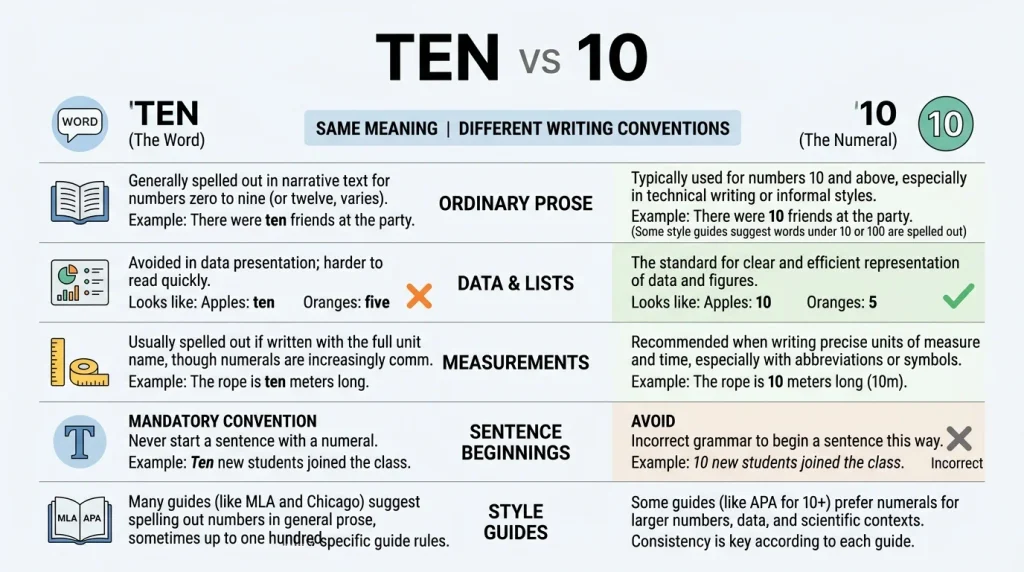
Incorrect vs. Correct
| Incorrect or Inconsistent | Correct | Why |
|---|---|---|
| The survey included ten participants. The second survey included 10 participants. | The survey included 10 participants. The second survey included 10 participants. | If the chosen style uses numerals for 10 and above, keep the same treatment. |
| 10 students attended the lecture. | Ten students attended the lecture. | A sentence-initial numeral is commonly avoided in formal writing. |
| The package weighs ten kg. | The package weighs 10 kg. | Numerals are normally used with measurements. |
| We interviewed 8 managers and ten directors. | We interviewed 8 managers and 10 directors. | Related quantities should be presented consistently when the style calls for numerals. |
| The experiment lasted ten minutes and produced 10 results. | The experiment lasted 10 minutes and produced 10 results. | The numerical information is being presented as data. |
| She purchased 10 books for her personal library. | She purchased ten books for her personal library. | In a style that spells out numbers of this size, the word form is preferred. |
| Ten percent of the group responded. | 10% of the group responded. | A percentage is normally expressed with a numeral and percentage symbol in many styles. |
| The temperature reached ten°C. | The temperature reached 10°C. | A numeral is used with a measurement symbol. |
| He finished in the 10th position in a paragraph using spelled-out ordinals throughout. | He finished in the tenth position. | Maintain the document’s chosen number convention where the style permits. |
| The report compares ten results with 25 results. | The report compares 10 results with 25 results. | Closely related numerical data should generally be formatted consistently. |
The important lesson is that “incorrect” does not always mean grammatically impossible. Several examples above could be acceptable under a different style guide. They are marked incorrect because they conflict with the particular convention being applied.
Why People Make This Mistake
The confusion between ten and 10 happens because English does not have one universal formatting rule for numbers.
Different style guides use different rules
This is the biggest reason.
A writer may learn that numbers from one through nine should be spelled out and numbers from 10 onward should use numerals. Later, that writer encounters a book or humanities style that spells out ten, twenty, or even one hundred.
Both systems can be correct within their intended contexts.
Writers confuse grammar with style
Ten and 10 are not different grammatical forms in the way that their and there are different words.
The number is the same. The difference is how the number is represented visually.
That means writing ten instead of 10 is not automatically a grammar mistake.
Writers rely on one simple rule too heavily
“Spell out numbers below 10” is useful advice, but it is not a complete system.
Measurements, percentages, statistics, dates, times, ages, money, tables, and other contexts can require different treatment.
Translation can create confusion
Writers working between languages may encounter different conventions for presenting numbers. A convention that is normal in one language or publishing system may not match English editorial practice.
The solution is not to memorize every possible rule. Instead, identify the style required for the document and apply it consistently.
Spellcheck cannot make every style decision
A spelling or grammar checker may recognize ten and 10 as valid, but that does not mean it will choose the correct style for your entire document.
Number formatting is often an editorial decision rather than a basic spelling error.
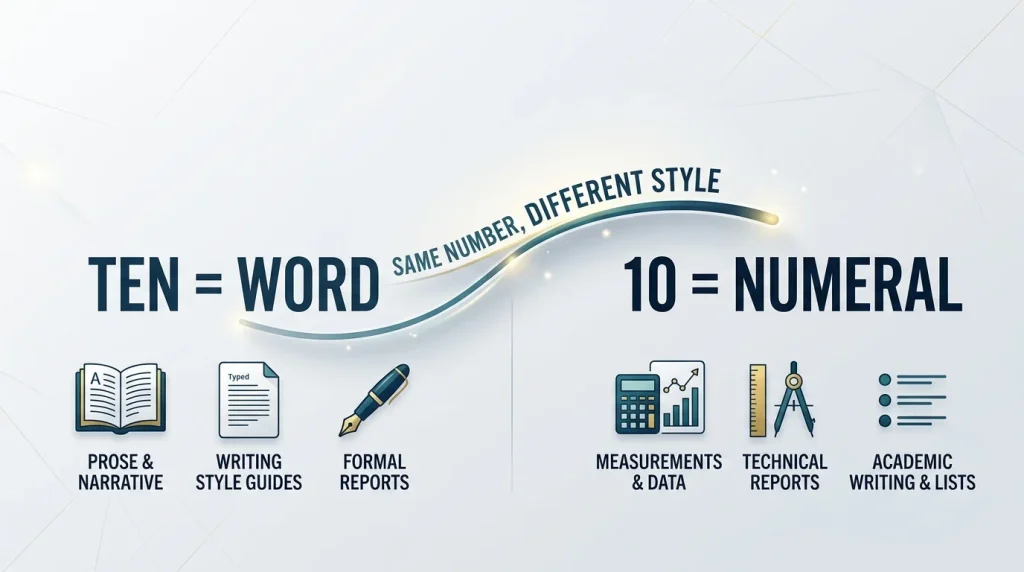
Common Mistakes Checklist
Mistake 1: Thinking “10” is more correct because it is shorter
Why it happens: Numerals take less visual space.
How to avoid it: Shorter does not automatically mean better. Follow the style and purpose of the document.
Mistake 2: Thinking “ten” is always more formal
Why it happens: Spelled-out numbers can look more literary or traditional.
How to avoid it: Formality does not determine the form by itself. A formal technical report may correctly use 10.
Mistake 3: Applying the zero-to-nine rule everywhere
Why it happens: It is an easy rule to remember.
How to avoid it: Treat it as a starting point, not a universal law. Check exceptions involving measurements, percentages, statistics, dates, money, and other special contexts.
Mistake 4: Mixing ten and 10 without a reason
Why it happens: Writers often edit documents in sections.
How to avoid it: Do a final search for number variations and check whether the changes follow a deliberate rule.
Mistake 5: Starting a sentence with 10
Why it happens: Digital writing makes numerals feel natural everywhere.
How to avoid it: Write Ten at the beginning when appropriate, or restructure the sentence.
Mistake 6: Ignoring the assigned academic style
Why it happens: Writers assume all academic writing follows the same number rules.
How to avoid it: Check whether your assignment requires APA, MLA, Chicago, or another style.
Read More: Superseded vs Superceded: Which Spelling Is Correct?
Ten vs 10 in Real English
Ten in natural prose
Ten can fit naturally into narrative or descriptive writing, particularly when numbers are not the main focus. For example, “She waited ten minutes” can read smoothly in continuous prose. In styles that spell out numbers of this size, ten is the expected choice. The form feels especially natural when the number is part of a sentence rather than a piece of numerical data.
10 in practical and data-focused writing
10 is especially useful when the number carries information that readers need to scan quickly. Reports, technical documents, tables, measurements, statistics, and other data-heavy material often favor numerals. A reader can identify 10, 25, and 100 quickly when they appear among other numerical values.
Ten and 10 can both be natural
There is nothing inherently unnatural about either form. The surrounding writing determines what feels appropriate. “She has ten books” and “She has 10 books” can both sound completely normal. The difference becomes important when the document follows a particular editorial convention. In other words, natural English does not automatically determine the visual form of every number.
Formal vs. Informal Usage
There is no simple formal-versus-informal rule that says “ten” is formal and “10” is informal.
Both can appear in formal writing.
For example:
The company employs ten people.
and:
The company employs 10 people.
Both can be professionally written, depending on the style system.
Likewise, casual writing can use either form:
I waited ten minutes.
I waited 10 minutes.
The more important question is whether the form fits the writing convention and context.
American vs. British English
There is no major American-versus-British English distinction that makes “ten” correct in one variety and “10” correct in the other.
The important differences are usually associated with the style guide, publication, genre, or institution, rather than the basic variety of English.
Therefore, do not assume that changing from American to British English requires changing every instance of ten to 10, or vice versa.
Comparison Table
| Feature | Ten | 10 |
|---|---|---|
| Meaning | Number ten | Number ten |
| Grammatical value | Cardinal number | Numerical representation of a cardinal number |
| Pronunciation | “ten” | Pronounced “ten” |
| Meaning changes? | No | No |
| Common in continuous prose | Yes | Yes |
| Common in data-heavy writing | Less common in some styles | Very common |
| Common with measurements | Usually not when paired with a symbol/unit | Usually preferred |
| Can begin a sentence? | Yes | Usually avoided |
| Required in every style? | No | No |
| Main deciding factor | Style and context | Style and context |
How Style Guides Treat Ten vs 10
The number 10 is a useful example of why number formatting cannot be reduced to one universal grammar rule.
| Style or Context | Typical Treatment of 10 |
|---|---|
| APA-style academic writing | 10 |
| Many professional/business styles | 10 |
| Technical/scientific writing | Usually 10, especially with measurements |
| MLA-style humanities writing with few numbers | ten can be preferred |
| Chicago-style general nonfiction | ten is generally preferred |
| Sentence beginning | Ten or rewrite the sentence |
| Measurement | Usually 10 |
| Percentage with symbol | Usually 10% |
| Data table | Usually 10 |
APA’s general convention is words for zero through nine and numerals for 10 and above, while MLA and Chicago use different approaches in many ordinary prose contexts.
This table is a practical guide, not a substitute for the specific style manual required by your school, employer, publisher, or journal.
Memory Trick
Use this simple question:
“Am I writing the number as part of prose, or am I presenting numerical information?”
If it is ordinary prose and your style spells out smaller numbers, think:
Words for the flow.
If it is data, measurement, statistics, or another numerical context, think:
Digits for the scan.
Then check the style guide if one applies.
A second shortcut is even simpler:
10 and ten mean the same thing; the style decides the look.
Real-Life Situations
In an email
If your workplace uses numerals for 10 and above:
The team needs 10 copies before Friday.
If the email is ordinary prose and follows a style that spells out the number:
The team needs ten copies before Friday.
In a school essay
The answer depends on the required academic style. Under a convention that uses numerals from 10 onward:
The survey included 10 students.
Under a style that spells out numbers that can be written in one or two words:
The survey included ten students.
In a business report
Numerals often make numerical information easier to scan:
Sales increased by 10% during the quarter.
In a measurement
Use the form appropriate to the measurement convention:
The container holds 10 liters.
At the beginning of a sentence
Avoid:
10 employees attended the meeting.
Prefer:
Ten employees attended the meeting.
Or:
The meeting was attended by 10 employees.
In a text message
Casual digital communication is flexible:
I’ll be there in 10 minutes.
and:
I’ll be there in ten minutes.
Both are easily understood. In informal communication, speed and personal preference often influence the choice.
Expert Tips
1. Choose the style before editing the document
Do not decide number formatting sentence by sentence. Determine the applicable style first.
2. Do not call every variation a grammar error
If someone writes ten where a particular style prefers 10, the problem is generally one of style consistency rather than basic grammar.
3. Look at nearby numbers
If a sentence contains several related quantities, formatting them consistently can make the information easier to understand.
For example:
The company has 10 offices, 25 branches, and 42 employees in the regional division.
A numerical series is easier to scan when the figures follow one system.
Read More: Slew vs Slough: What’s the Difference?
4. Treat measurements differently from ordinary prose
A number attached to a unit often follows a special convention. This is one reason “always spell out numbers below 10” is incomplete advice.
5. Rewrite awkward sentence openings
If a large numeral would have to start a sentence, restructuring can be cleaner than spelling out an unusually long number.
6. Do not rely solely on automatic grammar checking
A grammar checker may identify obvious errors but may not know which editorial system your publisher or professor requires.
7. Consistency matters more than personal preference
If your document has no external style requirement, choose a reasonable convention and apply it consistently.
Quick Summary
Ten and 10 represent exactly the same number. Neither form is automatically more correct. The choice depends on the writing context and the style guide you are following. Many professional and academic systems use numerals for 10 and above, while some humanities and book-writing conventions spell out numbers through 100. Use numerals especially where measurements, statistics, percentages, dates, or other precise numerical information are involved. Avoid beginning a sentence with a numeral when your style requires it to be spelled out. Most importantly, do not confuse number formatting with grammar: ten vs 10 is primarily a style decision. When no style guide is specified, choose a consistent system that makes the document clear and easy to read.
FAQ
Is “ten” grammatically correct?
Yes. Ten is the standard word form of the number 10 and is grammatically correct when used appropriately.
Is “10” grammatically correct?
Yes. 10 is the numeral representing the number ten. Using a numeral is also grammatically acceptable when the relevant writing style permits or requires it.
Should I write ten or 10 in a sentence?
It depends on the style you are following. Many styles use 10 for 10 and above, while some styles spell out ten in ordinary prose. Check the required style guide first.
Should I write “ten people” or “10 people”?
Both can be correct. Ten people may be preferred under a style that spells out smaller numbers, while 10 people is common under styles that use numerals for 10 and above.
Is 10 more formal than ten?
No. 10 is not inherently more formal than ten. Both can appear in formal writing. The choice is normally determined by editorial style and context.
Is ten more formal than 10?
No. Spelling out the number does not automatically make writing more formal. A technical report can correctly use 10, while a formal essay can correctly use ten, depending on the applicable convention.
Should I spell out 10 at the beginning of a sentence?
Generally, yes, when your style requires numbers at the beginning of sentences to be spelled out:
Ten students attended.
You can also restructure the sentence:
The class had 10 students.
Do I use 10 or ten before a measurement?
A numeral is generally used with a measurement:
10 kg
10 cm
10 minutes
The exact presentation can depend on the style guide and whether the unit is written out or abbreviated.
Is “ten” or “10” better in academic writing?
There is no single answer because academic styles differ. APA generally uses 10, while MLA and Chicago can prefer ten in ordinary prose under their respective number conventions.
Is “ten” or “10” better in business writing?
10 is often practical in business writing because numerals make quantities easy to scan, particularly in reports, lists, and data-heavy material. However, the organization’s house style should take priority.
Should I use ten or 10 in a text message?
Either is fine in casual texting. 10 may be faster to type, while ten can blend naturally into a sentence. There is no general texting rule that makes one grammatically superior.
What is the easiest way to remember ten vs 10?
Remember:
Ten and 10 have the same meaning. Style chooses the format.
If you are writing for a specific publication, school, employer, or journal, follow its style guide rather than relying on a universal number rule.
Mini Quiz
| # | Question | Answer | Explanation |
|---|---|---|---|
| 1 | Which form is preferred under a style that uses numerals for 10 and above? “The class has ___ students.” A) ten B) 10 | B) 10 | That style uses numerals for 10 and above. |
| 2 | Correct the sentence: “10 students joined the workshop.” | Ten students joined the workshop. | A sentence beginning with a numeral is commonly avoided. |
| 3 | Fill in the blank: “The package weighs ___ kg.” A) ten B) 10 | B) 10 | Numerals are normally used with measurements. |
| 4 | True or false: “Ten” and “10” have different meanings. | False | Both represent the same number. |
| 5 | Which is better for a data-heavy report? A) ten participants, twelve participants, fifteen participants B) 10 participants, 12 participants, 15 participants | B | Numerals make related data easier to scan. |
| 6 | Correct the sentence under a style that spells out numbers in ordinary prose: “The company hired 10 employees.” | The company hired ten employees. | The chosen style calls for the number to be spelled out. |
| 7 | Which statement is true? A) Ten is always more formal. B) 10 is always more formal. C) Neither is automatically more formal. | C | Formality does not determine the form by itself. |
| 8 | Fill in the blank: “The temperature reached ___°C.” A) ten B) 10 | B) 10 | Numerals are normally used with measurement symbols. |
| 9 | Which is better when a style requires numerals for 10 and above? “The survey included ___ participants and produced 25 responses.” A) ten B) 10 | B) 10 | Related numerical information should generally follow the same convention. |
| 10 | True or false: There is one universal English rule requiring everyone to write 10 rather than ten. | False | Different style guides use different number conventions. |
Final Takeaway
When deciding between ten vs 10, do not ask which one is “more correct” in every situation.
Ask:
What style am I following, what kind of information am I presenting, and am I being consistent?
If a style uses numerals for 10 and above, write 10.
If a style spells out numbers of this size, write ten.
And if there is no specified style guide, choose the option that makes the writing clearest and maintain the same convention throughout the document.



Pingback: Marrying vs Marring: Meaning, Difference & Correct Usage. - Meaning Wisdom
Pingback: Forward vs Foward: Which Spelling Is Correct?
Pingback: Loath vs Loathe: Meaning, Difference & Correct Usage.