


Realises and realizes are both correct. They are two spellings of the same verb, and the difference is mainly regional. Realises is the usual spelling in British English, while realizes is the standard spelling in American English. The meaning, pronunciation, grammar, and verb tense are the same. Choose the spelling that matches the English variety and style you are using, then use it consistently.
What Is the Difference Between Realises and Realizes?
The difference between realises and realizes is spelling, not meaning.
Both forms are the third-person singular present-tense form of the verb realise/realize.
For example:
- British English: She realises the problem.
- American English: She realizes the problem.
Both sentences mean that she becomes aware of or understands the problem.
The only visible difference is the letter s versus z.
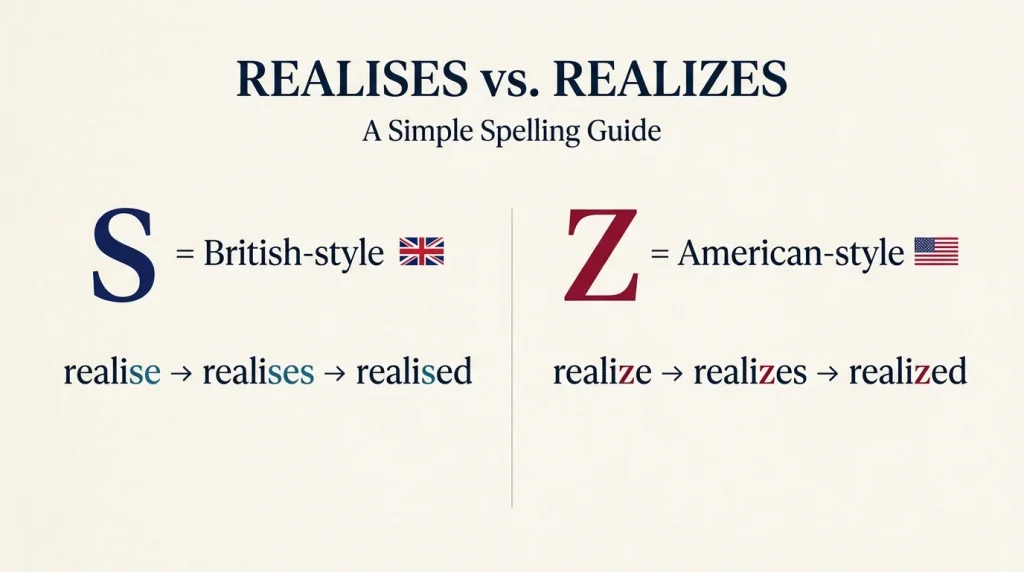
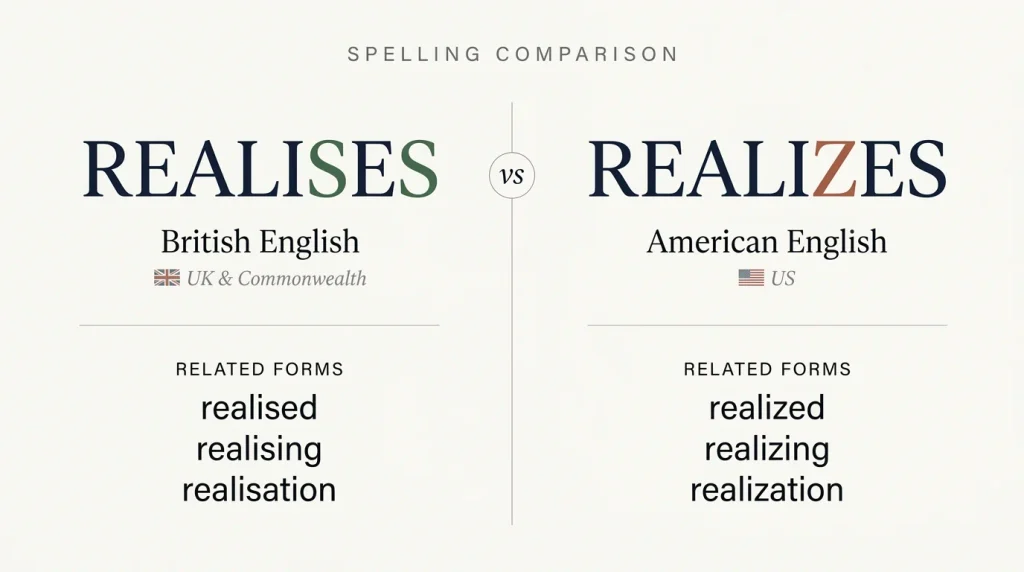
The same spelling distinction appears throughout the word family:
| British-style spelling | American-style spelling |
|---|---|
| realise | realize |
| realises | realizes |
| realised | realized |
| realising | realizing |
| realisation | realization |
So if you are writing in British English, you will normally use realises. If you are writing in American English, use realizes.
Why It Matters
At first, the difference may look too small to matter. In everyday conversation, it usually does not matter at all because the two forms are pronounced alike in ordinary use.
Writing is different.
Spelling can signal which variety of English you are following. A British reader will normally expect forms such as realises, organises, and recognises, while an American reader will normally expect realizes, organizes, and recognizes.
This becomes more noticeable in formal writing.
For example, imagine a British student writing:
The researcher realizes the importance of the findings.
The sentence is understandable and the grammar is fine, but realises would normally fit a British spelling style better.
Likewise, an American student would normally write:
The researcher realizes the importance of the findings.
Using realises throughout an American document may make the spelling look inconsistent with the rest of the document.
The important point is that this is primarily a spelling convention, not a difference in grammatical correctness.
Read More: Loath vs Loathe: Meaning, Difference & Correct Usage.
The Core Rule
Use “realises” when following the usual British -ise spelling convention. Use “realizes” when following American English spelling. Both mean the same thing.
Do not treat realises and realizes as different tenses.
The s/z difference does not tell you whether an action happens in the present or past.
- Present: She realises the truth.
- Past: She realised the truth.
Or in American English:
- Present: She realizes the truth.
- Past: She realized the truth.
The tense changes because of the verb ending, not because of the choice between s and z.
How to Use Realises and Realizes
Use “realises” in British-style English
If your writing follows the common British spelling convention, use realises.
Examples:
She realises that she has made a mistake.
He realises how difficult the task will be.
The company realises the importance of customer feedback.
Use “realizes” in American English
If you are writing in American English, use realizes.
Examples:
She realizes that she has made a mistake.
He realizes how difficult the task will be.
The company realizes the importance of customer feedback.
The sentence structure does not change.
Only the spelling changes.
Realises and realizes can mean “becomes aware”
This is the most common everyday meaning.
I suddenly realise that I left my phone at home.
I suddenly realize that I left my phone at home.
Both sentences describe the same moment of becoming aware of something.
They can also mean “understands”
She realises why her friend was upset.
She realizes why her friend was upset.
Here, the verb describes reaching an understanding.
They can refer to achieving a goal
Realise/realize can also mean to achieve something that someone hoped for or planned.
He finally realises his ambition of becoming a teacher.
He finally realizes his ambition of becoming a teacher.
The spelling changes according to the English variety, but the meaning does not.
Correct Examples
Here are examples showing how realises and realizes work in different types of writing.
Conversation
“Do you realise what time it is?”
American version:
“Do you realize what time it is?”
I realise that the deadline has changed, so I will adjust the schedule accordingly.
American version:
I realize that the deadline has changed, so I will adjust the schedule accordingly.
Workplace
The manager realises that the team needs more time.
American version:
The manager realizes that the team needs more time.
School writing
The student realises that the equation was copied incorrectly.
American version:
The student realizes that the equation was copied incorrectly.
Academic writing
The researcher realises that the original assumption was too broad.
American version:
The researcher realizes that the original assumption was too broad.
Social media
When she realises she has been talking for five minutes straight.
American version:
When she realizes she has been talking for five minutes straight.
Personal writing
I slowly realise how much the experience has changed me.
American version:
I slowly realize how much the experience has changed me.
Formal report
The organization realises the importance of updating its procedures.
American version:
The organization realizes the importance of updating its procedures.
Everyday situation
He realises that he has left his keys inside the car.
American version:
He realizes that he has left his keys inside the car.
Describing a sudden discovery
She suddenly realises that the person on the photograph is her old teacher.
American version:
She suddenly realizes that the person in the photograph is her old teacher.
Incorrect vs. Correct
The following examples focus on mistakes people actually make when choosing or forming these spellings.
| Incorrect | Correct | Why |
|---|---|---|
| She realise the problem. | She realises the problem. | A third-person singular subject such as “she” normally takes the -s form in the present tense. |
| She realizes the problem. | She realizes the problem. | This is already correct in American English. |
| She realises the problem yesterday. | She realised the problem yesterday. | “Yesterday” requires a past-tense form here. |
| She realizes the problem yesterday. | She realized the problem yesterday. | The past tense is “realized,” not “realizes.” |
| He has realize the mistake. | He has realized the mistake. | After “has,” use the past participle. |
| He has realises the mistake. | He has realised the mistake. | “Has” requires the past participle, not the third-person present form. |
| She is realise the truth. | She is realising the truth. | After “is,” an -ing form is needed for the progressive construction. |
| She is realize the truth. | She is realizing the truth. | American English uses “realizing” in this construction. |
| She realising the situation. | She is realising the situation. | The -ing form needs the appropriate auxiliary verb in this sentence. |
| He realizes that he made a mistake and later realises the reason. | He realizes that he made a mistake and later realizes the reason. | Mixing spelling conventions can make formal writing look inconsistent. |
The final example is especially important. Realizes is not grammatically wrong, and realises is not grammatically wrong. The issue is consistency within the chosen spelling system.
Why People Make This Mistake
Phonetic similarity
Realises and realizes normally sound the same. When two spellings have the same pronunciation, learners cannot always rely on sound to remember which spelling belongs to which English variety.
That is why the difference is easy to overlook.
Spelling overlap
English contains many words with -ise and -ize patterns. Learners may know one form from school, books, websites, or software and then encounter the other form elsewhere.
For example:
- realise / realize
- recognise / recognize
- organise / organize
- apologise / apologize
Seeing both systems regularly can create uncertainty.
Overgeneralisation
A learner may learn that British English often uses -ise and then assume every English word must follow that pattern.
The opposite can happen with American English.
Spelling conventions contain patterns, but they should not be treated as a universal rule for every word.
Autocomplete and spellcheck
Your word processor can make the situation even more confusing.
A document configured for American English may flag realises as unusual or suggest realizes.
A British-English spelling setting may prefer realises.
This does not automatically mean that the other spelling is universally wrong. It may simply mean that your software is checking against a particular language variety.
Translation interference
Learners who study English through another language may remember the spelling they encountered in one textbook or translation system.
If they later write for a different English-speaking audience, they may wonder why the same word appears with s in one place and z in another.
The solution is to identify the English variety required for the writing task.
Common Mistakes Checklist
Mistake 1: Thinking one spelling is always wrong
Problem: A writer sees realises and assumes it is a misspelling because they learned American English.
Why it happens: Their preferred English variety has conditioned them to expect realizes.
How to avoid it: Check the English variety you are using before changing the spelling.
Mistake 2: Thinking “realise” and “realize” have different meanings
Problem: A learner assumes the spelling changes the definition.
Why it happens: The visible difference is large enough to make the words look separate.
How to avoid it: Remember that these are spelling variants of the same verb.
Mistake 3: Treating “realizes” as the past tense
Problem: A writer uses “realizes” to describe something that happened yesterday.
Why it happens: The final s may look like a special verb form.
How to avoid it: Remember the basic pattern:
- realize → present
- realizes → third-person present
- realized → past
- realizing → -ing form
The British equivalents are:
- realise
- realises
- realised
- realising
Mistake 4: Mixing “realised” and “realized”
Problem: A document uses both forms without a deliberate reason.
Why it happens: Spellcheck, copying, editing, or switching between sources can introduce different spellings.
How to avoid it: Choose your English variety before proofreading and check the entire document for consistency.
Mistake 5: Assuming pronunciation tells you the spelling
Problem: A writer tries to decide between realises and realizes by sound.
Why it happens: The forms are pronounced alike in normal use.
How to avoid it: Treat this as a spelling-choice question, not a pronunciation question.
Realises vs Realizes in Real English
1. Both forms are grammatically correct
There is nothing grammatically defective about either realises or realizes. The two forms perform the same grammatical job when used as the third-person singular present form of the verb. The appropriate choice depends on the spelling convention being followed. In other words, the question is usually not “Which one is grammatically correct?” but “Which English spelling system am I using?”
2. “Realises” is natural in British-style writing
For a writer following the common British -ise convention, realises is the natural spelling to expect in ordinary writing. It fits the same pattern as forms such as recognises and organises. A British-style document would normally keep these choices consistent rather than switching between -ise and -ize without a reason.
3. “Realizes” is natural in American English
For American English, realizes is the normal spelling. An American reader will generally expect the -ize form in ordinary formal and informal writing. There is no change in meaning compared with realises. The difference is simply the spelling convention associated with the variety of English.
4. Neither spelling changes the sentence structure
You do not need a different grammar pattern when switching between the two forms. Compare:
She realises that the plan will fail.
and:
She realizes that the plan will fail.
The subject, tense, clause structure, and meaning remain the same. Only the spelling of the verb changes.
5. Consistency matters more than choosing a “better” form
There is no universal reason to replace every realises with realizes, or vice versa. The better choice is the one that fits your audience, publication, school, employer, or established style. Once you make that choice, consistency makes your writing look intentional and polished.
American vs. British English
This is a genuine regional spelling difference.
| English variety | Preferred/common form |
|---|---|
| American English | realizes |
| British English | realises |
| British English in some style traditions | realize may also be accepted |
| Other English varieties | Usage can depend on the local spelling convention and style guide |
For most writers, the practical rule is simple:
Writing for an American audience? Use “realizes.”
Following the common British -ise convention? Use “realises.”
There is an important nuance here: British English is not completely uniform about -ise/-ize spellings. Some British publishing and academic traditions use -ize. Therefore, saying that realize is impossible or incorrect in every form of British English would be too strong.
The safest approach is to follow the style guide or spelling system required by your publication, school, employer, or organization.
Formal vs. Informal Usage
The spelling difference does not determine whether the word is formal or informal.
Both realises and realizes can appear in:
- casual messages
- emails
- business documents
- school assignments
- academic writing
- reports
- professional correspondence
- published writing
What matters is the English variety being used.
For example, a formal British report may say:
The committee realises that further investigation is required.
A formal American report may say:
The committee realizes that further investigation is required.
Neither spelling makes the sentence more or less formal.
Comparison Table
| Feature | Realises | Realizes |
|---|---|---|
| Basic verb | realise | realize |
| Part of speech | Verb | Verb |
| Common spelling tradition | British English | American English |
| Meaning | Same | Same |
| Pronunciation | Normally the same | Normally the same |
| Third-person present | realises | realizes |
| Past tense | realised | realized |
| -ing form | realising | realizing |
| Noun | realisation | realization |
| Grammar | Same | Same |
| Formal writing | Correct where the spelling convention fits | Correct where the spelling convention fits |
| Informal writing | Correct where the spelling convention fits | Correct where the spelling convention fits |
Related Forms You Should Know
Knowing the related forms makes the spelling rule much easier to remember.
| British-style form | American-style form |
|---|---|
| realise | realize |
| realises | realizes |
| realised | realized |
| realising | realizing |
| realisation | realization |
The spelling choice should normally carry through the entire word family.
For example, if you are following a British -ise convention:
She realises the importance of the decision and later writes about her realisation.
In American English:
She realizes the importance of the decision and later writes about her realization.
The sentence structure is the same.
What Does “Realise/Realize” Actually Mean?
The most common meaning is to become aware of or understand something, sometimes suddenly.
I didn’t realise that the door was open.
I didn’t realize that the door was open.
It can also mean to achieve something that you hoped for or planned.
She realised her ambition of becoming a doctor.
She realized her ambition of becoming a doctor.
In specialized financial contexts, the verb can also describe receiving a particular amount from a sale or converting an asset into money.
So the word is more flexible than the simple definition “understand.”
Realise/Realize vs. Know
These verbs are related but are not always interchangeable.
Realise/realize often emphasizes a change in awareness.
I realized that I had forgotten my passport.
This suggests that the speaker became aware of the fact.
Know usually describes information that someone already possesses.
I knew that I had forgotten my passport.
This tells us that the person already had that knowledge.
The distinction is about meaning, not British versus American spelling.
Memory Trick
Use this simple association:
S = British-style “realises”
Z = American-style “realizes”
Then remember the word families:
-ise → realises → realised → realising → realisation
-ize → realizes → realized → realizing → realization
The important thing is not to memorize the two words as completely separate vocabulary items. Think of them as one verb with two spelling conventions.
Real-Life Situations
Job interview
You are describing a lesson you learned from a previous job.
British-style:
I realised that I needed to communicate more clearly with the team.
American-style:
I realized that I needed to communicate more clearly with the team.
Business meeting
A manager notices a problem during a discussion.
British-style:
The manager realises that the deadline is unrealistic.
American-style:
The manager realizes that the deadline is unrealistic.
You notice that you sent an incorrect attachment.
British-style:
I realise that I attached the wrong file to my previous email.
American-style:
I realize that I attached the wrong file to my previous email.
Text message
You suddenly remember something.
British-style:
I just realised I left my wallet at home.
American-style:
I just realized I left my wallet at home.
School exam
A student understands an error in their calculation.
British-style:
She realises that she used the wrong formula.
American-style:
She realizes that she used the wrong formula.
Mini Quiz
| # | Question | Answer | Explanation |
|---|---|---|---|
| 1 | Which spelling is standard in American English? A) realises B) realizes C) realisez | B) realizes | American English normally uses the -ize spelling. |
| 2 | Which spelling is common in British English? A) realizes B) realises C) realisez | B) realises | British English commonly uses the -ise spelling. |
| 3 | Fill in the blank: “She ___ that she had forgotten her keys.” British English | realised | The sentence describes a past event and follows the British spelling convention. |
| 4 | Fill in the blank: “She ___ that she had forgotten her keys.” American English | realized | “Realized” is the American past-tense form. |
| 5 | Correct the sentence: “He has realize the problem.” | He has realized the problem. / He has realised the problem. | A past participle is required after “has.” |
| 6 | True or false: “Realises” and “realizes” have different meanings. | False | They are spelling variants of the same verb. |
| 7 | Which is correct in American English? A) She realises the risk. B) She realizes the risk. | B) She realizes the risk. | “Realizes” is the standard American spelling. |
| 8 | Correct this British-English sentence: “He realizes the truth yesterday.” | He realised the truth yesterday. | “Yesterday” calls for the past tense, and the chosen British spelling is “realised.” |
| 9 | Fill in the blank: “They are ___ how serious the issue is.” British English | realising | The present participle in British spelling is “realising.” |
| 10 | True or false: You should normally keep your spelling convention consistent throughout formal writing. | True | Consistent spelling makes the document look controlled and professional. |
Expert Tips
1. Check the document language before proofreading
If your word processor is set to American English, it may prefer realizes. If it is configured for British English, it may prefer realises.
Set the document language first.
Otherwise, you may spend time “correcting” perfectly acceptable regional spellings.
2. Match your audience
If you are writing for an American company, realizes is usually the natural choice.
If you are writing for a British publication that follows the common -ise convention, realises is usually the better choice.
3. Do not switch spelling systems halfway through
Avoid writing:
She realises the problem, but later realizes the consequences.
Unless you have a specific editorial reason, choose one convention:
She realises the problem, but later realises the consequences.
or:
She realizes the problem, but later realizes the consequences.
4. Remember that spelling and grammar are separate issues
A spellchecker may flag a word because of regional settings.
That does not automatically mean the word is grammatically wrong.
Always ask two questions:
- Is the verb grammatically correct?
- Does its spelling match the English variety I am using?
Read More: Needs vs. Wants: The Difference Most People Get Wrong.
5. Watch the verb form, not just the spelling
The biggest mistake is sometimes not s vs. z at all.
For example:
❌ She realize the problem.
In standard present-tense English, the correct third-person form is:
She realizes the problem.
Or, in British spelling:
She realises the problem.
The subject determines the grammatical form; the English variety determines the spelling.
Read More: Marrying vs Marring: Meaning, Difference & Correct Usage.
FAQ
Is “realises” correct spelling?
Yes. Realises is a correct spelling, especially in British English and other writing that follows the common British -ise convention.
Is “realizes” correct spelling?
Yes. Realizes is the standard American English spelling. It is also used in some British style traditions.
Which is correct, realises or realizes?
Both are correct. Use realises when following the relevant British -ise convention and realizes when following American English spelling.
Is “realises” British or American?
Realises is commonly associated with British English. American English normally uses realizes.
Is “realizes” British or American?
Realizes is standard in American English. It can also occur in British English, particularly in style systems that use -ize spellings.
Does realises mean something different from realizes?
No. They have the same basic meanings. The difference is spelling rather than meaning.
Is “realizes” a past-tense word?
No. Realizes is the third-person singular present-tense form.
The American past tense is realized.
The British-style past tense is realised.
Is “realises” present tense?
Yes, when used as the third-person singular present form.
For example:
She realises the problem.
The American equivalent is:
She realizes the problem.
What is the past tense of realises?
The British-style past tense is realised.
For example:
She realised her mistake.
The American equivalent is realized.
What is the -ing form of realize?
The American form is realizing.
The British-style form is realising.
For example:
She is realizing the importance of the decision.
or:
She is realising the importance of the decision.
Can I use “realize” in British English?
Yes, depending on the spelling convention or style guide being followed. British English commonly uses realise, but -ize spellings are also found in British publishing and other formal contexts.
Should I use realises or realizes in an essay?
Use the form required by your English variety, school, university, or style guide. If you are writing in American English, use realizes. If you are following the common British -ise convention, use realises. Most importantly, remain consistent throughout the essay.
Quick Summary
Realises and realizes are two correct spellings of the same verb. The main difference is regional spelling convention: realises is commonly used in British English, while realizes is standard in American English. Neither spelling changes the basic meaning, pronunciation, or grammar of the verb. The same distinction appears in related forms such as realised/realized, realising/realizing, and realisation/realization. The best choice depends on your audience, publication, school, employer, or style guide. If you are writing for an American audience, choose realizes. If you are following the common British -ise convention, choose realises. Above all, keep the spelling consistent throughout your writing.



Pingback: Aesthetics vs Esthetics: Which Spelling Is Correct?