
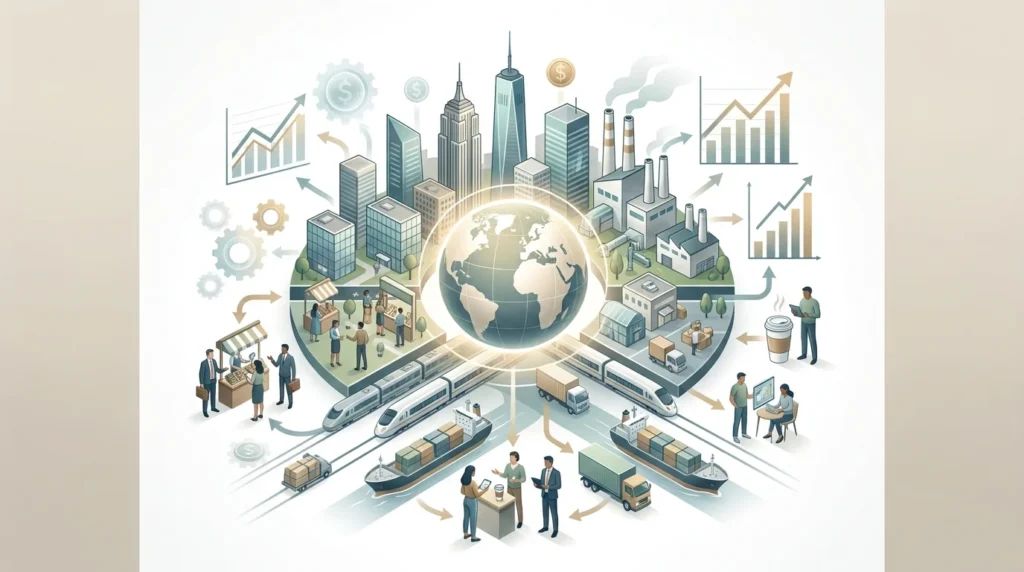

GDP is one of the most frequently mentioned numbers in economic news, yet many people hear the term without fully understanding what it actually measures. When the news says a country’s GDP is growing, falling, or larger than another country’s GDP, it is describing an important part of that economy’s economic activity.
GDP stands for Gross Domestic Product. In simple terms, GDP measures the monetary value of final goods and services produced within a country’s economic territory during a specific period, usually a quarter or a year. It is one of the most widely used indicators for assessing the size and performance of an economy.
But GDP is more than a single number. Understanding its meaning also requires knowing how GDP is calculated, what real and nominal GDP mean, how GDP per capita works, why imports are subtracted, and what GDP cannot tell us about people’s lives.
Meaning & Definition
GDP means Gross Domestic Product.
The simplest GDP definition is:
GDP is the total monetary value of final goods and services produced within a country’s borders or economic territory during a particular period.
The period is commonly one year or one quarter. GDP therefore gives economists, governments, businesses and investors a standardized way to examine the size and direction of economic activity. The OECD describes GDP as the standard measure of the value of final goods and services produced by a country during a given period.
What does Gross Domestic Product mean?
Each word in the term provides an important clue:
- Gross means the measurement is before deducting depreciation of fixed capital.
- Domestic means production occurring within the country’s economic territory.
- Product refers to goods and services produced.
For example, if a foreign-owned company operates a factory inside the United States, the factory’s domestic production contributes to U.S. GDP because the production takes place within the U.S. economy. GDP focuses primarily on where production occurs, rather than simply who owns the company.
GDP in Simple Words
Imagine an entire country as a giant marketplace. During one year, people buy food, clothing, cars, medical services, transportation, entertainment and countless other goods and services. Businesses build factories, purchase equipment and produce products. Governments also purchase goods and services and invest in infrastructure.
GDP attempts to put the value of qualifying final production into one overall economic measure.
For example, suppose a bakery sells a finished loaf of bread for $4. The flour used to make the bread is an intermediate input, so its value should not simply be added again to GDP. Otherwise, the same economic production could be counted multiple times. GDP therefore focuses on final goods and services or the value added during production.
Read More: POS Meaning: What Does POS Mean in Text, Slang & Social Media?
Background of GDP
Modern national economic accounting developed significantly during the Great Depression, when governments needed better information about economic activity. Economist Simon Kuznets led an important U.S. national income measurement project, with the resulting report on national income for 1929–1932 submitted to the U.S. Senate in 1934.
The development of national accounts gave policymakers a much clearer way to evaluate production, income and economic changes. Over time, national accounting systems became more sophisticated and internationally standardized. Today, national statistical agencies around the world produce GDP estimates using established accounting frameworks, allowing countries and international organizations to analyze economic performance more consistently.
Usage in Different Contexts
GDP is used in several important economic contexts. Governments use GDP and GDP growth data when assessing fiscal and economic policy. Central banks monitor economic activity when making monetary-policy decisions. Businesses use GDP trends to understand demand and market conditions, while investors use economic growth data when evaluating countries and markets.
GDP is also widely used in international comparisons. However, comparing GDP figures requires care because countries differ in population size, currency values, price levels and economic structures. That’s why analysts may use total GDP, GDP per capita, real GDP or purchasing-power-parity measures depending on the question they are trying to answer.
How Is GDP Calculated?
There are three major approaches to measuring GDP:
- Expenditure approach
- Income approach
- Production or output approach
In theory, all three approaches should arrive at the same overall measure because they are different ways of looking at the same economic activity. BEA explains GDP using all three perspectives: spending, income generated by production, and value added by industries.
The expenditure approach is especially common in introductory economics because it provides an intuitive picture of who purchases the economy’s final output.
GDP Formula
The standard expenditure formula is:
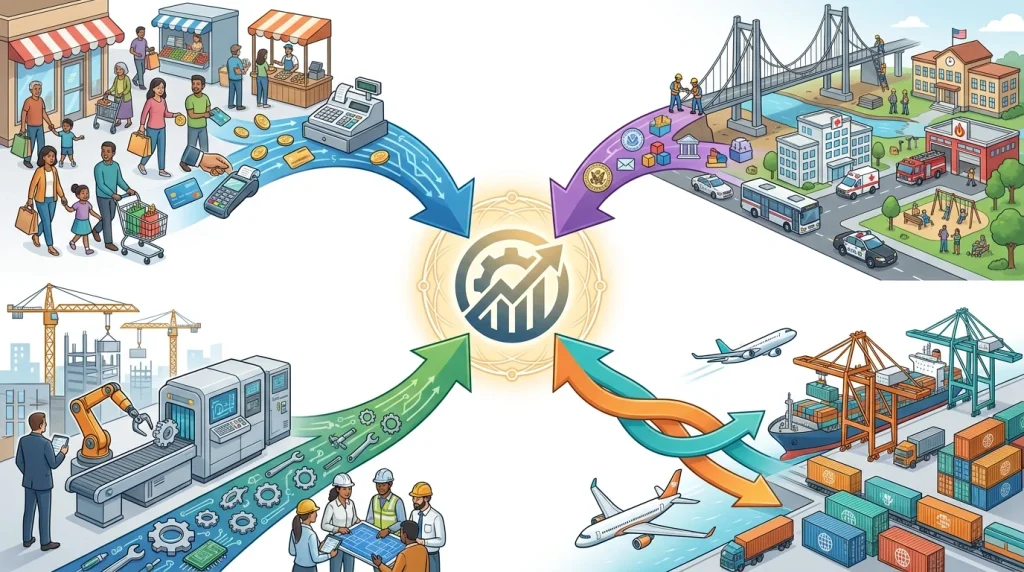
GDP = C + I + G + (X − M)
Where:
- C = Consumer spending
- I = Business investment
- G = Government spending
- X = Exports
- M = Imports
The term X − M represents net exports.
The reason imports are subtracted is important. Consumer spending can include imported products, but GDP is intended to measure domestic production. Subtracting imports removes foreign production that may have been included in consumption, investment or government expenditure.
Consumer Spending
Consumer spending represents household purchases of goods and services. Examples include groceries, clothing, transportation, restaurant meals, healthcare services and many other consumer activities.
Because households account for a large amount of economic activity in many economies, changes in consumer spending can significantly affect GDP. If consumers reduce spending sharply, businesses may experience lower demand, which can affect production, employment and investment.
Business Investment
Investment refers to spending on productive assets and inventories rather than simply buying financial assets such as stocks.
Examples can include factories, machinery, equipment, commercial structures and changes in inventories. Investment is important because it can expand an economy’s productive capacity and influence future economic growth.
Government Spending
Government spending included in GDP covers qualifying government purchases of goods and services and investment. Examples may include infrastructure, public administration, defense and other government-provided services.
It is important not to assume that every government payment automatically enters GDP in the same way. National accounting follows specific rules about which transactions represent production.
Net Exports
Net exports equal exports minus imports.
If a country exports more than it imports, net exports are positive. If it imports more than it exports, net exports are negative.
Imports are deducted because GDP measures production occurring domestically. An imported smartphone may be purchased by a household in the country, but the phone itself was produced elsewhere.
The Three Ways to Measure GDP
The expenditure approach looks at who purchases final output. The income approach looks at income generated through production, such as employee compensation, taxes and operating surplus. The production approach looks at value added by industries.
These methods provide complementary perspectives. The production approach can show which industries are contributing to economic activity. The income approach provides information about income generated by production, while the expenditure approach shows how final output is used.
Real GDP vs Nominal GDP
One of the most important distinctions in economics is the difference between nominal GDP and real GDP.
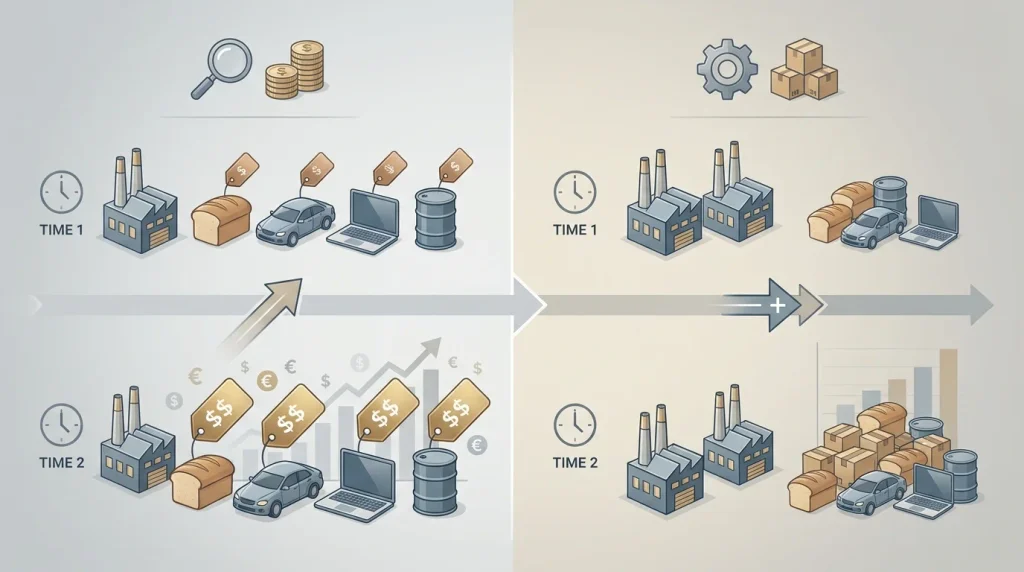
Nominal GDP measures output using current prices. If prices rise because of inflation, nominal GDP can increase even when the physical quantity of goods and services produced has not increased.
Real GDP adjusts for changes in prices. This makes real GDP more useful for evaluating whether actual economic output has increased or decreased over time. The IMF explains that nominal GDP needs to be adjusted for price changes when analysts want to determine whether output itself has grown.
Read More: Meaning: Definition, Types, Examples, and How Meaning Works.
Simple Example of Real and Nominal GDP
Imagine a country produces 1,000 phones in both Year 1 and Year 2.
If the average price rises from $500 to $600 while production remains at 1,000 phones, nominal GDP increases because the prices increased. However, actual production has not increased.
Real GDP attempts to remove this price effect so economists can determine whether the economy is actually producing more goods and services.
This distinction is crucial because confusing inflation with genuine economic growth can lead to an incorrect interpretation of GDP data.
What Is GDP Per Capita?
GDP per capita means GDP divided by the population.
The basic formula is:
GDP per capita = Total GDP ÷ Population
GDP per capita can provide a rough indication of the amount of economic output associated with each person. It is particularly useful when comparing economies with very different population sizes.
For example, a country with a very large population can have a huge total GDP while having a much lower GDP per capita than a smaller, wealthier country.
However, GDP per capita is an average. It does not mean every individual earns that amount of money, and it does not show how income is distributed among households.
What Does GDP Growth Mean?
GDP growth means that economic output has increased compared with an earlier period, usually after adjusting for inflation when economists are discussing real economic growth.
If real GDP rises, it generally indicates that an economy is producing more goods and services. Strong economic growth can be associated with higher business activity, employment opportunities and household incomes, although these effects are not automatically distributed equally.
The IMF notes that GDP is widely used as a reference point for the health of national and global economies, while the rate of change in GDP helps indicate whether economic activity is expanding or contracting.
What Does Negative GDP Growth Mean?
Negative GDP growth means real economic output has decreased compared with the previous measurement period.
A short decline does not automatically tell the complete story of an economy. Economists examine the size, duration and causes of the decline alongside employment, inflation, household spending, business investment and other indicators.
You may also hear that two consecutive quarters of falling GDP constitute a recession. That is a commonly used rule of thumb in public discussion, but recession dating is not universally determined by that rule alone. A broader assessment of economic activity may be required.
GDP and Recession
GDP is closely associated with discussions about recessions because a sustained contraction in economic activity can be reflected in declining real GDP.
During an economic downturn, consumers may spend less, businesses may reduce investment, production may slow and unemployment may increase. These changes can reduce overall economic output.
However, GDP should not be viewed in isolation. A serious assessment of economic conditions can also consider employment, income, industrial production, retail sales, inflation and other indicators.
GDP vs GNP
GDP and GNP are related but measure different things.
GDP focuses on production within a country’s economic territory.
GNP focuses on production or income associated with a country’s residents or nationals, depending on the national-accounting framework.
For example, production by a foreign-owned company located inside a country contributes to that country’s GDP. Meanwhile, income received by residents from production or assets abroad affects national-income measures.
This distinction explains why GDP and national-income measures can tell different stories about an economy. Modern international accounting often emphasizes Gross National Income (GNI) rather than the older GNP terminology.
GDP vs GNI
GDP measures domestic production, while GNI, or Gross National Income, focuses on income received by residents.
A simple way to remember the distinction is:
GDP = where production happens
GNI = income received by residents
These measures can differ substantially for countries with significant foreign-owned businesses, large overseas investments or substantial cross-border income flows.
Understanding the difference prevents a common mistake: assuming that the total value produced inside a country is always identical to the income received by that country’s residents.
GDP and Inflation
GDP and inflation are closely connected because GDP can be measured using current prices.
When prices increase, nominal GDP can rise even if actual production changes very little. That’s why economists use real GDP when they want to examine changes in economic output over time.
The GDP deflator is another important concept. It is a broad price measure derived from the relationship between nominal and real GDP and reflects price changes for domestically produced final goods and services.
Read More: Facetious Meaning: Definition, Examples, Synonyms & More.
GDP and Purchasing Power Parity
When comparing countries, simply converting GDP into U.S. dollars using market exchange rates does not always provide the clearest picture of domestic purchasing power.
Purchasing Power Parity, or PPP, uses differences in price levels between countries to create a more comparable measure of economic output.
PPP-based GDP can therefore provide a different perspective from GDP converted using market exchange rates. The IMF uses PPP-based GDP measures in international economic analysis and defines PPP GDP using purchasing-power-parity conversion rates.
What Goods and Services Are Included in GDP?
GDP includes qualifying final goods and services produced within the economy.
Examples can include:
- manufactured products
- construction
- transportation services
- restaurant services
- healthcare services
- professional services
- education services
- financial services
- government-provided services
- other market and qualifying nonmarket production
The focus is on economic production that falls within the national accounting framework.
Intermediate goods are generally not separately counted as final output because doing so could result in double counting. Their economic value is incorporated into the final product through the production chain.
What Is Not Included in GDP?
GDP has important boundaries.
Unpaid household work, for example, is generally not counted in GDP even though cooking, cleaning and childcare clearly provide economic value. Informal or illegal activities can also be difficult to measure accurately and may not be fully represented.
GDP also does not directly measure environmental quality, income equality, leisure, happiness or many other dimensions of human well-being. The IMF specifically emphasizes that GDP is not a complete measure of living standards or overall well-being.
This is one of the most important points to understand about GDP: a larger GDP does not automatically mean that every person in a country is better off.
Is a High GDP Always a Good Thing?
A high GDP generally indicates that an economy produces a large amount of goods and services, but the number alone cannot tell us whether people are living well.
Two countries can have similar GDP figures but very different populations. Another country may have high GDP per capita but significant income inequality. Economic production can also increase while environmental damage, resource depletion or other social costs increase.
For that reason, economists and policymakers often examine GDP alongside health, education, inequality, employment, environmental conditions and other indicators. The OECD emphasizes that GDP and GDP per capita remain important but need to be complemented by other dimensions of well-being for a fuller picture.
Why Is GDP Important?
GDP is important because it provides a common framework for understanding the size and direction of economic activity.
Governments can use GDP data when developing economic policy. Businesses can use it when planning investment and evaluating demand. Investors can consider GDP growth when assessing economic conditions, while researchers use national accounts to compare economies and study long-term development.
GDP is particularly useful because it condenses enormous amounts of economic activity into a standardized statistical framework. Without national accounts, understanding whether an economy is expanding, stagnating or contracting would be much more difficult.
GDP and Standard of Living
GDP can be related to living standards, especially when economists examine real GDP per capita, but it should not be treated as a complete measure of quality of life.
Higher output per person can provide greater economic resources, but the benefits may not be distributed equally. GDP also does not directly measure factors such as health, safety, leisure, environmental quality or social relationships.
The IMF and OECD both emphasize that GDP should be interpreted alongside broader measures when the goal is to understand human well-being rather than simply economic production.
Limitations of GDP
GDP is powerful, but it has several limitations.
First, it does not show how income is distributed. A country’s GDP can rise while many households see little improvement in their financial circumstances. Second, unpaid household production is largely outside the conventional GDP boundary. Third, GDP does not automatically subtract environmental damage or resource depletion.
GDP also does not directly measure happiness, health, education quality, personal security or leisure. Consequently, GDP is best understood as a measure of economic production, not a complete scorecard for society.
This distinction was recognized from the early development of national accounting itself. Simon Kuznets and later researchers emphasized the difference between measuring economic activity and measuring social welfare.
GDP vs Wealth
GDP measures economic production during a period. Wealth refers to the stock of assets and resources accumulated over time.
A country can produce a large amount of goods and services this year without necessarily having the largest stock of natural resources, infrastructure, financial assets or other forms of wealth.
This difference matters because GDP is a flow measure, while wealth is primarily a stock measure. Looking only at GDP can therefore miss important information about sustainability and the resources available to future generations.
Why GDP Can Increase Without People Feeling Richer
It is possible for GDP to rise while ordinary people do not feel significantly better off.
For example, total production may increase because the population grows. GDP can also increase because prices rise, although this is less informative about real output unless inflation is accounted for. Additionally, GDP growth may be concentrated in particular industries or among particular groups.
That is why analysts often look at real GDP per capita, wages, employment, household income, inflation and inequality alongside total GDP. GDP answers an important question—how much economic production is occurring—but it does not answer every question about economic well-being.
Read More: LFG Meaning: What Does LFG Mean in Text, Gaming & Social Media?
A Simple GDP Example
Imagine a small economy that produces only three final services and products in one year:
- Food worth $1 million
- Clothing worth $500,000
- Transportation services worth $500,000
Its simplified GDP would be $2 million.
Now imagine that the following year the economy produces the same quantities, but prices increase by 20%. Nominal GDP could rise even though actual production has not changed.
This simple example demonstrates why economists distinguish between nominal and real GDP. Nominal GDP tells us the value at current prices, while real GDP is designed to provide a clearer picture of changes in actual output.
Why GDP Figures Can Change After Publication
GDP estimates are not always final when they are first released.
Statistical agencies often publish preliminary or advance estimates using the information available at that time. As additional data arrive, estimates may be revised.
This means an initial GDP growth figure can later be adjusted. Revisions do not necessarily mean the original statistics were useless; they reflect the process of improving an estimate as better information becomes available.
For example, the U.S. BEA explains that different GDP approaches become available at different stages of the estimation cycle, allowing later estimates to incorporate additional information.
Why GDP Matters in Everyday Life
GDP can sound like an abstract economic statistic, but changes in economic activity can affect everyday life.
When an economy expands strongly, businesses may experience stronger demand and may increase hiring or investment. When economic activity contracts, businesses may reduce production, investment or hiring.
GDP does not determine what happens to every individual, but it provides an important picture of the economic environment surrounding households and businesses.
If you want to understand any meaning, definition, or explanation, you can explore Meaning Wisdom for clear and simple explanations.
Key Takeaway: What Does GDP Mean?
GDP means Gross Domestic Product. It measures the monetary value of final goods and services produced within a country’s economic territory during a specific period.
The most important things to remember are:
- GDP measures economic production.
- GDP normally covers a quarter or a year.
- The expenditure formula is C + I + G + (X − M).
- Real GDP adjusts for price changes.
- Nominal GDP uses current prices.
- GDP per capita divides GDP by population.
- GDP growth generally indicates expanding economic output.
- GDP does not measure overall happiness or quality of life.
- GDP differs from GNP and GNI.
- GDP is an important economic indicator, but it should be interpreted alongside other measures.
FAQs
What does GDP mean?
GDP stands for Gross Domestic Product. It measures the monetary value of final goods and services produced within a country’s economic territory during a specified period, commonly a quarter or a year.
What is GDP in simple words?
In simple words, GDP is a way of measuring how much an economy produces. It adds the value of qualifying final goods and services produced within a country during a specific period.
What is the full form of GDP?
The full form of GDP is Gross Domestic Product.
What is the GDP formula?
The commonly used expenditure formula is:
GDP = C + I + G + (X − M)
C represents consumer spending, I represents investment, G represents government spending, X represents exports and M represents imports.
What are the four components of GDP?
The four broad components in the expenditure approach are consumer spending, investment, government spending and net exports.
How is GDP calculated?
GDP can be calculated through three major approaches: expenditure, income and production. The expenditure approach adds final spending, the income approach adds income generated through production, and the production approach calculates value added across industries.
What is real GDP?
Real GDP is GDP adjusted for changes in prices. It is used to determine whether actual economic output has increased or decreased rather than simply reflecting changes in prices.
What is nominal GDP?
Nominal GDP measures economic output using current prices. It can increase because of higher production, higher prices, or both.
What is GDP per capita?
GDP per capita is total GDP divided by population. It provides an average measure of economic output per person but does not represent the actual income received by each individual.
What does GDP growth mean?
GDP growth generally means that economic output has increased compared with an earlier period. For meaningful comparisons of actual production, economists generally focus on growth in real GDP.
What does negative GDP growth mean?
Negative GDP growth means economic output has decreased relative to the comparison period. Economists examine the duration and size of the decline alongside other economic indicators to understand whether the economy is entering a broader downturn.
Does a higher GDP mean a country is richer?
A higher GDP means an economy produces more total output, but it does not necessarily mean that every resident is richer. Population size, income distribution, prices and other factors matter.
Is GDP the same as national income?
No. GDP measures production within an economic territory, while national-income measures such as GNI focus on income received by residents.
What is the difference between GDP and GNP?
GDP focuses on production within a country’s territory. GNP focuses on the production or income associated with a country’s residents or nationals. Modern national accounts commonly use GNI for the related income concept.
What is the difference between GDP and GNI?
GDP measures domestic production, while GNI measures income received by residents. Cross-border income flows can cause the two measures to differ.
Does GDP measure quality of life?
No. GDP measures economic production rather than overall quality of life. It does not fully capture income distribution, environmental conditions, leisure, health, happiness or many other aspects of well-being.
What is GDP growth rate?
The GDP growth rate measures the percentage change in GDP from one period to another. Economists commonly use real GDP growth to determine whether the volume of economic production is increasing or decreasing.
What is PPP GDP?
PPP GDP is GDP converted using purchasing-power-parity rates rather than ordinary market exchange rates. It is useful for international comparisons because it accounts for differences in price levels between countries.
Why are imports subtracted from GDP?
Imports are subtracted because GDP measures domestic production. Imported products may be included in consumer, business or government spending, so subtracting imports removes the value of foreign production from the calculation.
Why is GDP important?
GDP provides a standardized measure of economic activity. Governments, businesses, investors and researchers use it to evaluate economic growth, compare economies and understand changes in national production.
Can GDP increase while people’s living standards fall?
Yes. GDP can rise while inequality, environmental damage, inflation, unemployment or other factors negatively affect people’s experiences. GDP is therefore an important economic indicator but not a complete measure of well-being.
Why is real GDP more useful than nominal GDP for measuring growth?
Real GDP adjusts for price changes, making it easier to identify changes in actual production. Nominal GDP can increase simply because prices have risen, even when the quantity of goods and services produced has not increased.



Pingback: Overstimulated Meaning: What Does Overstimulated Mean?
Pingback: Hubris Meaning: Definition, Examples, Origins, and More.
Pingback: Contempt Meaning: Definition, Examples, Synonyms & More.
Pingback: EYP Meaning in Text Slang: What Does It Mean?