
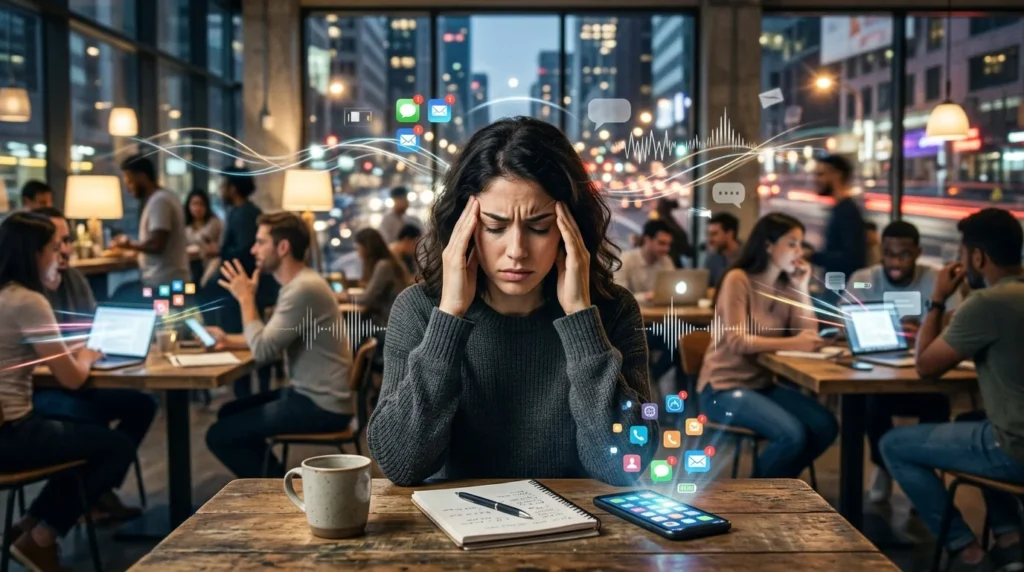

Have you ever reached a point where the noise, notifications, conversations, bright lights, responsibilities, and constant activity around you suddenly feel like too much? You may not simply be tired or annoyed. You may be overstimulated.
The word overstimulated describes a state in which someone is receiving more stimulation or input than they can comfortably process. That stimulation can come from the senses, emotions, social interaction, information, work, technology, or several things happening at the same time. In everyday conversation, someone might simply say, I’m overstimulated, to explain that they need a break, some quiet, or time away from everything.
In this guide, we will explain the overstimulated meaning in simple language, explore its dictionary definition, everyday and texting usage, common signs and triggers, its relationship with sensory overload, stress, ADHD and autism, and practical ways to respond when you or someone else feels overstimulated.
Meaning & Definition
Overstimulated means receiving or experiencing too much stimulation, excitement, information, sensory input, or activity to comfortably process at that moment.
In simple words, being overstimulated means there is too much going on for your mind or body to comfortably handle right now. Cambridge defines overstimulated as being too excited or interested, while the related verb overstimulate means to stimulate something or someone excessively.
For example, imagine sitting in a crowded restaurant with loud music playing, several people talking around you, bright lights overhead, your phone constantly vibrating, and several unfinished tasks on your mind. Even if none of these things is overwhelming by itself, the combination may become too much. You might feel irritated, distracted, restless, anxious, or desperate for some quiet.
Background
The word overstimulated comes from the verb stimulate, which means to encourage activity, interest, excitement, or a response. The prefix over- adds the idea of excess. Therefore, overstimulated literally suggests that something has been stimulated beyond a comfortable or useful level.
The word can be used in several contexts. In everyday English, it often describes a person who feels overwhelmed by too much activity or sensory information. In specialized scientific contexts, however, it can describe excessive activity in a biological system or organ. The everyday psychological and sensory meaning is the one most people are asking about when they search for overstimulated meaning.
Usage in Different Contexts
The meaning of overstimulated can change slightly depending on the situation. Someone might be overstimulated by physical sensations such as noise, light, smells, touch, or crowds. Another person might use the word to describe mental overload caused by multitasking, constant notifications, information, deadlines, or too many decisions.
It is also increasingly common in casual online communication. A person might text, I’m so overstimulated today, after spending hours answering messages, working, scrolling social media, and interacting with other people. In this context, the speaker may not be describing a formal medical condition. They are usually communicating that their mental, emotional, or sensory capacity feels temporarily exhausted.
What Does Overstimulated Mean in Simple Words?
In simple words, overstimulated means feeling like your brain or body has had more input than it can comfortably handle.
Think of your attention as having a limited amount of space. Noise, conversations, notifications, bright lights, tasks, emotions, and decisions can all use some of that space. When too many demands arrive at once, you may have trouble focusing or staying calm. This is why someone who normally enjoys a busy environment may still become overstimulated after a long, stressful day.
The important idea is too much for you at that moment. A crowded concert may be exciting for one person and overwhelming for another. The same person may tolerate it easily one day but become overstimulated another day because they are tired, stressed, hungry, or already dealing with too many demands.
What Does It Mean to Be Overstimulated?
To be overstimulated means that the amount or intensity of stimulation around you has become difficult to process comfortably. The stimulation may be physical, mental, emotional, social, or a combination of these.
You might notice that you suddenly want people to stop talking, turn off the television, put your phone away, leave a crowded room, or sit somewhere quiet. You may also become unusually irritated by small things. These reactions do not necessarily mean you are angry at the people around you. Sometimes your brain simply needs fewer inputs so it can recover.
What Does Overstimulated Mean in Text or Chat?
In texting, overstimulated usually means that someone feels mentally, emotionally, socially, or physically overwhelmed by everything happening around them.
For example, someone might send:
I’m overstimulated. I need some alone time.
In this sentence, the person is probably communicating that they have reached their limit for social interaction, noise, information, responsibilities, or emotions. They may be asking for space without necessarily being upset with anyone.
Online, the expression is often casual rather than clinical. It can refer to too many messages, social media, videos, conversations, notifications, social events, or emotional experiences. Current meaning-focused results increasingly describe this everyday online usage.
What Does I’m Overstimulated Mean?
When someone says I’m overstimulated, they usually mean:
I have too much happening around me or in my mind right now, and I need to reduce the stimulation.
The person might want silence, darkness, fewer conversations, personal space, a break from their phone, or time alone. It does not automatically mean that they dislike you or the situation.
For example, after a long day at work, someone might come home and say, I’m overstimulated, so I’m going to sit quietly for a while. They may simply need time to transition from a demanding environment to a calmer one.
What Does Feeling Overstimulated Feel Like?
Feeling overstimulated can be different for everyone, but common experiences include irritability, restlessness, difficulty concentrating, mental fatigue, anxiety, confusion, headaches, muscle tension, and a strong desire to escape or reduce stimulation.
You might feel as though ordinary sounds are suddenly much more irritating than usual. A simple question may feel difficult to answer because your attention is already occupied. Some people become quiet and withdrawn, while others become visibly frustrated or emotional. Healthline notes that adults experiencing overstimulation may have difficulty thinking clearly, focusing, making decisions, or staying calm.

Signs of Being Overstimulated
Common signs of overstimulation can affect your mind, emotions, body, and behavior.
Mental signs
You may have trouble concentrating, processing information, making decisions, or completing simple tasks. Your thoughts may feel scattered, especially when multiple people are talking or several responsibilities are demanding attention at once.
Emotional signs
Irritability, frustration, anxiety, agitation, emotional sensitivity, or feeling close to tears can occur. Some people may become angry over small things because their capacity to handle additional input is already low.
Physical signs
Headaches, fatigue, muscle tension, restlessness, and a strong need to rest can occur. Some people become especially sensitive to noise, light, touch, or other physical sensations.
Behavioral signs
A person may withdraw from conversation, leave a busy environment, stop responding to messages, seek a quiet room, cover their ears, close their eyes, or simply want to be left alone. Sensory overload can also involve communication difficulties or self-regulating behaviors in some people.
What Causes Overstimulation?
Overstimulation can have many different triggers. Common examples include loud environments, bright lights, strong smells, crowds, constant conversation, social demands, multitasking, excessive information, and continuous digital notifications.
The cause is not always one specific stimulus. Sometimes several moderate demands combine until they become overwhelming. For example, answering work emails while listening to music, receiving phone notifications, dealing with household responsibilities, and trying to have a conversation may collectively create more stimulation than you can comfortably manage.
Stress and fatigue can also reduce your ability to tolerate stimulation. This means an environment that feels manageable in the morning may feel extremely overwhelming after a long day with little rest.
Read More: POS Meaning: What Does POS Mean in Text, Slang & Social Media?
Common Triggers of Overstimulation
Some of the most common triggers include:
- Loud music or sudden sounds
- Bright or flashing lights
- Crowded public places
- Strong smells
- Unwanted physical contact
- Too many people talking at once
- Constant phone notifications
- Excessive screen time
- Social media
- Multitasking
- Work deadlines
- Too many decisions
- Emotional conflict
- Lack of sleep
- Stress and anxiety
- A cluttered environment
- Continuous social interaction
A useful point is that overstimulation is highly individual. One person may become overwhelmed by noise while another may be more affected by visual clutter or social demands. The Australian Psychological Society notes that triggers can include sound, light, taste, touch, smell, multiple demands, and chaotic environments.
Overstimulation and Sensory Overload
Overstimulation and sensory overload are closely related, but they are not always identical terms.
Sensory overload generally refers specifically to becoming overwhelmed by sensory information such as sounds, lights, smells, textures, or other physical sensations. Overstimulation can be broader and may include sensory input as well as emotional, cognitive, social, or informational demands.
For example, loud music and flashing lights at a concert could create sensory overload. But if you are simultaneously receiving dozens of work messages, worrying about an argument, making decisions, and dealing with a noisy environment, you might describe the entire experience as overstimulation.
The National Autistic Society explains sensory overload as becoming overwhelmed by sensory input and emphasizes that sensory experiences can differ considerably between individuals.
Overstimulated vs Overwhelmed
The words overstimulated and overwhelmed overlap, but they emphasize slightly different things.
Overstimulated usually highlights an excess of stimulation or input. Overwhelmed is broader and can describe feeling unable to cope with responsibilities, emotions, problems, or circumstances.
For example, loud music, bright lights, and a crowded room might leave you overstimulated. A huge workload, financial pressure, relationship conflict, and several deadlines might leave you overwhelmed. Of course, the two can happen together. A person can be both overstimulated and overwhelmed when physical and emotional demands accumulate.
Overstimulated vs Stressed
Stress and overstimulation can feel similar, but they are not exactly the same.
Stress usually refers to the mental or physical response to demands, pressure, or challenging circumstances. Overstimulation focuses more specifically on having too much input or activity to comfortably process at that time.
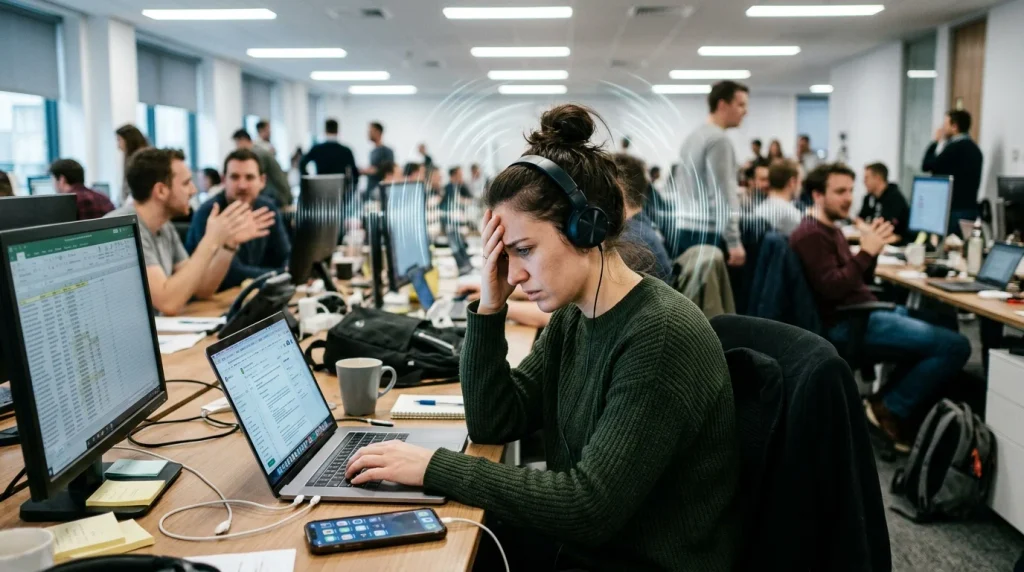
For example, you might be stressed because you have an important exam tomorrow. You might become overstimulated because you are trying to study while several people are talking, your phone is constantly buzzing, and loud music is playing nearby. Stress may be one factor that makes you less able to tolerate stimulation.
Overstimulated vs Anxious
Being overstimulated does not automatically mean that you have anxiety.
Someone can become overstimulated in a loud, crowded environment without having an anxiety disorder. Similarly, anxiety can make a person more sensitive to stimulation and can contribute to feeling overwhelmed.
Healthline notes that hyperstimulation-related anxiety is not itself a formal diagnosis and that feeling overwhelmed by daily events can contribute to or worsen anxiety in some people.
This distinction matters because everyday overstimulation is not enough by itself to diagnose a mental health condition.
Overstimulation and ADHD
People with ADHD may experience overstimulation, particularly when multiple sounds, conversations, tasks, notifications, or other distractions compete for attention.
However, being overstimulated does not mean someone has ADHD. Anyone can experience excessive stimulation. Some people with ADHD may simply find certain environments harder to filter or manage, which can make overstimulation more noticeable.
If someone frequently struggles with attention, impulsivity, organization, or other persistent symptoms, professional assessment is more appropriate than trying to interpret overstimulation alone as evidence of ADHD.
Overstimulation and Autism
Sensory processing differences are common in discussions about autism. Some autistic people may be particularly sensitive to sounds, lights, smells, textures, touch, or other sensory experiences. The National Autistic Society explains that autistic people can be more or less sensitive to sensory experiences and may become overwhelmed when sensory information becomes difficult to process.
At the same time, overstimulation is not exclusive to autistic people. Anyone can experience sensory overload, and tolerance can change depending on fatigue, stress, health, and the environment. Therefore, feeling overstimulated by yourself is not enough to conclude that you are autistic.
Can Adults Become Overstimulated?
Yes. Adults can absolutely become overstimulated.
Adult overstimulation can happen at work, while parenting, during social events, while traveling, in crowded stores, or after prolonged exposure to phones and other digital media. Adults may experience irritability, difficulty focusing, anxiety, fatigue, confusion, or a desire to withdraw.
One reason adult overstimulation can be overlooked is that people may interpret it as simply being in a bad mood. However, if the environment is demanding too much attention and sensory processing capacity, reducing the input may be more helpful than forcing yourself to continue.
Can Children Become Overstimulated?
Children can also become overstimulated, particularly when there are many activities, sounds, people, transitions, or unfamiliar experiences happening together.
A child may become unusually irritable, restless, emotional, quiet, or resistant when they have had too much stimulation. Cambridge specifically gives the example of children becoming overstimulated by heavy schedules of activities and having difficulty sleeping.
For children, recognizing early signs can be especially useful because they may not have the vocabulary to explain that they feel overloaded. A calmer environment, reduced noise, fewer demands, and an opportunity to rest can sometimes help.
Read More: Meaning: Definition, Types, Examples, and How Meaning Works.
Why Do I Get Overstimulated So Easily?
There is no single reason why someone may become overstimulated easily. Your tolerance can change depending on sleep, stress, workload, emotional state, physical health, and the type of environment you are in.
For example, a person who normally enjoys shopping in a busy mall may find the same environment unbearable after sleeping poorly and spending a stressful day at work. Sensory processing differences can also influence how strongly someone reacts to particular inputs.
The important point is that your tolerance is not necessarily fixed. Being more sensitive on one day does not automatically mean something is wrong.
How to Calm Down When You Feel Overstimulated
The first step is usually to reduce the amount of stimulation rather than adding more.
Move somewhere quieter if possible. Turn down music, silence unnecessary notifications, dim bright lights, step outside, or take a short break from conversation. If noise is a trigger, earplugs or noise-canceling headphones may help. If visual stimulation is the problem, reducing screens and clutter may make the environment easier to handle.
Slow breathing, rest, hydration, and a short period of quiet can also help some people settle. Cleveland Clinic recommends approaches such as deep breathing for sensory overload, while current expert guidance also emphasizes reducing sensory input and creating a calmer environment.
How to Prevent Overstimulation
Preventing overstimulation often starts with recognizing your personal triggers.
If you know that constant notifications make you mentally exhausted, silence nonessential alerts. If crowded places are difficult after a long day, schedule recovery time afterward. If bright light bothers you, adjust the lighting where possible. Small changes can prevent stimulation from accumulating until you reach your limit.
Taking short breaks can also be useful. The goal is not to avoid every stimulating experience. Instead, it is to recognize when your capacity is decreasing and give yourself enough recovery time before the stimulation becomes overwhelming.
What Should You Do When Someone Says They Are Overstimulated?
If someone says I’m overstimulated, a helpful response is usually to reduce pressure rather than demand an explanation.
You could say:
- Do you want some quiet?
- Take your time.
- We can talk later.
- Do you want to go somewhere calmer?
- Is there anything I can turn off or reduce?
Avoid assuming that the person is angry with you. They may simply need fewer sounds, questions, conversations, or other demands.
For someone experiencing sensory overload, the National Autistic Society recommends reducing triggers where possible, moving to a quieter environment, minimizing unnecessary speech or information, and allowing enough time and space to recover.
Read More: Facetious Meaning: Definition, Examples, Synonyms & More.
Examples of Overstimulated in a Sentence
Here are natural examples showing how the word is used:
- I feel overstimulated after spending all day in the crowded city.
- The loud music and flashing lights made the child overstimulated.
- I’m overstimulated right now, so I need a few minutes alone.
- After answering messages all evening, she felt mentally overstimulated.
- The busy office can be overstimulating when everyone is talking at once.
- He became overstimulated by the constant notifications on his phone.
- I love concerts, but I can still become overstimulated after several hours.
- She felt overstimulated by the noise, lights, and crowded room.
These examples demonstrate that the word can describe sensory, mental, social, and emotional overload depending on the context.
Is Overstimulated a Positive or Negative Word?
Overstimulated is usually negative or neutral-to-negative, because it generally describes having more stimulation than you comfortably want or can process.
However, the situation itself can be positive. Someone might become overstimulated at a concert they absolutely love, during an exciting celebration, or after an emotionally meaningful event. The problem is not necessarily that the stimulation is unpleasant. It may simply be too intense or prolonged.
This is why overstimulated is different from simply excited. Excitement can feel energizing and manageable, while overstimulation suggests that the amount of input has crossed someone’s comfortable limit.
Overstimulated and Social Interaction
Social interaction can be a source of overstimulation, especially when several conversations, expectations, emotions, and social decisions happen at once.
A person may enjoy spending time with friends but still need quiet afterward. Someone might describe themselves as socially overstimulated after attending a large gathering, answering many messages, meeting new people, or having intense conversations for several hours.
In casual language, this can overlap with the idea of having a low social battery. However, social exhaustion and sensory overstimulation are not identical. A person may be socially tired without sensory overload, or they may experience both at the same time.
Overstimulated by Phones, Social Media, and Notifications
Modern digital environments can create continuous streams of stimulation. A phone may simultaneously provide messages, videos, alerts, advertisements, social updates, news, and other information.
The result can be a feeling that your attention never gets a genuine break. You may put the phone down but still feel mentally busy. Reducing unnecessary notifications, taking screen breaks, using do-not-disturb settings, and creating periods without social media can help reduce the overall input.
This does not mean phones or social media automatically cause overstimulation. Their effect depends on the person, the amount of use, the content, and what else is happening in their life.
Is Overstimulation a Medical Condition?
Overstimulation itself is not necessarily a medical diagnosis. It is a description of a state in which a person feels unable to comfortably process the amount of stimulation they are receiving.
It can occur in ordinary daily life and may happen to people with or without a diagnosed condition. However, frequent or severe episodes can sometimes occur alongside sensory processing differences, anxiety, ADHD, autism, migraine, chronic stress, sleep problems, or other circumstances.
If overstimulation is persistent, severe, suddenly different from normal, or significantly interferes with daily life, discussing the pattern with an appropriate healthcare professional can help identify possible contributing factors.
Quick Summary of Overstimulated Meaning
The simplest definition is:
Overstimulated means feeling overwhelmed because you are receiving more sensory, mental, emotional, social, or informational input than you can comfortably process at that moment.
In texting, I’m overstimulated usually means:
I have too much going on right now and need some quiet, space, or a break.
The experience can include irritability, anxiety, fatigue, difficulty concentrating, headaches, restlessness, withdrawal, or increased sensitivity to noise, light, touch, or other stimulation. Anyone can experience it, and your tolerance can change depending on factors such as stress and fatigue.
If you want to understand any meaning, definition, or explanation, you can explore Meaning Wisdom for clear and simple explanations.
FAQ
What does overstimulated mean?
Overstimulated means experiencing too much stimulation or input to comfortably process at that moment. It can involve sensory input, emotions, social interaction, information, tasks, or several things at once.
What does I’m overstimulated mean in text?
In text or chat, I’m overstimulated usually means the person feels mentally, emotionally, socially, or physically overwhelmed and may need quiet, space, or a break.
Is overstimulated the same as overwhelmed?
They are similar but not identical. Overstimulated usually emphasizes excessive sensory or mental input, while overwhelmed is broader and can include pressure from responsibilities, emotions, problems, or circumstances.
What are the signs of being overstimulated?
Common signs include irritability, restlessness, anxiety, difficulty focusing, confusion, fatigue, headaches, muscle tension, withdrawal, and a strong desire to reduce noise or other stimulation.
What causes overstimulation?
Common triggers include loud noises, bright lights, crowds, strong smells, constant notifications, social interaction, multitasking, information overload, stress, poor sleep, and chaotic environments.
How do you calm down when overstimulated?
Reduce stimulation first. Move somewhere quieter, lower noise and light, silence unnecessary notifications, take a break, breathe slowly, and give yourself time to recover.
Can anyone become overstimulated?
Yes. Anyone can experience overstimulation. Your ability to tolerate stimulation can change depending on factors such as fatigue, stress, sleep, health, and the environment.
Is overstimulation related to ADHD?
It can be experienced by people with ADHD, but being overstimulated does not mean someone has ADHD. Overstimulation can happen to people without ADHD as well.
Is overstimulation related to autism?
Autistic people may experience sensory processing differences that make certain sensory environments overwhelming. However, overstimulation is not exclusive to autism and cannot by itself establish an autism diagnosis.
Is overstimulated a slang word?
Not exactly. Overstimulated is a standard English word, but its everyday use has expanded online. In texts and social media, people commonly use it informally to describe feeling mentally, emotionally, socially, or sensorially overwhelmed.
What is the difference between overstimulated and stressed?
Stress describes a response to pressure or demanding circumstances, while overstimulation focuses on having too much input or activity to comfortably process. The two can occur together.
What is the difference between overstimulation and sensory overload?
Sensory overload specifically involves being overwhelmed by sensory information such as sounds, lights, smells, touch, or textures. Overstimulation can be broader and may also involve cognitive, emotional, social, or informational demands.
Why do I feel overstimulated by people?
People can feel overstimulated by social interaction because conversations, noise, emotional responses, expectations, and constant attention can create many simultaneous demands. Large groups and long social events can be especially demanding for some individuals.
Can screen time make you feel overstimulated?
Extended screen use can contribute to feeling mentally overloaded for some people, particularly when it involves constant notifications, rapid content changes, multitasking, or prolonged information intake. Taking regular breaks can help reduce the amount of input.
How long does overstimulation last?
There is no single duration. It depends on the person, the trigger, how long the stimulation continues, and how quickly the person can reduce the input and recover. Some episodes may settle relatively quickly after a quiet break, while others may require more recovery time.
What should I say to someone who is overstimulated?
A simple response can be supportive: Take your time. Do you want some quiet or space? Reducing unnecessary questions and giving the person time to recover may be more helpful than demanding an explanation.



Pingback: Hubris Meaning: Definition, Examples, Origins, and More.
Pingback: Contempt Meaning: Definition, Examples, Synonyms & More.