
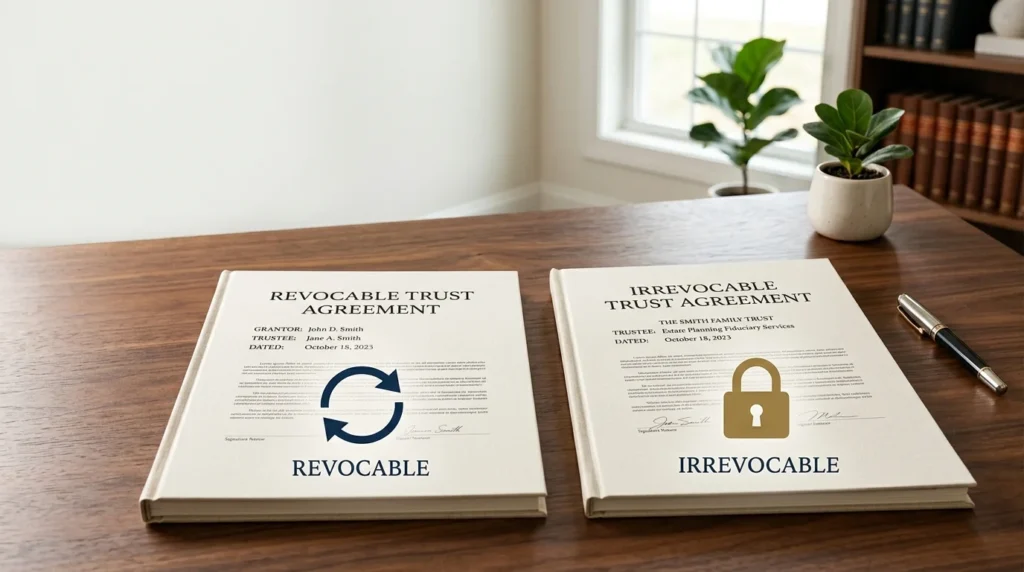

Revocable means something can generally be changed, cancelled, or withdrawn by the person who has the legal power to revoke it. Irrevocable means it generally cannot be revoked or changed by that person. In estate planning, a revocable trust provides greater flexibility and control, while an irrevocable trust generally involves giving up some control in exchange for potential legal, tax, or asset-planning benefits. The details depend on the document and jurisdiction.
What Is the Difference Between Revocable and Irrevocable?
The words revocable and irrevocable describe whether a legal arrangement can be revoked.
Revocable comes from the verb revoke, meaning to officially cancel, withdraw, or take back something. Therefore, a revocable arrangement is one that can be revoked under the applicable rules.
Irrevocable means that the power to revoke is absent or substantially restricted. In ordinary English, it describes something that cannot be reversed or changed. In legal contexts, however, “irrevocable” does not always mean that absolutely no change is possible under any circumstance. Certain laws, court procedures, consent mechanisms, or provisions in the governing document may allow limited modifications.
For trusts, the distinction is especially important:
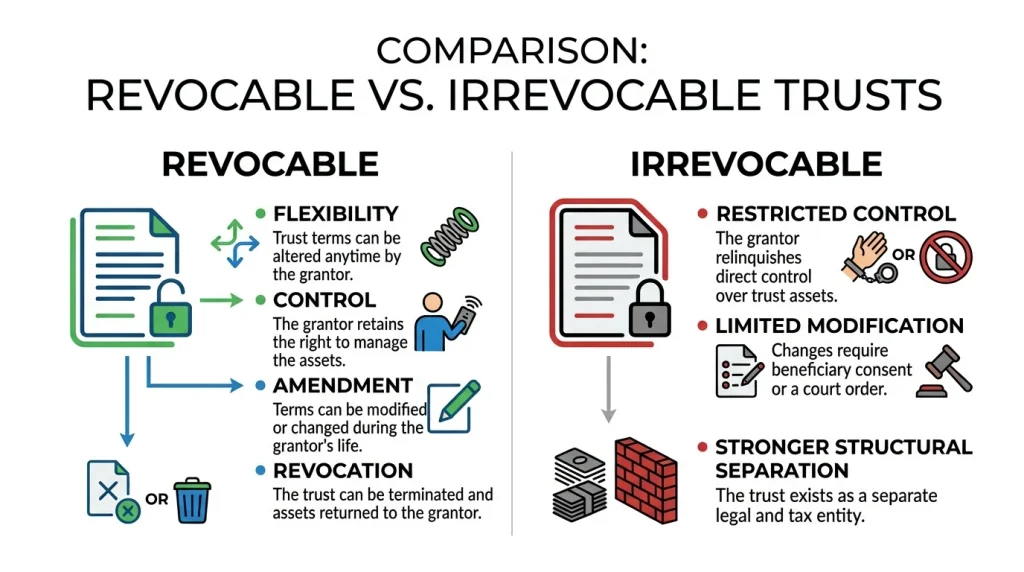
- A revocable trust can generally be revoked or amended by the person who holds the relevant power.
- An irrevocable trust generally cannot be revoked or amended by the grantor in the same way.
- A revocable trust generally gives the grantor more ongoing control.
- An irrevocable trust generally involves giving up some control over the assets or terms.
- The tax treatment of a trust cannot be determined simply from the word “irrevocable.” An irrevocable trust can still be treated as a grantor trust for U.S. federal tax purposes if the required powers or interests remain with the grantor.
So, the simplest distinction is:
Revocable = the relevant person retains a power to revoke. Irrevocable = that power generally does not exist.
Why It Matters
Choosing or describing something as revocable or irrevocable can have significant consequences because the distinction affects control, flexibility, ownership, administration, and sometimes taxation or asset protection.
For example, someone creating a revocable living trust may want to retain the ability to change beneficiaries or modify the trust during their lifetime. Someone establishing an irrevocable trust may instead have a specific planning objective that requires a greater separation between the creator and the assets.
The distinction also matters when reading legal documents. Saying that an arrangement is “irrevocable” does not automatically tell you everything about who controls the assets, who pays taxes, or what protections exist.
In U.S. trust law and taxation, the trust instrument and applicable state and federal rules matter. The IRS specifically notes that state law and the trust instrument establish whether a trust is revocable or irrevocable, and that an irrevocable trust may still receive grantor-trust tax treatment in certain circumstances.
The Core Rule
Use “revocable” when the relevant legal power to cancel or change something is retained. Use “irrevocable” when that power is generally unavailable.
For trusts:
- Revocable trust: the grantor generally retains the power to revoke or amend it.
- Irrevocable trust: the grantor generally cannot revoke or amend it in the same manner.
- Neither word alone tells you the entire tax or asset-protection result.
- The governing document and applicable law control the details.
The IRS defines a revocable trust as one where the grantor or a non-adverse party has the power to revoke it. It describes an irrevocable trust as one where that power does not exist.
Read More: Composed vs Comprised: Which Is Correct?
How to Use Revocable and Irrevocable Correctly
When to Use “Revocable”
Use revocable when something can legally be revoked.
Examples include:
- a revocable trust
- a revocable agreement
- a revocable license
- a revocable designation
- a revocable authorization
The word does not mean “temporary.” Something can remain revocable for years.
For example:
She created a revocable living trust and retained the power to amend it.
The important point is that the person retains a legal ability to revoke or modify the arrangement.
When to Use “Irrevocable”
Use irrevocable when the arrangement is not subject to ordinary revocation by the relevant person.
Examples include:
- an irrevocable trust
- an irrevocable decision
- an irrevocable election
- an irrevocable assignment
- an irrevocable commitment
For example:
The transfer was made under an irrevocable arrangement.
However, avoid assuming that “irrevocable” means “literally impossible to change under every conceivable legal procedure.” Legal systems can provide specific mechanisms for modification or termination.
Don’t Treat Them as Simple Synonyms for “Temporary” and “Permanent”
This is one of the most important distinctions.
Revocable does not simply mean temporary.
Irrevocable does not necessarily mean absolutely unchangeable under every circumstance.
The terms describe a particular legal power: the power to revoke.
Correct Examples
Here are examples showing how the two words work in different contexts.
- Estate planning:
She placed the property in a revocable trust so she could change the trust terms later. - Legal document:
The agreement was revocable under the conditions specified in the contract. - Business:
The company issued a revocable authorization that could be withdrawn under the agreement. - Workplace:
The employee’s authorization was revocable and could be cancelled by the designated authority. - Academic writing:
The court distinguished between a revocable arrangement and one that could not ordinarily be revoked. - Email:
“The beneficiary designation is revocable, so it can be changed according to the applicable rules.” - Conversation:
“Is that decision revocable, or has it already become final?” - Legal planning:
The family discussed whether an irrevocable trust was appropriate for their particular planning objectives. - Formal writing:
The document described the transfer as irrevocable. - Everyday explanation:
“Once the deadline passes, the election may become irrevocable.” - Professional communication:
“Please confirm whether this instruction is revocable before we process it.” - Contract discussion:
“The clause describes the offer as irrevocable for the specified period.”
Incorrect vs. Correct
| ❌ Incorrect | ✅ Correct | Why |
|---|---|---|
| The trust is irrevocable because I can change it whenever I want. | The trust is revocable if I retain the legal power to revoke it. | The two terms describe opposite revocation powers. |
| Revocable means the trust will only last temporarily. | Revocable means the trust can generally be revoked by the person with the relevant power. | Revocability concerns the power to revoke, not simply duration. |
| Irrevocable means nothing about the trust can ever be changed. | Irrevocable generally means the grantor cannot revoke or amend it in the ordinary way. | Legal mechanisms may permit limited changes. |
| An irrevocable trust is automatically taxed separately from its creator. | An irrevocable trust may receive different tax treatment depending on its terms and applicable tax rules. | “Irrevocable” alone does not determine federal tax treatment. |
| Revocable and reversible always mean exactly the same thing. | Revocable specifically refers to the ability to revoke. | “Reversible” is broader and not always the appropriate legal term. |
| She created an irrevocable trust so she could freely take the assets back. | She created an irrevocable trust under terms that generally restrict her ability to reclaim the assets. | The defining concept is restricted revocation. |
| The court made a revocable decision. | The court made a decision that was reversible or subject to further review, if that is what the facts show. | “Revocable” is not the natural choice for every decision that can be reconsidered. |
| The authorization is irrevocable, so it can be cancelled whenever necessary. | The authorization is revocable if the holder has the power to cancel it. | The sentence contradicts itself. |
| Every irrevocable trust is a non-grantor trust for tax purposes. | An irrevocable trust can still be a grantor trust for federal tax purposes in certain circumstances. | IRS rules recognize irrevocable grantor trusts. |
| Revocable means legally invalid. | Revocable means capable of being revoked under the applicable rules. | Revocability has nothing inherently to do with validity. |
Why People Make This Mistake
Phonetic and spelling confusion
The words look and sound similar because they share the same root:
revoke → revocable → irrevocable
The prefix ir- changes the meaning by expressing the negative:
- revocable = capable of being revoked
- irrevocable = not capable of being revoked in the ordinary sense
Because the words differ mainly by the prefix, readers can overlook the crucial distinction.
Overgeneralisation
People sometimes learn that “irrevocable” means “cannot be changed” and then apply that rule too broadly.
That shortcut can be misleading in legal writing. The precise question is usually who has the power to revoke or modify the arrangement, under what circumstances, and under which law?
Spelling overlap
Both words contain revoc- and -able, so visual recognition alone may not help when reading quickly.
Read More: Cant vs Cannot: Which Is Correct?
Autocomplete and spellcheck
Spellcheck can tell you whether a word is spelled correctly, but it generally cannot determine whether revocable or irrevocable expresses the legal meaning you intend.
A sentence can therefore be perfectly spelled and still legally misleading.
Translation interference
Learners translating from another language may encounter one word that broadly means “cancelable” or “final” and assume it maps exactly to the English legal terms.
That can produce technically understandable but inaccurate legal wording.
Common Mistakes Checklist
Mistake 1: Thinking revocable means temporary
What happens: A writer assumes a revocable trust must eventually end.
Why it happens: The word “revoke” is associated with cancelling something.
How to avoid it: Focus on the retained legal power to revoke, not the expected lifespan.
Mistake 2: Treating irrevocable as absolutely unchangeable
What happens: A writer says that an irrevocable trust can never be changed under any circumstances.
Why it happens: The ordinary meaning of “irrevocable” sounds absolute.
How to avoid it: Say that the grantor generally cannot revoke or amend it in the ordinary manner, unless the applicable law or trust terms provide another mechanism.
Mistake 3: Assuming tax treatment from the label alone
What happens: Someone assumes every irrevocable trust receives identical tax treatment.
Why it happens: “Irrevocable” sounds like a complete legal classification.
How to avoid it: Examine the trust’s provisions and the applicable tax rules. The IRS notes that an irrevocable trust can still be treated as a grantor trust in certain circumstances.
Mistake 4: Assuming revocable means no legal consequences
What happens: A writer describes a revocable trust as though it provides no meaningful estate-planning function.
Why it happens: Flexibility is mistaken for lack of legal effect.
How to avoid it: Remember that revocable trusts can be used for estate planning, management during incapacity, and avoiding probate for assets properly held in the trust.
Mistake 5: Using “reversible” everywhere
What happens: A writer replaces revocable with reversible.
Why it happens: The general meanings overlap.
How to avoid it: Use revocable when discussing a specific legal power of revocation. Use reversible for broader situations where something can be undone or changed.
Read More: SMO Meaning in Text: What Does It Mean?
Revocable vs. Irrevocable in Real English
“Revocable” in everyday English
Revocable is grammatically correct and natural in formal, legal, business, and administrative contexts. It is less common in casual conversation because everyday speakers often use phrases such as “can be cancelled,” “can be withdrawn,” or “can be changed.” In a legal document, however, revocable is the precise term when the relevant issue is a power of revocation.
“Irrevocable” in everyday English
Irrevocable is also standard English, but it has a strongly formal tone. It is natural when discussing legal documents, decisions, commitments, elections, or other matters intended to be final or difficult to reverse. In casual conversation, people may simply say “final” or “can’t be changed,” but that does not always carry the same legal precision.
“Revocable trust” vs. “trust that can be changed”
Both expressions can be grammatically correct, but they serve different purposes. Revocable trust is the established legal term and is more precise in legal or financial writing. A trust that can be changed is easier for beginners to understand but may be less precise because the exact scope of the power to amend or revoke depends on the governing document.
“Irrevocable trust” vs. “permanent trust”
These are not interchangeable in all contexts. Irrevocable trust identifies a particular legal characteristic: the absence of an ordinary power of revocation by the relevant party. Permanent trust is much less precise and could describe duration rather than revocation rights. For legal accuracy, use irrevocable when revocation is the issue.
American vs. British English
There is no major AmE-versus-BrE distinction in the basic meanings of revocable and irrevocable. Both varieties of English use the words in legal and formal contexts.
The pronunciation can vary between American and British English, as with many words, but the core distinction remains the same: revocable indicates that something can be revoked, while irrevocable indicates that it generally cannot be revoked.
The legal consequences, however, can differ by jurisdiction. A trust created under U.S. state law should not automatically be assumed to operate under the same rules as a trust created under English law or another country’s legal system.
Formal vs. Informal Usage
These are primarily formal words.
In legal, financial, academic, and professional writing:
- revocable is appropriate when discussing a legal right to revoke.
- irrevocable is appropriate when describing something that cannot ordinarily be revoked.
- can be cancelled is often clearer for a general audience.
- cannot be cancelled may be easier for beginners but can lose legal precision.
For example:
Formal:
The grantor established a revocable trust.
Plain English:
The grantor established a trust that they could generally change or cancel.
Both can be useful, but the first is the established legal terminology.
Comparison Table
| Feature | Revocable | Irrevocable |
|---|---|---|
| Basic meaning | Can generally be revoked | Generally cannot be revoked by the relevant person |
| Root | Revoke | Revoke + negative prefix |
| Flexibility | Generally greater | Generally more restricted |
| Grantor’s control | Usually greater | Usually reduced |
| Trust amendments | Generally easier | Generally restricted |
| Ability to reclaim assets | Often retained by grantor | Generally restricted |
| Tax treatment | Generally grantor-trust treatment in U.S. federal tax law | Can vary depending on trust provisions |
| Asset protection | Generally limited for the grantor’s own assets | May provide protection in appropriate structures |
| Probate planning | Can help avoid probate for properly funded trust assets | Can also avoid probate for properly held trust assets |
| Best interpretation | Focus on retained power to revoke | Focus on absence of ordinary power to revoke |
The table describes general concepts, not a substitute for analyzing a particular trust document or jurisdiction. The IRS and other legal sources emphasize that tax treatment and legal effects depend on the trust’s terms and applicable law.
Revocable vs. Irrevocable Trusts: The Practical Difference
For estate planning, the distinction becomes easier when you think about control versus restriction.
A revocable trust generally lets the grantor retain substantial control. The grantor may often amend the trust, change beneficiaries, or revoke the arrangement according to the document and applicable law.
An irrevocable trust generally restricts that control. The grantor transfers assets under terms that do not allow the same straightforward revocation.
That does not mean one category is universally better. They are designed around different planning objectives.
For example, revocable trusts are commonly used in estate planning because they can help manage assets during life and provide for distribution after death. Properly funded living trusts can also avoid probate for assets held by the trust.
Irrevocable trusts can be used for more specialized planning objectives, including certain estate-tax and asset-protection strategies. But the exact benefit depends heavily on the trust’s structure and applicable law.
Read More: LGH Meaning in Text: What Does It Mean?
When Should You Use Revocable or Irrevocable?
If you’re writing about a trust, the choice is not simply about which word sounds better.
Consider the underlying objective:
- Want to retain flexibility? A revocable structure may be relevant.
- Need a structure with more restricted control? An irrevocable structure may be relevant.
- Concerned about taxation? Analyze the actual trust provisions and applicable tax law.
- Concerned about creditor protection? The specific trust structure and jurisdiction matter.
- Concerned about probate? Consider how the assets are titled and whether the trust has actually been funded.
- Writing about a legal document? Use the exact terminology in the document rather than assuming its classification.
- Dealing with a specific legal decision? Determine whether the issue is revocation, appeal, amendment, cancellation, or another legal concept.
Memory Trick
Remember:
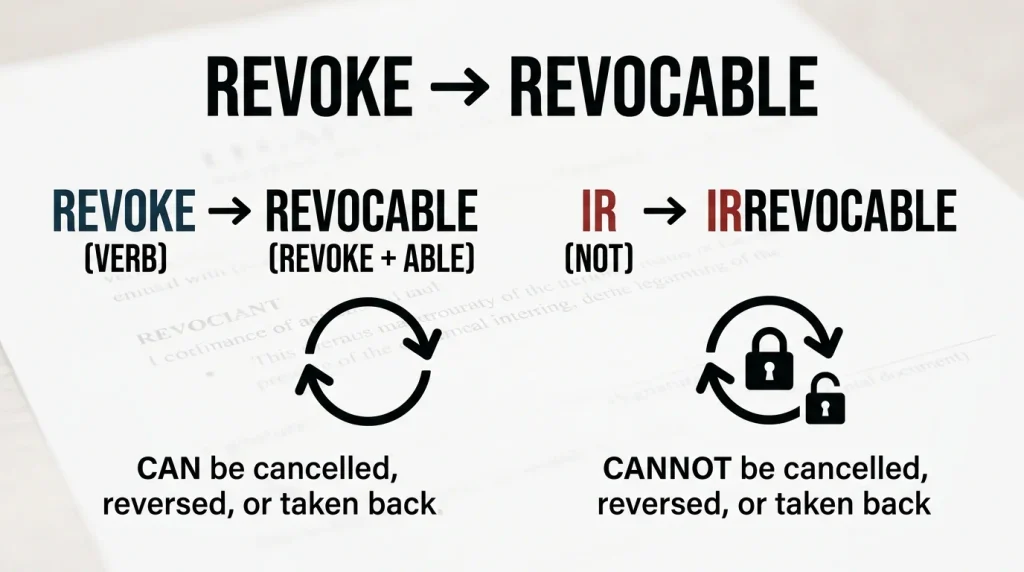
REVOKE → REVOCABLE
If you can revoke it, it is revocable.
Add IR-:
IR + REVOCABLE → IRREVOCABLE
If the ordinary power to revoke is not available, it is generally irrevocable.
A second memory aid:
Revocable = retain the right to revoke.
Irrevocable = relinquish the ordinary right to revoke.
Real-Life Situations
Estate-planning meeting
A client asks whether a trust can be changed later.
The adviser explains that the proposed trust is revocable, subject to its terms and applicable law.
Business agreement
A company grants an authorization that it can later withdraw.
The agreement may describe the authorization as revocable.
Legal document
A document contains language stating that the grantor cannot revoke the arrangement.
The document may establish an irrevocable structure, although the precise legal effect depends on the governing terms and law.
“Before we proceed, please confirm whether the designation is revocable under the current agreement.”
This is formal but natural professional English.
Exam question
A student sees:
“The grantor retains the power to revoke the trust.”
The correct classification is revocable.
Text message
A friend asks:
“Can you still change the trust?”
A plain-English response could be:
“If it’s revocable, you generally can, depending on the trust terms.”
Expert Tips
1. Start with the power, not the label
Instead of memorizing long definitions, ask:
Who can revoke it?
That question often reveals whether the arrangement is revocable.
2. Don’t confuse revocation with amendment
Revoking a document means cancelling it. Amending a document means changing it.
A document may provide different rules for each.
3. Don’t assume “irrevocable” means “zero flexibility”
An irrevocable trust can sometimes be modified or terminated through mechanisms permitted by applicable law or the trust document. That is different from saying the grantor has a normal unilateral power to revoke it.
4. Don’t infer tax treatment from the adjective
This is particularly important in U.S. estate planning. The IRS explains that an irrevocable trust can still be treated as a grantor trust when the applicable requirements are met.
5. Don’t assume every trust is the same
“Revocable trust” and “irrevocable trust” are broad categories. Specific trust types can have very different provisions and purposes.
6. Check the governing law
Trust law is not simply one universal rule. The applicable state or national law can affect whether a trust is revocable, how it can be modified, and what consequences follow.
7. Use plain English when explaining legal terminology
For a general audience, introduce the technical word and immediately explain it:
“A revocable trust is a trust that the person creating it can generally change or cancel.”
This is clearer than using legal terminology without explanation.
Quick Summary
Revocable and irrevocable describe whether something can ordinarily be revoked. A revocable arrangement gives the relevant person a power to cancel or withdraw it, while an irrevocable arrangement generally does not. In estate planning, revocable trusts usually provide greater flexibility and control, while irrevocable trusts generally involve greater restrictions and may serve specialized tax or asset-planning purposes. However, “irrevocable” does not automatically determine every tax or legal consequence. The trust document, governing law, and applicable tax rules all matter. For accurate legal writing, focus on the specific power to revoke rather than treating revocable as simply “temporary” or irrevocable as absolutely “unchangeable.”
FAQ
Is revocable the opposite of irrevocable?
Yes, in the basic sense. Revocable means capable of being revoked under the applicable rules, while irrevocable means not ordinarily capable of being revoked by the relevant person.
Does revocable mean temporary?
No. A revocable arrangement can remain in place for many years. The word describes the retained power to revoke, not how long the arrangement is expected to last.
Does irrevocable mean impossible to change?
Not necessarily in every legal circumstance. An irrevocable trust generally cannot be changed or revoked by the grantor in the ordinary manner, but applicable law or the trust document may provide limited mechanisms for modification or termination.
Is a revocable trust the same as a living trust?
Not always. “Living trust” generally describes a trust created during someone’s lifetime, while “revocable” describes whether it can be revoked. A living trust can therefore be revocable or, depending on its structure, irrevocable.
Can an irrevocable trust still be a grantor trust?
Yes. For U.S. federal tax purposes, an irrevocable trust can still qualify as a grantor trust if the grantor retains certain powers or interests specified by the tax rules.
Can a revocable trust avoid probate?
It can generally help avoid probate for assets that are properly transferred to and held by the trust. Simply creating a trust does not automatically transfer every asset into it.
Which word is more formal: revocable or reversible?
Revocable is the more precise legal term when you are talking about the legal power to revoke something. Reversible is broader and may be appropriate when discussing a decision, action, or situation that can be undone.
Can a revocable trust become irrevocable?
Yes. A revocable trust can become irrevocable under its terms or applicable law, including commonly upon the death of the grantor. The exact result depends on the trust document and governing law.
Does an irrevocable trust always protect assets from creditors?
No. Asset protection depends on the structure, applicable law, timing, and circumstances. Simply placing the word “irrevocable” in a trust’s name does not guarantee creditor protection.
Are revocable and irrevocable used outside trust law?
Yes. The terms can describe other legal arrangements, including certain agreements, authorizations, licenses, elections, and decisions. The underlying idea remains whether the relevant power of revocation exists.
Mini Quiz
| # | Question | Answer | Explanation |
|---|---|---|---|
| 1 | Multiple choice: Which means that something can generally be revoked? A) Irrevocable B) Revocable C) Permanent D) Final | B) Revocable | Revocable describes something that can be revoked under the applicable rules. |
| 2 | Fill in the blank: A trust that the grantor can generally revoke is a ______ trust. | Revocable | The retained power of revocation makes the trust revocable. |
| 3 | Multiple choice: Which statement is most accurate? A) Irrevocable always means impossible to change under every circumstance. B) Revocable always means temporary. C) Irrevocable generally means the grantor lacks the ordinary power to revoke. D) Both words mean the same thing. | C | Legal modification mechanisms can exist even where ordinary revocation is unavailable. |
| 4 | Correct the sentence: “The grantor can cancel the irrevocable trust whenever she wants.” | “The grantor can cancel the revocable trust whenever she wants,” if the trust terms actually give her that power. | The classification must match the legal power described. |
| 5 | Fill in the blank: The prefix ir- in irrevocable signals the ______ of the ordinary ability to revoke. | absence | Irrevocable indicates that ordinary revocation is not available to the relevant person. |
| 6 | Multiple choice: Which term is more precise in a legal context? A) Reversible trust B) Revocable trust C) Temporary trust D) Changeable trust | B) Revocable trust | “Revocable trust” is the established legal expression. |
| 7 | Correct the sentence: “Revocable means the trust only exists for a short period.” | “Revocable means the trust can generally be revoked by the person with the relevant power.” | Revocability concerns legal control, not duration. |
| 8 | Multiple choice: Can an irrevocable trust ever receive grantor-trust treatment for U.S. federal tax purposes? A) Never B) Yes, in certain circumstances C) Only if it is also called revocable D) Only after probate | B) Yes, in certain circumstances | IRS rules recognize circumstances in which an irrevocable trust remains a grantor trust. |
| 9 | Fill in the blank: If you want to describe a legal power to cancel an arrangement, ______ is generally more precise than “reversible.” | revocable | Revocable directly describes the power of revocation. |
| 10 | Correct the sentence: “The arrangement is revocable, so the grantor has no power to revoke it.” | “The arrangement is irrevocable if the grantor has no ordinary power to revoke it.” | The sentence originally contradicts the meaning of revocable. |



Pingback: Blowed vs Blew: Which One Is Correct? - Meaning Wisdom
Pingback: Whit vs Wit: What’s the Difference?