


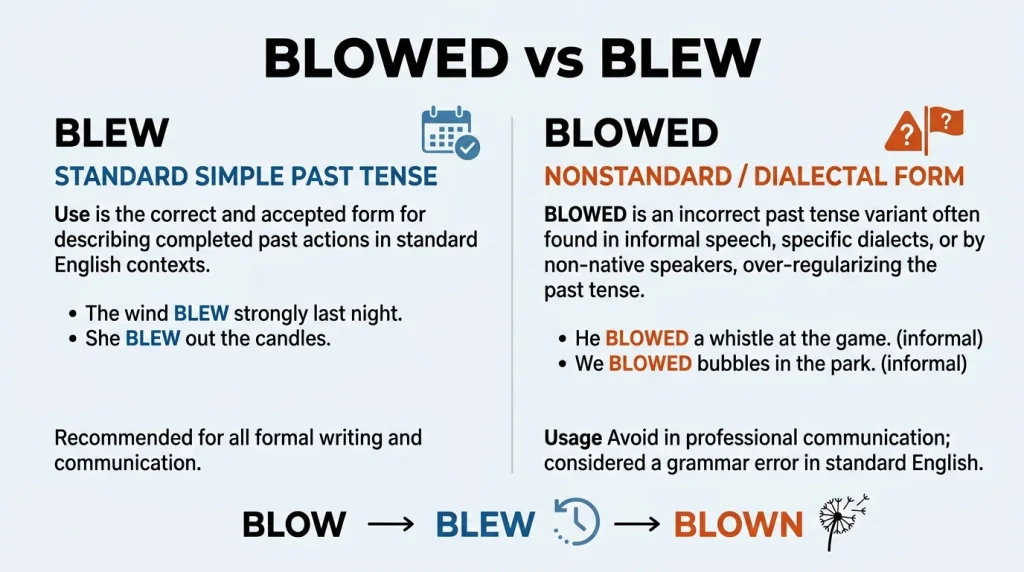
Blew is the standard simple past tense of blow: “The wind blew all night.” Blowed is not the standard past-tense form in general English, although it exists as a documented nonstandard and dialectal form, particularly in some U.S. varieties. The full standard pattern is blow → blew → blown. Use blew for the simple past and blown as the past participle.
What Is the Difference Between Blowed and Blew?
The main difference is grammatical.
Blew is the standard simple past form of the irregular verb blow.
Blowed is a nonstandard or dialectal form that appears in some varieties of English, but it is not the standard form you should use in formal, academic, professional, or general-purpose writing. Dictionaries document blowed as a real form, so simply calling it a nonexistent word would be inaccurate.
The standard verb forms are:
| Verb form | Standard form | Example |
|---|---|---|
| Base form | blow | I blow on the soup. |
| Simple past | blew | I blew on the soup. |
| Past participle | blown | I have blown on the soup. |
| Present participle | blowing | I am blowing on the soup. |
The important pattern to remember is:
blow → blew → blown
This pattern applies regardless of which meaning of blow you are using. The verb can describe moving air, forcing air from your mouth, making a musical sound, damaging something, wasting an opportunity, or several other actions, but its standard past forms remain blew and blown.
Why It Matters
Choosing blew instead of blowed matters because English has many irregular verbs that do not form their past tense by simply adding -ed.
A learner may naturally think:
blow + ed = blowed
That pattern works for regular verbs such as:
- walk → walked
- talk → talked
- clean → cleaned
- open → opened
But blow is irregular. Its standard past form changes internally:
blow → blew
Using blowed in a school assignment, business email, examination, or formal article can make the sentence look grammatically nonstandard.
There is an important nuance, though. Blowed is not imaginary. It appears in dictionaries as a nonstandard or dialectal form and can occur in regional speech, quoted dialogue, literature, and expressions intended to reproduce a particular voice. The American Heritage Dictionary identifies it as chiefly Southern and Upper Southern U.S. usage, while Dictionary.com labels it nonstandard.
So the practical rule is simple:
Use “blew” in standard English. Recognize “blowed” as a dialectal or nonstandard form rather than assuming every occurrence is a spelling mistake.
The Core Rule
Standard English: blow → blew → blown.
Use:
- blow for the base or present form
- blew for the simple past
- blown for the past participle
- blowing for the -ing form
Examples:
The wind blew the door open.
The wind has blown the door open.
The wind is blowing strongly.
The wind may blow again tonight.
Do not normally write:
The wind blowed the door open.
For standard English, write:
The wind blew the door open.
How to Use Blow, Blew, and Blown
Use “blow” for the base form
The base form appears in the present tense with I, you, we, and they, after modal verbs, and in infinitives.
Examples:
I blow on my coffee before drinking it.
They blow bubbles in the garden.
You should blow gently into the instrument.
She wants to blow out the candles.
Use “blew” for the simple past
Use blew when describing an action that happened in the past.
Examples:
The wind blew all night.
She blew out the candles.
He blew the whistle.
The storm blew several branches off the tree.
I blew my chance to explain.
The simple past does not normally need have, has, or had.
Use “blown” as the past participle
Blown is the past participle, so it appears in perfect constructions and passive constructions.
Examples:
The wind has blown the leaves across the yard.
The storm had blown the roof tiles away.
The candles were blown out.
The door had been blown open.
A useful test is to look for a helping verb such as have, has, had, is, are, was, or were, depending on the construction.
Read More: Revocable vs Irrevocable: Key Differences Explained.
Don’t replace blew with blown
This mistake is just as common in the other direction.
Incorrect:
Yesterday, the wind blown hard.
Correct:
Yesterday, the wind blew hard.
The word yesterday points to a completed past event, so the simple past blew is required.
Don’t replace blown with blew
Incorrect:
The wind has blew the papers away.
Correct:
The wind has blown the papers away.
After has, the standard form is the past participle blown.
Correct Examples
Here are original examples showing how the forms work in different situations.
- Conversation:
“The wind blew my hat into the street.” - Email:
“The storm blew several signs down outside the office.” - School writing:
“A strong wind blew across the valley during the night.” - Workplace:
“The electrical surge blew the fuse.” - Social media:
“That final shot completely blew me away.” - Academic writing:
“The prevailing wind blew from the west during the observation period.” - Everyday conversation:
“I blew on the soup because it was too hot.” - Professional report:
“The storm had blown debris across the access road before the inspection began.” - School assignment:
“The leaves had been blown into the corner of the playground.” - Music:
“She blew a short note on the trumpet.” - Workplace conversation:
“He blew the presentation by forgetting the final figures.” - Text message:
“The wind blew the umbrella inside out.” - Formal writing:
“The doors were blown open by the force of the explosion.” - Casual conversation:
“I blew all my money on concert tickets.”
Read More: Composed vs Comprised: Which Is Correct?
Incorrect vs. Correct
| ❌ Incorrect | ✅ Correct | Why |
|---|---|---|
| The wind blowed hard yesterday. | The wind blew hard yesterday. | Blew is the standard simple past of blow. |
| She blowed out the candles. | She blew out the candles. | The completed past action requires blew. |
| He has blew the whistle. | He has blown the whistle. | After has, use the past participle blown. |
| The storm had blew the roof away. | The storm had blown the roof away. | Had requires the past participle. |
| The referee blowed the whistle. | The referee blew the whistle. | The standard past form is blew. |
| The balloon was blew away. | The balloon was blown away. | Passive constructions use the past participle blown. |
| The leaves blowed across the yard. | The leaves blew across the yard. | A completed past event takes blew. |
| I have blew out the candle. | I have blown out the candle. | Have + past participle requires blown. |
| The wind blown the papers away. | The wind blew the papers away. | There is no helping verb requiring a past participle. |
| She blowed a kiss goodbye. | She blew a kiss goodbye. | Standard English uses blew as the simple past. |
| The storm has blowed over. | The storm has blown over. | The standard past participle is blown. |
| He blowed his chance. | He blew his chance. | The idiomatic past form is blew. |
Why Do People Say “Blowed”?
The mistake is understandable because English usually forms the past tense of regular verbs with -ed.
A learner sees:
blow
and may automatically apply the familiar pattern:
blow + ed = blowed
But blow is an irregular verb, so its standard past form does not follow the regular -ed pattern.
There is another reason the situation is slightly more complicated: blowed really does occur in English.
Some dictionaries record blowed as a nonstandard or dialectal past tense and past participle. The American Heritage Dictionary specifically identifies it as chiefly Southern and Upper Southern U.S. usage. Dictionary.com also labels it nonstandard.
That means a learner may encounter sentences such as:
“I blowed it dry.”
or:
“It blowed my mind.”
Such examples do not establish blowed as the standard form. They may reflect regional speech, character voice, informal usage, or deliberate dialect representation.
Phonetic similarity
Blow and blew have very different spellings but related sounds. When people hear a sentence rather than read it, the spelling distinction disappears.
Spelling overlap
The ending -ed is so common in English past tense forms that learners may expect every verb to follow it.
Overgeneralisation
Once someone learns a rule such as “add -ed to make the past,” they may apply that rule to irregular verbs.
English contains many exceptions to the regular pattern:
- go → went
- take → took
- see → saw
- know → knew
- blow → blew
Autocomplete and spellcheck
Spellcheck can identify many misspellings, but it cannot always tell whether a word is appropriate for the grammatical context.
A sentence containing blowed may not trigger the same kind of warning as an obviously misspelled word, especially when the software recognizes the term as an existing word.
Translation interference
Learners whose first language has a more regular past-tense system may naturally expect an equivalent of blow + -ed.
The solution is not to memorize a complicated explanation. Learn the three main forms together:
blow — blew — blown
Common Mistakes Checklist
Mistake 1: Using “blowed” as the normal past tense
What happens: A writer says, “The wind blowed yesterday.”
Why it happens: The writer applies the regular -ed rule.
How to avoid it: Memorize blow → blew → blown as one unit.
Mistake 2: Using “blew” after “has”
What happens: “The wind has blew the papers away.”
Why it happens: The writer remembers that blew is a past form but does not distinguish simple past from past participle.
How to avoid it: After has/have/had, use blown.
Mistake 3: Using “blown” by itself as the simple past
What happens: “Yesterday, the wind blown the door open.”
Why it happens: The writer knows blown is a past form but forgets that it is a past participle.
How to avoid it: For simple past, use blew.
Mistake 4: Assuming every “-ed” form is standard
What happens: A learner creates blowed because the form looks regular.
Why it happens: Most English verbs do use -ed in the simple past.
How to avoid it: Learn irregular verbs individually.
Mistake 5: Assuming every occurrence of “blowed” is a typo
What happens: A reader sees blowed in dialogue and assumes the author made an error.
Why it happens: The reader knows the standard form is blew.
How to avoid it: Consider context. Blowed is documented as a nonstandard/dialectal form and can be used intentionally to represent a regional voice.
Read More: Cant vs Cannot: Which Is Correct?
Mistake 6: Confusing past tense with past participle
What happens: A learner treats blew and blown as interchangeable.
Why it happens: Both refer to past actions.
How to avoid it: Learn their grammatical jobs, not just their meanings.
Blowed vs. Blew in Real English
Grammatically correct and standard: “blew”
Blew is the normal standard-English simple past form of blow. It works naturally in everyday conversation, professional writing, school assignments, academic prose, and ordinary storytelling. For example, “The wind blew the door shut” is straightforward standard English. If you are unsure which form to use for a completed past event, blew is the appropriate standard choice.
Grammatically correct and standard: “blown”
Blown is the standard past participle. It is natural in constructions such as “has blown,” “had blown,” and “was blown.” It also appears in established expressions and adjective-like uses, such as blown away and full-blown. A common learner error is to choose blew simply because the action happened in the past, without checking the grammatical construction.
Documented but nonstandard or dialectal: “blowed”
Blowed is not simply a nonexistent form. Dictionaries record it as a nonstandard or dialectal past tense and past participle of blow. The American Heritage Dictionary marks it as chiefly Southern and Upper Southern U.S. usage. This makes it possible to encounter blowed in regional speech, dialogue, or literary representation, even though standard edited English normally uses blew and blown.
Natural everyday English
In ordinary standard conversation, speakers use blew rather than blowed: “The wind blew my hat away,” “She blew out the candles,” or “He blew his chance.” Blowed can sound regional or deliberately informal to speakers who use standard forms, so it should not be substituted for blew merely because the sentence is casual. Casual English does not automatically make a nonstandard verb form appropriate.
Formal vs. Informal Usage
The distinction is especially important in formal writing.
Formal and standard writing
Use:
- blew
- blown
Examples:
The storm blew across the region overnight.
Several windows had been blown out.
These forms are appropriate for:
- school assignments
- examinations
- academic writing
- business emails
- professional reports
- websites
- formal correspondence
Informal or dialectal speech
You may encounter blowed in regional or nonstandard speech.
For example:
“The wind blowed the door wide open.”
If this sentence appears in a novel, interview transcript, or piece of dialogue, the form may be intentional. Replacing it automatically with blew could remove part of the speaker’s regional voice.
For your own standard English, however, use blew.
Comparison Table
| Feature | Blowed | Blew |
|---|---|---|
| Standard simple past? | No | Yes |
| Standard past participle? | No | No |
| Standard past participle | — | blown |
| Dialectal use | Yes | Yes, as standard form |
| Nonstandard use | Documented | No |
| Appropriate for formal writing | Generally no | Yes |
| Example | “He blowed the whistle.” | “He blew the whistle.” |
| Best choice for learners | No | Yes |
| Standard verb pattern | — | blow → blew → blown |
| Main grammatical role | Nonstandard/dialectal past or participle | Simple past |
Is “Blowed” Ever Correct?
The answer depends on what correct means.
If you mean standard edited English, use blew for the simple past and blown for the past participle.
If you mean whether the form exists in real English, then yes: blowed is documented. It occurs as a nonstandard or dialectal form, and some dictionaries identify particular regional uses.
This distinction matters because language is larger than formal grammar rules. A dialect form can be real and meaningful without being the preferred form in standard written English.
Therefore:
“Blowed” exists, but “blew” is the standard simple past form of “blow.”
What About “Blowed Up”?
This is one of the most common searches involving the word.
For standard English, write:
The building blew up.
Not:
The building blowed up.
But there is another construction:
The building was blown up.
Here blown is correct because the sentence uses a passive construction.
Compare:
| Sentence | Correct? | Why |
|---|---|---|
| The building blew up. | Yes | Simple past |
| The building blowed up. | Nonstandard | Blowed is not the standard past |
| The building was blown up. | Yes | Passive construction |
| The building has blown up. | Yes | Perfect construction |
| The building has blew up. | No | After has, use blown |
This is why the question “Is it blew up or blown up?” cannot be answered without looking at the entire sentence.
Memory Trick
Remember the three forms as a rhyme-like sequence:
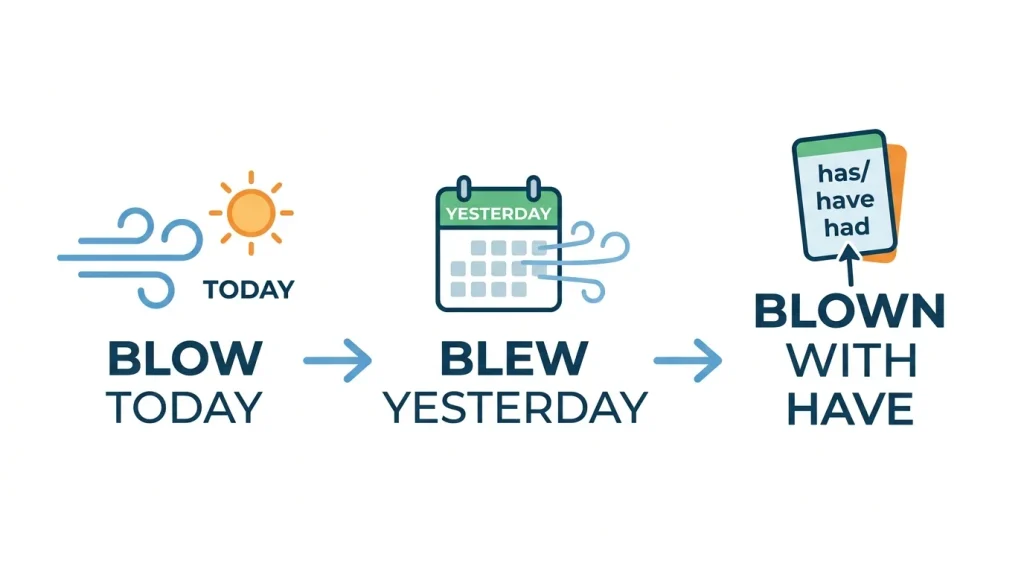
Blow today, blew yesterday, blown with have.
Or use the compact pattern:
BLOW → BLEW → BLOWN
Think:
EW = simple past
OWN = past participle
So:
Yesterday, the wind blew.
The wind has blown.
The moment you see has, have, or had, check whether you need blown.
Real-Life Situations
Interview
Question: “What happened during the storm?”
Natural answer:
“The wind blew several signs down.”
Because the speaker is describing a completed past event, blew is the simple past.
Meeting
“The storm blew a tree across the entrance last night.”
Again, blew describes a completed event.
“The strong winds blew debris onto the parking area.”
This is appropriate professional English.
Text message
“The wind blew my umbrella inside out 😂”
The informal setting does not change the standard past form.
Exam
Question: Choose the correct form:
Yesterday, the wind ___ strongly.
Answer:
blew
Not blowed.
Academic writing
“The prevailing wind blew from the northwest during the observation period.”
The standard irregular form is appropriate even in technical writing.
Dialogue in fiction
A writer may intentionally use:
“That wind blowed the whole fence down!”
This could be used to represent a particular dialect or character voice. In that context, changing it automatically to blew may change the intended speech pattern.
Read More: SMO Meaning in Text: What Does It Mean?
Mini Quiz
| # | Question | Answer | Explanation |
|---|---|---|---|
| 1 | Multiple choice: What is the standard simple past of blow? A) blowed B) blew C) blown D) blowing | B) blew | Blew is the standard simple past form. |
| 2 | Fill in the blank: The wind ___ the door shut last night. | blew | “Last night” describes a completed past event, so use the simple past. |
| 3 | Multiple choice: Which sentence is standard? A) She blowed out the candles. B) She blew out the candles. C) She blown out the candles. | B) She blew out the candles. | Blew is the standard simple past. |
| 4 | Fill in the blank: The storm has ___ across the region. | blown | After has, use the past participle blown. |
| 5 | Correct the sentence: “The wind has blew the papers away.” | The wind has blown the papers away. | Has + past participle requires blown. |
| 6 | Multiple choice: Which is the standard verb pattern? A) blow–blowed–blowed B) blow–blew–blown C) blow–blew–blew D) blow–blown–blew | B) blow–blew–blown | These are the standard base, simple past, and past participle forms. |
| 7 | Fill in the blank: The referee ___ the whistle at the end of the game. | blew | The sentence describes a completed past action. |
| 8 | Correct the sentence: “The windows were blew out by the storm.” | The windows were blown out by the storm. | Passive constructions use the past participle blown. |
| 9 | Multiple choice: Which statement about blowed is most accurate? A) It does not exist. B) It is always the correct past tense. C) It is documented as a nonstandard or dialectal form. D) It is the standard past participle. | C | Dictionaries document blowed as a nonstandard or dialectal form. |
| 10 | Correct the sentence: “Yesterday, the leaves blown across the yard.” | Yesterday, the leaves blew across the yard. | The simple past requires blew. |
Expert Tips
Learn the complete verb family
Don’t memorize only:
blow = present
blew = past
Add the past participle:
blow → blew → blown
This prevents a second common mistake: using blew after has, have, or had.
Learn the phrase, not just the word
Instead of memorizing isolated forms, learn common combinations:
- the wind blew
- blew out the candles
- blew the whistle
- blew away
- has blown over
- was blown away
- had blown out
This makes the correct form easier to retrieve naturally.
Look for time markers
Words such as yesterday, last night, earlier, two hours ago, and last year often point toward the simple past.
Last night, the wind blew hard.
But remember that the whole sentence still determines the construction.
Look for helping verbs
When you see has, have, or had, check for the past participle:
has blown
have blown
had blown
Not:
has blew
Don’t “correct” dialect automatically
If you’re editing a formal article, use standard English.
If you’re transcribing someone’s exact speech or writing dialogue for a character, a nonstandard form may be intentional.
The right editorial choice depends on the purpose of the text.
Don’t confuse grammar with dictionary existence
A word can be documented without being the preferred form for standard English.
Blowed is a useful example. Its dictionary entry shows that it exists in real usage, while its nonstandard or dialectal labeling tells you that it is not the ordinary standard form.
FAQ
Is “blowed” a real word?
Yes. Blowed is documented in dictionaries as a nonstandard or dialectal form of blow. It is therefore inaccurate to say that the word never exists. However, it is not the standard form you should normally use in formal or general-purpose English.
Is “blew” the past tense of blow?
Yes. Blew is the standard simple past form of blow.
The wind blew all night.
The standard verb pattern is blow → blew → blown.
Is “blown” the past tense of blow?
Not exactly. Blown is the past participle, while blew is the simple past.
Yesterday, the wind blew.
The wind has blown all night.
Is “blowed” grammatically wrong?
In standard English, blowed is not the normal simple past or past participle of blow. It is documented as nonstandard or dialectal, so it can be appropriate when representing certain varieties of speech, but it is not the preferred form for standard formal writing.
Why does “blowed” sound natural to some people?
English regularly forms past tense by adding -ed, so blowed follows a pattern that works for many verbs. In addition, blowed exists in some dialects, particularly certain Southern U.S. varieties.
Is it “blew up” or “blowed up”?
In standard English, use blew up for the simple past.
The balloon blew up.
However, use blown up when the grammar calls for the past participle:
The balloon was blown up.
Is “blew” correct after “has”?
No. Standard English uses blown after has.
She has blown out the candle.
Not:
She has blew out the candle.
Is “blowed” ever used in American English?
Yes. It is documented as a nonstandard form and is identified by the American Heritage Dictionary as chiefly Southern and Upper Southern U.S. usage. That does not make it the standard form for general American English writing.
Is “blew” used in both American and British English?
Yes. Blew is the standard simple past form in both major varieties. The basic standard pattern remains blow → blew → blown.
Can “blowed” be used in a novel?
Yes, if the writer is deliberately representing a dialect, regional speech, or a particular character’s voice. Because blowed is documented as a dialectal/nonstandard form, its presence in dialogue does not automatically indicate an editing error.
What is the easiest way to remember blew vs. blown?
Remember:
Blow today → blew yesterday → blown with have.
Then apply the pattern:
blow → blew → blown
Quick Summary
Blew is the standard simple past tense of blow, while blown is its standard past participle. The easiest pattern to remember is blow → blew → blown. Use “blew” for completed past actions: “The wind blew hard last night.” Use “blown” with helping verbs or in passive constructions: “The wind has blown hard” or “The door was blown open.” Blowed is not the standard form, but it is a real documented nonstandard and dialectal form, particularly associated with some Southern U.S. speech. Therefore, use blew in standard writing, while recognizing blowed when it appears in regional speech, dialogue, or literary contexts.



Pingback: Whit vs Wit: What’s the Difference?
Pingback: Que vs Cual: Qué vs Cuál Explained Simply.