


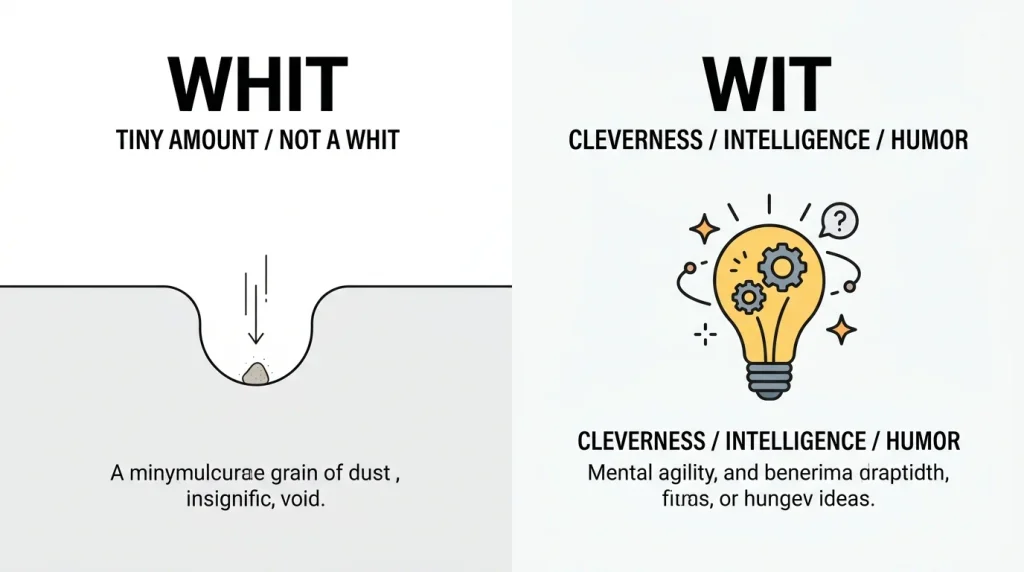
Use whit when you mean a tiny amount or the smallest degree of something, especially in expressions such as “not a whit” or “doesn’t care a whit.” Use wit when you mean cleverness, intelligence, humor, or quick thinking, as in “She has a sharp wit.” A simple test is: tiny amount = whit; clever thinking or humor = wit.
What Is the Difference Between Whit and Wit?
Whit and wit are two different nouns that happen to sound the same in many English accents. This makes them easy to confuse when writing.
Whit means a very small amount, particle, or degree. It is particularly common in negative expressions:
- not a whit
- not one whit
- doesn’t care a whit
- hasn’t changed a whit
For example:
The new policy didn’t make a whit of difference.
Here, whit means even the smallest amount.
Wit, on the other hand, is connected with intelligence and clever expression. It can describe someone’s ability to make clever or humorous remarks, as well as practical intelligence or quick thinking.
Her quick wit made everyone laugh.
Here, wit refers to her ability to think and respond cleverly.
The distinction is therefore based on meaning, not pronunciation. Dictionaries define whit as a very small amount and wit in terms of cleverness, intelligence, humor, and mental ability.
Why It Matters
Confusing these words can change the meaning of a sentence completely.
Consider:
He has a great deal of wit.
This means he is clever, mentally sharp, or humorously intelligent.
Now compare:
It didn’t matter a whit.
This means it did not matter at all or in the smallest degree.
The problem becomes especially noticeable in fixed expressions. Writing “not a wit” when you mean “not at all” is a spelling mistake, because the traditional expression is “not a whit.”
Correct word choice also matters in professional and academic writing. A single wrong word can make an otherwise polished sentence look careless, particularly when the intended expression is an established idiom.
The Core Rule
Rule: Use “whit” for a tiny amount or degree. Use “wit” for cleverness, intelligence, humor, or quick thinking.
A fast substitution test can help:
- If you could replace the word with tiny amount, bit, iota, or slightest degree, use whit.
- If you could replace it with cleverness, intelligence, humor, or mental sharpness, use wit.
For example:
- It didn’t change one whit. → It didn’t change one bit.
- She has remarkable wit. → She has remarkable cleverness.
- He doesn’t care a whit. → He doesn’t care at all.
- His quick wit saved the conversation. → His quick thinking saved the conversation.
How to Use Whit
Whit is a noun referring to a very small amount or degree of something. In modern English, it is particularly associated with negative constructions.
Common patterns with whit
- not a whit
- not one whit
- not a whit of + noun
- doesn’t care a whit
- didn’t matter a whit
- not changed a whit
- not a whit better
- not a whit different
Examples:
The revised plan was not a whit better than the original.
She didn’t care a whit about the criticism.
There wasn’t a whit of evidence supporting the claim.
His attitude hasn’t changed one whit.
The second version is not a whit clearer.
The word is grammatically a noun, but it normally appears in set or strongly established patterns rather than being freely substituted for everyday words such as bit.
Cambridge labels whit as formal and defines not a whit as meaning “not any amount.” Collins similarly describes the word as usually occurring with a negative construction.
Read More: Blowed vs Blew: Which One Is Correct?
How to Use Wit
Wit has several related meanings.
It can mean the ability to make clever or humorous remarks:
Her wit made the interview entertaining.
It can also refer to intelligence or the ability to think quickly:
He used his wit to solve the problem.
And it appears in plural expressions involving mental ability or composure:
- keep your wits about you
- at your wits’ end
- frighten someone out of their wits
- live by your wits
The adjective witty comes from wit:
She made a witty observation.
The noun wit is therefore connected with mental sharpness and clever expression, while whit concerns quantity or degree.
Correct Examples
Here are examples showing how the two words work in different settings.
- Conversation:
“I don’t care a whit what they think about my decision.” - Email:
“The updated proposal is not a whit different from the version we reviewed yesterday.” - School:
“The teacher’s quick wit kept the class engaged.” - Workplace:
“Her wit helped break the tension during the difficult meeting.” - Academic writing:
“The additional evidence did not change the argument one whit.” - Social media:
“His dry wit makes his posts surprisingly entertaining.” - Interview:
“She answered the unexpected question with confidence and wit.” - Literary discussion:
“The author’s wit gives the dialogue much of its charm.” - Everyday writing:
“The repair didn’t improve the device one whit.” - Formal writing:
“The new evidence does not make the original conclusion one whit less plausible.” - Problem-solving:
“He relied on his wit when the original plan failed.” - Description of a person:
“Everyone appreciated her intelligence and quick wit.”
Notice that whit relates to degree or amount, while wit relates to mental ability or clever expression.
Incorrect vs. Correct
| ❌ Incorrect | ✅ Correct | Why |
|---|---|---|
| It didn’t matter a wit. | It didn’t matter a whit. | The meaning is “not at all,” so the word is whit. |
| She has a sharp whit. | She has a sharp wit. | Sharp wit means cleverness or intelligence. |
| He doesn’t care a wit about it. | He doesn’t care a whit about it. | The expression means he does not care at all. |
| His quick whit impressed everyone. | His quick wit impressed everyone. | Quick wit means quick, clever thinking. |
| It hasn’t changed one wit. | It hasn’t changed one whit. | One whit means the smallest amount. |
| Her whit made the speech funny. | Her wit made the speech funny. | Humor and clever expression are associated with wit. |
| There isn’t a wit of evidence. | There isn’t a whit of evidence. | A whit of evidence means even a tiny amount of evidence. |
| He answered with intelligence and whit. | He answered with intelligence and wit. | Wit can mean cleverness or mental sharpness. |
| The result is not a wit better. | The result is not a whit better. | Not a whit better means not even slightly better. |
| She used her whit to solve the problem. | She used her wit to solve the problem. | The intended meaning is intelligence or resourcefulness. |
Why People Make This Mistake
1. They sound the same
In many accents, whit and wit are pronounced /wɪt/. That makes the distinction invisible when someone hears the word rather than sees it written. Cambridge gives the same /wɪt/ pronunciation for both words.
2. Their spellings differ by only one letter
The only difference in the written forms is the h:
- whit
- wit
Because the words are short and similar, it is easy to type the wrong one.
3. “Whit” is relatively uncommon
Modern speakers are much more likely to say a little, a bit, or at all than to use whit in spontaneous conversation.
For example:
It didn’t change a bit.
is much more ordinary than:
It didn’t change a whit.
The latter is correct, but it has a more formal, literary, or traditional feel.
4. People remember the sound but not the expression
Someone may remember hearing “not a whit” but later write “not a wit.” Because the two words sound alike, pronunciation cannot solve the spelling problem.
5. Spellcheck cannot always understand meaning
Automatic spelling tools can identify many misspellings, but whit and wit are both legitimate English words. If you type the wrong one in a grammatically possible sentence, a spellchecker may not flag it.
For example:
She has a sharp wit.
and
She has a sharp whit.
The second sentence is not the intended English expression, but the software may recognize whit as a correctly spelled word.
6. Translation can interfere
Learners whose first language expresses these concepts differently may associate the two English forms with a single translated word or sound. The safest approach is to learn the meaning and common phrase, rather than relying only on pronunciation.
Read More: Revocable vs Irrevocable: Key Differences Explained.
Common Mistakes Checklist
Mistake 1: Writing “not a wit”
Problem: Using wit in the expression meaning “not at all.”
Why it happens: Wit is much more familiar than whit.
Correct form: not a whit
The delay made not a whit of difference.
Mistake 2: Using “whit” for intelligence
Problem: Writing whit when discussing cleverness.
Why it happens: The spelling is similar, and both words are short.
Correct form: wit
Her quick wit impressed the interview panel.
Mistake 3: Treating the words as interchangeable
They are not interchangeable merely because they can sound identical.
Avoid it by asking: Is the sentence about amount or mental ability?
Mistake 4: Assuming “whit” is completely obsolete
Whit is uncommon in ordinary conversation, but it remains a recognized English word and appears in established expressions such as not a whit.
Mistake 5: Assuming “wit” only means humor
Wit can refer to humor and clever expression, but it can also mean intelligence, practical understanding, or mental resourcefulness.
Whit vs Wit in Real English
Grammatically correct
Both words are standard English when they express their appropriate meanings. Whit works as a noun for a tiny amount or degree, especially in negative expressions. Wit works as a noun for cleverness, intelligence, humorous expression, or quick thinking. So sentences such as “It didn’t change a whit” and “She has a sharp wit” are grammatically correct and semantically clear.
Grammatically possible but unnatural
A sentence can be structurally grammatical while sounding unusual because whit is relatively formal and uncommon in everyday speech. For example, “I don’t care a whit about the result” is understandable and correct, but many speakers would naturally say “I don’t care at all about the result” or “I don’t care one bit.” The issue is register and frequency, not grammatical correctness.
Natural everyday English
In ordinary conversation, wit is much more natural when talking about cleverness or humor, while everyday speakers usually prefer bit, little, or at all instead of whit. You are more likely to hear “She has a great sense of humor” or “It didn’t change a bit” than a sentence containing whit. Still, expressions such as “not a whit” remain recognizable.
American vs. British English
There is no meaningful difference in the core meanings of whit and wit between American and British English.
There can, however, be a pronunciation difference involving whit. Cambridge represents whit as /wɪt/ in both its UK and US entries, while some dictionary sources give an additional /hwɪt/ pronunciation for American English. In practice, many English speakers pronounce the initial wh and w the same way.
The meaning remains the same:
- whit = a tiny amount
- wit = cleverness, intelligence, humor, or quick thinking
So American or British spelling does not determine which word you should choose.
Formal vs. Informal Usage
This distinction is relevant because whit is considerably more formal and less common in everyday English.
Whit often appears in formal, literary, or traditional expressions:
The evidence did not alter the conclusion one whit.
In ordinary conversation, a speaker is more likely to say:
The evidence didn’t change the conclusion at all.
or:
The evidence didn’t change the conclusion one bit.
Wit, however, is normal in both informal and formal English:
She has a quick wit.
The essay combines serious analysis with wit.
The register difference is therefore mainly about whit, not wit. Cambridge explicitly labels whit as formal.
Comparison Table
| Feature | Whit | Wit |
|---|---|---|
| Part of speech | Noun | Noun |
| Main meaning | A tiny amount or degree | Cleverness, intelligence, humor, or quick thinking |
| Pronunciation | Usually /wɪt/ | /wɪt/ |
| Common in everyday speech? | Less common | Yes |
| Typical use | “not a whit,” “not one whit” | “quick wit,” “sharp wit,” “at your wits’ end” |
| Can refer to humor? | No | Yes |
| Can refer to intelligence? | No | Yes |
| Can indicate a tiny amount? | Yes | No |
| Register | Often formal or literary | General English |
| Related adjective | — | witty |
Important Expressions with Whit
Learning the common expressions is often easier than trying to memorize the word in isolation.
Not a whit
Means not at all or not even slightly.
The criticism did not bother her one whit.
Not one whit
This has essentially the same meaning.
His explanation was not one whit more convincing.
Care a whit
Usually appears in a negative sentence.
I don’t care a whit what they say.
A whit of
This can refer to a tiny amount.
There wasn’t a whit of evidence to support the allegation.
These expressions are why whit remains useful even though it is relatively uncommon as an everyday standalone noun.
Important Expressions with Wit
Quick wit
The ability to think and respond quickly and cleverly.
Her quick wit made her an excellent debater.
Sharp wit
Cleverness that can also suggest a pointed or incisive style.
His sharp wit was obvious from the first conversation.
At your wits’ end
To be completely unsure what to do next because a problem has become extremely difficult or frustrating.
After trying every solution, they were at their wits’ end.
Keep your wits about you
To remain alert and think clearly, especially in a difficult situation.
Keep your wits about you when negotiating the contract.
To wit
A formal expression meaning namely or that is to say. It is a special expression and should not be confused with the ordinary meaning of wit.
Read More: Composed vs Comprised: Which Is Correct?
Memory Trick
Use this simple mnemonic:
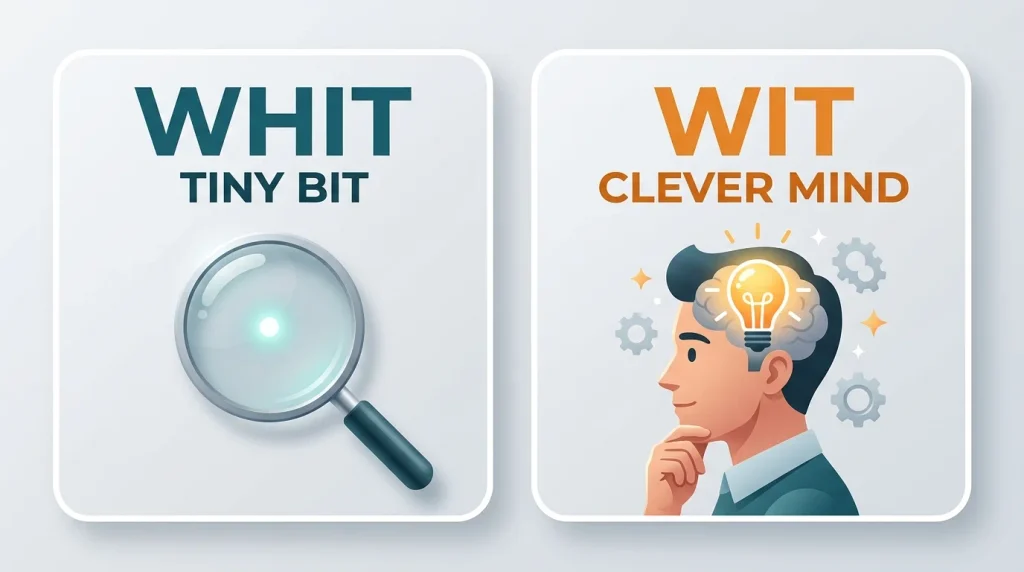
Whit = a tiny bit. Wit = a clever mind.
The h in whit can remind you of “how little?”
If you are talking about the amount of something, think whit.
If you are talking about someone’s brain, cleverness, or humor, think wit.
Another quick association:
whit → little bit
wit → clever wit
Real-Life Situations
Interview
A candidate gives a clever answer to an unexpected question.
She handled the difficult question with confidence and wit.
Here, wit refers to clever thinking and expression.
Meeting
A manager wants to say that a proposal has not improved even slightly.
The revised proposal is not a whit better than the first one.
Here, whit means “not even slightly.”
You want to emphasize that someone’s opinion has not changed your position.
Your comments have not changed my position one whit.
Text Message
A friend asks whether you care about an online argument.
I don’t care a whit about what they posted.
This is grammatically correct, although “I don’t care at all” would sound more ordinary in casual texting.
Exam
A student is describing a character’s personality.
The character uses wit to expose the absurdity of the situation.
Here, wit refers to clever and often humorous expression.
Mini Quiz
| # | Question | Answer | Explanation |
|---|---|---|---|
| 1 | She has a sharp ___ that makes everyone laugh. | wit | The sentence is about cleverness and humor. |
| 2 | The change did not help one ___. | whit | “One whit” means even the smallest amount. |
| 3 | Which is correct: “not a wit” or “not a whit” when you mean “not at all”? | not a whit | The established expression is “not a whit.” |
| 4 | Fill in the blank: “His quick ___ helped him answer immediately.” | wit | Quick wit means quick, clever thinking. |
| 5 | Correct the sentence: “The criticism didn’t bother her a wit.” | The criticism didn’t bother her a whit. | The intended meaning is “not at all.” |
| 6 | Which word means a tiny amount: whit or wit? | whit | A whit is a very small amount or degree. |
| 7 | Fill in the blank: “There wasn’t a ___ of evidence.” | whit | “A whit of evidence” means a tiny amount of evidence. |
| 8 | Correct the sentence: “He is known for his sharp whit.” | He is known for his sharp wit. | Sharp wit refers to cleverness. |
| 9 | Which sentence is correct? A) “She has great whit.” B) “She has great wit.” | B) She has great wit. | Wit can mean cleverness or humorous intelligence. |
| 10 | Complete the sentence: “The new version isn’t a ___ better.” | whit | “Not a whit better” means not even slightly better. |
Expert Tips
Learn “whit” through phrases, not isolation
Because whit is relatively uncommon, memorizing it as a standalone definition may not be enough. Learn its most useful patterns:
- not a whit
- not one whit
- not a whit of
- doesn’t care a whit
- not a whit better
Learn “wit” through word families
The relationship between wit, witty, and wittiness makes the meaning easier to recognize.
wit → witty → wittiness
If a sentence describes someone as witty, the noun connected with that quality is wit.
Read More: Cant vs Cannot: Which Is Correct?
Use substitution when editing
When proofreading, replace the confusing word mentally:
- whit → tiny amount / bit / iota
- wit → cleverness / intelligence / humor
If the substitution destroys the intended meaning, choose the other word.
Don’t let pronunciation decide spelling
Because the words can sound identical, saying the sentence aloud will not necessarily reveal the correct spelling.
Instead, identify the intended meaning first.
Remember that “whit” is not a synonym for “wit”
The words are similar in spelling and sound, but their meanings come from different lexical histories and have developed into clearly different modern uses. The overlap is primarily phonetic, not semantic.
FAQ
Is “whit” the same as “wit”?
No. Whit means a very small amount or degree, while wit refers to cleverness, intelligence, humorous expression, or quick thinking.
Is “not a whit” correct English?
Yes. Not a whit is a recognized expression meaning “not at all” or “not even slightly.”
Is “not a wit” correct?
Not when you mean “not at all.” The traditional expression is not a whit. “Wit” has a different meaning connected with intelligence and cleverness.
Does “whit” mean a little bit?
Yes. A whit is a very small amount, particle, or degree. It is particularly common in negative expressions such as “not a whit.”
Does “wit” mean intelligence?
Yes. Wit can refer to intelligence, mental sharpness, practical understanding, or the ability to think quickly. It can also refer specifically to clever or humorous expression.
Are whit and wit pronounced the same?
They are pronounced the same in many varieties of English, commonly as /wɪt/. Some pronunciation sources also recognize /hwɪt/ for whit in American English.
Is whit commonly used in modern English?
It is a recognized modern English word, but it is much less common than everyday alternatives such as bit, little, or at all. It survives especially in expressions such as “not a whit.”
Is “whit” formal English?
Yes. Cambridge labels whit as formal. It can have a literary or traditional tone, especially outside its established negative expressions.
Can “wit” describe a person?
Yes. A wit can mean a person known for clever or humorous remarks. For example, “She is a celebrated wit.”
What does “to wit” mean?
To wit is a formal expression meaning namely, that is, or more precisely. It is a separate established use of wit and is generally associated with formal writing.
What is the easiest way to remember whit vs wit?
Remember: whit = tiny bit; wit = clever mind. If the sentence concerns quantity or degree, choose whit. If it concerns intelligence, cleverness, or humor, choose wit.
Quick Summary
Whit and wit sound alike in many English accents, but they have different meanings. Whit is a noun meaning a very small amount or degree and is especially common in expressions such as “not a whit,” “not one whit,” and “doesn’t care a whit.” Wit refers to cleverness, intelligence, quick thinking, or the ability to use words humorously. It appears in expressions such as “quick wit,” “sharp wit,” and “at your wits’ end.” The simplest memory rule is “whit = tiny bit; wit = clever mind.” When proofreading, focus on the intended meaning rather than pronunciation because the two words can sound identical.



Pingback: Que vs Cual: Qué vs Cuál Explained Simply.
Pingback: Slew vs Slough: What’s the Difference?