
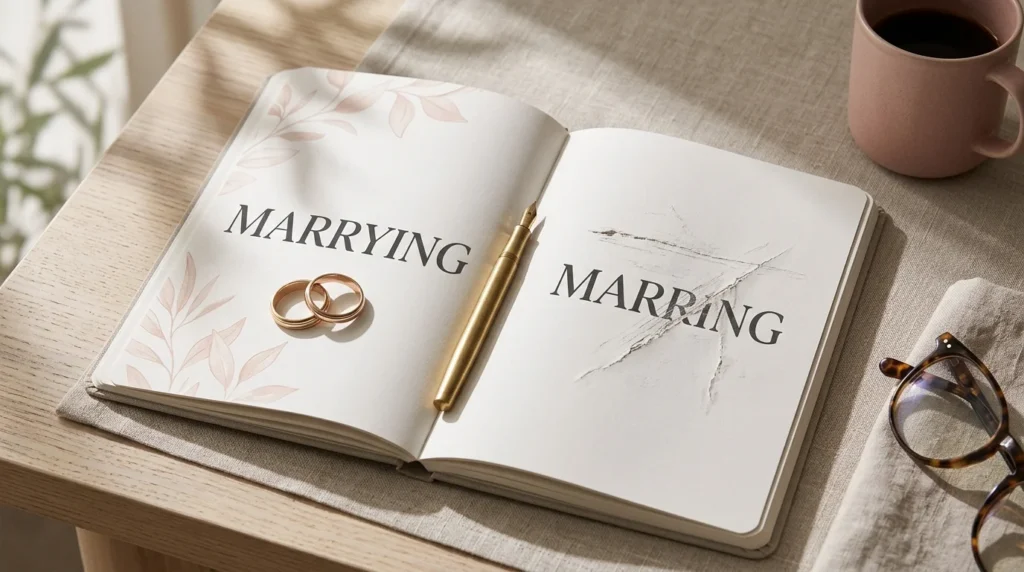

Marrying and marring are different words with completely different meanings. Marrying is the present participle of marry and refers to getting married or combining things. Marring is the present participle of mar and means damaging, spoiling, or making something less attractive or enjoyable. Use marrying for marriage or combination and marring for damage or imperfection.
What Is the Difference Between Marrying and Marring?
The difference between marrying and marring comes down to their base verbs:
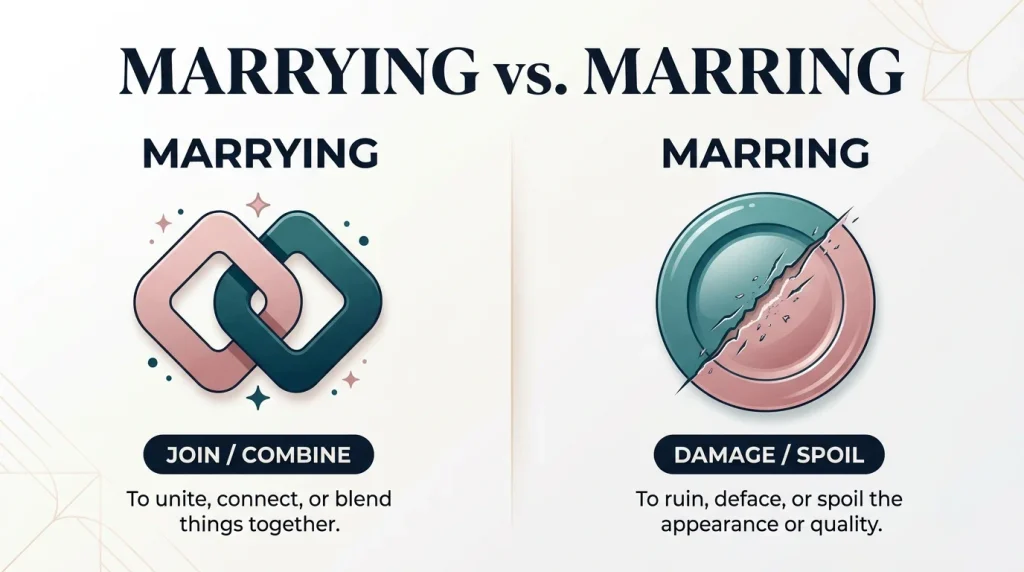
- Marrying comes from marry, meaning to enter into marriage or combine things.
- Marring comes from mar, meaning to spoil, damage, or make something less good.
The two words look almost identical, but they are not interchangeable.
For example:
- They are marrying next spring.
This means they are getting married. - The scratches are marring the surface.
This means the scratches are damaging or spoiling the surface.
The extra r in marring is not a minor spelling variation. It belongs to a different verb and therefore creates a completely different meaning.
The verb marry can also be used metaphorically for combining qualities or elements, while mar is used for something that spoils or diminishes another thing.
Why Does the Difference Matter?
Choosing the wrong word can change your sentence completely.
Imagine writing:
The stain is marrying the carpet.
A reader may stop because marrying does not mean damaging the carpet. The intended word is marring.
Likewise:
They are marring in June.
If you mean that two people are getting married, the correct word is marrying.
This distinction matters in:
- Emails and professional writing
- School assignments
- Essays and reports
- News and editorial writing
- Social media posts
- Wedding announcements
- Product descriptions
- Reviews
- Creative writing
- Everyday communication
The mistake is particularly noticeable because these words are visually similar. A single letter can turn a sentence about marriage into a sentence about damage.
Read More: Ten vs 10: Which One Should You Use?
The Core Rule
Use marrying when the meaning is getting married or combining things. Use marring when the meaning is damaging, spoiling, or making something less good.
A simple way to remember it:
Marrying = joining.
Marring = damaging.
The two verbs have different meanings and different grammatical bases:
| Word | Base verb | Basic meaning |
|---|---|---|
| Marrying | marry | Getting married or combining |
| Marring | mar | Damaging or spoiling |
Both marrying and marring are grammatically legitimate words. The issue is choosing the one that expresses the intended meaning.
How to Use Marrying
Marrying is the present participle of marry. It can describe the process of getting married or, in another use, the combination of two different things.
Cambridge defines marry as becoming legally accepted as someone’s husband or wife and also records a figurative use meaning to combine different qualities.
1. Marrying in a relationship context
Use marrying when someone is getting married.
Examples:
- They are marrying next Saturday.
- She is marrying her longtime partner.
- He talked about marrying after they finished university.
- My cousin is marrying someone she met at work.
2. Marrying in the sense of combining
Marry can also mean to combine two qualities, ideas, styles, or elements successfully.
Examples:
- The designer is marrying traditional details with modern materials.
- The restaurant succeeds by marrying local ingredients with international techniques.
- The project is about marrying practical experience with academic research.
- The architect is marrying function and visual simplicity.
This figurative use is important because marrying does not always refer to two people getting married. It can describe a combination of things as well.
How to Use Marring
Marring is the present participle of mar.
To mar something means to spoil it, damage it, or make it less good or enjoyable. The verb is commonly used when a flaw, mistake, defect, event, or problem negatively affects something.
Examples:
- A deep scratch was marring the wooden table.
- Several errors were marring an otherwise excellent report.
- The noise was marring the peaceful atmosphere.
- Poor lighting was marring the appearance of the photograph.
- A technical problem was marring the presentation.
Marring does not necessarily mean completely destroying something. Often, it means that something has been spoiled or negatively affected.
For example, if a beautiful painting has one noticeable scratch, you could say the scratch is marring the painting. The painting still exists, but its appearance has been negatively affected.
Correct Examples of Marrying vs Marring
Here are examples across everyday, professional, academic, and online contexts.
| Context | Correct Example |
|---|---|
| Conversation | “They are marrying next month.” |
| Wedding | “She is marrying her college sweetheart.” |
| Relationship | “He has been thinking about marrying her.” |
| Workplace | “The company is marrying innovation with practical design.” |
| Business | “The new strategy is marrying efficiency with flexibility.” |
| “We are marrying the two approaches into one proposal.” | |
| School | “The essay discusses marrying theory with practical experience.” |
| Academic writing | “The researchers explored ways of marrying traditional methods with newer techniques.” |
| Social media | “Finally marrying my best friend!” |
| Design | “The designer is marrying classic style with modern materials.” |
| Review | “A visible scratch is marring the otherwise polished finish.” |
| News writing | “Heavy rain was marring the opening ceremony.” |
Notice that marrying can have a positive or neutral meaning when it refers to combination, while marring describes a negative effect.
Incorrect vs. Correct
| ❌ Incorrect | ✅ Correct | Why |
|---|---|---|
| They are marring next weekend. | They are marrying next weekend. | The sentence refers to getting married. |
| She is marring her longtime partner. | She is marrying her longtime partner. | Marrying is the present participle of marry. |
| A stain is marrying the carpet. | A stain is marring the carpet. | The stain is damaging or spoiling the carpet’s appearance. |
| Scratches are marrying the table. | Scratches are marring the table. | Scratches spoil the table’s surface. |
| The typo is marrying the article. | The typo is marring the article. | The typo is negatively affecting the article. |
| They are marring their traditional methods with technology. | They are marrying their traditional methods with technology. | Here the intended meaning is combining. |
| The defect is marrying the product’s appearance. | The defect is marring the product’s appearance. | A defect spoils the appearance. |
| She has always dreamed of marring him. | She has always dreamed of marrying him. | The intended meaning is becoming his spouse. |
| The loud music was marrying the peaceful atmosphere. | The loud music was marring the peaceful atmosphere. | The music is spoiling the atmosphere. |
| The architect is marring modern design with traditional elements. | The architect is marrying modern design with traditional elements. | The architect is combining two design approaches. |
The important point is that these are not two spellings of the same word. They come from different verbs.
Why People Confuse Marrying and Marring
They look almost identical
Both words begin with mar- and contain -ing. When someone reads quickly, the difference can be easy to overlook.
Their pronunciation can sound similar
The words are not pronounced identically, but their similar spelling and sound can contribute to confusion, especially in fast speech or unfamiliar vocabulary.
People overgeneralize spelling patterns
English has many words that form their -ing forms by adding -ing. Learners may recognize marry and mar but fail to notice that they are completely different base verbs.
Autocomplete cannot understand every intended meaning
Spellcheck and autocomplete can help identify spelling errors, but they do not always understand what you intended to say.
If you type:
“The scratch is marrying the surface.”
the spelling of marrying may be perfectly valid even though the word is wrong for the intended meaning. A spelling checker may not treat it as a spelling error.
Read More: Responsibility vs Responsability: Which Is Correct?
Translation can interfere
English learners may translate a concept directly from another language and choose a visually similar English word without checking the exact meaning. Learning the base verbs first is a better strategy.
Common Mistakes Checklist
Mistake 1: Using marring for marriage
If someone is getting married, use marrying.
Wrong: They are marring in December.
Right: They are marrying in December.
Mistake 2: Using marrying for damage
If something is being spoiled or damaged, use marring.
Wrong: The crack is marrying the glass.
Right: The crack is marring the glass.
Mistake 3: Assuming the extra “r” is optional
It is not.
Marry → marrying
Mar → marring
The difference comes from the base verb, not personal spelling preference.
Mistake 4: Forgetting the figurative meaning of marry
Marrying can describe combining things, not just people.
Example: The design marries simplicity with functionality.
Mistake 5: Treating mar as a common synonym for destroy
Mar usually means to spoil, damage, or diminish something rather than completely destroy it.
For example:
The scratch marred the finish.
The finish has been spoiled, but it has not necessarily been destroyed.
Marrying vs Marring in Real English
Grammatically correct: “They are marrying next month.”
This is completely natural when the subject refers to people who are getting married. Marrying is the present participle of marry, and it can follow forms of be to create a progressive construction. “They are marrying next month” is grammatical, although in everyday conversation “They are getting married next month” may often be the more explicit choice because it states the event in a familiar phrase.
Grammatically correct but more formal: “The error is marring the report.”
This sentence is grammatical and natural, but mar is a relatively formal verb. It is particularly useful in edited writing, criticism, reviews, journalism, and descriptive prose. In casual conversation, a speaker may more often say that an error is “spoiling,” “hurting,” or “ruining” the report. The choice depends partly on register, not grammar.
Natural everyday English: “The design marries old and new ideas.”
This figurative use of marry is established English, especially in writing about design, technology, business, art, food, and ideas. It means that two different qualities or elements are successfully combined. In casual speech, however, “combines” or “blends” may be simpler depending on the audience. The metaphor works best when the sentence clearly involves two elements being brought together.
Read More: Superseded vs Superceded: Which Spelling Is Correct?
American vs. British English
There is no meaningful American-versus-British spelling difference between these two words.
| Word | American English | British English |
|---|---|---|
| Marrying | marrying | marrying |
| Marring | marring | marring |
| Meaning | Same | Same |
| Spelling rule | Same | Same |
The distinction is based on meaning, not regional spelling.
Pronunciation can vary by accent, as many English words do, but that does not create a different spelling or meaning.
Formal vs. Informal Usage
The two words differ somewhat in register.
Marrying is an ordinary word and works naturally in both everyday and formal English.
Marring is grammatically normal but tends to appear more often in formal, literary, journalistic, critical, or descriptive writing. Cambridge labels mar as formal.
For casual conversation, you might say:
“The scratch ruined the look.”
In a more formal review, you might write:
“The scratch marred the otherwise polished finish.”
Neither is inherently more correct. The second simply has a more formal tone.
Comparison Table: Marrying vs Marring
| Feature | Marrying | Marring |
|---|---|---|
| Base verb | Marry | Mar |
| Part of speech | Present participle | Present participle |
| Main meaning | Getting married | Damaging or spoiling |
| Figurative meaning | Combining things | Spoiling something |
| Usual effect | Joining or uniting | Negative or damaging |
| Common context | Relationships, design, ideas | Defects, errors, damage, criticism |
| Example | They are marrying next year. | The stain is marring the wall. |
| Register | Everyday and formal | Often formal |
| Interchangeable? | No | No |
| US/UK spelling difference | None | None |
Memory Trick
Use this simple mnemonic:
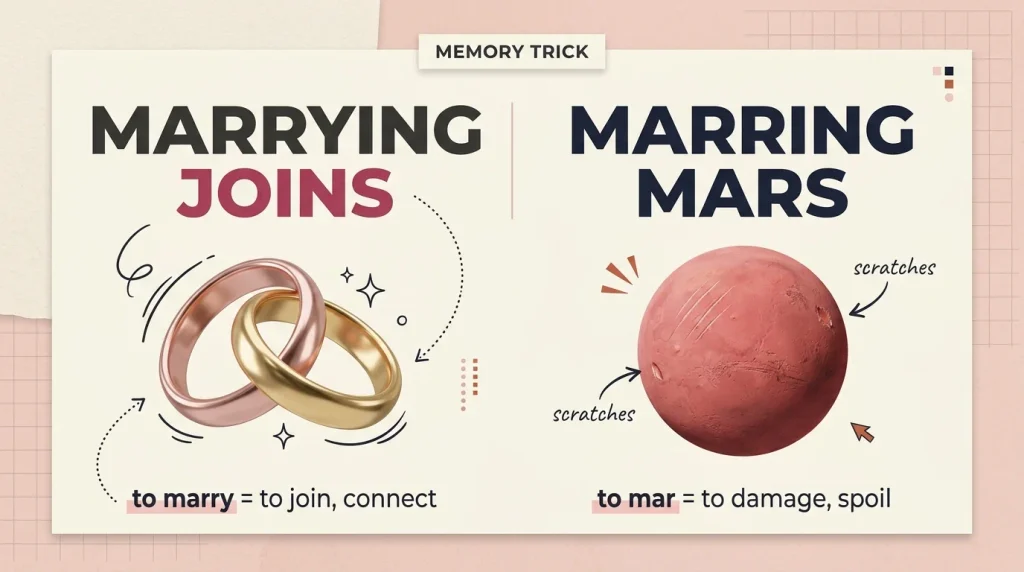
Marrying joins. Marring mars.
The word marring contains mar, and mar means to spoil or damage.
Think:
Marrying = marriage = joining
Marring = mar = damage
If the sentence is about two people or two things coming together, think marrying.
If something is making another thing worse, think marring.
Real-Life Situations
At a wedding
Someone asks:
“When are they marrying?”
The answer refers to their wedding or marriage.
Correct: They are marrying in October.
In a workplace meeting
A manager wants to describe a combination of approaches:
“We need to marry the old process with the new technology.”
Here marry means combine.
In a product review
A reviewer notices a visible defect:
“The deep scratch is marring the otherwise excellent finish.”
Here mar means spoil.
In an email
A colleague discusses two approaches:
“The proposal does a good job of marrying creativity with practicality.”
The two qualities are being combined.
In an exam
A student writes:
“The spelling mistake is marrying the quality of the essay.”
The intended meaning is negative, so the correct word is:
“The spelling mistake is marring the quality of the essay.”
Mini Quiz
| # | Question | Answer | Explanation |
|---|---|---|---|
| 1 | They are ___ next summer. A) marring B) marrying | B) marrying | The sentence refers to getting married. |
| 2 | A large stain was ___ the wall. A) marrying B) marring | B) marring | The stain is spoiling the wall’s appearance. |
| 3 | Fill in: The designer is ___ traditional style with modern materials. | marrying | Here marrying means combining. |
| 4 | Fill in: Several errors were ___ an otherwise strong report. | marring | The errors are negatively affecting the report. |
| 5 | Correct the sentence: “They are marring in June.” | They are marrying in June. | The intended meaning is getting married. |
| 6 | Correct the sentence: “The scratch is marrying the surface.” | The scratch is marring the surface. | A scratch damages or spoils a surface. |
| 7 | Which word comes from mar? A) marrying B) marring | B) marring | Marring is the present participle of mar. |
| 8 | Which word can mean combining two qualities? A) marrying B) marring | A) marrying | Marry can figuratively mean combine. |
| 9 | Which sentence is correct? A) The defect is marrying the finish. B) The defect is marring the finish. | B) The defect is marring the finish. | The defect is spoiling the finish. |
| 10 | Which sentence is correct? A) The company is marring tradition with innovation. B) The company is marrying tradition with innovation. | B) The company is marrying tradition with innovation. | The sentence describes combining two elements. |
Expert Tips
Look at the base verb first
When you are unsure about an -ing word, remove -ing.
- marrying → marry
- marring → mar
Then ask what the base verb means.
This is often more reliable than trying to memorize the two spellings separately.
Read More: Slew vs Slough: What’s the Difference?
Look for the emotional direction
Ask whether something is being joined or spoiled.
- Joined or combined → marrying
- Spoiled or damaged → marring
Do not rely entirely on spellcheck
Both marrying and marring are correctly spelled English words. A spellchecker may therefore accept the wrong one if it fits the grammar of the sentence.
The real problem can be word choice, not spelling.
Remember that “marry” has a broader meaning
Do not restrict marrying to romantic relationships.
You can marry:
- tradition and innovation
- theory and practice
- form and function
- old techniques and new technology
In these cases, the word means combine.
Remember that “mar” can be abstract
Something does not have to be physically broken for it to be marred.
A mistake can mar a report.
A disagreement can mar an event.
A defect can mar a design.
An error can mar an otherwise successful performance.
The central idea is that something has been made less good, attractive, enjoyable, or successful.
FAQ
Is “marrying” a correct word?
Yes. Marrying is the present participle of the verb marry. It can refer to getting married or to combining two things or qualities.
Is “marring” a correct word?
Yes. Marring is the present participle of mar. It means damaging, spoiling, or making something less good or enjoyable.
Is marring the same as marrying?
No. They have completely different meanings. Marrying relates to marriage or combination, while marring relates to damage or spoiling.
Can “marrying” mean combining things?
Yes. The verb marry has a figurative use meaning to combine different qualities or elements. For example, “The design marries simplicity with functionality.”
Does “marring” always mean physical damage?
No. Mar can describe damage to an appearance, quality, experience, event, argument, or achievement. Something can be marred without being physically broken.
Is “marring” a formal word?
It can be. Mar is commonly treated as a formal verb, so marring can sound more polished or literary than everyday alternatives such as “spoiling” or “ruining.”
Which is correct: “marrying” or “marring”?
Both are correct words. The correct choice depends on your intended meaning. Use marrying for marriage or combination and marring for damage or spoiling.
Can you use “marrying” for objects?
Yes, when marry is being used figuratively to mean combine.
For example:
The designer is marrying wood with metal.
Can you use “marring” for a person?
Usually, mar takes something that can be negatively affected rather than simply meaning that a person is physically harmed. For example, “The scandal marred his reputation” means the scandal damaged his reputation.
What is an easy way to remember marrying vs marring?
Remember:
Marrying joins. Marring mars.
If something is being brought together, choose marrying. If something is being spoiled, choose marring.
Quick Summary
Marrying and marring are both correct English words, but they come from different verbs and have different meanings. Marrying is the present participle of marry and means getting married or, figuratively, combining two things. Marring is the present participle of mar and means damaging, spoiling, or making something less good or enjoyable. Use marrying for relationships, combinations, and blended qualities; use marring for defects, errors, damage, and negative effects. The words are spelled the same in American and British English. The easiest memory trick is: “Marrying joins; marring mars.” Always choose the word based on the meaning of your sentence, not simply how similar the two spellings look.



Pingback: Needs vs. Wants: The Difference Most People Get Wrong.