


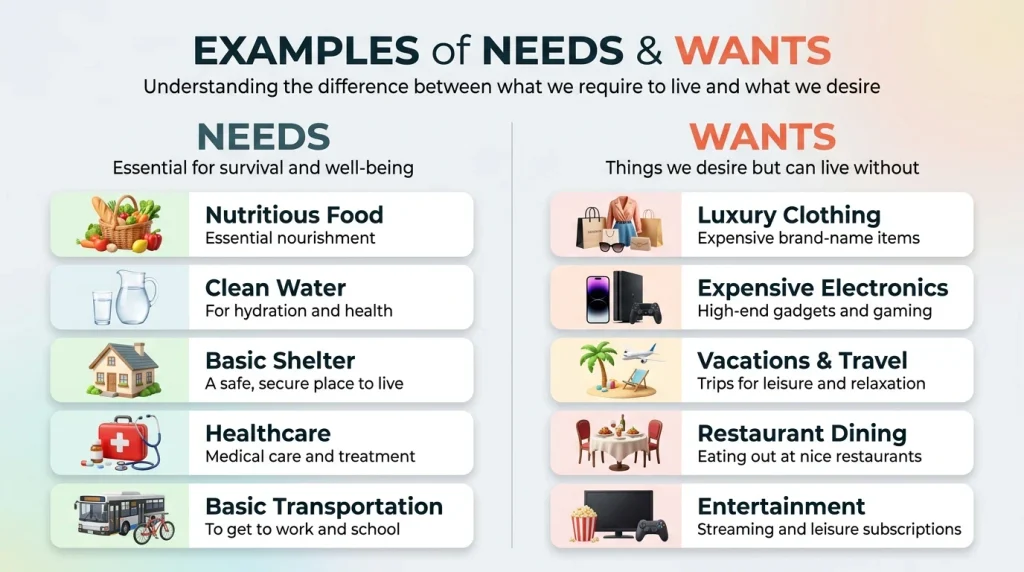
The difference between needs and wants is that needs are things essential for survival, health, safety, or basic well-being, while wants are things people desire to make life more comfortable, enjoyable, or convenient. Food, water, shelter, and basic healthcare are needs. Designer clothes, luxury vacations, and the latest smartphone are generally wants. The distinction depends on whether something is essential or simply preferred in a particular situation.
What Are Needs and Wants?
Needs and wants are two categories of things people consider when making decisions about how to spend money, use resources, and manage their daily lives.
A need is something necessary for a person’s basic survival, health, safety, or ability to function. A want is something a person would like to have but can generally live without.
For example, everyone needs food to stay healthy. However, choosing an expensive restaurant instead of preparing a meal at home is usually a want. The food itself meets a need, while the particular dining experience is a preference.
The difference is not always about the product itself. It is often about the purpose, circumstances, and available alternatives.
Consider these examples:
- Housing: A safe place to live is a need, but a large luxury house is generally a want.
- Clothing: Basic clothing appropriate for the weather is a need, while expensive designer outfits are usually wants.
- Transportation: Getting to work or school may require transportation, but purchasing a luxury sports car is a want.
- Technology: Access to a working device may be necessary for education or employment, while upgrading to the newest model for its extra features is generally a want.
- Healthcare: Necessary medical treatment is a need, while an optional cosmetic procedure is generally a want.
Understanding these categories helps people recognize the difference between what is essential and what they simply prefer.
Read More: Marrying vs Marring: Meaning, Difference & Correct Usage.
Why Does the Difference Between Needs and Wants Matter?
Knowing the difference between needs and wants is important because people have limited money, time, and resources. They cannot always afford or obtain everything they desire.
When people treat every want as a need, they may spend more than they can afford and overlook important responsibilities.
For example, imagine someone receives their monthly salary and immediately spends a large amount on new clothes, entertainment, and restaurant meals. They may later struggle to pay rent, purchase groceries, or cover transportation expenses.
Recognizing needs and wants encourages better decisions.
Here is why the distinction matters:
Better Money Management
People can create more realistic budgets when they identify essential expenses before spending money on optional purchases.
Less Unnecessary Spending
Recognizing wants makes it easier to avoid impulse purchases, unnecessary upgrades, and expenses that do not provide lasting value.
Financial Security
Prioritizing essential expenses and planning for emergencies can help people prepare for unexpected situations.
More Informed Decisions
The distinction encourages people to consider whether a purchase solves a genuine problem or simply satisfies a temporary desire.
Achieving Long-Term Goals
When people control unnecessary spending, they may have more resources available for education, savings, housing, and other important goals.
The main idea is not that wants are bad. Enjoyment and comfort are also important parts of life. The goal is to make sure that optional spending does not interfere with essential responsibilities.
The Core Rule: How to Identify Needs and Wants
If you require something for basic survival, health, safety, or essential daily functioning, it is generally a need.
Examples: Basic food, safe housing, essential medicine, and necessary transportation.
WANT
If something is desirable but you can reasonably live or function without it, it is generally a want.
Examples: Luxury clothing, expensive holidays, premium entertainment, and unnecessary upgrades.
A simple question can help you decide:
Would I still be able to meet my basic needs and carry out essential responsibilities without this particular item or service?
- If the answer is no, it may be a need.
- If the answer is yes, it is probably a want.
- If the answer depends on your circumstances, examine the purpose and available alternatives.
Remember that this is a practical guideline, not an absolute rule. The same item can be a need for one person and a want for another.
How to Identify Needs and Wants in Everyday Life
The easiest way to distinguish needs from wants is to examine why you need something, what happens if you do not have it, and whether a simpler alternative can meet the same requirement.
Use these steps before making a purchase.
Step 1: Identify the Purpose
Ask yourself why you want the product or service.
Are you purchasing it because it solves an essential problem, or because you like its appearance, features, or convenience?
For example, purchasing a basic winter jacket because you live in a cold climate meets a practical need. Buying another expensive jacket simply because it is fashionable is generally a want.
Step 2: Consider the Consequences of Going Without It
Think about what would happen if you did not purchase the item.
If not having it would seriously affect your health, safety, or ability to manage essential responsibilities, it may be a need.
If you can comfortably continue your daily activities without it, it is more likely to be a want.
Step 3: Look for a Basic Alternative
Sometimes, the need is genuine, but the particular product you prefer is not essential.
For example, transportation may be necessary to reach your workplace. However, a luxury car is not necessarily required when a reliable, affordable vehicle or public transportation can meet the same need.
Separate the essential function from the optional features.
Step 4: Consider Your Personal Situation
Your circumstances can change how you classify something.
A laptop may be a want for someone who already has a suitable computer at home. However, it may be a need for a university student whose education requires one.
Similarly, a car may be essential for someone who lives far from public transportation but unnecessary for someone who can easily walk or use public transit.
Step 5: Prioritize Your Spending
Once you identify your needs and wants, organize your expenses according to importance.
A practical priority order is:
- Cover essential living expenses, including housing, food, utilities, and healthcare.
- Set aside money for important financial responsibilities and emergency savings.
- Pay for necessary transportation, education, and work-related expenses.
- Allocate available money to entertainment, shopping, hobbies, and other wants.
This approach helps you enjoy optional purchases without neglecting important responsibilities.
Examples of Needs and Wants
Needs and wants appear in almost every part of everyday life. The following examples show how to distinguish between them.
Food and Groceries
Food is a basic human need because the body requires nutrition to function properly.
However, not every food purchase is essential.
| Situation | Classification | Reason |
|---|---|---|
| Buying rice and vegetables | Need | Provides essential nutrition. |
| Purchasing drinking water | Need | Necessary for hydration where safe water is unavailable. |
| Buying expensive chocolates | Want | An optional treat. |
| Ordering restaurant food regularly | Usually want | A convenience or dining preference. |
| Purchasing groceries for the week | Need | Supports regular meals. |
| Buying premium imported snacks | Want | More expensive alternatives are not usually essential. |
The important distinction is between needing nourishment and preferring a particular type of food.
Housing and Accommodation
A safe place to live is a fundamental need. People require shelter to protect themselves from weather, danger, and other environmental conditions.
However, the size, location, and luxury level of a home may reflect personal wants.
| Situation | Classification | Reason |
|---|---|---|
| Paying basic rent | Need | Provides necessary shelter. |
| Having a safe place to sleep | Need | Supports health and safety. |
| Buying a luxury mansion | Want | Goes beyond basic housing requirements. |
| Installing an expensive home theater | Want | Provides optional entertainment. |
| Paying essential electricity bills | Need | Supports basic household functioning. |
| Adding a swimming pool | Want | An optional luxury feature. |
A larger home may be necessary for a family with specific space or accessibility requirements, so context still matters.
Clothing and Personal Care
Clothing protects people from weather and supports basic hygiene, comfort, and appropriate participation in everyday activities.
Fashion preferences, however, can turn ordinary purchases into wants.
| Situation | Classification | Reason |
|---|---|---|
| Buying weather-appropriate clothing | Need | Provides protection. |
| Purchasing basic shoes | Need | Supports everyday movement. |
| Buying a designer handbag | Want | Primarily a style preference. |
| Purchasing another pair of fashionable shoes | Usually want | Optional if suitable footwear is already available. |
| Buying necessary hygiene products | Need | Supports personal hygiene. |
| Getting an expensive beauty treatment | Usually want | An optional service rather than a basic necessity. |
Education and Technology
Education and technology can serve both essential and optional purposes.
For example, a student may need a computer to complete assignments, attend online classes, or access learning materials. However, the latest premium laptop is not automatically a need.
| Situation | Classification | Reason |
|---|---|---|
| Buying required textbooks | Need | Supports required learning. |
| Purchasing a suitable laptop for online classes | Need | May be necessary for education. |
| Upgrading to a premium gaming laptop | Want | Extra gaming performance is optional. |
| Paying essential internet expenses | Need | May be necessary for work or education. |
| Purchasing a gaming console | Want | Primarily provides entertainment. |
| Buying optional online subscriptions | Want | Provides additional convenience or entertainment. |
Transportation can be a need when someone must travel for work, education, healthcare, or other essential responsibilities.
However, the most expensive transportation option is not necessarily required.
| Situation | Classification | Reason |
|---|---|---|
| Bus fare to work | Need | Enables necessary travel. |
| Fuel for essential commuting | Need | Supports transportation. |
| Buying a basic reliable vehicle | May be a need | Depends on available alternatives. |
| Purchasing a luxury sports car | Want | Offers optional features and status. |
| Taking a private helicopter trip | Want | A luxury transportation choice in ordinary circumstances. |
| Paying for optional sightseeing tours | Want | Provides recreation. |
Correct vs. Incorrect Classification of Needs and Wants
People sometimes confuse an essential requirement with a preferred product or service. The following table shows common classification mistakes and their more accurate alternatives.
Here, incorrect means an inaccurate general classification, not an incorrect English sentence. Individual circumstances can change some answers.

| Incorrect classification | More accurate classification | Why |
|---|---|---|
| Every expensive house is a need. | Basic, safe housing is a need; luxury features are generally wants. | Shelter is essential, but luxury is optional. |
| The latest smartphone is a need. | A suitable working phone may be a need; the newest model is usually a want. | Essential communication does not require the newest technology. |
| Restaurant meals are always needs. | Food is a need; restaurant dining is usually a want. | Basic nutrition can be obtained through different options. |
| Designer clothing is a need. | Suitable clothing is a need; designer labels are generally wants. | Brand preference does not create a basic necessity. |
| Every car is a need. | Necessary transportation is a need; owning a particular car may be a want. | Public transportation or another option may be available. |
| Entertainment is always a need. | Basic well-being matters, but premium entertainment is generally a want. | Expensive entertainment services are optional. |
| Every laptop upgrade is necessary. | A functional device may be necessary; unnecessary upgrades are wants. | Existing equipment may already meet the requirement. |
| Saving money is only a want. | Financial preparation can be an important need. | Emergency savings help protect future financial security. |
| All gym memberships are needs. | Physical activity supports health; a paid gym membership is one optional way to exercise. | Walking and home exercise may be alternatives. |
| Every vacation is a need. | Rest and recreation matter, but expensive vacations are generally wants. | A luxury trip is not essential for basic living. |
Why Do People Confuse Needs and Wants?
Although the basic difference seems simple, people do not always make accurate decisions. Several factors make the distinction more complicated.
1. Advertising Makes Wants Feel Necessary
Marketing often presents products as essential for happiness, success, confidence, or social acceptance.
For example, an advertisement may suggest that someone needs the newest smartphone to stay productive and connected.
Although a smartphone can be useful or necessary in certain circumstances, upgrading a perfectly functional device is usually a want.
Read More: Ten vs 10: Which One Should You Use?
2. Social Pressure Influences Spending
People sometimes purchase things because their friends, colleagues, or family members own them.
Someone may feel pressured to buy expensive clothing, a particular vehicle, or the latest electronics to fit into a social group.
The desire to fit in does not automatically make a purchase necessary.
3. Convenience Is Mistaken for Necessity
Convenience makes life easier, but something convenient is not always essential.
For example, ordering food through a delivery service may save time. However, if someone has access to groceries and can prepare meals, the delivery service is generally an optional convenience.
4. Personal Habits Change Perceptions
When people become accustomed to certain comforts, they may begin to view them as necessities.
A person who regularly drinks premium coffee may feel that purchasing it every morning is essential. However, the coffee itself may be a preference rather than a basic requirement.
5. Individual Circumstances Are Different
A purchase that is optional for one person may be necessary for someone else.
A car may be unnecessary for someone living near their workplace and public transportation. However, it may be essential for someone living in a remote area with limited transport options.
This is why needs and wants should not always be classified without considering the person’s situation.
Common Mistakes When Identifying Needs and Wants
Understanding the definitions is only the beginning. People also need to recognize common mistakes when applying these concepts.
Treating Every Preference as a Need
What happens: Someone believes that a particular brand, product, or experience is essential simply because they prefer it.
Why it happens: Familiarity and personal attachment can make optional purchases feel necessary.
How to avoid it: Identify the actual purpose of the purchase and consider whether a less expensive alternative would meet the same requirement.
Ignoring Future Needs
What happens: Someone spends all available money on current wants without considering future responsibilities.
Why it happens: Immediate enjoyment can feel more rewarding than preparing for uncertain expenses.
How to avoid it: Include savings, emergency funds, and upcoming essential expenses in your financial planning.
Assuming Cheap Means Necessary
What happens: A person assumes that an inexpensive purchase must be a need.
Why it happens: Price and necessity are different concepts.
How to avoid it: Judge purchases by their purpose, not simply by their cost. A cheap decorative item can still be a want.
Assuming Expensive Means Unnecessary
What happens: Someone believes that every expensive purchase is automatically a want.
Why it happens: People associate necessity with low cost.
How to avoid it: Consider the circumstances. Essential medical treatment, specialized equipment, or necessary accessibility products can be expensive.
Forgetting That Needs Can Change
What happens: Someone continues using an old spending plan even after their circumstances change.
Why it happens: People may not reconsider their priorities regularly.
How to avoid it: Review your needs whenever your income, employment, health, household size, or living situation changes.
Needs vs. Wants in Real Life
The distinction becomes clearer when we look at how people actually make decisions.
There are three important ways to understand the difference:
Essential Requirement
A basic need is something a person genuinely requires to maintain an acceptable level of health, safety, or daily functioning.
For example, someone who lives in an area with freezing winters needs suitable clothing to stay warm. Without it, their health and safety could be affected.
Necessary Purpose, Optional Choice
Sometimes the purpose is essential, but the specific choice is not.
A student may need a computer for university assignments. However, choosing a high-end gaming laptop instead of an affordable device that meets the course requirements is generally a preference.
Both choices serve the same basic purpose, but only the functional device is necessary.
Natural Everyday Preference
Wants are not negative. People naturally desire comfort, entertainment, convenience, and enjoyable experiences.
Someone may want to visit a restaurant, purchase fashionable clothing, or travel during a holiday. These are ordinary preferences, provided they do not interfere with essential responsibilities.
The important point is to distinguish between what you need to accomplish something and how you would prefer to accomplish it.
Read More: Responsibility vs Responsability: Which Is Correct?
Are Needs and Wants Different for Everyone?
Yes. Needs and wants can vary depending on a person’s age, health, occupation, location, responsibilities, and financial circumstances.
For example, consider three different people:
- A university student: A laptop may be a need if online assignments and classes require one.
- A delivery driver: A reliable vehicle or motorcycle may be a need because it supports their employment.
- An office employee: A personal vehicle may be a want if public transportation provides a practical way to reach work.
The product itself does not determine its category. Its purpose and the person’s situation are equally important.
Other examples include:
| Item | When It May Be a Need | When It May Be a Want |
|---|---|---|
| Smartphone | Essential communication or work | Replacing a working phone for a newer model |
| Internet | Required for work or education | Additional premium entertainment services |
| Car | No practical alternative for essential travel | Luxury or recreational driving |
| Medicine | Necessary prescribed treatment | Optional nonessential products |
| Laptop | Required for education or employment | Premium upgrades beyond actual requirements |
| Clothing | Protection from weather | Fashion-focused purchases |
| Accommodation | Safe and suitable housing | Additional luxury space or features |
| Childcare | Necessary for work or essential responsibilities | Optional additional services beyond the required care |
This flexibility is important. A fixed list cannot accurately classify every purchase for every person.
Needs vs. Wants vs. Desires
Needs, wants, and desires are related concepts, but they are not identical.
A need is an essential requirement. A want is something a person would like to have. A desire can describe a strong personal wish or ambition.
For example, someone needs transportation to reach work. They may want a comfortable car and desire a particular luxury sports car.
The three concepts can overlap in everyday language, but distinguishing them helps explain why people make certain spending decisions.
| Feature | Needs | Wants | Desires |
|---|---|---|---|
| Basic meaning | Essential requirements | Things people would like to have | Strong wishes or aspirations |
| Necessity | Generally essential | Generally optional | Not necessarily essential |
| Main purpose | Survival and basic well-being | Comfort and enjoyment | Personal satisfaction or ambition |
| Examples | Food, shelter, healthcare | Dining out, entertainment | Dream home, luxury vehicle |
| Spending priority | High | After essential expenses | Depends on affordability and goals |
| Can change with circumstances? | Yes | Yes | Yes |
One important distinction is that desires can be stronger than ordinary wants. However, a strong desire does not make something a genuine necessity.
How to Create a Budget Based on Needs and Wants
A budget is a plan for how you will use your available money. Separating needs and wants is one of the most practical ways to create a realistic spending plan.
The popular 50/30/20 budgeting method offers a starting point:
The 50/30/20 Budgeting Method
50% — Needs
50%
Housing, groceries, utilities, healthcare, and essential transportation.
30% — Wants
30%
Dining out, hobbies, entertainment, shopping, and optional purchases.
20% — Savings and Debt Repayment
20%
Savings, emergency funds, and additional debt payments.
Illustrative budgeting guideline. Actual percentages should reflect income, essential costs, and financial obligations.
For example, if someone earns $2,000 per month, the suggested allocation would be:
| Budget Category | Percentage | Amount |
|---|---|---|
| Needs | 50% | $1,000 |
| Wants | 30% | $600 |
| Savings and debt repayment | 20% | $400 |
| Total | 100% | $2,000 |
This method is a guideline, not a strict requirement. Someone with high housing costs, medical expenses, or limited income may need to allocate more than 50% to necessities.
The most important principle is to cover essential expenses and plan for financial security before increasing optional spending.
Memory Trick: How to Remember Needs vs. Wants
An easy way to remember the difference is:
NEED = Necessary to live or function.
WANT = Would be nice to have.
Think about purchasing a pair of shoes.
- If your current shoes are damaged and you need suitable footwear, buying another pair is a need.
- If you already have several suitable pairs but want a fashionable new design, buying another pair is a want.
You can also remember this simple question:
Need it to function, or want it for enjoyment?
This small test can help you make better decisions when shopping, planning a budget, or explaining the difference to someone else.
Read More: Superseded vs Superceded: Which Spelling Is Correct?
Real-Life Situations:
Needs and Wants in Action
The following situations show how people can apply the distinction in everyday decisions.
Situation 1: Shopping at a Grocery Store
Sara visits a supermarket to purchase food for her family. She adds vegetables, rice, milk, and bread to her shopping cart. She also considers purchasing expensive chocolates and imported snacks.
Explanation: Basic groceries are needs because they provide essential nutrition. The chocolates and premium snacks are wants because they are optional treats.
Situation 2: Choosing a Smartphone
Ahmed’s smartphone stops working, and he needs a replacement to communicate with clients and manage his work. He considers purchasing either an affordable model or an expensive flagship phone.
Explanation: Having a suitable working phone may be a need because of his employment responsibilities. Purchasing the most expensive model is a want if a cheaper device meets those requirements.
Situation 3: Planning a Family Budget
A family receives its monthly income. They need to pay rent, electricity bills, groceries, and school expenses. They also want to purchase a new television.
Explanation: Essential household and education expenses should generally receive priority. The television can be purchased later if enough money remains.
Situation 4: Preparing for a Job Interview
A job applicant needs appropriate clothing for an interview. They already own a clean, suitable outfit but are considering buying an expensive designer suit.
Explanation: Appropriate interview clothing may be a practical need. A particular designer brand is a want unless the situation genuinely requires specific clothing.
Situation 5: Planning a Holiday
A couple has saved money for essential household expenses and wants to travel during their annual leave. They consider staying in a luxury resort instead of choosing affordable accommodation.
Explanation: The holiday is generally a want, although rest and recreation can support well-being. The luxury resort is an additional preference.
Situation 6: Studying for University
A student needs internet access and a suitable laptop to complete online coursework. They also want a premium tablet for entertainment.
Explanation: The laptop and internet may be educational needs. The additional tablet is a want if it is not required for the student’s studies.
Expert Tips for Making Better Needs and Wants Decisions
The following practical tips can help you make more thoughtful choices.
- Separate the need from the brand: You may need a product, but you do not necessarily need a particular brand.
- Avoid emotional purchases: Give yourself time before purchasing something you did not originally plan to buy.
- Compare alternatives: Check whether a more affordable option can perform the same essential function.
- Consider long-term value: A purchase that protects your health, supports your education, or helps you earn an income may be more important than a temporary pleasure.
- Do not eliminate every want: A balanced financial plan should also leave room for enjoyment when affordable.
- Review your priorities regularly: Your needs may change when your responsibilities, health, income, or living situation change.
- Distinguish between need and urgency: An item can be a genuine need without requiring immediate purchase, while some optional purchases can feel urgent because of advertising or limited-time offers.
A useful habit is to pause and ask yourself three questions before spending:
- What problem does this purchase solve?
- Do I already have something that can do the same job?
- Will purchasing it interfere with my essential expenses or financial goals?
These questions make it easier to recognize unnecessary spending without feeling that every enjoyable purchase is irresponsible.
Quick Summary: Needs vs. Wants
Needs are essential things people require for survival, health, safety, and basic daily functioning. Wants are things people desire because they provide additional comfort, enjoyment, convenience, or satisfaction. Food, safe housing, basic clothing, and necessary healthcare are examples of needs, while luxury products, expensive vacations, and optional entertainment are generally wants. However, the same item can be a need for one person and a want for another, depending on their circumstances. The easiest way to tell them apart is to ask whether you genuinely require something or simply prefer having it. Understanding this difference helps people prioritize essential expenses, control unnecessary spending, build savings, and make more responsible financial decisions.
Frequently Asked Questions (FAQs)
What is the main difference between needs and wants?
Needs are essential requirements for survival, health, safety, or basic functioning. Wants are optional things people desire for additional comfort, convenience, or enjoyment. For example, food is a need, but ordering an expensive restaurant meal is generally a want.
Are needs more important than wants?
Generally, yes. Needs should receive priority because they support essential living requirements. However, wants also have value because entertainment, hobbies, and enjoyable experiences contribute to quality of life. A healthy financial plan makes room for both when possible.
Can something be both a need and a want?
Yes. The same product can serve an essential purpose while also offering optional features. For example, a smartphone may be necessary for someone’s employment, but purchasing a premium model with extra features may be a want.
Is money a need or a want?
Money is not usually classified as a basic physical need itself, but it is an important resource for obtaining necessities such as food, housing, healthcare, and transportation. Having sufficient financial resources helps people meet their needs and prepare for future expenses.
Is education a need or a want?
Education is important for personal development, employment opportunities, and participation in society. Basic education is widely considered an essential need. However, particular courses, premium training programs, and optional qualifications may be wants depending on someone’s circumstances and goals.
Is saving money a need or a want?
Saving money can be an important financial need because it helps people prepare for emergencies, future expenses, and unexpected changes in income. Although the amount someone can save depends on their circumstances, planning for financial security is an important habit.
Is internet access a need or a want?
Internet access can be a need when it is required for education, employment, essential communication, or accessing important services. However, premium subscriptions, additional entertainment packages, and optional online services are generally wants.
Why do people confuse needs with wants?
People often confuse the two because advertising, social pressure, convenience, and personal habits influence purchasing decisions. A product may feel essential simply because someone is accustomed to using it. Considering its actual purpose and available alternatives can help identify whether it is a need or a want.
Are wants always unnecessary?
No. Wants are not automatically wasteful or irresponsible. They provide enjoyment, comfort, and personal satisfaction. The important thing is to manage them according to your available resources and avoid allowing optional spending to interfere with essential expenses.
How can children learn the difference between needs and wants?
Children can learn through everyday examples and simple shopping activities. Ask them to separate essential items, such as food and school supplies, from optional purchases, such as toys and sweets. Discussing why each item belongs in a particular category helps develop decision-making and money-management skills.
What is the easiest way to remember needs vs. wants?
Remember that a need is something necessary to live or function, while a want is something you would like to have. Ask yourself: Can I reasonably manage without this item? If yes, it is probably a want rather than a need.
Mini Quiz:
Test Your Understanding of Needs vs. Wants
Test what you have learned with these 10 questions. Each question includes the correct answer and an explanation.
| No. | Question | Answer and Explanation |
|---|---|---|
| 1 | Which is generally a basic need? A) Luxury watch B) Drinking water C) Designer handbag | Answer: B) Drinking water. Water is essential for hydration and survival. |
| 2 | A person already owns a working phone but wants the newest model. Is the upgrade a need or a want? | Answer: Want. The existing phone already meets the person’s basic communication needs. |
| 3 | Fill in the blank: Food, shelter, and basic healthcare are examples of ______. | Answer: Needs. They support basic survival, health, and well-being. |
| 4 | Which is generally a want? A) Basic groceries B) Necessary medicine C) Luxury vacation | Answer: C) Luxury vacation. It is an optional recreational expense. |
| 5 | A student needs a laptop for mandatory online classes. Is the laptop a need or a want? | Answer: Need. A suitable laptop is necessary for the student’s educational responsibilities in this situation. |
| 6 | True or false: An expensive purchase is always a want. | Answer: False. Some essential medical treatments, equipment, and accessibility products can be expensive. |
| 7 | Fill in the blank: A ______ is something desirable but not generally essential for basic living. | Answer: Want. Wants provide additional comfort, convenience, or enjoyment. |
| 8 | Someone needs transportation to work but purchases a luxury sports car when affordable alternatives are available. Which part is the want? | Answer: The luxury sports car. Transportation may be a need, but choosing a luxury vehicle is an optional preference. |
| 9 | Correct the statement: Every restaurant meal is a basic need. | Answer: Food is a need, but restaurant dining is generally a want. People can meet their nutritional requirements through other options. |
| 10 | A person pays rent, buys groceries, and then spends the remaining money on entertainment. Is this a sensible spending priority? | Answer: Generally, yes. Covering essential expenses before optional entertainment is a sensible budgeting approach, provided other important obligations are also considered. |


Pingback: Forward vs Foward: Which Spelling Is Correct?