
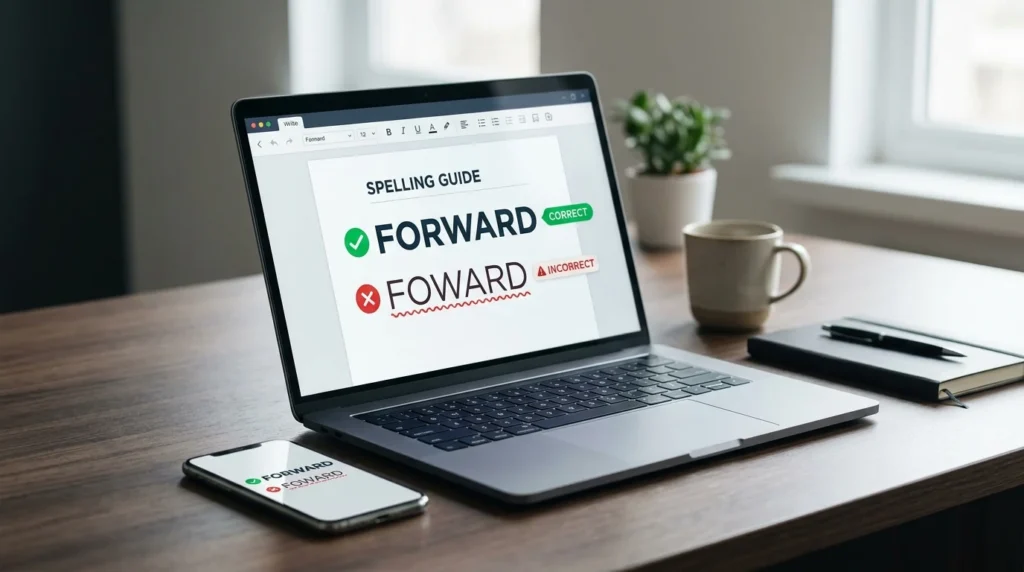

Forward is the correct spelling. Foward is an incorrect spelling caused by dropping the first r. Use forward when you mean moving toward the front, progressing, looking toward the future, or sending something onward. For example, write “I look forward to hearing from you,” not “I look foward to hearing from you.”
What Is the Difference Between Forward and Foward?
There is no true meaning difference between forward and foward because only forward is a standard English word.
Forward is the correct spelling and can function as an adverb, adjective, verb, and noun. Depending on the sentence, it can describe movement toward the front, progress, something positioned near the front, sending something onward, or a player positioned toward the front of a team.
Foward, on the other hand, is simply a misspelling of forward. It does not represent a different English word, a special informal form, or an alternative spelling.
The simplest rule is:
Use forward. Never use foward in standard English writing.
The mistake is easy to make because the first r in forward can be less noticeable in rapid or relaxed pronunciation. When people spell a word from the way it sounds, they may accidentally leave that letter out.
So if you are writing an email, school assignment, résumé, report, text message, or article, choose forward.
Why It Matters
A missing letter may seem like a tiny mistake, but spelling errors can affect how polished your writing looks.
The word forward appears in many common expressions:
- look forward to
- move forward
- move forward with a plan
- step forward
- go forward
- bring forward
- come forward
- forward an email
- fast-forward
- from this day forward
Because these expressions are common in everyday and professional English, writing foward can make an otherwise clear sentence look careless.
Consider a business email:
I look foward to discussing the proposal with you.
The meaning is still understandable, but the spelling is incorrect.
The professional version is:
I look forward to discussing the proposal with you.
The correction is only one letter, but that letter belongs there every time.
The Core Rule
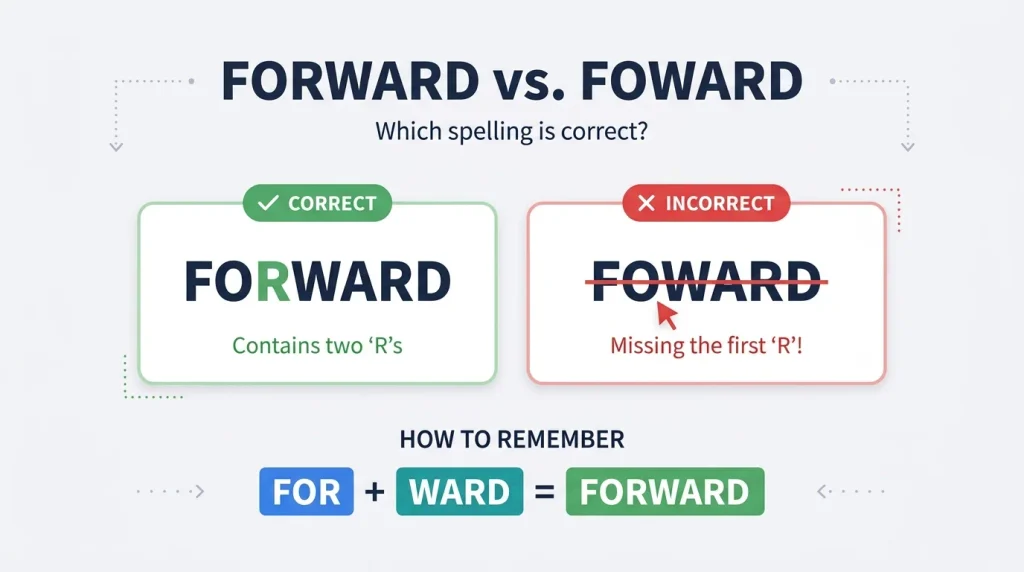
FORWARD = correct
FOWARD = incorrect
Remember that forward contains two r’s:
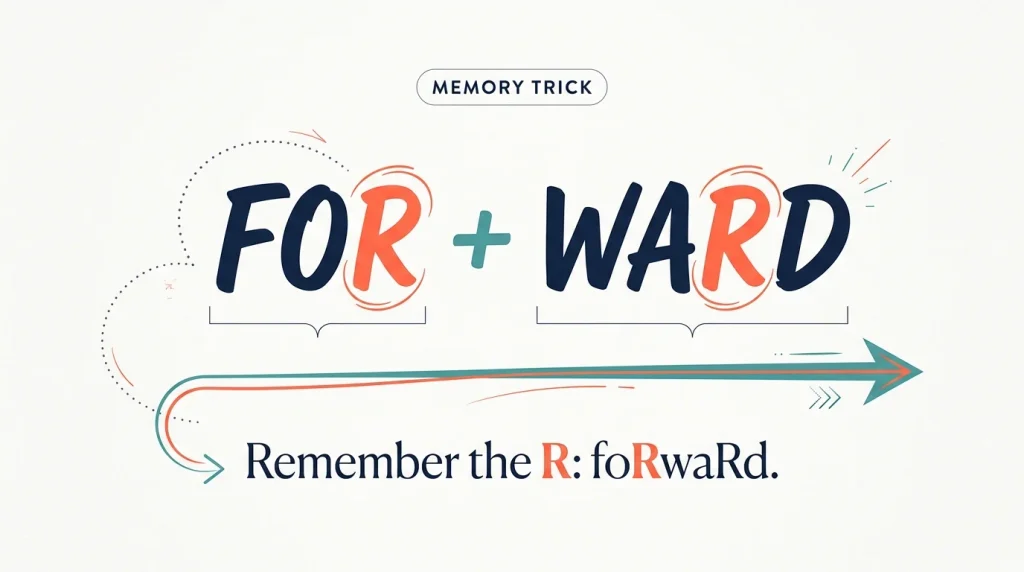
foRwaRd
The first r comes before w, and the second appears near the end.
If you write foward, the first r has disappeared.
The easiest rule to remember
Move foRward, not foward.
When you are unsure, mentally split the word:
for + ward = forward
Do not spell it only by the way it sounds.
How to Use Forward
Forward has several legitimate uses, so understanding the word itself makes the spelling easier to remember.
Forward as an Adverb
An adverb can describe how, where, or in what direction something happens.
Forward can mean toward the front or ahead.
Examples:
- She stepped forward.
- He leaned forward.
- The car moved forward.
- Please look forward.
- The children ran forward.
It can also describe progress:
- The project is moving forward.
- We need to move forward with the plan.
- The investigation is finally moving forward.
It can refer to a later point in time:
- From this day forward, things will be different.
- The rule will apply from tomorrow forward.
Read More: Needs vs. Wants: The Difference Most People Get Wrong.
Forward as an Adjective
As an adjective, forward describes a noun.
Examples:
- The forward door was damaged.
- The team made a forward movement.
- The aircraft has a forward cabin.
- We need better forward planning.
- The player took a forward position.
It can also describe someone who is excessively confident or familiar in a social situation:
His comments were a little too forward.
Here, forward does not mean physically moving ahead. It describes behavior.
Forward as a Verb
Forward can also be a verb meaning to send something onward to another person or destination.
Examples:
- Please forward the email to Sarah.
- I will forward the document this afternoon.
- Could you forward the message to the manager?
- The office forwarded my application to the correct department.
This use is especially common in email and workplace communication.
Forward as a Noun
In sports, a forward can be a player whose position is toward the attacking end of the field or court.
For example:
The forward scored twice during the match.
So forward is much more than a directional word. It has several grammatical and contextual uses.
Correct Examples
Here are examples showing how forward naturally appears in different types of English.
| Situation | Correct Example |
|---|---|
| Conversation | Take one step forward. |
| Text message | I’m looking forward to seeing you. |
| I look forward to your response. | |
| Workplace | Let’s move forward with the proposal. |
| School | The arrow points forward. |
| Academic writing | The findings may help move research forward. |
| Business | Please forward the invoice to accounting. |
| Social media | We need to move forward and focus on what comes next. |
| Interview | I’m looking forward to contributing to the team. |
| Formal writing | From this point forward, all requests must be submitted online. |
| Travel | Please move forward to the next counter. |
| Sports | The forward passed the ball to a teammate. |
Notice that the spelling remains forward in every case.
Incorrect vs. Correct
| ❌ Incorrect | ✅ Correct | Why |
|---|---|---|
| I look foward to meeting you. | I look forward to meeting you. | The spelling of the standard word is forward, with the first r. |
| Please move foward. | Please move forward. | The directional word requires the first r. |
| She stepped foward to speak. | She stepped forward to speak. | Foward is a misspelling, not a separate form. |
| We need to move foward. | We need to move forward. | The phrase uses the standard spelling forward. |
| I will foward the email. | I will forward the email. | Forward is also a verb meaning “send onward.” |
| Please look foward to the event. | Please look forward to the event. | The fixed expression is look forward to. |
| The project is moving foward. | The project is moving forward. | Progress is described with forward. |
| Take a step foward. | Take a step forward. | Directional use requires the correct spelling. |
| We should go foward with the plan. | We should go forward with the plan. | Go forward with is a standard expression. |
| The car rolled foward. | The car rolled forward. | The direction is forward, not foward. |
| I’m looking foward to Friday. | I’m looking forward to Friday. | The common phrase is look forward to. |
| She leaned foward to listen. | She leaned forward to listen. | Forward is the correct directional adverb. |
Why People Make This Mistake
The spelling error usually comes from the difference between pronunciation and spelling.
1. The first r can be easy to miss
In rapid speech, forward may not sound as clearly separated into for + ward as it looks when written.
A learner may hear something closer to:
fo-ward
and then reproduce that sound in writing:
foward
But English spelling does not always follow casual pronunciation exactly.
2. People type quickly
The word is frequently used in emails, messages, documents, and online writing. Because forward is familiar, writers may type it automatically and fail to notice the missing letter.
3. The word still looks believable
This is one reason the error can survive proofreading.
foward has a familiar-looking ending:
-ward
It therefore looks close enough to the correct word that a writer may overlook the missing r.
4. Spellcheck is not perfect
Spellcheck can be useful, but it should not replace proofreading. Different software tools have different correction behavior, and a writer should not assume that every typo will be detected automatically.
5. Translation and language interference
English learners may also experience interference from their first language. If a learner’s language does not represent the sound or spelling of forward in the same way, remembering the exact English spelling can take extra practice.
The solution is simple: memorize the written form forward, rather than trying to reconstruct it from pronunciation.
Read More: Marrying vs Marring: Meaning, Difference & Correct Usage.
Common Mistakes Checklist
Mistake 1: Dropping the first r
❌ foward
✅ forward
Why it happens: The first r may be less noticeable in quick speech.
How to avoid it: Remember for + ward.
Mistake 2: Writing “foreward”
❌ foreward
✅ forward
The correct word is not spelled foreward. The historical development of the word does not mean modern writers should insert e after for.
Mistake 3: Writing “forword”
❌ forword
✅ forward
The second part is -ward, not -word.
Mistake 4: Forgetting the spelling in “look forward to”
The standard expression is:
I look forward to hearing from you.
Not:
I look foward to hearing from you.
Mistake 5: Assuming “foward” is informal English
It is not a standard informal alternative. A text message does not make the spelling correct.
Forward in Real English
Natural and Standard
Forward is completely natural in everyday English when referring to direction, progress, future time, or sending something onward.
We need to move forward.
Please forward the message.
I look forward to seeing you.
These are ordinary expressions that work in both casual and professional communication.
Grammatically Possible but Context-Dependent
Some uses of forward are correct but depend strongly on context.
For example:
His behavior was forward.
This sentence can be grammatical, but the intended meaning is not simply “moving ahead.” In this use, forward describes someone who is overly confident, bold, or insufficiently reserved.
Similarly:
The company is looking forward.
This may be grammatical, but looking forward to something is normally the clearer expression when you mean anticipating a future event.
The lesson is that correct spelling does not automatically make every sentence natural. You must also choose the right meaning and construction.
Natural Everyday English
Some expressions are so established that they are worth learning as complete phrases:
- look forward to
- move forward
- go forward
- step forward
- come forward
- bring forward
- put forward
- forward an email
Learning these as chunks can be more useful than memorizing an isolated definition.
American vs. British English
There is no American-versus-British spelling difference between foward and forward.
Both varieties use:
forward
The useful regional distinction is forward vs. forwards.
In British English, forwards is commonly used as an adverb in expressions describing movement or direction:
She stepped forwards.
American English generally favors:
She stepped forward.
Both forward and forwards can occur in British English in appropriate adverbial uses. The important point for this article is that adding an s does not make foward correct.
Also remember that some fixed expressions use forward regardless of regional preference:
I look forward to hearing from you.
Please forward the email.
We look forward to working with you.
Do not change these to fowards simply because you are writing British English.
Formal vs. Informal Usage
Forward is appropriate in both formal and informal English.
Formal examples
We look forward to receiving your application.
Please forward the completed form to the administration office.
From this point forward, all requests must be submitted electronically.
Informal examples
I’m looking forward to the weekend.
Just forward me the message.
Let’s move forward.
There is no need to replace forward with another spelling in casual writing.
The incorrect foward does not become acceptable simply because the context is informal.
Forward vs. Foward Comparison Table
| Feature | Forward | Foward |
|---|---|---|
| Standard English spelling | Correct | Incorrect |
| Meaning | Has several meanings | No standard meaning |
| First r | Present | Missing |
| Can be an adverb | Yes | No |
| Can be an adjective | Yes | No |
| Can be a verb | Yes | No |
| Can be a noun | Yes | No |
| Used in “look forward to” | Yes | No |
| Used in business writing | Yes | No |
| Used in casual messages | Yes | No |
| Use in academic writing | Yes | No |
| Recommended spelling | Forward | Never use |
Memory Trick
Use this simple mnemonic:
FOR + WARD = FORWARD
The word contains FOR before WARD.
Another visual trick is:
foRwaRd
There are two r’s in the correct spelling.
You can also connect it with the opposite:
forward ↔ backward
Both words keep their r:
- forward
- backward
If you remember that the two directional words both contain r, you are less likely to write foward.
Real-Life Situations
1. In an interview
You want to describe your attitude toward a new position.
“I’m looking forward to contributing to the company.”
Not:
“I’m looking foward to contributing to the company.”
2. In a business email
You need a colleague to send a message to another department.
“Please forward the email to the finance team.”
Here, forward is a verb.
3. In a meeting
The team has agreed on its next step.
“Now we can move forward with the project.”
Here, forward describes progress.
4. In a text message
A friend asks whether you are excited about an upcoming event.
“Yes, I’m really looking forward to it.”
5. In an exam
A student describes movement:
“The runner moved forward after the starting signal.”
The spelling remains forward.
6. In academic writing
A researcher describes future progress:
“These findings may help move the field forward.”
7. In everyday conversation
Someone asks you to change position:
“Could you step forward for a moment?”
8. In an email reply
A professional closing might say:
“I look forward to hearing from you.”
This is one of the most important expressions to spell correctly.
Read More: Ten vs 10: Which One Should You Use?
Expert Tips
Learn the phrase, not just the word
Instead of memorizing only forward, practice common combinations:
- look forward to
- move forward
- go forward
- step forward
- come forward
- put forward
- bring forward
- forward an email
This builds automatic spelling through repeated context.
Be careful with “look forward to”
One common grammar issue is that to in look forward to is a preposition, so it is normally followed by a noun or an -ing form.
Correct:
I look forward to meeting you.
Incorrect:
I look forward to meet you.
The spelling issue and grammar issue are separate, but the phrase is common enough that both are worth checking.
Proofread the middle of the word
When proofreading, people often notice missing endings but overlook letters in the middle.
Instead of scanning only the first and last letters, check:
foRwaRd
That makes the missing-r error much easier to catch.
Do not spell from sound alone
English has many words whose spelling cannot be perfectly predicted from casual pronunciation.
For forward, rely on the written pattern:
for + ward
rather than attempting to reconstruct the spelling from how the word sounds in rapid speech.
FAQ
Is “foward” a correct word?
No. Foward is an incorrect spelling of forward. In standard English writing, use forward.
Is it “looking forward” or “looking foward”?
The correct phrase is looking forward.
For example:
I’m looking forward to seeing you.
How do you spell forward correctly?
The correct spelling is:
F-O-R-W-A-R-D
It contains two r’s.
Why do people spell forward as foward?
The error can happen because the first r is easy to overlook in quick or relaxed pronunciation. Fast typing and spelling by sound can also contribute to the mistake.
Read More: Responsibility vs Responsability: Which Is Correct?
Does foward have a different meaning?
No. It is not a standard alternative word with a different meaning. It is a misspelling of forward.
Is “foward” acceptable in texting?
No. Informal texting may contain intentional abbreviations and slang, but foward is simply a spelling mistake when the writer means forward.
Is forward an adjective or adverb?
It can be both. For example, forward is an adverb in “move forward” and an adjective in “forward movement.”
Can forward be a verb?
Yes. As a verb, forward can mean to send something onward, especially a message, email, letter, or document.
Please forward the email to me.
Is “forwards” also correct?
Yes, forwards is a standard word when used as an adverb, and it is particularly common in British English. For example, “She stepped forwards.” However, forward is also correct in this use.
Is forward spelled differently in British English?
No. The standard spelling is forward in both American and British English. British English also commonly uses forwards as an adverb in certain contexts.
Is “I look forward to hearing from you” correct?
Yes. I look forward to hearing from you is a standard and widely used expression in professional and personal communication.
Is “foreward” correct?
No. Foreward is also an incorrect spelling. The correct spelling is forward.
Mini Quiz
| # | Question | Answer | Explanation |
|---|---|---|---|
| 1 | Choose the correct spelling: A) foward B) forward | B) forward | Forward is the standard spelling. |
| 2 | Fill in the blank: I look ___ to meeting you. | forward | The fixed expression is look forward to. |
| 3 | Correct the sentence: “Please move foward.” | Please move forward. | The first r must be included. |
| 4 | Which is correct? A) I will foward the email. B) I will forward the email. | B | Forward can be used as a verb meaning to send something onward. |
| 5 | Fill in the blank: Take one step ___. | forward | Forward describes movement toward the front. |
| 6 | True or false: Foward is an informal spelling of forward. | False | It is a misspelling, not a standard informal variant. |
| 7 | Which spelling contains two r’s? A) foward B) forward | B) forward | The correct spelling is foRwaRd. |
| 8 | Correct the sentence: “We need to move foward with the plan.” | We need to move forward with the plan. | Move forward is the standard expression. |
| 9 | Which is correct? A) looking foward to Friday B) looking forward to Friday | B | The established phrase is look forward to. |
| 10 | Complete the spelling: FOR + WARD = ___ | FORWARD | Splitting the word into for + ward helps preserve the first r. |
Quick Summary
Forward is the correct spelling, while foward is a misspelling. The error usually happens when the first r is overlooked during fast typing or is not clearly noticed in relaxed pronunciation. Forward can describe movement toward the front, progress, future time, something positioned near the front, or the act of sending something onward. It works as an adverb, adjective, verb, and noun. The easiest way to remember the spelling is for + ward = forward or foRwaRd, which shows its two r’s. American and British English both use forward; British English also commonly uses forwards as an adverb. Whenever you mean the standard word, write forward, never foward.



Pingback: Loath vs Loathe: Meaning, Difference & Correct Usage.
Pingback: Realises vs Realizes: Which Spelling Is Correct?