


Loath means reluctant or unwilling, usually in the pattern “be loath to + verb”: I am loath to leave. Loathe is a verb meaning to hate or strongly dislike: I loathe waiting in traffic. So, loath = reluctant and loathe = hate. The final e in loathe is a useful memory clue because loathe is the verb. Although dictionaries record loathe as a less common variant of the adjective loath, loath is the standard spelling to use when you mean “reluctant.”
What Is the Difference Between Loath and Loathe?
The easiest way to understand loath vs loathe is to look at their grammatical jobs.
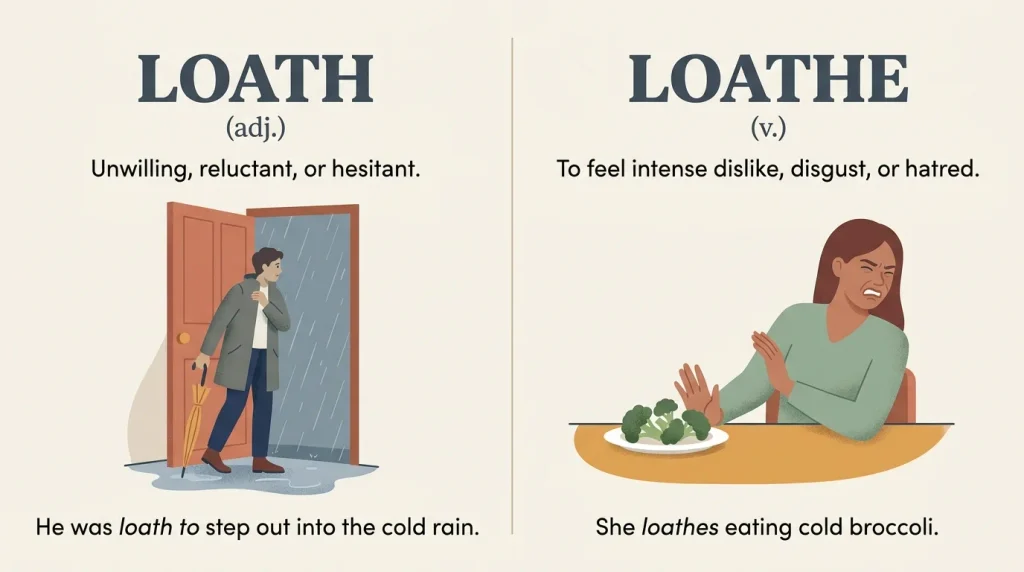
- Loath is an adjective. It describes someone who is reluctant or unwilling to do something.
- Loathe is a verb. It describes the strong feeling of hating or intensely disliking someone or something.
Compare these sentences:
I am loath to complain.
Here, loath describes the speaker’s reluctance to complain.
I loathe unnecessary complaints.
Here, loathe expresses strong dislike toward complaints.
The difference is not merely spelling. Replacing one word with the other can completely change the meaning of a sentence.
Why It Matters
Choosing the wrong word can make an otherwise polished sentence look like a spelling or grammar mistake.
This is especially important because both loath and loathe are legitimate English words. A spellchecker may therefore fail to identify the problem. If you write “I loathe to admit it” when you mean “I am reluctant to admit it,” the software may recognize loathe as a correctly spelled word even though it is the wrong choice for the intended construction.
The distinction matters in:
- Professional emails
- Academic writing
- Essays and assignments
- Reports and formal documents
- Business communication
- Editing and proofreading
- English-language exams
- Careful everyday writing
Knowing the meaning and grammatical role of each word is much more reliable than depending on spellcheck.
The Core Rule
Use loath when you mean “reluctant” or “unwilling.” Use loathe when you mean “hate” or “strongly dislike.”
A quick substitution test makes the distinction easy:
If “reluctant” fits → use loath.
She was loath to apologize.
= She was reluctant to apologize.
If “hate” fits → use loathe.
She loathes dishonesty.
= She hates dishonesty.
This rule handles almost every modern usage situation you are likely to encounter.
How to Use Loath
Loath is an adjective. It is most commonly used in the construction:
be + loath + to + verb
Examples include:
- I am loath to admit that I was wrong.
- She was loath to leave the company.
- They are loath to change the policy.
- He seemed loath to discuss the incident.
- We were loath to cancel the event.
The word expresses reluctance, not hatred.
For example:
I am loath to sell my old car.
This does not mean that I hate my car. It means that I am reluctant or unwilling to sell it.
Likewise:
The manager was loath to reject the proposal.
The manager may actually like the proposal. The point is that the manager is reluctant to reject it.
Loath Usually Appears Before an Infinitive
An infinitive is the basic form of a verb with to, such as to leave, to admit, to agree, or to respond.
A very common pattern is:
subject + be + loath + to + verb
Examples:
- She is loath to complain.
- He was loath to interfere.
- They are loath to compromise.
- I am loath to criticize him.
- The company is loath to raise prices.
This pattern is so common that “loath to” is one of the clearest clues that you need loath rather than loathe. Cambridge specifically lists be loath to do something as the standard construction.
How to Use Loathe
Loathe is a verb meaning to hate, strongly dislike, or feel intense aversion toward someone or something.
Examples include:
- I loathe dishonesty.
- She loathes crowded places.
- They loathe each other.
- He loathes being interrupted.
- We loathe wasting food.
Unlike loath, loathe can directly express an attitude toward an object.
The basic pattern is:
subject + loathe + object
For example:
I loathe hypocrisy.
Here, hypocrisy is what the speaker strongly dislikes.
You can also use loathe before a gerund, which is a verb ending in -ing that functions like a noun:
She loathes waiting in long lines.
He loathes being criticized in public.
Modern learner dictionaries give patterns such as loathe somebody/something and loathe doing something.
Correct Examples
Here are examples showing how loath and loathe work in different situations.
Conversation
1. “I’m loath to interrupt you, but we need to leave.”
The speaker is reluctant to interrupt.
2. “I absolutely loathe being late.”
The speaker strongly dislikes being late.
3. “I am loath to recommend delaying the project.”
The writer is reluctant to recommend a delay.
4. “Our customers loathe unexpected fees.”
The customers strongly dislike unexpected fees.
School
5. “Maya was loath to admit that she had misunderstood the question.”
She was reluctant to admit the mistake.
6. “Many students loathe memorizing long lists of dates.”
They strongly dislike the activity.
Workplace
7. “The director was loath to make a decision without more evidence.”
The director was reluctant to decide.
8. “Employees may loathe a policy that creates unnecessary paperwork.”
They may strongly dislike the policy.
Social Media
9. “I’m loath to post this because it could be misunderstood.”
The person is reluctant to post it.
10. “I loathe clickbait headlines.”
The person strongly dislikes them.
Academic Writing
11. “Researchers may be loath to draw a conclusion from limited evidence.”
They may be reluctant to draw that conclusion.
12. “The author appears to loathe the political system described in the novel.”
The author strongly dislikes it.
Incorrect vs. Correct
| ❌ Incorrect | ✅ Correct | Why |
|---|---|---|
| I am loathe to complain. | I am loath to complain. | The sentence means “I am reluctant to complain,” so the adjective loath is needed. |
| She was loathe to leave early. | She was loath to leave early. | Loath commonly appears after a form of be before to + verb. |
| They are loathe to admit the mistake. | They are loath to admit the mistake. | The intended meaning is reluctance, not hatred. |
| He loath crowded offices. | He loathes crowded offices. | Here the word is a verb meaning “strongly dislikes,” so the correct present-tense form is loathes. |
| I loath waiting in traffic. | I loathe waiting in traffic. | Loathe is the verb meaning “hate.” |
| We loath unnecessary meetings. | We loathe unnecessary meetings. | The subject we needs the verb loathe. |
| She loathes to speak publicly. | She is loath to speak publicly. | The intended meaning is that she is reluctant to speak. |
| He is loathes to discuss it. | He is loath to discuss it. | After is, the adjective loath is required in this construction. |
| The team was loathe to change direction. | The team was loath to change direction. | The team was reluctant, not hateful. |
| They loath dishonesty. | They loathe dishonesty. | The sentence needs the verb loathe to express strong dislike. |
Why Do People Confuse Loath and Loathe?
The confusion is understandable because the two words are almost identical in spelling and are related historically. They also both express negative attitudes, although the meanings are different.
Several factors make the mistake especially easy.
1. The Spelling Is Almost Identical
The only visible difference is the final e:
loath
loathe
When two words look this similar, writers can remember the spelling without remembering the grammatical function.
2. Their Meanings Are Related
Both words have connections to negative feelings. Loath describes reluctance, while loathe expresses strong dislike or hatred.
That semantic connection makes it easy to associate the two words incorrectly.
3. Pronunciation Can Add Confusion
In common American and British pronunciation, loathe has a voiced th sound, as in breathe or clothe. Loath is commonly pronounced with a voiceless th sound, like the ending of both, although dictionaries also record a voiced pronunciation for loath. (Dictionary.com)
So pronunciation can help, but it should not be your only test.
4. Spellcheck May Not Help
Both loath and loathe are valid words. A spellchecker can therefore see either spelling as a correctly spelled English word.
The real problem is often word choice, not spelling.
5. Learners May Overgeneralize the Final E
English has many familiar spelling pairs where adding a final e changes a word or its pronunciation, such as:
- breath → breathe
- cloth → clothe
- bath → bathe
That pattern can encourage learners to assume that loath and loathe work in exactly the same way.
There is a useful connection here, but the grammar still has to be learned: loath is an adjective, whereas loathe is normally a verb.
6. Translation Can Interfere
In languages where “reluctant,” “unwilling,” “hate,” and “dislike” are represented differently, learners may map both English words to the same translated word.
That can make the spelling distinction harder to remember. The safest approach is to learn the English sentence pattern rather than translate the words individually.
Common Mistakes Checklist
Mistake 1: Writing “loathe to” for reluctance
Wrong for the usual intended meaning:
I loathe to admit it.
Better:
I am loath to admit it.
Why? The intended meaning is “I am reluctant to admit it.” Loath is the adjective that expresses that reluctance.
Mistake 2: Using “loath” as the verb “hate”
Wrong:
I loath spicy food.
Correct:
I loathe spicy food.
Why? The sentence needs a verb meaning “strongly dislike.”
Read More: Needs vs. Wants: The Difference Most People Get Wrong.
Mistake 3: Forgetting the verb ending
Wrong:
She loathe long meetings.
Correct:
She loathes long meetings.
Why? With he, she, or it in the present tense, loathe becomes loathes.
Mistake 4: Assuming “loath” means “hate”
It does not normally mean that in modern standard usage. The adjective loath means reluctant or unwilling.
Mistake 5: Assuming the final E is optional
For the usual meanings, it is not simply optional.
- loath = reluctant
- loathe = strongly dislike
There is, however, an important dictionary nuance: loathe is also recorded as a less common variant spelling of the adjective loath. For clear modern writing, using loath for “reluctant” and loathe for “hate” avoids confusion.
Loath and Loathe in Real English
Loath: Grammatically Correct and Natural
“I am loath to criticize her.”
This is grammatically correct and natural in careful English. It means that the speaker is reluctant or unwilling to criticize her. The construction be loath to + verb is established and common enough in formal written English to be immediately understood. Cambridge labels loath as formal, which means it is especially suited to careful writing rather than casual everyday conversation.
Loathe: Grammatically Correct and Natural
“I loathe dishonesty.”
This is a straightforward and natural use of loathe. The verb expresses strong dislike or hatred. It can take a person or thing as its object, as in They loathe each other, or an -ing form, as in She loathes waiting. Although loathe is a strong word, it is not restricted to highly formal writing and can appear in ordinary speech and writing.
“I Loathe to Admit It”: Why It Causes Trouble
“I loathe to admit it” is generally not the construction you want when you mean “I am reluctant to admit it.” In standard contemporary usage, the clearer form is “I am loath to admit it.”
The reason is grammatical: loath functions as the adjective describing the speaker’s state, while loathe normally functions as the verb meaning “hate.” There is a historical and dictionary complication because loathe is recorded as a variant spelling of the adjective, but that variant is less common.
American vs. British English
There is no major American-versus-British meaning difference between loath and loathe.
Both varieties use:
- loath for the adjective meaning reluctant or unwilling
- loathe for the verb meaning strongly dislike or hate
Pronunciation can differ in the normal ways that American and British English pronunciation differ. Cambridge gives loath as /loʊθ/ in American English and /ləʊθ/ in British English, while loathe is pronounced with the corresponding voiced th sound.
There is also a variant spelling loth, which dictionaries record alongside loath. It is not necessary to use loth in ordinary modern writing.
Formal vs. Informal Usage
The distinction between the two words is not primarily about formality, but loath is relatively formal in modern English.
For example:
I am loath to disagree with you.
This sounds polished and somewhat formal.
In ordinary conversation, many speakers would more naturally say:
I don’t really want to disagree with you.
Or:
I’m reluctant to disagree with you.
By contrast, loathe can be used in both formal and informal contexts:
The report criticizes the practice.
I absolutely loathe waiting in traffic.
The second sentence is informal and emphatic, but loathe itself is not limited to formal writing. Oxford notes that loathe can be stronger than hate, while also being used informally for things someone simply really does not like.
Loath vs. Loathe Comparison Table
| Feature | Loath | Loathe |
|---|---|---|
| Part of speech | Adjective | Verb |
| Main meaning | Reluctant; unwilling | Hate; strongly dislike |
| Common pattern | be loath to + verb | loathe + noun/object |
| Example | I am loath to leave. | I loathe delays. |
| Meaning in example | I am reluctant to leave. | I strongly dislike delays. |
| Final E | No | Yes |
| Common register | Formal/careful | General; can be emphatic |
| Pronunciation clue | Usually voiceless “th” | Voiced “th” |
| Common mistake | Using loathe for reluctance | Dropping the final e |
| Easy substitute | reluctant | hate |
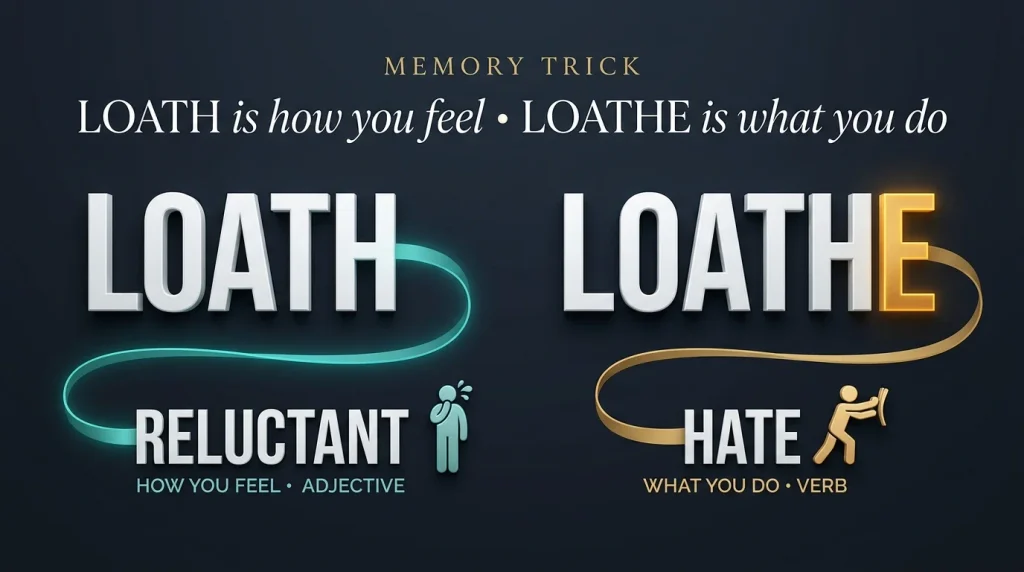
Memory Trick
Use this simple rule:
Loath is how you feel; loathe is what you do.
If you feel reluctant, choose loath.
If you do the hating, choose loathe.
Another useful reminder is:
E = Emotion expressed by the verb “loathe.”
So:
loath → reluctant
loathe → hate
You can also connect loathe with other familiar final-E verb patterns such as clothe, bathe, and breathe. The spelling pattern is not a complete grammar rule, but it can make the distinction easier to remember.
Read More: Marrying vs Marring: Meaning, Difference & Correct Usage.
Real-Life Situations
In an Interview
If you are reluctant to criticize a former employer:
“I am loath to speak negatively about my previous employer.”
Here, loath is correct because you are expressing reluctance.
In a Workplace Meeting
If you strongly dislike unnecessary meetings:
“I loathe meetings that have no clear purpose.”
Here, loathe is correct because you are expressing strong dislike.
In an Email
If you do not want to reject a colleague’s proposal:
“I am loath to reject the proposal without discussing it further.”
Use loath because the meaning is “reluctant.”
In a Text Message
If you strongly dislike something:
“I loathe doing laundry.”
Use loathe because the meaning is “really hate.”
In an Exam
If the sentence is:
“She was ___ to admit that she had made a mistake.”
Ask yourself: Does the blank mean reluctant or hate?
The answer is loath:
“She was loath to admit that she had made a mistake.”
Expert Tips
1. Look at the word immediately after it
If you see:
loath to + verb
there is a very good chance you need loath.
Example:
They were loath to accept the offer.
2. Ask what the subject is doing
If the subject is expressing a strong dislike toward something, use loathe.
She loathes dishonesty.
If the subject is describing reluctance to perform an action, use loath.
She is loath to confront him.
3. Do not rely only on pronunciation
The pronunciation difference can help, but grammar and meaning are stronger tests.
4. Remember that both words can pass spellcheck
This is a word-choice problem. Spellcheck may not tell you that the wrong word has been selected.
5. Use “reluctant” as your fastest test
If you can replace the word with reluctant, use loath.
I am loath to complain.
I am reluctant to complain.
If you can replace it with hate, use loathe.
I loathe dishonesty.
I hate dishonesty.
6. Prefer “loath” for the adjective in edited writing
Although loathe has been recorded as a variant spelling of the adjective, loath is the clearer and more widely preferred spelling for “reluctant.” Using the two spellings consistently prevents ambiguity.
Read More: Ten vs 10: Which One Should You Use?
Quick Summary
Loath and loathe are easily confused because they look almost identical, but they perform different grammatical jobs. Loath is an adjective meaning reluctant or unwilling, most commonly used in the pattern “be loath to + verb.” Loathe is a verb meaning to hate or strongly dislike someone or something. Compare “I am loath to leave” with “I loathe waiting.” A reliable memory trick is “loath is how you feel; loathe is what you do.” Although dictionaries recognize loathe as a less common variant spelling of the adjective, loath is the safest choice when you mean “reluctant,” especially in edited writing.
Frequently Asked Questions
Is it loath or loathe?
Both are correct words, but they have different usual meanings. Loath is an adjective meaning reluctant or unwilling, while loathe is a verb meaning to hate or strongly dislike.
Is “I am loath to admit it” correct?
Yes. “I am loath to admit it” is correct and means “I am reluctant to admit it.” The adjective loath describes the speaker’s unwillingness.
Is “I loathe to admit it” correct?
Not for the usual modern meaning of “I am reluctant to admit it.” The standard, clearer construction is “I am loath to admit it.” Some dictionaries record loathe as a variant spelling of the adjective, but it is less common.
Does loath mean hate?
Normally, no. In modern standard usage, loath means reluctant or unwilling. Loathe is the verb meaning to hate or strongly dislike.
Does loathe mean reluctant?
Normally, no. Loathe means to hate or strongly dislike. If you mean reluctant, use loath, as in “She was loath to complain.”
Is loath an adjective or a verb?
Loath is an adjective. It describes a person’s reluctance or unwillingness. It is especially common in the construction “be loath to + verb.”
Is loathe a verb or an adjective?
Loathe is normally a verb. It means to hate or strongly dislike someone or something. For example: “They loathe dishonesty.”
Is loath a formal word?
Yes. Dictionaries commonly label loath as formal. It is completely correct, but everyday speakers may more often use words such as reluctant or unwilling.
How do you pronounce loath and loathe?
Loath is commonly pronounced with a voiceless th sound, while loathe has a voiced th sound. However, dictionaries also record a voiced pronunciation for loath, so pronunciation alone is not a completely reliable way to distinguish them.
What is the difference between “loath” and “loth”?
Loth is a variant spelling of loath, meaning reluctant or unwilling. Loath is the clearer choice for most modern writing.
Is “I loathe broccoli” correct?
Yes. “I loathe broccoli” is grammatically correct because loathe is the verb meaning to strongly dislike something.
Is “I am loathe to leave” correct?
For standard modern edited writing, use “I am loath to leave.” It means “I am reluctant to leave.” Although loathe is recorded as a variant adjective spelling, loath is the conventional spelling for this construction.
Mini Quiz
| # | Question | Answer | Explanation |
|---|---|---|---|
| 1 | She was ___ to complain. A) loath B) loathe | A) loath | She was reluctant to complain, so the adjective loath is needed. |
| 2 | I ___ unnecessary paperwork. A) loath B) loathe | B) loathe | The sentence expresses strong dislike, so loathe is the verb. |
| 3 | Correct the sentence: “He is loathe to admit his mistake.” | He is loath to admit his mistake. | He is reluctant to admit the mistake, so use loath. |
| 4 | They ___ waiting in long lines. A) loath B) loathe | B) loathe | Loathe means strongly dislike, and it can be followed by an -ing form. |
| 5 | Correct the sentence: “I loath dishonest people.” | I loathe dishonest people. | The sentence needs the verb loathe. |
| 6 | The manager was ___ to cancel the event. A) loath B) loathe | A) loath | The manager was reluctant to cancel it. |
| 7 | Which word means “strongly dislike”? A) loath B) loathe | B) loathe | Loathe is the verb meaning to hate or strongly dislike. |
| 8 | Correct the sentence: “She loathe crowded restaurants.” | She loathes crowded restaurants. | With she in the present tense, the verb is loathes. |
| 9 | I am ___ to criticize my colleague. A) loath B) loathe | A) loath | The speaker is reluctant to criticize the colleague. |
| 10 | Complete the rule: Loath = ___; loathe = ___. | reluctant; hate | This is the simplest distinction to remember: loath = reluctant, loathe = hate. |



Pingback: Realises vs Realizes: Which Spelling Is Correct?
Pingback: Aesthetics vs Esthetics: Which Spelling Is Correct?