

Aesthetics and esthetics mean essentially the same thing. Both can refer to the study or principles of beauty, art, taste, and visual appeal. Aesthetics is the more familiar spelling for general, academic, artistic, and international writing. Esthetics is a recognized American spelling and is particularly familiar in terms related to professional beauty and skincare, such as esthetics and esthetician. Neither spelling is inherently wrong.
What Is the Difference Between Aesthetics and Esthetics?
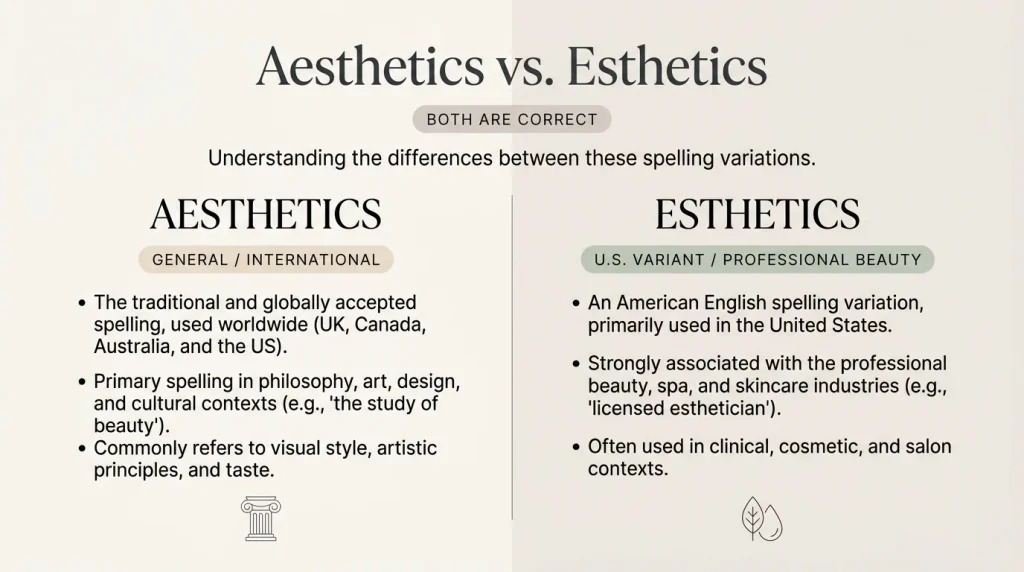
The difference between aesthetics and esthetics is primarily one of spelling and usage preference.
Aesthetics is the traditional and more broadly recognized spelling. It is commonly used when discussing art, beauty, design, philosophy, literature, architecture, fashion, and visual style.
Esthetics is an accepted variant, especially associated with American English. It has the same basic meaning as aesthetics, although particular industries and professional contexts may favor it.
For example:
- The aesthetics of the building are impressive.
- She is interested in the aesthetics of modern art.
- The website needs better visual aesthetics.
- She is studying esthetics at a beauty school.
- The clinic offers training in medical esthetics.
The important point is that these are not two completely different concepts. In many sentences, they can be substituted for one another without changing the basic meaning.
Why Does the Difference Matter?
Choosing between the two spellings usually does not change what your sentence means, but it can affect how natural or appropriate your writing looks to a particular audience.
Consider a university essay:
The aesthetics of Renaissance painting influenced later artists.
Here, aesthetics is the natural choice for most readers.
Now consider a U.S. beauty-school program:
She enrolled in an esthetics program after finishing high school.
Here, esthetics fits the professional context naturally.
The distinction becomes important when you are writing for a specific industry, audience, institution, or regional variety of English. A spelling can be grammatically correct while another spelling is more conventional in that particular setting.
The Core Rule
Use “aesthetics” as your default spelling. Use “esthetics” when American usage, a professional term, organization, school, program, or established context specifically favors it.
There is no general rule saying that esthetics is wrong.
Likewise, there is no rule saying that aesthetics can only be used in British English. Both spellings are accepted in American English, and aesthetics remains widely used there.
The simplest decision is:
- General or international writing: Choose aesthetics.
- Academic, artistic, philosophical, or design writing: Aesthetics is usually the natural choice.
- U.S. beauty or skincare terminology: Esthetics may be the established choice.
- Following an organization’s official spelling: Match that spelling.
- Unsure which one to use: Choose aesthetics.
How to Use Aesthetics
Aesthetics is commonly used as a noun when talking about beauty, artistic principles, appearance, taste, or visual qualities.
Art and Philosophy
The course explores the aesthetics of contemporary art.
Design
The designer considered both functionality and aesthetics.
Architecture
The new building combines modern aesthetics with traditional materials.
Fashion
The collection has a minimalist aesthetic.
Websites and Branding
The company redesigned its website to improve its visual aesthetics.
Everyday Description
I like the aesthetics of this room.
In modern English, aesthetic and aesthetics can also be used in discussions of a recognizable visual style or overall look.
For example:
The café has a cozy, vintage aesthetic.
Here, aesthetic is being used as a singular noun meaning a particular style or visual character.
How to Use Esthetics
Esthetics is the accepted U.S. spelling of aesthetics. It can be used in the same general sense when referring to beauty, art, visual qualities, and related ideas.
For example:
The esthetics of the product were carefully considered.
However, you are especially likely to encounter esthetics in American professional contexts involving beauty, skincare, and related services.
Examples include:
She wants to pursue a career in esthetics.
The school offers an esthetics program.
He specializes in medical esthetics.
This does not mean that esthetics is restricted to beauty. It is still a variant of aesthetics and can occur in artistic, academic, and other contexts.
Correct Examples
Here are examples showing how the two spellings work in different situations.
| Situation | Correct Example |
|---|---|
| Conversation | I really like the aesthetics of this apartment. |
| We should consider the aesthetics of the new design. | |
| School | The class examines aesthetics in modern art. |
| University | Her paper discusses the aesthetics of film. |
| Workplace | The team’s goal is to improve the product’s aesthetics. |
| Design | Functionality and aesthetics need to work together. |
| Architecture | The building’s aesthetics reflect its surroundings. |
| Social media | The photos have a consistent minimalist aesthetic. |
| Beauty industry | She is studying esthetics at a U.S. beauty school. |
| Skincare | The clinic offers training in medical esthetics. |
| Academic writing | The article examines the relationship between aesthetics and ethics. |
| Branding | The company’s visual aesthetics are easy to recognize. |
Notice that aesthetics works comfortably across many general contexts, whereas esthetics can sound especially natural when the context involves American professional beauty terminology.
Incorrect vs. Correct
The following examples focus on situations where writers may choose the less natural form for their intended context.
| Incorrect or Less Suitable | Correct | Why |
|---|---|---|
| ❌ The university course is about esthetics of art. | ✅ The university course is about aesthetics of art. | Aesthetics is the more familiar choice in general academic discussion. |
| ❌ Esthetics is always an incorrect spelling. | ✅ Esthetics is an accepted spelling. | It is a recognized U.S. variant of aesthetics. |
| ❌ Aesthetics is only British English. | ✅ Aesthetics is also used in American English. | The spelling is not restricted to British English. |
| ❌ You must use esthetics whenever you write in American English. | ✅ American English accepts both forms. | Esthetics is a U.S. variant, but aesthetics is also widely used. |
| ❌ She studies esthetics as a branch of philosophy. | ✅ She studies aesthetics as a branch of philosophy. | Aesthetics is the more conventional general term in this context. |
| ❌ The beauty school offers an aesthetics program. | ✅ The beauty school offers an esthetics program. | In U.S. beauty education, esthetics is an established professional term. |
| ❌ Esthetics and aesthetics have completely different meanings. | ✅ Esthetics and aesthetics have the same core meaning. | They are spelling variants rather than unrelated words. |
| ❌ My essay uses aesthetics because esthetics is a spelling mistake. | ✅ My essay uses aesthetics because it is the preferred general spelling here. | The issue is preference and context, not correctness. |
| ❌ Every American publication should replace aesthetics with esthetics. | ✅ American writers can use either form where appropriate. | There is no universal requirement to replace one with the other. |
| ❌ The two spellings must be pronounced differently. | ✅ The two spellings generally represent the same word and pronunciation. | The difference is primarily orthographic. |
Why Do People Confuse Aesthetics and Esthetics?
The confusion is understandable because the two words differ by only one letter.
Phonetic Similarity
When spoken aloud, aesthetics and esthetics sound essentially the same in ordinary pronunciation. If you learn the word by hearing it rather than seeing it written, it can be difficult to know which spelling to use.
Spelling Overlap
Both forms contain the same core letters:
A E S T H E T I C S
versus
E S T H E T I C S
The small visual difference makes it easy to assume one must be a typo.
Overgeneralization
English has many British-American spelling differences, so learners sometimes assume every spelling containing ae must be British and every spelling without it must be American.
That pattern is sometimes useful, but it does not mean that one form is automatically wrong in every context.
Spellcheck Limitations
Spellcheckers may accept both forms because both are legitimate words. A spelling checker can tell you that a word exists, but it usually cannot tell you which variant is most appropriate for your audience.
Translation Interference
Learners may encounter a single preferred spelling in their first language or in translated material. When they later encounter the alternative English form, they may assume one is incorrect.
The better approach is to recognize esthetics as a legitimate variant rather than treating the difference as a spelling error.
Common Mistakes Checklist
Mistake 1: Calling “esthetics” wrong
Why it happens: The spelling looks like a shortened version of aesthetics.
How to avoid it: Remember that esthetics is an accepted U.S. spelling.
Mistake 2: Assuming “aesthetics” is British-only
Why it happens: Learners often associate ae spellings with British English.
How to avoid it: Do not treat aesthetics as exclusively British. It is also widely used in American English.
Mistake 3: Assuming both spellings are completely interchangeable in every professional setting
Why it happens: Both have the same basic meaning.
How to avoid it: Check established terminology when writing for a particular school, profession, company, or organization.
Mistake 4: Changing an organization’s established spelling
Why it happens: A writer assumes the most familiar spelling must be universally preferable.
How to avoid it: Preserve official names and established program titles.
Mistake 5: Mixing variants randomly
Why it happens: Writers switch between spellings without noticing.
How to avoid it: Choose the spelling appropriate to your audience and keep your usage consistent.
Aesthetics vs Esthetics in Real English
Aesthetics in everyday and general English
Aesthetics is the safer general-purpose choice when you are talking about the visual or artistic qualities of something. A reader is unlikely to question the spelling in discussions of art, architecture, design, fashion, literature, branding, or philosophy. It is also common when describing the overall visual style of an object, place, product, or creative work.
Esthetics in American professional English
Esthetics is grammatically correct and can be completely natural in American professional contexts, especially when the subject is beauty, skincare, or related training. For example, esthetics program can be the established terminology used by a U.S. educational institution. In such cases, changing it to aesthetics may make the phrase less consistent with the institution’s terminology.
Aesthetics in academic writing
Aesthetics is generally the stronger choice when writing about the academic field concerned with beauty, art, taste, and related judgments. It is familiar across international English and works well in essays, research writing, lectures, and discussions of philosophy or art theory.
Esthetics outside the beauty industry
Esthetics is not limited to skincare or beauty. It can also refer to aesthetics more broadly. However, because many readers encounter the spelling in U.S. beauty-related contexts, the word may carry a stronger professional association there. Context therefore matters more than a rigid rule about meaning.
American vs. British English
There is a genuine regional spelling distinction, but it is easy to overstate it.
Esthetics is recognized as a U.S. spelling of aesthetics. At the same time, aesthetics is also used in American English, so it would be inaccurate to say that Americans must use esthetics.
| Feature | Aesthetics | Esthetics |
|---|---|---|
| Core meaning | Study or principles of beauty, art, and taste | Same |
| Accepted spelling | Yes | Yes |
| American English | Yes | Yes |
| British English | Standard/familiar form | Less typical |
| Academic writing | Very common | Possible |
| Art and philosophy | Very common | Possible |
| General international writing | Safer default | Less familiar to some readers |
| U.S. beauty terminology | Used | Particularly familiar |
| Best choice when unsure | Yes | Usually not the default |
A useful way to think about the distinction is:
Aesthetics = general-purpose spelling
Esthetics = accepted U.S. variant, with strong professional use in some beauty-related contexts
Read More: Loath vs Loathe: Meaning, Difference & Correct Usage.
Formal vs. Informal Usage
This distinction is mostly about context rather than formality.
Formal and academic writing
For essays, research papers, academic discussions, and international publications, aesthetics is generally the clearest default.
The study examines the aesthetics of contemporary architecture.
Professional U.S. beauty contexts
In American beauty education and skincare-related contexts, esthetics may be the established professional spelling.
The college offers a certificate in esthetics.
Informal writing
Either spelling may appear in informal writing, depending on the writer’s regional variety and the context.
I love the aesthetics of this place.
For general social-media or lifestyle writing, aesthetics is usually the more immediately recognizable choice.
Comparison Table
| Feature | Aesthetics | Esthetics |
|---|---|---|
| Part of speech | Noun | Noun |
| Basic meaning | Beauty, artistic principles, or the study of beauty | Same |
| Spelling status | Correct | Correct |
| Main distinction | More broadly familiar | U.S. variant |
| Academic use | Strong | Possible |
| Art/philosophy | Strong | Possible |
| Design | Very common | Possible |
| Beauty/skincare | Common | Especially established in some U.S. contexts |
| International audience | Recommended default | May be less familiar |
| If you are unsure | Choose this | Use when context supports it |
Memory Trick
Use this simple memory trick:
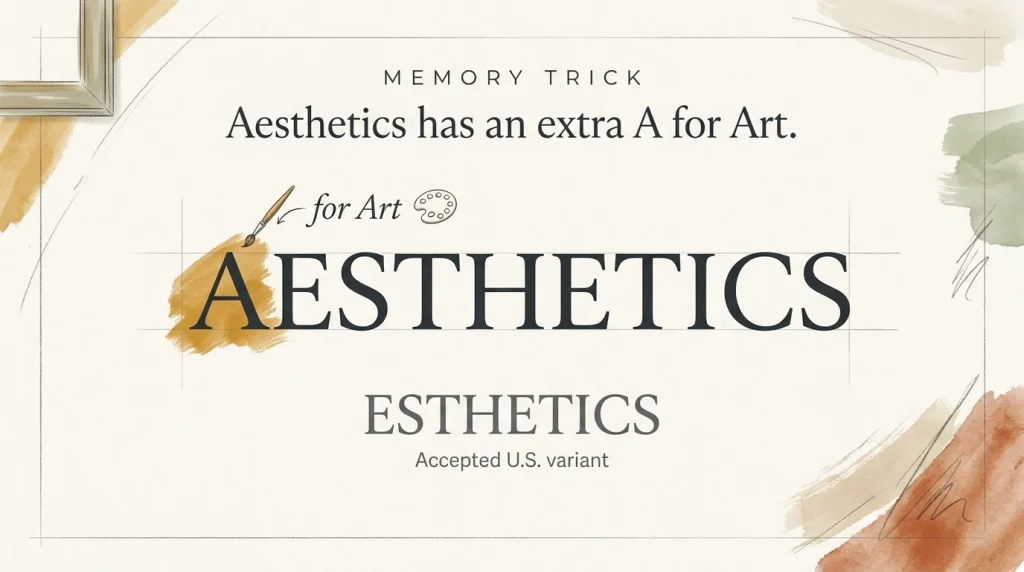
Aesthetics has an extra “A” for “art.”
When you are discussing art, beauty, design, philosophy, or visual style, think of the familiar spelling:
AESTHETICS
For a U.S. professional beauty context, remember:
ESTHETICS = U.S. variant
The trick is not a rule of English. It is simply a way to remember which spelling is the safer default.
Real-Life Situations
1. University essay
You are writing about the philosophy of art.
Best choice:
The essay explores the aesthetics of beauty and artistic judgment.
2. Design meeting
Your team is discussing a new product.
Best choice:
We need to improve the product’s aesthetics without sacrificing usability.
3. Social media
You are describing the visual style of a photograph.
Natural choice:
I love the soft, minimalist aesthetic of this photo.
4. U.S. beauty school
You are talking about a professional training program.
Natural choice:
She enrolled in an esthetics program.
5. Academic research
You are discussing architecture.
Natural choice:
The researchers examined the aesthetics of urban public spaces.
6. Skincare clinic
You are describing a professional service.
Natural choice:
The clinic specializes in medical esthetics.
7. Workplace email
You are discussing branding.
Natural choice:
We should review the visual aesthetics before launching the campaign.
8. International audience
You are writing an article intended for readers from different English-speaking countries.
Best default:
The aesthetics of the design appeal to a wide audience.
Expert Tips
- Do not treat esthetics as a typo. It is a legitimate spelling variant.
- Use aesthetics when you need the safest general-purpose form.
- Follow established terminology in professional contexts. If a U.S. school calls its program “Esthetics,” retain that spelling.
- Do not assume American English requires esthetics. Both spellings occur in U.S. English.
- Consider your audience. International readers may recognize aesthetics more readily.
- Keep your spelling consistent. Switching between forms without a reason can look careless.
- Do not confuse aesthetic with aesthetics. Aesthetic can describe something related to beauty or can function as a noun for a particular visual style; aesthetics is the noun for the broader concept or field.
- Check official names exactly. A school’s course, company’s department, or professional certification may have a fixed spelling.
- Do not let spellcheck decide your style. A spellchecker can recognize both words but cannot always determine which variant best fits your audience.
- When in doubt, choose aesthetics. It is the most versatile option for general English.
Quick Summary
Aesthetics and esthetics are both correct spellings. They have the same basic meaning and can refer to beauty, art, taste, visual qualities, and the study of beauty. Aesthetics is the safer general-purpose spelling and is especially suitable for academic, artistic, design, philosophical, and international writing. Esthetics is an accepted U.S. variant and is particularly familiar in some American professional beauty and skincare contexts. The difference is therefore not simply “correct versus incorrect.” Instead, it is mainly a matter of spelling preference, audience, and established usage. If you are writing for a general audience and are unsure which form to choose, aesthetics is usually the best choice.
FAQ
FAQ
Is “esthetics” a correct spelling?
Yes. Esthetics is a legitimate spelling and is recognized as a U.S. variant of aesthetics. It is not simply a misspelling.
Is “aesthetics” correct in American English?
Yes. Aesthetics is used in American English as well as British and international English. American English also accepts the spelling esthetics.
Which is more common: aesthetics or esthetics?
Aesthetics is generally the more familiar spelling in broad, general English. Esthetics is less general but has established usage in American English, including professional beauty and skincare contexts.
Should I use aesthetics or esthetics in an essay?
For most academic essays, aesthetics is the safer choice, particularly when discussing art, philosophy, literature, architecture, or beauty in a general sense.
Is esthetics only used for skincare?
No. Esthetics can have the broader meaning associated with aesthetics. However, American professional beauty and skincare terminology gives the spelling a particularly strong association with that field.
Are aesthetics and esthetics pronounced the same?
They are generally pronounced essentially the same. The main distinction is their spelling rather than a difference in pronunciation or meaning.
Read More: Needs vs. Wants: The Difference Most People Get Wrong.
Can I use aesthetics and esthetics in the same article?
You can, but there should be a reason. If you are writing general content, consistent use of aesthetics is usually clearer. If you are referring to a specific U.S. professional term that uses esthetics, retain that spelling.
Is “esthetician” related to “esthetics”?
Yes. Esthetician is a U.S. form associated with a professional who provides beauty or skincare treatments. This is one reason esthetics appears frequently in American beauty-industry terminology.
Which spelling should ESL learners learn first?
Aesthetics is usually the better first spelling to learn because it is broadly recognizable and works well in academic, artistic, design, and general contexts. Learners should then recognize esthetics as a valid U.S. variant.
Can I replace every occurrence of aesthetics with esthetics?
Not necessarily. Although the meanings overlap, established names, professional terminology, and audience expectations can make one spelling more appropriate than the other.
Is “aesthetics” more formal than “esthetics”?
Not strictly. The difference is primarily regional and contextual. Aesthetics may feel more natural in formal academic writing because it is widely established there, while esthetics may be perfectly natural in a U.S. professional context.
What should I use if I am writing for an international audience?
Use aesthetics as the default. It is widely recognizable and avoids unnecessary regional ambiguity.
Quiz
Mini Quiz
| # | Question | Answer | Explanation |
|---|---|---|---|
| 1 | Which spelling is generally the safest choice for general international writing? A) Esthetics B) Aesthetics | B) Aesthetics | Aesthetics is the more broadly familiar general spelling. |
| 2 | Fill in the blank: The designer focused on the visual ______ of the website. | aesthetics | The sentence discusses general visual qualities, making aesthetics a natural choice. |
| 3 | True or false: “Esthetics” is always a spelling mistake. | False | Esthetics is an accepted U.S. spelling of aesthetics. |
| 4 | Which sentence is better for a U.S. beauty-school context? A) She enrolled in an esthetics program. B) She enrolled in an estheticses program. | A | Esthetics is an established term in U.S. beauty education. |
| 5 | Correct the sentence: “Aesthetics is only used in British English.” | Aesthetics is also used in American English. | American English uses both aesthetics and esthetics. |
| 6 | Fill in the blank: The course examines the ______ of modern art. | aesthetics | Academic discussions of art commonly use aesthetics. |
| 7 | Which statement is correct? A) Only aesthetics is correct. B) Only esthetics is correct. C) Both are correct. | C) Both are correct. | They are accepted spelling variants. |
| 8 | Correct the sentence for a general academic context: “The paper examines the esthetics of Renaissance painting.” | The paper examines the aesthetics of Renaissance painting. | Aesthetics is the more conventional general academic choice here. |
| 9 | Fill in the blank: The clinic specializes in medical ______. | esthetics | Esthetics is well established in U.S. professional beauty and medical-beauty terminology. |
| 10 | Which is the best advice when you are unsure which spelling to use? A) Always use esthetics. B) Always use aesthetics. C) Use aesthetics as the general default and check established terminology when necessary. | C | This approach accounts for both accepted spellings and context-specific usage. |



Pingback: Drunk vs. Drank: What's the Difference? - Meaning Wisdom