
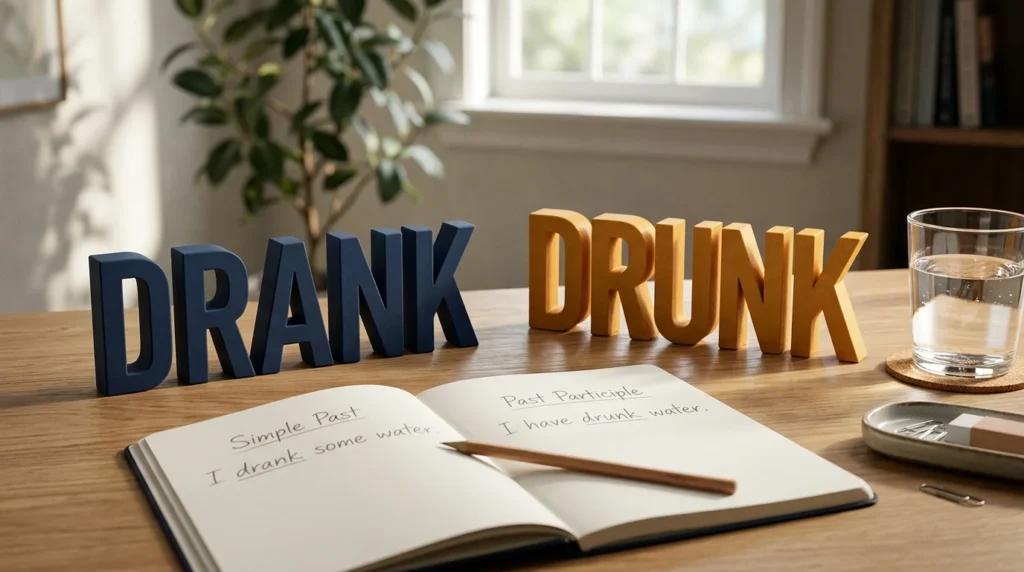

Use drank when describing a completed drinking action in the simple past: “She drank a glass of milk.” Use drunk with a helping verb such as has, have, or had: “She has drunk a glass of milk.” The verb forms follow the irregular pattern drink – drank – drunk. Remember that drunk can also function as an adjective meaning intoxicated, as in “He was drunk.”
What Is the Difference Between Drunk and Drank?
Drunk and drank are two forms of the same irregular verb: drink. They describe drinking in different grammatical structures.
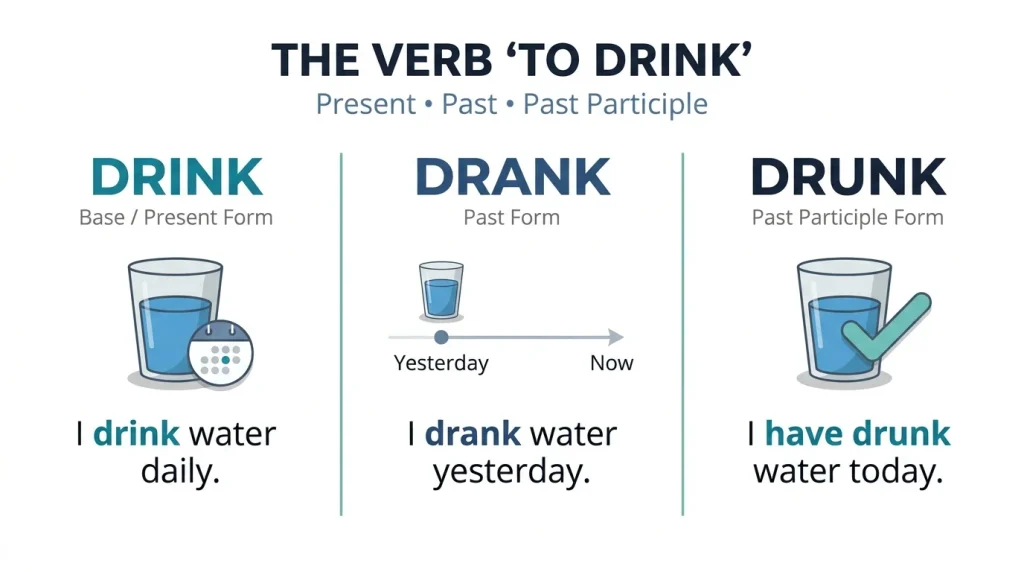
- Drink: The base form, used in sentences such as “I drink water every morning.”
- Drank: The simple past tense, used for an action that happened in the past.
- Drunk: The past participle, used with helping verbs to form perfect tenses and in some passive constructions.
Here is the basic distinction:
| Word | Grammatical form | Example |
|---|---|---|
| Drink | Base form / present tense | I drink tea every morning. |
| Drank | Simple past tense | I drank tea this morning. |
| Drunk | Past participle | I have drunk three cups of tea. |
The main question is not whether the drinking action happened in the past. Both drank and drunk can refer to past events. The important difference is the grammatical structure of the sentence.
Why the Difference Matters
Choosing between drank and drunk helps you build grammatically correct sentences. The wrong form can make otherwise clear writing sound awkward or reveal a misunderstanding of English verb tenses.
This distinction matters in several situations:
- Schoolwork and exams: You may need to identify the simple past tense or past participle.
- Professional writing: Correct verb forms help make reports, emails, and documents more polished.
- Everyday conversation: Knowing which form to use makes it easier to describe past events naturally.
- English learning: Understanding irregular verbs helps you learn similar patterns, such as sing – sang – sung and begin – began – begun.
The good news is that you do not need to memorize dozens of complicated rules. Learning one three-part verb pattern will help you use both words correctly.
Read More: Aesthetics vs Esthetics: Which Spelling Is Correct?
The Core Rule:
When to Use Drank or Drunk
Use DRANK
Use drank for a simple past action.
Example: “I drank a bottle of water after the run.”
Use DRUNK
Use drunk as the past participle, usually with have, has, or had.
Example: “I have drunk two bottles of water today.”
The simplest pattern to memorize is:
- Drink — present or base form.
- Drank — simple past.
- Drunk — past participle.
Remember that drunk also works as an adjective meaning affected by alcohol. For example, “He was drunk” is correct because drunk describes his condition, not because it follows a perfect-tense pattern.
How to Use Drank and Drunk Correctly
When to Use Drank
Use drank when you want to state that someone consumed a liquid at a past time. It is the simple past form of drink and can stand as the main verb without a perfect-tense helping verb.
The sentence often includes a past-time expression such as yesterday, last night, an hour ago, or during lunch, although these expressions are not required.
Examples:
- I drank a cup of tea before work.
- We drank fresh juice after the match.
- She drank some water during the lecture.
- They drank coffee together last weekend.
- My brother drank the last glass of milk.
You can also use drank when describing a sequence of completed past actions.
For example: “I finished my homework, drank some water, and went to bed.”
All three verbs describe events in a past sequence.
When to Use Drunk
Use drunk as the past participle when forming perfect tenses with have, has, or had. The helping verb combines with the past participle to express how one event relates to another time.
Present perfect: Have/has + drunk
The present perfect often connects a past action to the present.
- I have drunk enough water for now.
- She has drunk all the orange juice.
- They have drunk this brand of tea before.
- He has already drunk two cups of coffee.
Past perfect: Had + drunk
The past perfect describes an action completed before another past event or reference point.
- I had drunk my coffee before the meeting began.
- She had drunk the medicine before the doctor arrived.
- They had drunk all the water by the time we reached the campsite.
Future perfect: Will have + drunk
The future perfect describes an action that will be complete by a future time.
- By noon, I will have drunk three glasses of water.
- By the end of the event, the guests will have drunk all the lemonade.
In each case, drunk is the past participle. The helping verb determines the tense of the complete verb phrase.
Can Drunk Be Used Without Have, Has, or Had?
Yes. This is an important exception to the beginner-friendly rule.
When drunk is an adjective, it can appear after verbs such as be, seem, or become.
- He is drunk.
- She seemed drunk after the party.
- The passenger became drunk during the celebration.
Here, drunk describes a person’s condition. It is not functioning as the past participle in a perfect tense.
The past participle can also appear in passive constructions, such as “The water was drunk by the thirsty traveler.” This is grammatically possible, although many writers would naturally prefer “The thirsty traveler drank the water.”
Correct Examples of Drank and Drunk
The following examples show how these forms work across everyday conversations, schoolwork, professional writing, and online communication.
| Situation | Correct example | Why it works |
|---|---|---|
| Everyday conversation | I drank some water after breakfast. | Simple past action. |
| Text message | I drank your coffee by mistake. | A completed action in the past. |
| Family conversation | Dad drank his tea while reading the news. | Drank is the main verb. |
| Workplace email | I have drunk the water you left on my desk. | Have takes the past participle drunk. |
| School assignment | The athlete drank water after the race. | The sentence reports a past event. |
| Academic writing | Participants drank the prepared solution before the next stage. | A completed action in a research procedure. |
| Meeting report | The team had drunk its refreshments before the presentation started. | Had drunk places the action before another past event. |
| Social media caption | We drank fresh coconut water on the beach yesterday. | A past activity is being described. |
| Travel diary | I drank traditional tea at a small café in Lahore. | The action happened during a past experience. |
| Future planning | By the time the guests arrive, we will have drunk our tea. | The action will be complete before a future point. |
| Health journal | I have drunk more water this week than last week. | The present perfect relates past activity to a current period. |
| Storytelling | Before sunset, the hikers had drunk the last of their water. | The past perfect shows an earlier completed action. |
Incorrect vs. Correct: 10 Common Drank and Drunk Mistakes
These examples use standard written English. Each correction shows the grammatical reason behind the change.
| Incorrect | Correct | Why |
|---|---|---|
| I drunk a glass of water yesterday. | I drank a glass of water yesterday. | Use the simple past drank for a completed past action. |
| She drunk all the milk last night. | She drank all the milk last night. | Drunk is not the standard simple past form. |
| We drunk tea after lunch. | We drank tea after lunch. | The sentence needs the simple past tense. |
| He has drank two cups of coffee. | He has drunk two cups of coffee. | Has requires the past participle in standard present-perfect grammar. |
| I have drank enough water today. | I have drunk enough water today. | Use drunk after have. |
| They had drank everything before we arrived. | They had drunk everything before we arrived. | The past perfect uses had plus a past participle. |
| By 10 a.m., she will have drank three glasses of juice. | By 10 a.m., she will have drunk three glasses of juice. | The future perfect uses will have plus the past participle. |
| The water was drank by the hikers. | The water was drunk by the hikers. | A passive construction uses the past participle. |
| He has never drank herbal tea before. | He has never drunk herbal tea before. | The present perfect requires drunk in standard usage. |
| After the run, Maya drunk a sports drink. | After the run, Maya drank a sports drink. | The verb is a simple past action, so use drank. |
A useful editing habit is to check the word immediately before the verb. If the sentence contains have, has, or had as a helping verb, you will generally need drunk, not drank.
Why People Confuse Drunk and Drank
Several features of English make these forms easy to mix up.
1. The words look and sound similar
Both words end in -nk and have the same first three letters. Their vowel sounds differ, but the spelling pattern makes them easy to confuse when writing quickly.
2. English irregular verbs change unpredictably
Regular verbs usually form the past tense by adding -ed, as in walked or played. Irregular verbs follow different patterns.
The verb drink changes its internal vowel:
- Drink
- Drank
- Drunk
Similar patterns appear in sing – sang – sung and ring – rang – rung. Learning the complete set helps prevent errors.
3. Learners overgeneralize one form
Once someone learns that drank refers to the past, it may seem logical to use it after have or has. But English distinguishes the simple past from the past participle.
That is why “I drank water” and “I have drunk water” use different forms.
4. Spellcheck does not always catch the error
Both drank and drunk are correctly spelled English words. A basic spellchecker may accept either one without recognizing that the verb form does not fit the sentence.
Grammar checking requires attention to sentence structure, not just spelling.
5. Translation can create confusion
Some languages use a single past form in situations where English distinguishes the simple past from the past participle. Learners may therefore translate the meaning correctly but choose the wrong English verb form.
The best solution is to learn the English pattern itself rather than translating each word directly.
Common Mistakes Checklist
Before publishing an article, submitting an assignment, or sending an important email, review these frequent errors.
- Using drunk as the simple past: Write “I drank the juice,” not “I drunk the juice,” in standard English.
- Using drank after have or has: Write “She has drunk the juice,” not “She has drank the juice,” in standard formal usage.
- Forgetting the helping verb: If you want the past participle in a perfect tense, include the appropriate auxiliary: “They had drunk the water.”
- Confusing the adjective with the verb form: “He was drunk” describes his condition. It does not follow the same structure as “He had drunk the water.”
- Writing drinked: The standard forms are drank and drunk, not drinked.
- Changing a correct sentence unnecessarily: “I drank water yesterday” is already correct. You do not need to add have.
- Assuming a past-time word always determines the form: The full sentence matters. “Yesterday, I drank water” is correct, while “By yesterday, I had drunk the water” can also be correct.
Drank vs. Drunk in Real English
Grammatically correct
“I drank two cups of tea this morning” and “I have drunk two cups of tea this morning” can both be correct. The best choice depends on the intended meaning and the time frame. The simple past presents the drinking as a past event. The present perfect connects it to the present or to a period that may still be relevant. English allows both structures, but each has its own grammar.
Grammatically possible but unnatural
“The water was drunk by the thirsty traveler” is grammatically correct because was drunk forms a passive construction. However, it may sound unnecessarily formal or awkward in everyday storytelling. “The thirsty traveler drank the water” is usually more direct. The passive version makes sense when the writer wants to emphasize the water rather than the person who drank it, such as in a report about what happened to a limited supply.
Natural, everyday English
In everyday conversation, people commonly say “I drank some water,” “Have you drunk anything today?” and “He is drunk.” The first uses the simple past, the second uses the past participle in a question, and the third uses drunk as an adjective. When speaking casually, focus on the grammatical pattern rather than trying to make every sentence sound formal. Natural English can be simple without sacrificing correctness.
American vs. British English
There is no standard American-versus-British spelling difference between drank and drunk. Both varieties use drank as the simple past and drunk as the past participle.
| Meaning or form | American English | British English |
|---|---|---|
| Simple past | I drank some water. | I drank some water. |
| Present perfect | I have drunk some water. | I have drunk some water. |
| Past perfect | I had drunk some water. | I had drunk some water. |
| Adjective | He was drunk. | He was drunk. |
You may encounter informal or regional variation in speech, but learners and professional writers should follow the standard distinction. You do not need to change either word to suit an American or British audience.
Formal vs. Informal Usage
The grammatical distinction applies in both formal and informal English. The difference is that informal speech may contain nonstandard forms that are not suitable for edited writing.
In formal English, use drank for the simple past and drunk for the past participle. This is the safest approach for academic assignments, business emails, reports, and examinations.
- Formal: “The participants drank the solution before the test.”
- Formal: “The participants had drunk the solution before the test began.”
In informal English, you may hear people use drank where standard grammar calls for drunk, such as “I’ve drank enough.” This usage occurs in casual speech, but it is not the recommended form for standard written English.
If your goal is to improve grammar, use the standard pattern regardless of whether the conversation is casual or professional.
Comparison Table: Drink vs. Drank vs. Drunk
| Feature | Drink | Drank | Drunk |
|---|---|---|---|
| Verb form | Base form | Simple past | Past participle |
| Main function | Present, infinitive, or command | Reports a past action | Forms perfect tenses and passive constructions |
| Common structure | Can / should / to + drink | Subject + drank | Have / has / had + drunk |
| Example | I drink tea daily. | I drank tea yesterday. | I have drunk tea today. |
| After have | Not normally in a perfect tense | Not standard in the present perfect | Correct: have drunk |
| Can describe intoxication? | No, not in the usual adjective sense | No | Yes, as an adjective |
| Example of adjective use | — | — | He looks drunk. |
Memory Trick: Drink, Drank, Drunk
Remember this simple sentence:
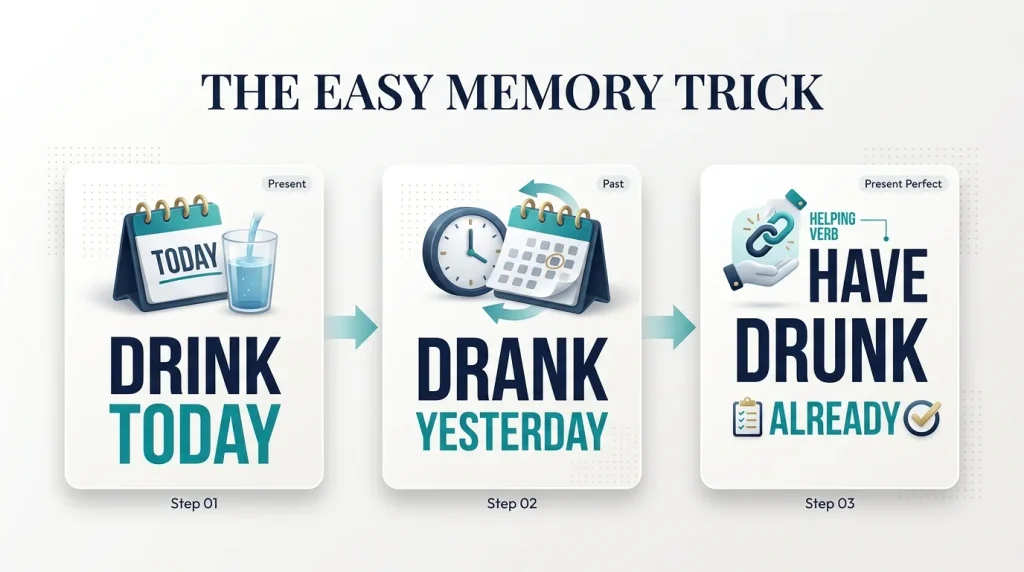
“I drink today, I drank yesterday, and I have drunk already.”
Each phrase matches a different grammatical form:
- Drink today: The base form works for present habits and general statements.
- Drank yesterday: The simple past reports a completed past action.
- Have drunk already: The past participle follows the helping verb have.
For another reminder, think of the similar verb pattern sing – sang – sung. The middle form is the simple past, and the final form is the past participle.
Say both sequences aloud a few times:
- Drink – drank – drunk.
- Sing – sang – sung.
This technique helps you recognize the pattern instead of guessing which vowel to use.
Real-Life Situations: Which Word Should You Choose?
Situation 1: Talking to a friend
Your friend asks what you did after the gym.
Correct response: “I drank a whole bottle of water.”
Why: You are describing a completed action in the past, so drank is the correct form.
Situation 2: Writing a workplace email
Your manager asks whether you finished the refreshments prepared for a meeting.
Correct response: “We have drunk the water that was provided, but there are still a few bottles left.”
Why: The present-perfect structure uses have drunk.
Situation 3: Completing an English exam
You see the sentence: “By the time the teacher arrived, the students had ___ all the juice.”
Correct answer: “drunk.”
Why: The helping verb had requires the past participle in this past-perfect construction.
Situation 4: Posting a travel caption
You want to describe a trip you took last weekend.
Correct caption: “We drank fresh lemonade while watching the sunset.”
Why: The sentence describes a completed event in the past.
Read More: Loath vs Loathe: Meaning, Difference & Correct Usage.
Situation 5: Describing someone’s condition
You are explaining why a friend should not drive after a party.
Correct sentence: “He is drunk, so he should not drive.”
Why: Drunk is an adjective describing intoxication. It is not the simple past form of the verb in this sentence.
Expert Tips for Using Drank and Drunk
- Check the verb structure before the meaning. Ask whether the sentence needs a simple past verb, a perfect tense, a passive construction, or an adjective.
- Learn all three forms together. Memorize drink – drank – drunk as one unit instead of learning each word separately.
- Do not rely only on time expressions. Words such as yesterday often signal the simple past, but a sentence can still use the past perfect to show that an action happened before another past event.
- Read the complete sentence aloud. Hearing “I have drank” may not reveal the error to every speaker, so use the grammar rule as your final check.
- Learn from related verbs. Patterns such as begin – began – begun and sing – sang – sung reinforce the difference between simple past and past participle.
- Remember the adjective. In “She was drunk,” the word describes her state. Do not try to apply the have/has/had rule to every appearance of drunk.
Quick Summary
Drank and drunk are two forms of the irregular verb drink, but they serve different grammatical purposes. Use drank as the simple past when describing a completed past action, as in “I drank water yesterday.” Use drunk as the past participle in perfect tenses, such as “I have drunk enough water” and “She had drunk her tea.” The same distinction applies in standard American and British English. However, drunk can also function as an adjective meaning intoxicated, as in “He was drunk.” To remember the difference, learn the complete verb pattern: drink – drank – drunk. When uncertain, check the sentence structure before choosing the word.
FAQ: Drunk vs. Drank
1. Is it “I drank” or “I drunk”?
In standard English, say “I drank” when describing a simple past action. For example, “I drank a glass of water after lunch.” Use “I have drunk” when forming the present perfect.
2. Is “I have drank” ever correct?
“I have drank” occurs in informal and nonstandard speech, and similar usage has historical precedents. However, the standard form for edited writing, exams, and professional communication is “I have drunk.”
3. Is “drunk” a real word?
Yes. Drunk is the past participle of drink and can also be an adjective meaning intoxicated. For example, “She has drunk her tea” uses the past participle, while “She is drunk” uses the adjective.
4. What is the difference between drunk and drunken?
Drunk is both a past participle and an adjective. Drunken is mainly an adjective used to describe something associated with intoxication, as in “a drunken argument” or “drunken behavior.” In most everyday sentences, drunk is the more common adjective for a person’s condition.
5. Is “I had drank” grammatically correct?
In standard English, use “I had drunk.” The past perfect is formed with had plus the past participle. For example, “I had drunk my coffee before the meeting began.”
6. Can I say “I drank already”?
Yes. “I drank already” is grammatical in some contexts, particularly in conversational American English. “I’ve already drunk” is also possible, depending on the intended meaning and context. The simple past presents the action as a past event, while the present perfect connects it to the present.
7. What is the negative form of drank?
Use did not drink or its contraction didn’t drink. For example, say “I didn’t drink any coffee yesterday,” not “I didn’t drank any coffee.” After did or didn’t, use the base form drink.
8. Should I say “have drunk” or “have been drinking”?
Both can be correct, but they emphasize different things. “I have drunk three glasses of water” focuses on the amount consumed. “I have been drinking water all morning” emphasizes an ongoing or repeated activity over a period of time.
9. What is the past tense of “drink” in a question?
Use did plus the base form drink: “Did you drink the water?” Do not use “Did you drank?” because did already marks the past tense.
10. Is “drunk” correct in a sentence without a helping verb?
Yes, when it functions as an adjective or noun. “He looks drunk” uses an adjective, and “The drunk was escorted outside” uses a noun referring to an intoxicated person. However, for the standard simple past of the verb drink, use drank.
Mini Quiz: Drunk vs. Drank
Test your understanding with these 10 questions. Choose the correct answer before checking the explanation.
| No. | Question | Answer and explanation |
|---|---|---|
| 1 | Yesterday, I ___ two glasses of milk. (A) drunk (B) drank | B — drank. The sentence describes a completed past action. |
| 2 | She has ___ all her water. (A) drank (B) drunk | B — drunk. The present perfect uses has plus the past participle. |
| 3 | By the time we arrived, they had ___ the juice. (A) drank (B) drunk | B — drunk. The past perfect uses had plus the past participle. |
| 4 | Correct this sentence: “I drunk coffee this morning.” | I drank coffee this morning. Use the simple past form. |
| 5 | Correct this sentence: “He has drank enough water.” | He has drunk enough water. Use the past participle after has. |
| 6 | Which sentence is correct? (A) Did you drank the tea? (B) Did you drink the tea? | B — Did you drink the tea? Use the base form after did. |
| 7 | Choose the correct form: “By tonight, I will have ___ enough water.” | Drunk. The future perfect uses will have plus the past participle. |
| 8 | Which word describes intoxication? (A) Drank (B) Drunk | B — drunk. For example, “He was drunk.” Here, the word is an adjective. |
| 9 | Complete the sentence: “We ___ lemonade during our trip last summer.” | Drank. The sentence describes a past event. |
| 10 | Correct this sentence: “She didn’t drank anything at lunch.” | She didn’t drink anything at lunch. After didn’t, use the base form. |



Pingback: Prepair or Prepare? The Correct Spelling Explained.