

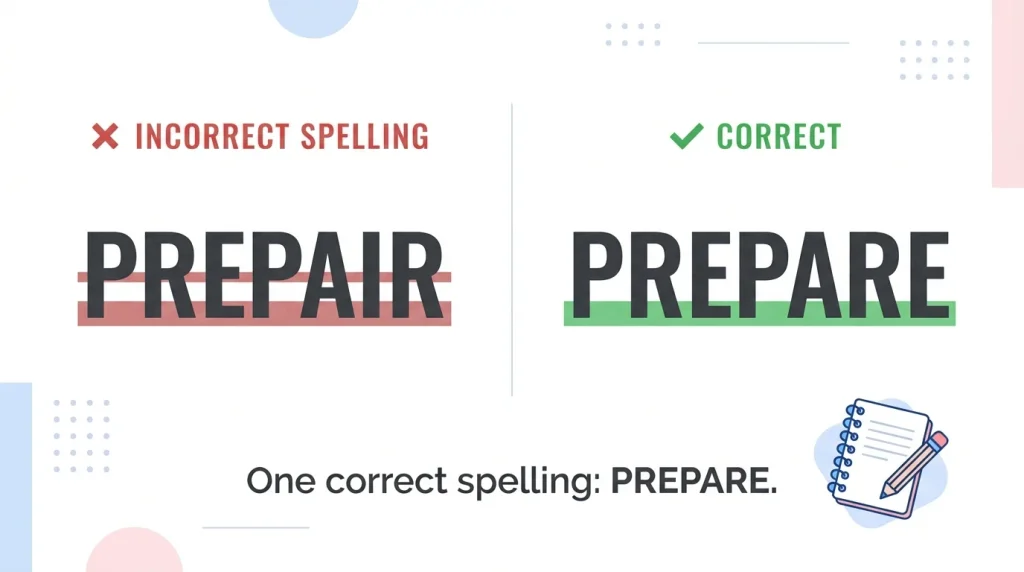
The correct spelling is prepare, not prepair. Prepare is a verb that means to get something or someone ready for a future event, task, or situation. For example, you prepare for an exam, prepare a meal, or prepare a report. Although prepair may look reasonable because it sounds like the word pair, it is a misspelling in standard English. Remember to write prepare with one a followed by r.
What Is the Difference Between Prepair and Prepare?
The difference is simple: prepare is the standard English spelling, while prepair is a spelling mistake when you intend to use the verb prepare.
Prepare
Correct
The standard verb meaning to get ready or make something ready.
Example: I need to prepare for tomorrow’s interview.
Prepair
Incorrect spelling
Not the standard spelling of the verb meaning to get ready.
Incorrect: I need to prepair for tomorrow’s interview.
What Does Prepare Mean?
Prepare means to make yourself, another person, or something ready for a particular purpose or event. It can describe practical actions, such as cooking dinner or organizing documents, as well as mental preparation, such as getting ready for an exam or an important conversation.
Prepare can be used with a direct object, with the preposition for, or with to followed by a verb.
- Prepare something: She prepared a presentation.
- Prepare for something: He prepared for his driving test.
- Prepare to do something: We prepared to leave early.
- Prepare someone for something: The coach prepared the team for the final match.
The correct form depends on the sentence, but the spelling remains prepare.
Why Does the Correct Spelling Matter?
Spelling errors can make otherwise clear writing look rushed or unprofessional. If you use prepair in a job application, school assignment, business email, or published article, readers may notice the mistake even if they understand your meaning.
The error is especially easy to overlook because prepair resembles the familiar word pair. Spellcheck may catch it, but you should not rely on automated correction alone. Learning the correct spelling helps you write confidently and recognize the related forms prepared, preparing, and preparation.
The Core Rule: Always Write Prepare
The rule is straightforward: when you mean to get ready or make something ready, spell the word prepare.
Remember these forms:
- Present form: prepare
- Third-person singular: prepares
- Past tense: prepared
- Present participle: preparing
- Related noun: preparation
Do not add an extra i to create prepair. The spelling of the verb is p-r-e-p-a-r-e.
Read More: Drunk vs. Drank: What’s the Difference?
How to Use Prepare Correctly
Prepare for an Event or Situation
Use prepare for when you are getting ready for an event, challenge, or situation.
Examples:
- I need to prepare for my final examination.
- The company is preparing for a product launch.
- We prepared for the possibility of heavy rain.
Prepare Something
Use prepare directly before the thing you make ready. In grammar, that thing is called the direct object.
Examples:
- Please prepare the meeting agenda.
- She prepared lunch for her family.
- The students prepared their research reports.
Prepare to Do Something
Use prepare to followed by the base form of a verb when someone gets ready to perform an action.
Examples:
- The passengers prepared to board the plane.
- I am preparing to give my first presentation.
- They prepared to discuss the new proposal.
Do not confuse this construction with prepare for. Compare:
- Correct: We prepared for the meeting.
- Correct: We prepared to attend the meeting.
The first refers to getting ready for an event; the second focuses on the action of attending it.
Use Prepared and Preparing When the Sentence Requires Them
Prepare changes form according to tense and sentence structure.
- Prepared: We prepared the documents yesterday.
- Preparing: She is preparing for her interview.
- Prepares: He prepares breakfast every morning.
- Preparation: Careful preparation improves your chances of success.
These are all standard forms. Prepairing and prepaired are incorrect spellings when the intended words are preparing and prepared.
Correct Examples of Prepare in Everyday English
The following examples show how to use prepare naturally in different situations.
- Everyday conversation: I need to prepare dinner before my parents arrive.
- Email: I will prepare the requested documents and send them this afternoon.
- School: Students should prepare for the science examination in advance.
- Workplace: Our team is preparing a proposal for the new client.
- Social media: Taking a little time to prepare makes a big difference.
- Academic writing: The researchers prepared the samples before conducting the experiment.
- Job interview: She prepared several answers to common interview questions.
- Travel: We prepared our luggage the night before the flight.
- Business meeting: Please prepare a short summary of the project’s progress.
- Personal development: He is preparing himself for a major career change.
- Cooking: My brother prepares breakfast while I make coffee.
- Unexpected situations: It is sensible to prepare for possible delays.
Notice that every example uses prepare or one of its correctly spelled grammatical forms.
Read More: Aesthetics vs Esthetics: Which Spelling Is Correct?
Incorrect vs. Correct: 10 Common Spelling Mistakes
| Incorrect | Correct | Why |
|---|---|---|
| I will prepair dinner tonight. | I will prepare dinner tonight. | The correct spelling is prepare. |
| Please prepair the report. | Please prepare the report. | The verb does not contain an extra i. |
| She is prepairing for her exam. | She is preparing for her exam. | The -ing form is preparing. |
| He prepaired for the interview. | He prepared for the interview. | The past tense is prepared. |
| We must prepair a presentation. | We must prepare a presentation. | Use prepare after must. |
| They prepair meals every Sunday. | They prepare meals every Sunday. | Use prepare with they. |
| I have prepaired everything. | I have prepared everything. | The past participle is prepared. |
| Are you ready to prepair? | Are you ready to prepare? | The base form follows to here. |
| The staff will be prepairing the room. | The staff will be preparing the room. | The correct continuous form is preparing. |
| Good prepairation takes time. | Good preparation takes time. | The related noun is preparation. |
The key lesson is that correcting the spelling may also require correcting the word ending. Prepare, prepared, preparing, and preparation are related, but they serve different grammatical roles.
Why Do People Confuse Prepair and Prepare?
1. The Words Sound Similar
When spoken, prepare can sound as though it contains the word pair. This may lead someone to write prepair, even though the spelling does not match the sound they imagine.
English spelling is not always predictable from pronunciation, so hearing a word correctly does not guarantee that you will spell it correctly.
2. The Word Pair Is Familiar
The word pair means two things that belong together or are considered as a set. Because it is familiar, writers may unconsciously substitute it for the final part of prepare.
However, prepare and pair have different meanings and spellings.
3. Related Words Can Cause Confusion
Writers sometimes remember the general shape of a word but forget its exact spelling. Knowing the word preparation can help because it reinforces the shared spelling pattern in prepare and prepared.
4. Autocomplete and Spellcheck Are Not Perfect
Digital keyboards and writing applications can suggest corrections, but they may not catch every error in every context. A correction can also be overlooked if you type quickly or accept a suggestion without checking it.
5. Translation Can Influence Spelling
English learners may transfer spelling patterns from another language into English. If a word’s pronunciation suggests a different spelling, the learner may write the sound rather than memorize the conventional English form.
The solution is to learn prepare as a complete written word and practice its related forms.
Common Mistakes Checklist
Use this checklist when proofreading your writing.
- Writing prepair instead of prepare: Memorize the standard spelling, especially when writing quickly.
- Writing prepaired instead of prepared: Remember that the past tense ends in -ed after the stem prepar-.
- Writing prepairing instead of preparing: The correct present participle is preparing.
- Writing prepairation instead of preparation: The noun is spelled preparation, not prepairation.
- Using the wrong sentence structure: Choose prepare for an exam, prepare a report, or prepare to leave according to your intended meaning.
- Trusting spellcheck without reviewing the sentence: Read the sentence again to check both spelling and meaning.
A useful proofreading habit is to search your draft for prepair. If you intend the ordinary verb or one of its related forms, replace the misspelling with the appropriate standard form.
Prepare in Real English
Grammatically Correct: Prepare for an Exam
“I need to prepare for my examination” is grammatically correct and natural. It means you need to study, organize your materials, or take other steps to get ready. This construction works in conversation, formal writing, school assignments, and professional settings. The preposition for connects the preparation with the event or situation you expect.
Grammatically Possible but Unnatural: Prepare Myself for Every Small Task
The sentence “I prepare myself for every small task” is grammatically possible. However, depending on the situation, it may sound unnecessarily formal or suggest that each ordinary task requires considerable mental effort. In everyday conversation, “I get ready for every task” or simply “I get ready” may sound more natural. The best choice depends on what you want to emphasize.
Natural Everyday English: I’m Getting Ready
In casual conversation, people often say “I’m getting ready” rather than “I’m preparing” when talking about ordinary activities such as leaving home, meeting a friend, or getting dressed. Both expressions can be correct, but prepare often emphasizes planning, organizing, or deliberate readiness. “I’m preparing for my interview” sounds entirely natural, while “I’m getting ready to leave” is a common everyday choice.
American vs. British English
There is no standard American-versus-British spelling difference between prepare and its usual forms. Both varieties use:
- Prepare
- Prepared
- Preparing
- Preparation
Pronunciation can vary between accents, but the spelling remains the same. You should not write prepair to represent either American or British English.
Formal vs. Informal Usage
Prepare is suitable for both formal and informal communication.
| Situation | Natural example |
|---|---|
| Formal business email | We will prepare the final report by Friday. |
| Academic writing | The samples were prepared under controlled conditions. |
| Workplace conversation | I’ll prepare the slides before the meeting. |
| Casual conversation | Give me a few minutes to prepare. |
| Text message | I’m getting ready now. |
In casual conversation, get ready can sound more relaxed. In professional, academic, or technical writing, prepare is often a precise and appropriate choice.
Prepare vs. Similar and Confusing Words
| Word | Meaning | Example |
|---|---|---|
| Prepare | Make ready | I will prepare the room. |
| Prepair | Nonstandard misspelling of prepare | Avoid this spelling in standard writing. |
| Prepared | Past tense or past participle of prepare; also an adjective | She prepared the notes. |
| Preparing | The -ing form of prepare | He is preparing lunch. |
| Preparation | The act or process of getting ready | Preparation took two hours. |
| Pair | Two matching or associated things | I bought a pair of shoes. |
| Repair | Fix something damaged or broken | They will repair the computer. |
One important distinction: pair and repair are real English words, but neither is an alternative spelling of prepare.
Memory Trick: Prepare to Be Ready
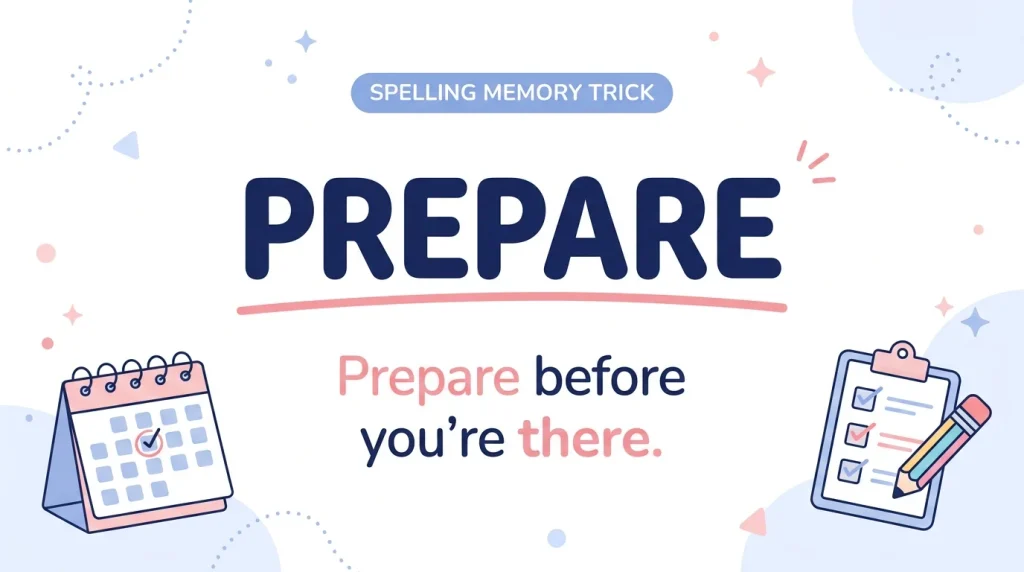
Remember this phrase: “Prepare before you’re there.”
Both prepare and before suggest getting something ready ahead of time. When you prepare for an event, you do the necessary work before it happens.
You can also remember the spelling by breaking it into letters:
PRE + PARE = PREPARE
The final part is pare, not pair. Say the word, write it correctly, and connect it with a familiar example such as “prepare for an exam.”
Real-Life Situations: Prepare in Context
Job Interview
Incorrect: “I need to prepair for my interview.”
Correct: “I need to prepare for my interview.”
Why it works: The sentence uses prepare for to describe getting ready for an upcoming event.
Workplace Meeting
Incorrect: “Please prepair the slides before 10 a.m.”
Correct: “Please prepare the slides before 10 a.m.”
Why it works: The slides are the direct object of the verb prepare.
Text Message
Incorrect: “I’m prepairing now. I’ll call you soon.”
Correct: “I’m preparing now. I’ll call you soon.”
Why it works: The present continuous form uses preparing.
School Examination
Incorrect: “I have prepaired for the test all week.”
Correct: “I have prepared for the test all week.”
Why it works: The present perfect construction uses have followed by the past participle prepared.
Read More: Loath vs Loathe: Meaning, Difference & Correct Usage.
Travel Planning
Incorrect: “We should prepair for delays.”
Correct: “We should prepare for delays.”
Why it works: The modal verb should takes the base form prepare.
Quick Summary
Prepair or prepare? The correct spelling is prepare. It is a verb meaning to get ready or make something ready for an event, task, or situation. Use prepare for an exam, prepare a report, or prepare to leave according to the sentence. Its correct forms include prepares, prepared, and preparing, while the related noun is preparation. The spelling prepair is a mistake when you mean this verb. Although it resembles the word pair, the two words have different meanings. American and British English use the same standard spelling. To remember it, think of the phrase “Prepare before you’re there” and check your writing before submitting it.
Frequently Asked Questions
Is prepair a real word?
Prepair is not the standard spelling of the verb prepare. If you mean getting ready or making something ready, use prepare. An unusual occurrence as a name or specialized form would not make it a standard substitute in ordinary English.
Is prepare one word or two?
Prepare is one word. It should not be written as two separate words when used as the verb meaning to get ready.
How do you spell prepare correctly?
Spell it P-R-E-P-A-R-E. It contains one a followed by r in the final part of the word.
What is the past tense of prepare?
The past tense is prepared. For example, “She prepared the documents yesterday.”
Is it preparing or prepairing?
The correct spelling is preparing. Remove the final e from prepare before adding -ing.
Is it prepared or prepaired?
The correct spelling is prepared. The word prepaired is a misspelling when the intended meaning is the past tense or past participle of prepare.
What is the noun form of prepare?
The noun is preparation. For example, “The team spent two hours on preparation before the presentation.”
Should I write prepare for or prepare to?
Use prepare for before a noun or noun phrase, such as “prepare for the meeting.” Use prepare to before a verb, such as “prepare to speak.” The construction depends on what follows the word.
Is prepare spelled differently in American and British English?
No. The standard spelling is prepare in both American and British English. Pronunciation may differ, but the spelling does not.
Why do people write prepair?
People may confuse the spelling because prepare sounds similar to pair. Typing quickly, relying on pronunciation, or overlooking an autocorrect suggestion can also contribute to the mistake.
Is prepare formal or informal?
Prepare works in both formal and informal contexts. It is common in business emails, academic writing, everyday conversation, and instructions. In casual speech, get ready is another natural option.
Mini Quiz: Prepair or Prepare?
Test your understanding with these 10 questions. Try answering before checking the explanations.
| No. | Question | Answer and explanation |
|---|---|---|
| 1 | Choose the correct spelling: prepair / prepare. | Prepare. It is the standard spelling of the verb. |
| 2 | Fill in the blank: I need to ___ for my exam. | Prepare. The correct expression is prepare for my exam. |
| 3 | Correct the sentence: She is prepairing dinner. | She is preparing dinner. The -ing form is preparing. |
| 4 | Choose the correct past tense: prepaired / prepared. | Prepared. The past tense ends in -ed. |
| 5 | Fill in the blank: Please ___ a report for the manager. | Prepare. The verb takes a report as its direct object. |
| 6 | True or false: British English uses the spelling prepair. | False. The standard spelling in both varieties is prepare. |
| 7 | Correct the sentence: We have prepaired everything. | We have prepared everything. The present perfect uses have plus prepared. |
| 8 | Choose the correct noun: prepairation / preparation. | Preparation. It is the noun related to prepare. |
| 9 | Fill in the blank: They prepared ___ leave early. | To. The correct construction is prepared to leave. |
| 10 | Correct the sentence: He will prepair for the interview tomorrow. | He will prepare for the interview tomorrow. Use the base form after will. |



Pingback: Selling or Saling: Which Spelling Is Correct?
Pingback: Gleen or Glean: Which Spelling Is Correct?