


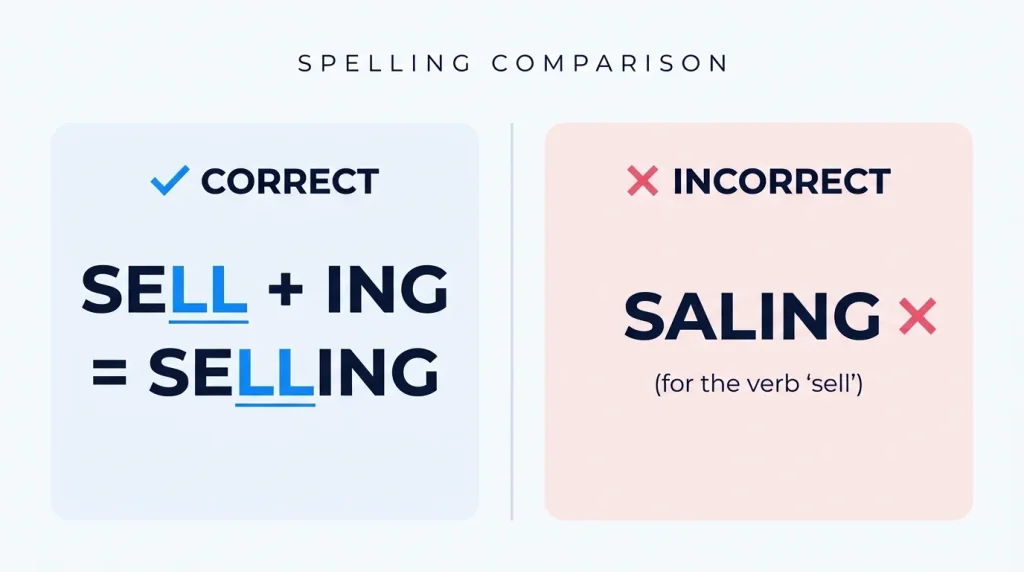
The correct spelling is selling, not saling, when you mean exchanging something for money. Selling is the present participle and gerund form of the verb sell. You double the final l before adding -ing because sell ends in a consonant preceded by a vowel in a stressed, one-syllable word. For example, “She is selling her old laptop” is correct.
What Does Selling Mean?
Selling means giving something to another person in exchange for money or another agreed form of payment. It is the -ing form of the verb sell, which means to offer goods, services, or property to a buyer.
The word can describe an action happening now, an ongoing activity, or the general activity of making sales.
Examples:
- She is selling her bicycle.
- Selling handmade products online can be profitable.
- The company is selling its products internationally.
- He enjoys selling cars.
In each example, selling is spelled with two l letters. The spelling saling is incorrect when it is intended as the standard form of sell.
Why Does the Correct Spelling Matter?
Spelling mistakes can make otherwise clear writing look less polished. If you use saling instead of selling in a product listing, business email, school assignment, or social media post, readers may notice the error or misunderstand your intended word.
This distinction is especially important in professional writing, where accurate spelling helps communicate attention to detail.
For example:
- Incorrect: We are saling our products at a discount.
- Correct: We are selling our products at a discount.
The message is understandable in both cases, but only the second sentence uses standard English spelling.
Read More: Prepair or Prepare? The Correct Spelling Explained.
The Core Rule: Selling vs. Saling
The rule is simple: add -ing to sell by keeping both l letters.
The spelling changes as follows:
- Base verb: sell
- Remove nothing: sell
- Add -ing: selling
The result is selling, not saling.
This follows a common English spelling pattern: many short verbs ending in a single vowel followed by a consonant double that final consonant before a vowel suffix such as -ing.
Examples of the same pattern include:
- run → running
- sit → sitting
- get → getting
- plan → planning
- sell → selling
The rule does not apply to every verb ending in a consonant. The number of syllables, stress pattern, and final letters can affect whether doubling occurs.
How to Use Selling Correctly
The word selling has several grammatical uses. Understanding the sentence helps you choose the correct form.
1. Use Selling for an Action Happening Now
Use selling with a form of be (am, is, or are) to describe an action in progress. This is called the present continuous tense.
Examples:
- I am selling my old computer.
- She is selling homemade candles.
- They are selling tickets for the concert.
- Our store is selling winter clothes at reduced prices.
2. Use Selling to Describe an Activity
Selling can also function as a gerund, which means a verb ending in -ing acts like a noun.
Examples:
- Selling online requires patience.
- Selling real estate can be challenging.
- He learned the basics of selling through experience.
In these sentences, selling names an activity rather than describing what someone is doing at that exact moment.
3. Use Selling to Describe a Person or Thing
The word can describe a person involved in a sale or an item that is being offered for purchase.
Examples:
- The employee selling the tickets answered my question.
- We visited a shop selling handmade furniture.
- The company is promoting its best-selling product.
4. Use the Correct Form of Sell in Other Tenses
Not every sentence requires selling. Choose the verb form that fits the tense and grammatical structure.
| Verb form | Example |
|---|---|
| Sell (base form) | I sell books online. |
| Sells (third-person singular) | She sells handmade jewelry. |
| Selling (-ing form) | He is selling his bicycle. |
| Sold (past tense) | They sold their house. |
| Sold (past participle) | The car has been sold. |
Remember that selled and saled are not standard past-tense forms of sell. The correct past tense is sold.
Correct Examples of Selling in Sentences
These examples show how selling works in everyday conversation, business, education, and online communication.
- Everyday conversation: My neighbor is selling his old motorcycle.
- Online marketplace: I am selling a used phone in excellent condition.
- Business email: We are selling our products at competitive prices.
- Workplace: The sales team is selling more products this month.
- School assignment: Selling goods is one way businesses earn revenue.
- Social media: I’m selling handmade bracelets through my online shop.
- Real estate: They are selling their apartment before moving abroad.
- Customer service: Our company is selling a new range of kitchen appliances.
- Academic writing: Selling goods internationally can expose businesses to new markets.
- Casual text message: Are you still selling that gaming console?
- Job interview: I have experience selling products to different customer groups.
- Advertising: The business is selling its new service to local customers.
- Personal finance: Selling unused items can help you earn extra money.
- Retail: The store is selling seasonal decorations at a discount.
- Entrepreneurship: Selling digital products can reduce some traditional business costs.
Every example uses the same spelling: selling.
Incorrect vs. Correct: Selling or Saling?
The following table shows common errors and their correct forms.
| Incorrect | Correct | Why |
|---|---|---|
| She is saling her car. | She is selling her car. | The verb sell keeps both l letters before -ing. |
| We are saling clothes online. | We are selling clothes online. | Saling is not the standard spelling of this verb form. |
| He enjoys saling books. | He enjoys selling books. | A gerund formed from sell is spelled selling. |
| They started saling products. | They started selling products. | The verb after started can take the -ing form. |
| I am saling my old laptop. | I am selling my old laptop. | The correct present participle doubles the final l. |
| Are you saling your furniture? | Are you selling your furniture? | The question still requires the standard spelling. |
| The shop is saling food. | The shop is selling food. | The subject and tense do not change the spelling. |
| She makes money by saling jewelry. | She makes money by selling jewelry. | After the preposition by, the gerund selling is appropriate. |
| The company is saling its services. | The company is selling its services. | The standard verb form contains two l letters. |
| Saling products online takes time. | Selling products online takes time. | When used as the subject of a sentence, the word is still selling. |
| He is saling tickets for the event. | He is selling tickets for the event. | The final consonant is doubled before -ing. |
| They are saling their house next month. | They are selling their house next month. | A future arrangement can use the present continuous, but the spelling remains selling. |
The correction is the same in every case: when the intended verb is sell, write selling.
Why People Make This Spelling Mistake
Several factors explain why writers sometimes type saling instead of selling.
1. Confusion About Vowels
Some learners assume that adding -ing means removing a letter from the base verb. However, sell does not lose either l when it becomes selling.
The correct spelling preserves the original consonants and adds the suffix.
2. Overgeneralizing Spelling Rules
English verbs do not all form their -ing versions in the same way.
- make → making
- hope → hoping
- run → running
- sell → selling
The first two verbs lose their final silent e. The latter two double their final consonant. Applying one pattern to every verb can lead to errors.
3. Pronunciation Does Not Show the Spelling Clearly
The pronunciation of sell and selling does not require you to pronounce two separate l sounds. Because the doubled letter does not create an obvious extra sound, learners may forget to write it twice.
4. Autocorrect and Typing Errors
Typing quickly on a phone can produce saling, especially if you are not checking the word carefully. Spellcheck can help, but it should not replace knowledge of the correct form.
5. Translation Interference
Learners may transfer spelling patterns from another language into English. If their first language uses different rules for forming verb endings, they may incorrectly simplify the English spelling.
The solution is to learn sell → selling as a complete word pair rather than relying entirely on pronunciation.
Read More: Drunk vs. Drank: What’s the Difference?
Common Mistakes Checklist
Use this checklist when proofreading your writing.
- Writing saling instead of selling: Remember that sell keeps both l letters before -ing.
- Writing seling with one l: Check the base verb before adding a suffix.
- Using saled for the past tense: The correct past tense is sold.
- Confusing selling with sale: Selling is an -ing verb form; sale is a noun referring to an act or event of selling, often at a reduced price.
- Using sells after every subject: Use sells with he, she, or it in the simple present, but use sell with I, you, we, and they.
- Using selling without the required auxiliary: In a standard present continuous sentence, write “She is selling,” not “She selling.”
- Assuming every verb doubles its last letter: Apply the appropriate spelling rule to each verb rather than guessing.
A quick final check can prevent most of these errors: identify the base verb, select the correct grammatical form, and verify the spelling.
Selling in Real English
Grammatically Correct
“I’m selling my old laptop” is grammatically correct and natural when you are offering the laptop for purchase. The structure combines am with the present participle selling to describe an action in progress. Similarly, “Selling online takes time” is correct because selling acts as a noun. Both sentences use the same spelling but different grammatical structures.
Grammatically Possible but Unnatural
A sentence such as “I am selling a pen to you at this very moment” can be grammatically correct, but it may sound unnecessarily formal or wordy in an ordinary conversation. Depending on the situation, a speaker might simply say, “I’m selling you this pen.” The important point is that naturalness depends on context and wording, not on changing selling to saling.
Natural, Everyday English
People commonly use selling in sentences such as “Are you selling your car?”, “She’s selling cookies at school,” and “We’re selling tickets online.” In business contexts, phrases such as selling products, selling services, and selling online are also standard. These expressions are easy to understand because they follow familiar grammatical patterns. In all of them, the standard spelling remains selling.
American vs. British English
There is no spelling difference between American and British English for this word.
| American English | British English |
|---|---|
| selling a car | selling a car |
| selling products | selling products |
| selling online | selling online |
| The shop is selling books. | The shop is selling books. |
Some English words ending in -l follow different doubling conventions across the two varieties, particularly in certain longer verbs. However, that variation does not affect selling. Both varieties use the spelling selling.
Formal vs. Informal Usage
The spelling selling is appropriate in formal and informal English alike. The level of formality depends on the sentence and context, not on an alternative spelling.
- Formal: The company is selling its regional distribution division.
- Professional: We are currently selling the remaining inventory.
- Informal: I’m selling my old headphones.
- Text message: Are you still selling that bike?
Avoid saling in professional emails, academic assignments, advertisements, and casual messages when you mean the verb sell. It is not an accepted informal substitute for selling.
Selling vs. Saling: Comparison Table
| Feature | Selling | Saling |
|---|---|---|
| Standard spelling of the verb form | Yes | No |
| Based on the verb sell | Yes | No |
| Correct in standard English sentences about selling | Yes | No |
| Used in the present continuous | Yes | No |
| Used as a gerund | Yes | No |
| Suitable for professional writing | Yes | No |
| Suitable for school assignments | Yes | No |
| Correct in ordinary text messages | Yes | No |
| Has two l letters | Yes | No |
| Recommended when discussing a sale | Yes | No |
Important distinction: Saling could appear as a proper name or in a specialized context, but it is not the standard spelling of the -ing form of sell. The comparison above concerns the intended verb form.
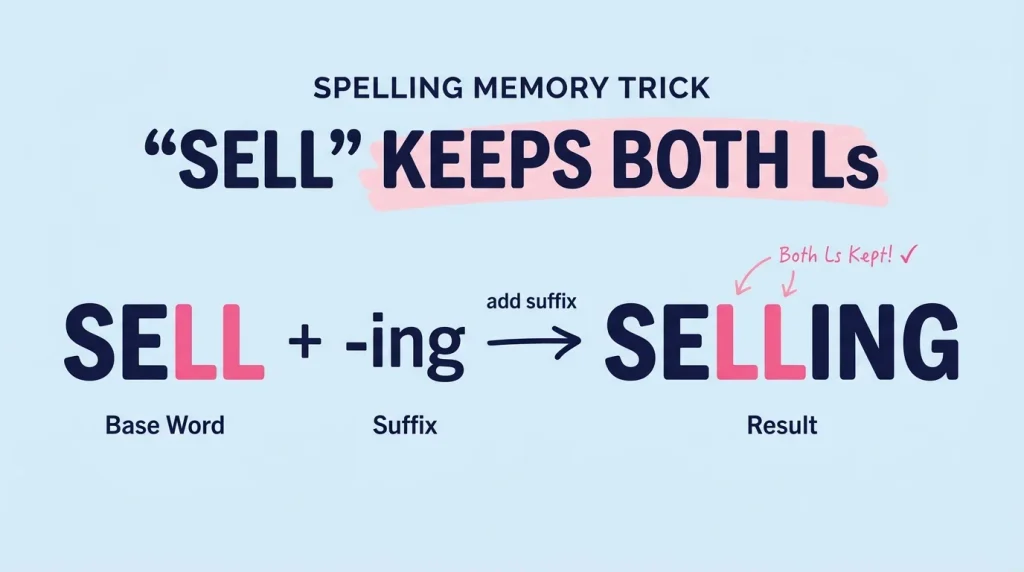
Memory Trick: How to Remember Selling
Use this simple mnemonic:
“Sell keeps both Ls when selling.”
Start with sell. Keep both l letters and add -ing:
SELL + ING = SELLING
You can also remember the pattern by comparing sell → selling with run → running. Both verbs double the final consonant before adding -ing.
Whenever you are unsure, write the base verb first. Then add the ending without removing either l.
Real-Life Situations: Selling in Context
1. At a Job Interview
Question: What experience do you have in retail?
Answer: I have three years of experience selling clothing and accessories.
Why it works: Selling describes the activity the applicant has experience performing.
2. In a Business Email
Message: We are currently selling our products in three new markets.
Why it works: The present continuous describes an ongoing business activity.
3. In an Online Marketplace Listing
Listing: Selling a lightly used laptop in excellent working condition. Contact me for details.
Why it works: This shortened listing style is common in advertisements. The spelling remains selling.
4. In a Text Message
Message: Are you still selling your headphones?
Reply: Yes, they’re still available.
Why it works: The question asks whether the person is continuing to offer the item for sale.
5. In a School Exam
Question: Choose the correct spelling: The shop is ___ handmade gifts.
- A. saling
- B. selling
- C. seling
Answer: B. selling.
Why it works: The verb sell doubles its final l before adding -ing.
Read More: Aesthetics vs Esthetics: Which Spelling Is Correct?
Expert Tips for Avoiding Selling and Saling Errors
- Memorize the base form and its inflections together. Learn sell, sells, selling, sold, and sold as one group.
- Do not rely on pronunciation alone. A word can contain a doubled consonant without requiring a separate extra sound.
- Check the grammatical role. Determine whether you need sell, sells, selling, or sold before proofreading the spelling.
- Use a reliable spellchecker as a second check. A spellchecker can catch many errors, but context still matters.
- Proofread important business content carefully. Product descriptions, sales emails, and online listings benefit from accurate spelling.
- Practice the spelling pattern with similar verbs. Remember run → running, sit → sitting, and sell → selling.
These habits help you learn the rule rather than correcting the same mistake repeatedly.
Frequently Asked Questions
Is saling ever correct in English?
Saling is not the standard spelling of the verb form meaning to exchange something for money. It could occur as a proper name or in a specialized context, but when you mean the activity of selling, use selling.
Why does selling have two Ls?
The verb sell ends in a consonant preceded by a vowel in a one-syllable word. When the suffix -ing is added, the final consonant is doubled, producing selling.
Is selling a verb or a noun?
It can function as either, depending on the sentence. In “She is selling her car,” it forms part of the verb phrase. In “Selling takes patience,” it is a gerund functioning as a noun.
What is the difference between sell and selling?
Sell is the base form of the verb, while selling is its -ing form. Use sell in sentences such as “I sell books” and selling in “I am selling books” or “Selling books is my job.”
Is selling grammatically correct?
Yes. Selling is the standard and grammatically correct form when the -ing form of sell is needed. Its precise role depends on the sentence.
What is the past tense of selling?
The past tense of sell is sold. For example, “I sold my old phone yesterday.” You can also say, “I was selling phones when I worked there,” to describe an ongoing past activity.
Is selling correct in American and British English?
Yes. Both American and British English use selling. There is no regional spelling difference for this word.
Should I write selling or sale?
Use selling to describe the activity or action of offering something for purchase. Use sale as a noun, as in “The store is having a sale.” Compare “She is selling shoes” with “The shoes are on sale.”
How do you spell selling in a business email?
Write selling, with two l letters. For example: “We are selling our products at competitive prices.” The spelling is appropriate for business correspondence and other professional writing.
What is the easiest way to remember selling?
Remember the formula sell + ing = selling. Keep both l letters from the original verb before adding the ending.
Mini Quiz: Test Your Spelling
Choose the correct answers and review the explanations to check your understanding.
| No. | Question | Answer and explanation |
|---|---|---|
| 1 | Choose the correct spelling: She is ___ her old phone. (A) saling (B) selling | B. selling. The verb sell keeps both l letters. |
| 2 | Complete the sentence: I enjoy ___ handmade gifts. | Selling. The -ing form works after enjoy. |
| 3 | Correct this sentence: They are saling their house. | They are selling their house. Replace the nonstandard spelling with selling. |
| 4 | Which is the correct past tense of sell? (A) saled (B) sold (C) selled | B. sold. Sell has the irregular past-tense form sold. |
| 5 | Fill in the blank: The shop is ___ fresh bread. | Selling. The present continuous uses is plus the -ing form. |
| 6 | Is this sentence correct? “Selling online takes patience.” | Yes. Selling is a gerund functioning as the sentence’s subject. |
| 7 | Correct the error: He makes money by saling cars. | He makes money by selling cars. Use selling after the preposition by. |
| 8 | Choose the correct form: She ___ furniture every weekend. (A) sell (B) sells (C) selling | B. sells. The simple present takes -s with she. |
| 9 | Complete the sentence: The company has ___ thousands of units. | Sold. The present perfect uses has plus the past participle sold. |
| 10 | Is saling the standard spelling of the -ing form of sell? | No. The standard spelling is selling, with two l letters. |
Quick Summary
Selling is the correct spelling when you need the -ing form of the verb sell. The spelling saling is incorrect for this meaning in standard English. To form selling, keep both l letters in sell and add -ing. You can use selling in the present continuous, as in “She is selling her car,” or as a gerund, as in “Selling online takes patience.” The word is spelled the same way in American and British English and is suitable for both formal and informal writing. Remember the simple formula: sell + ing = selling. For the past tense, use sold, not saled or selled.



Pingback: Gleen or Glean: Which Spelling Is Correct?