
Copyright is the correct word when discussing legal rights that protect original creative works, such as articles, photographs, books, music, and software. Copywrite is usually a misspelling of copyright, but it is also recorded as a rare verb meaning to write advertising copy. In everyday professional English, use copyright for legal protection and copywriting for the process of creating promotional content.
What Is the Difference Between Copywrite and Copyright?
The difference between copywrite and copyright comes down to meaning and context. Although they sound alike, they are not interchangeable.
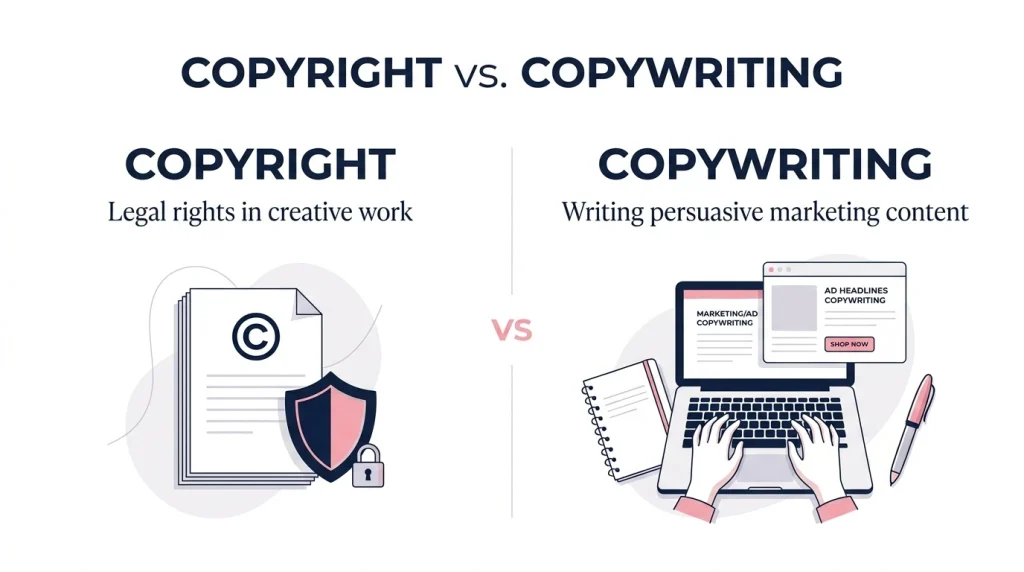
- Copyright: A legal right associated with original creative expression.
- Copywrite: Usually an incorrect spelling when someone means copyright; rarely used as a verb for writing advertising copy.
- Copywriter: A person who writes promotional or advertising content.
- Copywriting: The activity of writing persuasive marketing content.
The easiest way to understand these words is to think about what someone is doing. If a photographer wants to protect an image, the relevant term is copyright. If a business hires someone to write an advertisement, that person is a copywriter, and the work is called copywriting.
For example, a company might hire a copywriter to write a product description while retaining or acquiring copyright in the finished work under the applicable agreement and law. Writing the content and holding rights to it are two separate matters.
Why the Difference Matters
Choosing the right word makes your writing clearer, especially in professional, academic, legal, and marketing contexts.
Imagine that you have published an original article on your website. You want to explain that other people cannot automatically assume they have permission to reproduce it. Writing that the article is protected by copyright communicates the relevant legal concept.
Now imagine that you are applying for a marketing job. If you write that you have experience in copywriting, you are describing your ability to create advertising or promotional material. Writing copyrighting or using copywrite when you mean copywriting may confuse the reader.
These distinctions matter in several situations:
- Website publishing: Use copyright when referring to rights in original content.
- Marketing jobs: Use copywriter or copywriting to describe the profession and skill.
- Academic assignments: Use the established legal term when discussing intellectual property.
- Business emails: Distinguish between creating promotional text and owning rights to that text.
- Contracts: Use precise legal language rather than relying on informal or mistaken terms.
A spelling mistake does not automatically determine the legal status of a work. However, using the correct terminology helps you communicate your intended meaning accurately.
The Core Rule
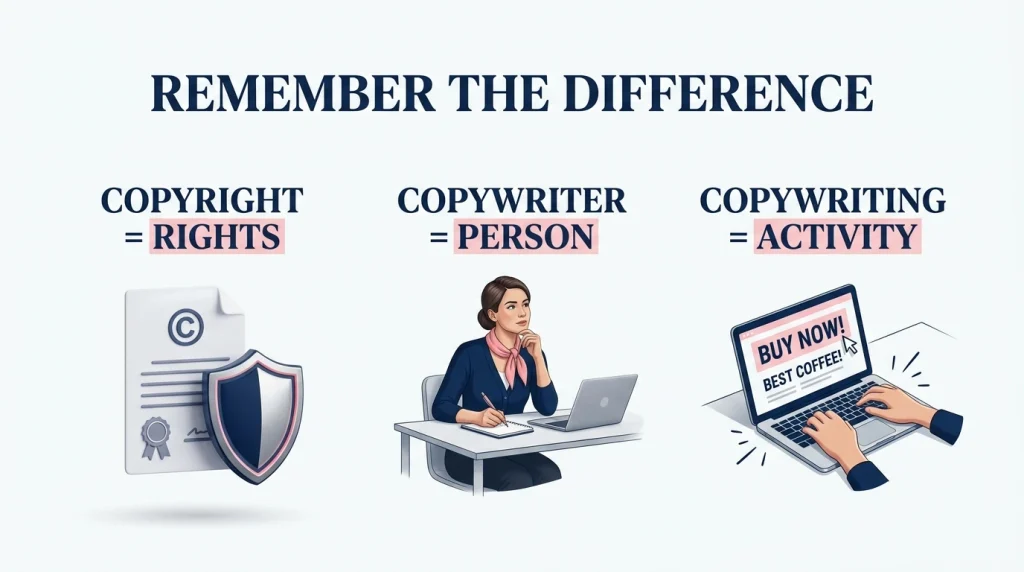
Remember these three words
Copyright = legal rights
Use it when discussing the legal protection of original creative work.
Copywriter = person
Use it for someone who writes advertising or promotional material.
Copywriting = activity
Use it for the process of writing marketing or advertising content.
In standard professional writing, avoid copywrite when you mean copyright, copywriter, or copywriting. If you need to describe the act of creating advertising text, simply write write copy or create marketing content.
How to Use Copyright and Copywriting Correctly
When to Use Copyright
Copyright is primarily a noun, but it can also function as a verb. As a noun, it refers to legal rights in qualifying original creative work. As a verb, to copyright means to secure or establish copyright protection for a work through the applicable legal process or, in ordinary usage, to claim copyright in it.
Use copyright when discussing:
- Rights associated with a book, article, photograph, song, film, or software.
- Who owns or controls the rights to a creative work.
- Whether permission is needed to reproduce or distribute protected material.
- Copyright notices on websites, documents, or published content.
- Licensing or transferring copyright.
Examples:
- The photographer owns the copyright to the image.
- Please check the copyright status before reproducing the illustration.
- The company acquired the copyright under a written agreement.
- The website displays a copyright notice in its footer.
- The author wants to understand how to protect the rights in her new book.
One important point: copyright does not necessarily protect every idea, fact, name, or short phrase. The scope of protection depends on the type of material and the applicable law.
When to Use Copywriter
A copywriter is a person who creates written content for advertising, marketing, or other persuasive communication.
Copywriters may produce:
- Product descriptions.
- Website landing pages.
- Email marketing campaigns.
- Social media advertisements.
- Sales letters.
- Promotional brochures.
- Advertising slogans and campaign text.
Examples:
- We hired a copywriter to improve our product pages.
- The copywriter created a new campaign for the clothing brand.
- She works as a freelance copywriter for small businesses.
The ending -er often identifies a person who performs an activity. Here, the copywriter is the person who writes copy.
When to Use Copywriting
Copywriting is the noun for the activity or profession of creating persuasive written content.
Examples:
- Copywriting is an important part of our marketing strategy.
- He enrolled in a course to improve his copywriting skills.
- Good copywriting explains the value of a product clearly.
- She specializes in email copywriting for online businesses.
You can also say write copy when you want a straightforward verb phrase.
For instance, instead of writing, “I need to copywrite a landing page,” write, “I need to write copy for a landing page.”
Can You Ever Use Copywrite?
Yes, but only with care. Copywrite is recorded as a rare verb formed from copywriter. It can mean writing the text of an advertisement. However, this usage is uncommon, and many readers will interpret the word as a spelling error.
In most professional contexts, the more natural choices are write copy, create advertising copy, or do copywriting.
If you are discussing intellectual property, use copyright instead.
Correct Examples of Copyright and Copywriting
The following examples show how these terms work across everyday and professional situations.
| Context | Example sentence | Why it is correct |
|---|---|---|
| Everyday conversation | The artist owns the copyright to the painting. | Copyright refers to legal rights. |
| Please confirm that we have permission to use this copyrighted image. | Copyrighted describes the image’s legal status. | |
| School | Our assignment explains how copyright applies to published books. | Copyright is the relevant legal concept. |
| Workplace | The company hired a copywriter to revise its website. | Copywriter identifies a person. |
| Social media | I’m learning copywriting to improve my product captions. | Copywriting names the writing activity. |
| Academic writing | The paper examines copyright in digital publishing. | Copyright refers to legal protection. |
| Freelance work | I write copy for small businesses and online stores. | Write copy describes creating promotional content. |
| Publishing | The publisher negotiated the rights to reproduce the illustrations. | Rights describes what the agreement concerns. |
| E-commerce | Our copywriter wrote a clearer description of the new laptop. | Copywriter is the person creating the text. |
| Website footer | © 2026 Example Company. All rights reserved. | This is a conventional copyright notice format. |
These examples illustrate an important distinction: a piece of writing can be created for marketing purposes and also be subject to copyright. The words copywriting and copyright describe different aspects of that situation.
Incorrect vs. Correct: 10 Common Examples
In the table below, copywrite is treated as incorrect when the intended meaning is copyright, copywriter, or copywriting. The rare verb meaning “write advertising copy” is a separate, less common use.
| Incorrect sentence | Correct sentence | Why |
|---|---|---|
| The photograph has copywrite protection. | The photograph has copyright protection. | Copyright is the legal term. |
| I need to check the copywrite status of this article. | I need to check the copyright status of this article. | The sentence concerns legal rights. |
| She owns the copywrite to her novel. | She owns the copyright to her novel. | Copyright refers to the relevant rights. |
| Our business needs a copywrite for its new campaign. | Our business needs a copywriter for its new campaign. | A copywriter is a person. |
| He is studying copywrite for his marketing career. | He is studying copywriting for his marketing career. | Copywriting names the activity. |
| I want to improve my copywrite skills. | I want to improve my copywriting skills. | Copywriting is the established term for the skill. |
| Please add a copywrite notice to the website. | Please add a copyright notice to the website. | A copyright notice communicates a copyright claim. |
| The publisher purchased the copywrite from the author. | The publisher purchased the copyright from the author. | The intended meaning concerns legal rights. |
| We hired a copywrite to write our sales emails. | We hired a copywriter to write our sales emails. | The sentence needs a word for a person. |
| Her copywrite helped increase product sales. | Her copywriting helped increase product sales. | Copywriting describes the work or skill. |
What About “Copyrighted” and “Copywritten”?
These words are especially easy to confuse.
Copyrighted is the standard form when you mean that a work is protected by copyright or that copyright applies to it.
Copywritten is sometimes used mistakenly in place of copyrighted. It may also appear in contexts where people confuse copyright with copywriting, but it is not the standard word for legal protection.
Compare:
- Correct: The photograph is copyrighted.
- Incorrect for the intended legal meaning: The photograph is copywritten.
- Correct: The copywriter wrote the advertisement.
- Correct: The copywriting team revised the advertisement.
When in doubt, use copyrighted for the legal meaning and written by a copywriter when you want to identify who created the marketing text.
Why People Confuse Copywrite and Copyright
They Sound the Same
Copyright and copywrite are homophones: words that sound alike but have different spellings or meanings. In common English pronunciation, right and write sound identical.
Because the difference is not audible, a listener cannot determine which spelling someone intends without context.
The Spelling Looks Logical
People often associate the act of writing with anything that contains the word copy. That can make copywrite look like a logical spelling for copyright.
However, the legal word is formed with right, referring to rights, not write, referring to the act of writing.
Copywriter and Copywriting Are Real Words
The words copywriter and copywriting are established terms in marketing. Someone who knows those words may assume that copywrite is the correct base form for every related meaning.
The connection is understandable, but the terms serve different purposes. The noun copywriter names a person, and copywriting names an activity. Copyright concerns legal rights.
Spellcheck May Not Catch the Error
Spellcheckers do not always identify mistakes involving words that are correctly spelled in another context. A system may also fail to recognize what you intended to say.
Because copyright and copywrite sound alike, reading the sentence aloud may not help. Review the meaning of the sentence instead.
Translation Can Add to the Confusion
Learners of English sometimes translate a word for legal ownership literally, or they may connect the English word write with the act of creating content. This can lead them to choose copywrite.
The solution is to learn each word as a complete term rather than trying to build its meaning from its spelling alone.
Common Mistakes Checklist
Use this checklist when editing your work.
- Using copywrite for legal protection: Replace it with copyright or copyrighted, depending on the sentence.
- Calling a person a copywrite: Use copywriter when referring to someone who creates promotional content.
- Calling the profession copywrite: Use copywriting when referring to the skill or activity.
- Writing copywritten when you mean copyrighted: Choose copyrighted for the standard legal meaning.
- Confusing copyright with plagiarism: Copyright concerns legal rights; plagiarism concerns presenting another person’s work or ideas as your own without proper acknowledgment. They can overlap, but they are not the same.
- Assuming all online content is free to reuse: Public availability does not automatically mean that content is free of copyright restrictions.
- Assuming a copyright notice creates every right: A notice can communicate a claim, but the existence and scope of copyright depend on the work and applicable law.
- Relying on sound alone: Both words can sound alike, so choose the spelling that matches your intended meaning.
A quick proofreading habit can prevent most of these mistakes: identify whether the sentence concerns legal rights, a person, or a writing activity before selecting the word.
Copywrite or Copyright in Real English
Grammatically Correct
Copyright is correct when the sentence refers to legal rights, while copywriter and copywriting are correct when discussing marketing work. For example, “The author owns the copyright” and “She works in copywriting” are both natural sentences. The words are not interchangeable simply because they sound alike. Their grammatical roles and meanings determine which one belongs in a sentence.
Grammatically Possible but Unnatural
Copywrite can be used as a rare verb meaning to write advertising copy, so it is not accurate to say that the spelling has absolutely no recognized use. Nevertheless, “She copywrites advertisements” is much less familiar than “She writes advertising copy.” The latter is clearer and more widely suitable for professional communication, especially when the audience may not recognize the rare verb.
Natural, Everyday English
In ordinary conversation, marketing, and business writing, people generally use write copy, copywriter, and copywriting to discuss advertising content. They use copyright, copyrighted, and copyright owner when discussing legal protection and rights. For example, “Our copywriter created the campaign, and the contract explains who owns the copyright” sounds clear because each term expresses a distinct idea.
American vs. British English
There is no meaningful American-versus-British spelling difference between these terms.
| Term | American English | British English |
|---|---|---|
| Copyright | Copyright | Copyright |
| Copyrighted | Copyrighted | Copyrighted |
| Copywriter | Copywriter | Copywriter |
| Copywriting | Copywriting | Copywriting |
| Copywrite | Rare verb or mistaken spelling, depending on context | Rare verb or mistaken spelling, depending on context |
You do not need to change copyright to copywrite for a British audience or vice versa. The standard spellings are the same in both varieties of English.
Formal vs. Informal Usage
The distinction matters most when you are writing for a professional audience.
Formal writing: Use copyright, copyrighted, copyright owner, and copywriting according to their meanings. In legal documents, follow the terminology used in the relevant agreement and jurisdiction.
Informal writing: You may encounter copywrite in social posts, casual messages, or marketing conversations. However, its appearance does not make it a suitable replacement for the standard term.
Professional recommendation: Write write copy rather than using the rare verb copywrite. It is direct, familiar, and unlikely to confuse your reader.
Comparison Table: Copyright, Copywrite, Copywriter, and Copywriting
| Feature | Copyright | Copywrite | Copywriter | Copywriting |
|---|---|---|---|---|
| Main meaning | Legal rights in creative work | Rare verb for writing advertising copy; often a mistake | Person who writes promotional content | Activity of creating promotional content |
| Typical role | Noun; also verb | Rare verb | Noun | Noun |
| Common context | Publishing, media, law | Limited usage | Advertising, marketing | Advertising, marketing |
| Example | The book has copyright protection. | The agency rarely uses this verb. | We hired a copywriter. | She studies copywriting. |
| Best everyday choice | Use for legal rights | Usually avoid | Use for the person | Use for the activity |
Related Words You Should Know
- Copyright owner: The person or organization that holds the relevant copyright.
- Copyrighted: Protected by copyright.
- Copyright infringement: An unauthorized use that violates applicable copyright law.
- Copy: Written material created for a particular purpose; in marketing, it commonly means advertising or promotional text.
- Copywriter: A person who creates such text.
- Copywriting: The practice of writing such text.
Understanding these related terms makes it easier to choose the right word without relying on spelling alone.
Memory Trick: Rights or Writing?
Use this simple mnemonic:
Copyright protects. Copywriters write. Copywriting sells.
- RIGHT in copyright reminds you of legal rights.
- WRITER in copywriter identifies the person doing the work.
- WRITING in copywriting identifies the activity.
Imagine a business launching a new product. A copywriter writes the advertisement, copywriting describes the work, and copyright may apply to the resulting original text. The three terms belong to the same business situation but describe different things.
If you remember only one distinction, remember this: copyright is about rights; copywriting is about writing.
Real-Life Situations: Which Word Should You Choose?
Situation 1: Publishing a Blog Article
You have written an original article and want to discuss the rights associated with it.
Correct: “I need to understand the copyright rules that apply to my article.”
Why: The issue concerns legal protection, not advertising.
Situation 2: Hiring a Marketing Professional
Your company needs someone to create persuasive website content.
Correct: “We are looking for an experienced copywriter.”
Why: A copywriter is a person who creates promotional text.
Situation 3: Improving a Product Page
You want to make your product description more persuasive and easier to understand.
Correct: “I need to improve the copywriting on this product page.”
Why: Copywriting refers to the activity or skill of producing marketing content.
Situation 4: Sending a Business Email
A colleague asks whether your company can reuse a photograph from another website.
Correct: “Let’s check the copyright status and permission requirements before using the image.”
Why: The question concerns legal rights and permitted use.
Situation 5: Preparing for an Exam
You need to explain the difference between the two terms in a sentence.
Correct: “Copyright concerns legal rights, while copywriting is the process of creating persuasive written content.”
Why: The sentence distinguishes their meanings directly.
Expert Tips for Choosing the Right Word
- Identify the subject before checking the spelling. If you are discussing ownership or legal protection, think copyright. If you are discussing advertising, think copywriting.
- Use the complete word when precision matters. Writing copyrighted image is clearer than trying to shorten the phrase or invent a variation.
- Do not confuse authorship with ownership. The person who writes content and the person who owns its copyright are not necessarily the same. Contracts, employment arrangements, and applicable laws can affect ownership.
- Do not assume that original marketing content is automatically owned by the person who wrote it. The applicable rules and agreements matter.
- Proofread homophones by meaning. Words that sound alike can escape ordinary spellcheck, so check the role each word plays in the sentence.
- Prefer familiar expressions over rare alternatives. “Write advertising copy” is usually clearer than “copywrite advertising.”
- Remember that copyright and plagiarism are different concepts. A use may raise copyright concerns without being plagiarism, and plagiarism can occur in circumstances that do not involve copyright infringement.
These tips help you choose the right spelling while keeping your writing accurate and professional.
Quick Summary
Copyright and copywrite sound alike, but they have different meanings. Copyright is the standard term for legal rights associated with original creative work. Copywrite is usually a spelling mistake when someone means copyright, although it is recognized as a rare verb for writing advertising copy. For everyday professional communication, use write copy instead. A copywriter is a person who creates promotional content, while copywriting is the activity of producing that content. Remember the simple rule: copyright concerns rights, copywriters write, and copywriting creates marketing messages. These terms have the same standard spellings in American and British English. Choosing the correct word makes your writing clearer, more natural, and more professional.
Frequently Asked Questions
Is copywrite or copyright correct?
Copyright is correct when you mean legal rights associated with creative work. Copywrite is usually a misspelling in this context, although it has a rare use as a verb meaning to write advertising copy.
Is copywrite a real English word?
Yes. It is recorded as a rare verb meaning to write advertising text. However, it is often mistaken for copyright, so write copy is generally the clearer choice in everyday and professional English.
Is copyright one word or two?
Copyright is written as one word. It should not be written as copy write when referring to legal rights.
What is the difference between copyright and copywriting?
Copyright concerns legal rights associated with creative work. Copywriting is the process of creating persuasive written content for advertising or marketing. One concerns rights; the other concerns writing.
Is a copywriter the same as a copyright owner?
No. A copywriter creates promotional text, while a copyright owner holds the relevant legal rights. One person may be both, but a contract, employment arrangement, or applicable law may determine who owns the copyright.
Should I write copyrighted or copywritten?
Use copyrighted when describing something protected by copyright. Copywritten is not the standard form for this legal meaning and is often the result of confusing copyright with copywriting.
Is copyright the same in American and British English?
Yes. Copyright, copywriter, and copywriting are standard spellings in both American and British English. There is no regional spelling change that makes copywrite the standard legal term.
Does copyright mean nobody can ever use my work?
No. Copyright does not automatically prohibit every use. Permissions, licenses, exceptions, limitations, and other legal rules may allow particular uses. The answer depends on the work and the applicable law.
Does putting a copyright notice on my website protect my content?
A copyright notice can communicate that you claim copyright in your content, but it does not by itself settle every question about ownership or enforcement. The applicable law determines the protection available.
Can I say “I copywrite for a living”?
People may understand this as a reference to advertising work, but it is an uncommon expression. “I work in copywriting” or “I write copy for a living” is clearer and more conventional.
What is the easiest way to remember copyright vs. copywrite?
Remember copyright = rights. For marketing, remember copywriter = person and copywriting = activity. These associations help you choose the correct word even when the words sound identical.
Mini Quiz: Copywrite or Copyright?
Test your understanding with these ten questions. Try answering before checking the explanations.
| No. | Question | Answer and explanation |
|---|---|---|
| 1 | Choose the correct word: The author owns the (copywrite / copyright) to the novel. | Copyright. It refers to legal rights in the work. |
| 2 | Fill in the blank: Our company hired a ______ to write product advertisements. | Copywriter. This is the person who creates promotional content. |
| 3 | Correct the sentence: This photograph is copywritten. | This photograph is copyrighted. Copyrighted is the standard form for the legal meaning. |
| 4 | Which word names the activity of writing promotional content: copyright or copywriting? | Copywriting. It refers to the process or skill of creating marketing text. |
| 5 | Choose the correct word: Please check the ______ status of this image. | Copyright. The sentence concerns legal rights and permitted use. |
| 6 | Correct the sentence: I want to improve my copywrite skills. | I want to improve my copywriting skills. Copywriting is the established term for the skill. |
| 7 | True or false: Copyright and copywriting mean the same thing. | False. Copyright concerns legal rights; copywriting concerns creating promotional text. |
| 8 | Fill in the blank: She works as a freelance ______ for several online businesses. | Copywriter. The blank refers to a person. |
| 9 | Correct the sentence: We need to add a copywrite notice to our website. | We need to add a copyright notice to our website. Copyright notice is the conventional expression. |
| 10 | Choose the clearest expression: “I copywrite advertisements” or “I write advertising copy.” | I write advertising copy. It is the more familiar and straightforward expression. |