
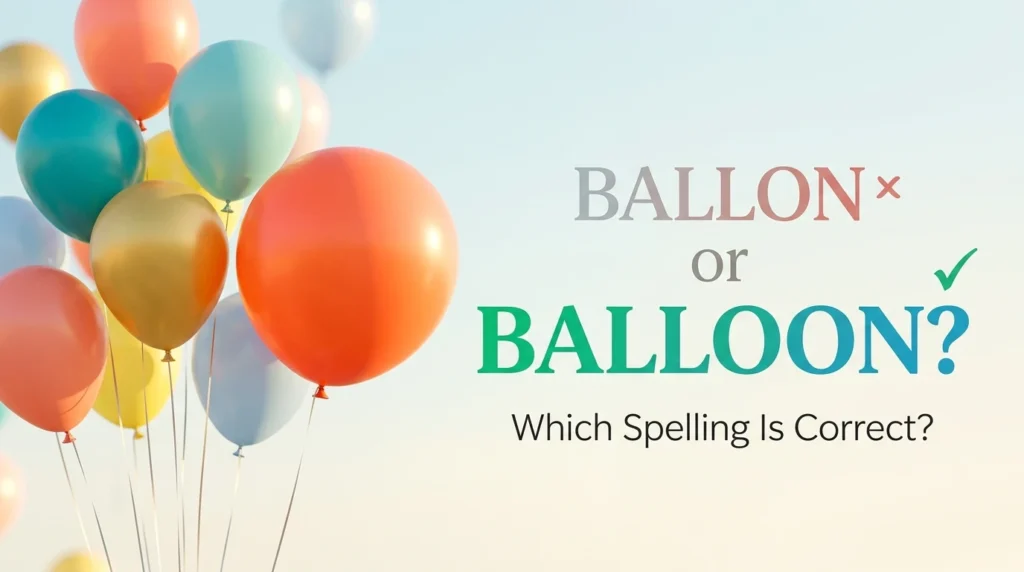

Balloon is the correct spelling when you mean an inflatable object used for decorations, parties, celebrations, or scientific purposes. It can also refer to an aircraft that floats through the air or serve as a verb meaning to expand rapidly. Ballon is not the standard spelling for these everyday English meanings, although it appears in specialized terminology, including ballet. The easiest way to remember the correct spelling is that balloon contains two Ls and two Os: balloon. Both American and British English use this spelling.
What Is Balloon?
A balloon is a flexible container that expands when filled with air or another gas. Balloons are commonly used as toys, party decorations, advertising displays, and scientific instruments. Larger balloons can carry passengers or equipment through the air, as in a hot-air balloon or weather balloon.
The word also has a verb form. When something balloons, it grows, swells, or increases rapidly. For example, if a company’s expenses balloon during the year, its costs rise significantly.
The spelling balloon remains the same in all these uses.
The Different Meanings of Balloon
- Party decoration: A colorful inflatable object used for celebrations.
- Aircraft: A large structure filled with hot air or a lighter-than-air gas.
- Verb: To swell, expand, or increase rapidly.
- Speech bubble: A shape containing words in a comic strip.
- Figurative expression: Something that grows much larger than expected, such as ballooning expenses.
Examples:
- We filled the room with colorful balloons.
- The hot-air balloon rose above the hills.
- Our monthly expenses ballooned after the move.
- The cartoon showed a balloon above the character’s head.
In every example, balloon is the correct spelling.
Why the Correct Spelling Matters
Spelling mistakes can affect how clearly and professionally your writing communicates. Although most readers will understand ballon when you mean balloon, the error may distract them from your message.
Using the correct spelling is especially important in the following situations:
- School assignments: Correct spelling demonstrates attention to written English.
- Professional emails: Accurate writing helps maintain a polished impression.
- Business content: Product descriptions, advertisements, and event announcements should use standard spelling.
- Social media: Correct spelling makes captions and posts easier to read and share.
- Academic writing: Consistency matters when describing scientific instruments, experiments, or changes in measurable quantities.
The mistake is usually easy to fix. Learning the word’s letter pattern helps you avoid repeating it.
The Core Rule: Ballon vs. Balloon
The spelling rule
Write balloon when referring to an inflatable object, a floating aircraft, or something that expands rapidly.
- Correct: balloon
- Incorrect for the ordinary English meaning: ballon
- Correct plural: balloons
- Correct verb forms: balloons, ballooned, ballooning
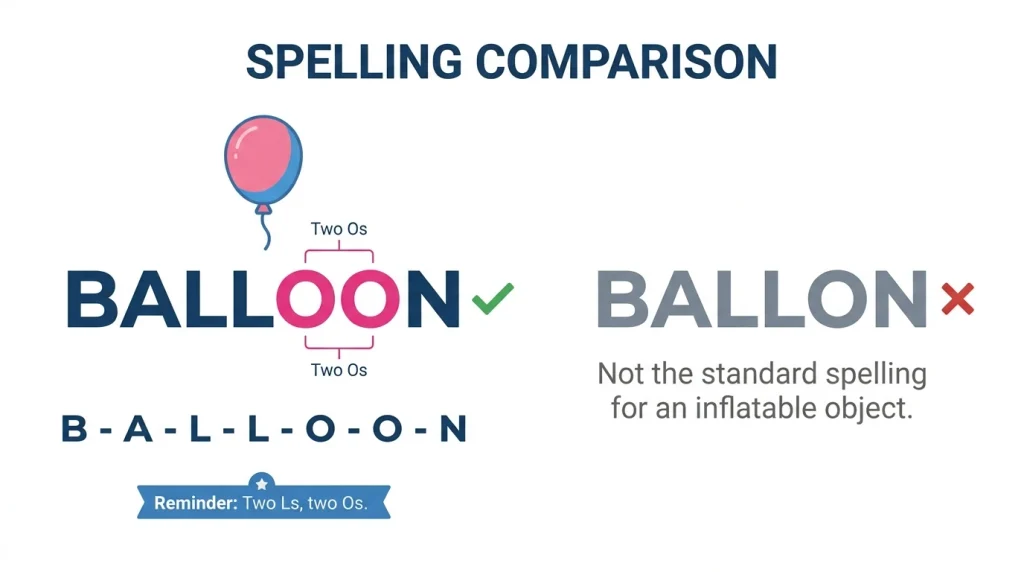
Remember: The word contains two Ls and two Os.
The standard spelling is not determined by how quickly you pronounce the word or how many letters you think you hear. It is determined by the established spelling of the English word.
How Many Letters Are in Balloon?
The word balloon contains seven letters:
B – A – L – L – O – O – N
The word ballon contains six letters:
B – A – L – L – O – N
The difference is the second O. When you mean an ordinary inflatable object, leaving out that letter creates a spelling error.
How to Use Balloon Correctly
The word balloon can function as both a noun and a verb. Understanding these two grammatical roles makes it easier to use the word correctly in different sentences.
1. Use Balloon as a Noun
A noun names a person, place, thing, or idea. In this case, balloon names an object or a type of aircraft.
Examples:
- A yellow balloon floated across the playground.
- The children received a balloon each.
- We ordered a hundred balloons for the celebration.
- The weather balloon collected information about the atmosphere.
When referring to more than one, add s to form balloons.
| Singular | Plural |
|---|---|
| One balloon | Two balloons |
| A red balloon | Several red balloons |
| The weather balloon | The weather balloons |
Do not write ballons when you mean the plural of the everyday English noun.
2. Use Balloon as a Verb
A verb describes an action or a state. As a verb, balloon can mean to expand, swell, or increase quickly.
Examples:
- The company’s operating costs ballooned last year.
- The fabric ballooned in the wind.
- Our original budget ballooned after several unexpected expenses.
- The number of applications has ballooned since the announcement.
The verb can describe physical expansion or a rapid increase in an amount.
Its main forms are:
| Verb form | Example |
|---|---|
| Base form | Costs can balloon quickly. |
| Present tense | The budget balloons every year. |
| Past tense | The budget ballooned last year. |
| Present participle | Costs are ballooning again. |
| Past participle | Expenses have ballooned significantly. |
Notice that every form retains the two Os.
3. Use Balloon in Compound Words
A compound expression combines two or more words to describe a particular object or idea.
Common examples include:
- Hot-air balloon: An aircraft that rises using heated air.
- Weather balloon: A balloon used to carry instruments for atmospheric measurements.
- Balloon animal: A shape made by twisting an elongated balloon.
- Balloon payment: A large payment due at the end of certain loan arrangements.
- Balloon sleeve: A sleeve with a rounded, full shape.
These expressions retain the spelling balloon. You should not remove an O simply because the word appears beside another noun.
Correct Examples of Balloon in Everyday English
The following original examples show how to use the word naturally across different situations.
- Everyday conversation: “Could you tie that balloon to the chair before it floats away?”
- Birthday party: “We need enough balloons to decorate the entire living room.”
- School assignment: “The experiment demonstrated how a balloon expands when filled with air.”
- Professional email: “Please confirm the number of balloons required for Friday’s company event.”
- Business report: “Unexpected shipping charges caused the project budget to balloon.”
- Social media caption: “A little cake, a few balloons, and a wonderful birthday.”
- Academic writing: “The research team released a weather balloon to collect atmospheric data.”
- Travel conversation: “We watched a hot-air balloon drift across the valley at sunrise.”
- News report: “The organization’s operating costs ballooned over the past year.”
- Creative writing: “A silver balloon rose above the crowd and disappeared into the clouds.”
- Shopping: “The store sells reusable decorations alongside latex balloons.”
- Classroom instructions: “Inflate the balloon carefully and tie its opening securely.”
The spelling stays the same regardless of the setting, tone, or purpose of the sentence.
Incorrect vs. Correct: 12 Common Spelling Mistakes
| Incorrect | Correct | Why |
|---|---|---|
| She bought a ballon. | She bought a balloon. | The standard noun contains two Os. |
| The ballon is red. | The balloon is red. | The second O is missing in the incorrect version. |
| We need ten ballons. | We need ten balloons. | The plural is formed from balloon plus s. |
| The child popped a ballon. | The child popped a balloon. | The common object requires the full spelling. |
| I saw a hot-air ballon. | I saw a hot-air balloon. | Compound expressions retain the spelling balloon. |
| The ballon floated away. | The balloon floated away. | The ordinary English noun has two Os. |
| Please order blue ballons. | Please order blue balloons. | The plural still contains both Os. |
| The weather ballon was released. | The weather balloon was released. | The established term is weather balloon. |
| The costs ballon every year. | The costs balloon every year. | The verb is spelled balloon. |
| Their expenses ballon rapidly. | Their expenses balloon rapidly. | The verb needs the second O. |
| Expenses have ballon-ed upward. | Expenses have ballooned upward. | The past participle is ballooned. |
| Ballooning prices became a concern after the costs ballon. | Ballooning prices became a concern after the costs ballooned. | Both the participle and past-tense verb retain the double O. |
The main lesson is simple: the spelling remains balloon whether you are referring to an object, a compound term, or an increase in size or cost.
Why People Confuse Ballon and Balloon
Several factors can make this spelling mistake easy to overlook.
1. The Double O Is Easy to Miss
When people type quickly, they may accidentally leave out a repeated letter. Because ballon still looks similar to balloon, the missing O can go unnoticed during proofreading.
2. Pronunciation Does Not Reveal Every Letter
Balloon is pronounced approximately buh-LOON, with the stress on the second syllable. The two Os represent the long vowel sound in the stressed syllable.
However, pronunciation alone does not tell a writer how many letters to include. Many English words contain spelling patterns that cannot be reliably reconstructed from sound alone.
3. Spell-Check Tools Have Limits
Spell-checking software can catch many typing mistakes, but it does not always identify an incorrect word in context. A form that exists in another language or specialized terminology may not trigger a warning.
A spell-checker is useful, but it should not replace understanding the word you intend to use.
4. Autocomplete Can Reinforce Errors
Typing suggestions may help complete familiar words, but a writer can still select the wrong suggestion or submit a message before checking it. This is particularly easy to do when writing quickly on a phone.
5. Other Languages Use Different Spellings
The French word ballon is a genuine word. It can refer to a ball or balloon, depending on the context. Someone familiar with French may therefore recognize the shorter form.
However, a valid spelling in French does not make ballon the standard spelling of the everyday English word.
Common Mistakes Checklist
Before publishing or submitting your writing, check these common errors.
- Missing the second O: Write balloon, not ballon, when referring to an inflatable object.
- Using the wrong plural: Write balloons, not ballons, for multiple inflatable objects.
- Misspelling a compound term: Write hot-air balloon and weather balloon with the full spelling.
- Misspelling the past tense: Write ballooned, not balloned, when describing a rapid increase.
- Misspelling the continuous form: Write ballooning, not balloning.
- Trusting appearance alone: Check the complete spelling rather than deciding that a word looks right.
- Ignoring the sentence’s meaning: Decide whether you need a noun describing an object or a verb describing expansion.
A quick check of the two Os can prevent most everyday mistakes involving this word.
Balloon in Real English
Grammatically Correct
“Several balloons decorated the entrance” is grammatically correct because balloons is the plural noun naming the decorations. “The cost ballooned” is also correct because ballooned is a verb describing a rapid increase. Both sentences use the standard spelling and the appropriate grammatical form. The choice between noun and verb depends on what the sentence needs to communicate.
Grammatically Possible but Unnatural
A sentence such as “The party contained a ballooning quantity of decorative balloons” is grammatically possible, but it sounds unnecessarily complicated for ordinary conversation. A clearer version is “The party had more and more balloons.” The verb balloon is useful when describing rapid growth, but it should not replace simpler wording when the intended meaning is merely that something increased.
Natural, Everyday English
In everyday English, people commonly say “Let’s buy some balloons,” “The balloon popped,” and “Our expenses ballooned.” These expressions are clear and natural in their respective contexts. The noun is especially common when discussing celebrations, while the verb is useful for describing rapid growth in costs, numbers, or physical size. Choosing the form that fits the meaning makes the sentence easier to understand.
American vs. British English
There is no spelling difference between American and British English for this word. Both use balloon for the inflatable object and balloons for the plural.
The principal differences you may notice involve related vocabulary, pronunciation details, or regional expressions rather than the spelling itself.
| Feature | American English | British English |
|---|---|---|
| Standard spelling | Balloon | Balloon |
| Plural | Balloons | Balloons |
| Past tense | Ballooned | Ballooned |
| Present participle | Ballooning | Ballooning |
| Hot-air aircraft | Hot-air balloon | Hot-air balloon |
| Spelling ballon for the ordinary object | Incorrect | Incorrect |
You do not need to change the spelling for an American or British audience.
Formal vs. Informal Usage
The word balloon is appropriate in both formal and informal writing. Its role and meaning determine how it fits into a sentence.
Informal usage: “The balloon popped before the party started.”
Formal usage: “The research team released a weather balloon to collect atmospheric measurements.”
Business usage: “Operating expenses ballooned during the final quarter.”
Academic usage: “The instrument was suspended beneath a balloon to measure atmospheric conditions.”
The spelling does not change with formality. What changes is the surrounding vocabulary and the amount of technical detail.
Comparison Table: Ballon vs. Balloon
| Feature | Balloon | Ballon |
|---|---|---|
| Standard everyday English spelling | Yes | No |
| Letter count | Seven | Six |
| Contains two Ls | Yes | Yes |
| Contains two Os | Yes | No |
| Means an inflatable object | Yes | Not in standard English usage |
| Can mean to increase rapidly | Yes | No, not for this ordinary English meaning |
| Correct plural for inflatable objects | Balloons | Not ballons |
| Used in American English | Yes | Not as the standard spelling |
| Used in British English | Yes | Not as the standard spelling |
| Specialized use | Common English noun and verb | Appears in specialized terminology, including ballet |
The comparison is straightforward: choose balloon for ordinary English writing. The shorter spelling is not an alternative spelling for the everyday object.
Memory Trick: Remember the Two Os
Use this simple memory trick:
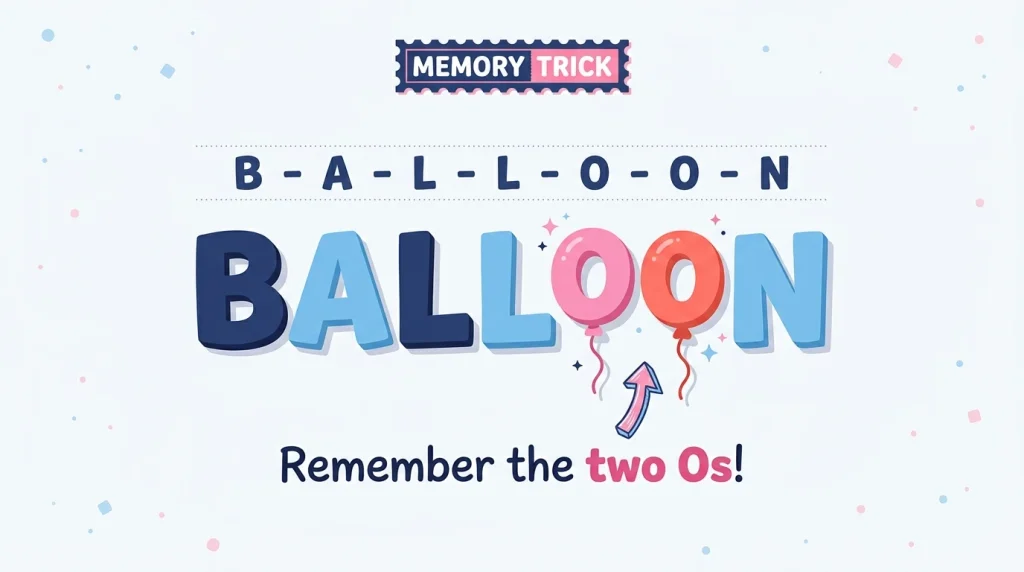
A balloon needs two Os to float in your mind.
Picture the two Os as two round balloons tied together:
B A L L O O N
You can also divide the word into two parts:
- BALL — the first four letters are easy to recognize.
- OON — remember the two Os before the final N.
Say the word, picture its shape, and check the spelling: balloon.
The trick also works for related forms:
- Balloon
- Balloons
- Ballooned
- Ballooning
The double O remains in every form.
Read More: Plack or Plaque: Which Spelling Is Correct?
Real-Life Situations: Which Spelling Should You Choose?
Situation 1: Writing a Birthday Invitation
You are inviting friends to a birthday party and want to mention the decorations.
Incorrect: “There will be colorful ballons and cake.”
Correct: “There will be colorful balloons and cake.”
The plural refers to multiple decorations, so balloons is the appropriate form.
Situation 2: Sending a Work Email
You are asking an event supplier to confirm an order.
Incorrect: “Please deliver 30 ballons by Friday.”
Correct: “Please deliver 30 balloons by Friday.”
Using standard spelling helps make the request clear and professional.
Situation 3: Writing a School Report
You are describing an experiment involving a balloon.
Incorrect: “The ballon expanded as air entered it.”
Correct: “The balloon expanded as air entered it.”
The noun names the object used in the experiment.
Situation 4: Discussing Business Costs
You are explaining an unexpected rise in spending.
Incorrect: “Our expenses ballon during busy periods.”
Correct: “Our expenses balloon during busy periods.”
Here, balloon is a verb that describes a rapid increase.
Situation 5: Posting on Social Media
You are sharing a photograph from a celebration.
Incorrect: “Best birthday ever, with so many ballons!”
Correct: “Best birthday ever, with so many balloons!”
Casual writing still benefits from correct spelling.
Expert Tips for Using Balloon Correctly
These practical habits can help you avoid spelling errors even when writing quickly.
- Memorize the complete letter pattern. Think of the word as B-A-L-L-O-O-N rather than relying on its pronunciation.
- Learn the word family together. Practicing balloon, balloons, ballooned, and ballooning makes it easier to retain the correct spelling.
- Proofread repeated letters. Double letters are easy to overlook, so pay attention to both the Ls and the Os.
- Use context to check meaning. If you are describing a physical object or rapid growth, balloon is almost certainly the form you need.
- Read the complete sentence aloud. This will not reveal every spelling error, but it can help you notice whether you have chosen the correct noun or verb.
- Do not depend entirely on autocorrect. A tool can help identify mistakes, but you should still verify the spelling yourself.
The most useful habit is to check the word visually before submitting important writing. Once you remember the double O, the distinction becomes much easier.
FAQ: Ballon or Balloon
Is ballon ever correct in English?
Yes, ballon appears in specialized English terminology, including ballet, where it describes a dancer’s light, springy quality when jumping. It is not the standard spelling of the everyday word for an inflatable object. In ordinary writing about party decorations, toys, or aircraft, use balloon.
Is balloon spelled with one L or two?
Balloon is spelled with two Ls and two Os. Its seven letters are B, A, L, L, O, O, and N. Remembering both pairs of repeated letters is the easiest way to avoid common spelling mistakes.
Is the plural ballon or balloons?
The correct plural is balloons. Add an S to the singular noun balloon. For example, “The shop sells colorful balloons.” Writing ballons is incorrect when referring to multiple inflatable objects.
Why does balloon have two Os?
The double O is part of the established spelling of the word. It represents the long vowel sound heard in the stressed syllable, pronounced approximately “loon.” English spelling does not always follow a perfectly predictable sound-to-letter pattern, so learning the complete word is helpful.
Is balloon both a noun and a verb?
Yes. As a noun, it refers to an inflatable object or aircraft. As a verb, it means to swell, expand, or increase rapidly. For example, “The balloon popped” uses the noun, while “The expenses ballooned” uses the verb.
How do you spell ballooning?
The correct spelling is ballooning. Begin with balloon and add -ing, keeping both Os. For example, “The ballooning cost of the project concerned the team.”
How do you spell ballooned?
The correct spelling is ballooned. It is the past-tense and past-participle form of balloon. For example, “The company’s expenses ballooned unexpectedly.” Do not omit either O when adding the ending.
Is balloon the correct spelling in American and British English?
Yes. Both American and British English use balloon. There is no regional spelling distinction between the two varieties for this word.
How do you pronounce balloon?
Balloon is pronounced approximately buh-LOON, with the stress on the second syllable. The final syllable rhymes with moon. The pronunciation is the same in its basic form across standard American and British English, although individual accents may vary.
What does it mean when costs balloon?
When costs balloon, they increase rapidly or become much larger than expected. For example, “Renovation costs ballooned after the team discovered structural damage.” The word is figurative here; the costs do not literally inflate like a rubber object.
What is the difference between a balloon and a hot-air balloon?
A balloon is a broad term for an inflatable object or a gas-filled structure. A hot-air balloon is a particular type of aircraft that rises when the air inside its envelope is heated. Both expressions use the same correct spelling: balloon.
Does spell-check always catch ballon?
No. Spell-checkers can miss mistakes, especially when a form is recognized in another language or a specialized context. Always check the meaning of the sentence and verify that you have written balloon when referring to an ordinary inflatable object.
Quick Summary
Balloon is the correct standard English spelling for an inflatable object, a floating aircraft, or something that expands rapidly. The spelling ballon is incorrect for these everyday meanings, although it occurs in specialized terminology, including ballet. Remember that balloon contains seven letters, with two Ls and two Os. Its plural is balloons, its past tense is ballooned, and its continuous form is ballooning. American and British English use the same spelling. Whether you are writing a birthday invitation, a school assignment, a professional email, or a business report, choose the form that fits the sentence. When in doubt, remember the two Os and write balloon.



Pingback: Parfume or Perfume: Which Spelling Is Correct?
Pingback: Majestic or Magestic: Which Spelling Is Correct?