
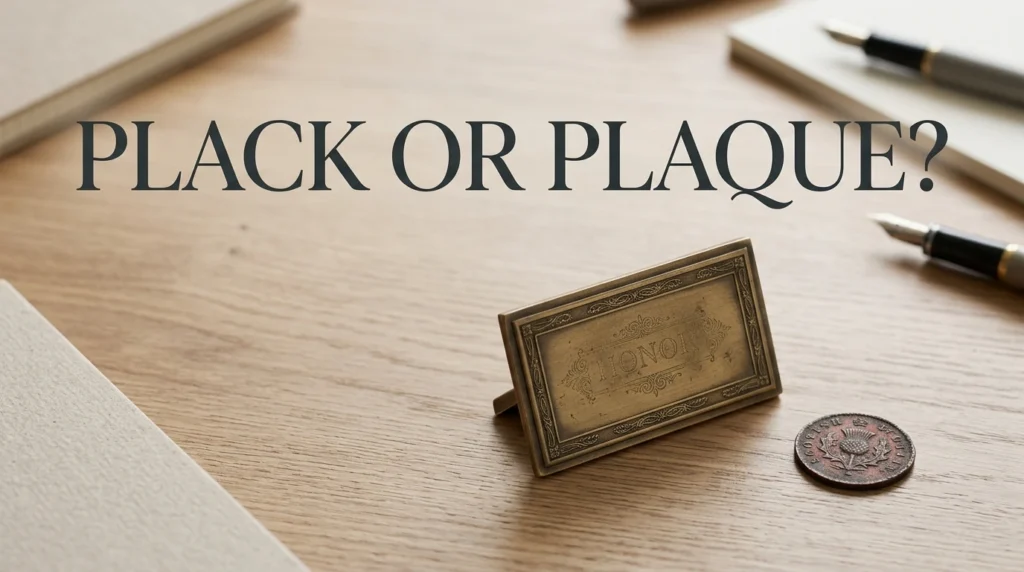

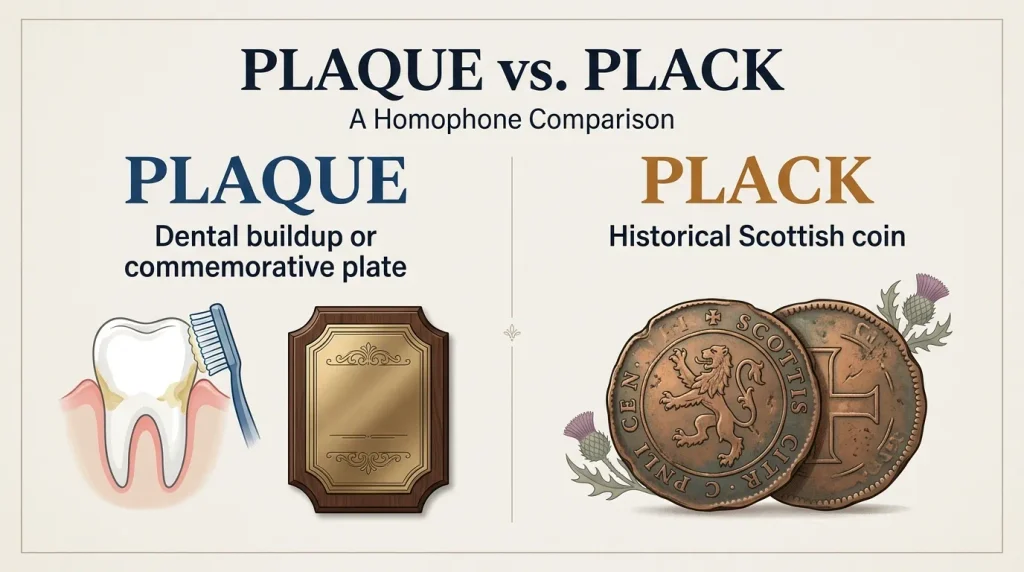
Use plaque when referring to a substance that builds up on teeth, a flat plate with writing on it, or certain abnormal deposits in the body. Use plack only when referring to the historical Scottish coin or in a context where that specific word is intended. For everyday writing, health discussions, school assignments, and workplace communication, plaque is almost certainly the word you need if you are describing dental buildup or a commemorative sign.
What Is the Difference Between Plack and Plaque?
The difference between plack and plaque is primarily meaning and spelling. Although they sound alike, they are not interchangeable.
What Does Plaque Mean?
Plaque is a noun with several established meanings.
- Dental plaque: A soft, sticky film that forms on teeth and contains bacteria.
- Commemorative plaque: A flat plate, often made of metal or stone, bearing words or images to remember a person or event.
- Medical plaque: A localized deposit or abnormal area in body tissue, with the precise meaning depending on the medical condition.
For example:
- The dentist explained how to remove plaque from my teeth.
- A bronze plaque commemorates the founder of the school.
- The doctor discussed the significance of plaque found in the patient’s arteries.
The context determines which meaning of plaque is intended.

English meaning – Cambridge Dictionary
+1
What Does Plack Mean?
Plack is a historical word for a small Scottish coin used during the fifteenth and sixteenth centuries. It is uncommon in modern everyday English and is mainly encountered in historical writing, older literature, and specialized dictionary entries.
dsl.ac.uk
+1
For example:
- The historical account mentions a plack used in Scotland centuries ago.
- The student encountered the word plack while reading about medieval Scottish currency.
If you are talking about teeth, a memorial plate, or a medical deposit, writing plack will generally be a spelling mistake.
Why Does the Difference Matter?
Choosing the correct spelling helps readers understand your meaning immediately. Although a reader might infer what you intended, the wrong word can make otherwise clear writing look careless.
Consider these situations:
- Healthcare: A dentist removes dental plaque, not dental plack.
- History: A plaque may commemorate an event, while a plack refers to an old Scottish coin.
- Education: Correct spelling matters in assignments, examinations, and written explanations.
- Professional writing: Reports, presentations, and public information should use the established word that matches the subject.
- Online publishing: Correct spelling makes an article easier to understand and prevents avoidable editing errors.
The important lesson is that a word can sound right while still being the wrong choice for the meaning you intend.
The Core Rule
Remember this spelling rule
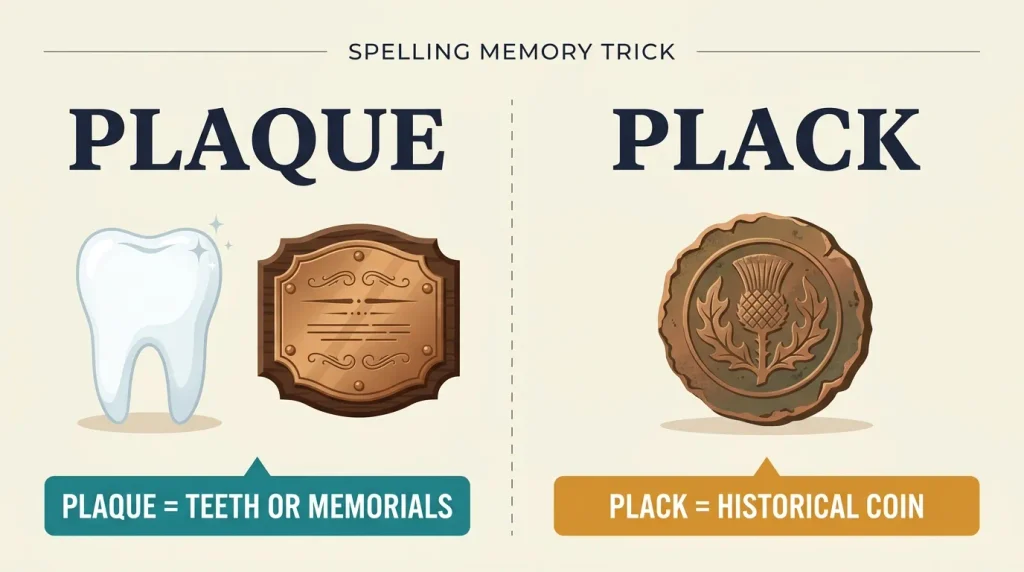
- Plaque = dental buildup, a commemorative plate, or a medical deposit.
- Plack = a historical Scottish coin.
If you mean something on your teeth or a plate attached to a wall, write plaque.
The ending -que in plaque produces a /k/ sound. This spelling pattern can look unusual to learners, but it is part of the standard spelling of the word.
How to Use Plack and Plaque Correctly
When to Use Plaque
Use plaque when discussing any of its established modern meanings.
- Dental care: Use it when writing about the film that forms on teeth.
- Memorials and buildings: Use it for a plate bearing an inscription that commemorates a person or event.
- Medical conditions: Use it when referring to a localized deposit or lesion described as a plaque.
- Science: Use it in specialized contexts where the term refers to a plaque in a biological or laboratory setting.
Examples:
- Brush your teeth regularly to help control plaque.
- The university installed a plaque outside the library.
- The report describes plaque buildup in the artery.
- The laboratory researchers observed a plaque in the bacterial culture.
When to Use Plack
Use plack when the subject specifically concerns the historical Scottish coin.
Examples:
- The historian described the value of a Scottish plack.
- The old document recorded a payment made in placks.
- The museum displayed information about coins used in Scotland centuries ago.
In contemporary writing, this word is rare. Do not use it as a shortened version of plaque or as a casual spelling alternative.
Correct Examples of Plaque and Plack
The following examples show how the words work in different situations.
- Everyday conversation: “My dentist said I need to remove plaque more effectively.”
- Email: “Please arrange for a commemorative plaque to be installed near the entrance.”
- School assignment: “Dental plaque can contribute to tooth decay and gum problems.”
- Workplace: “The building’s new plaque will recognize the company’s founding team.”
- Social media: “We finally unveiled the plaque honoring our former coach.”
- Academic writing: “The study examined the relationship between bacterial plaque and oral health.”
- Healthcare discussion: “The specialist explained what the plaque finding meant in this particular case.”
- Museum description: “The exhibit explains how a plack was used in historical Scotland.”
- Historical writing: “The account refers to a small payment measured in placks.”
- Proofreading: “Change ‘dental plack’ to ‘dental plaque’ before submitting the report.”
These examples illustrate the difference between a common modern word and a rare historical term.
Incorrect vs. Correct: Plack or Plaque?
The table below covers common mistakes and explains why each correction is appropriate.
| Incorrect | Correct | Why |
|---|---|---|
| The dentist removed the plack. | The dentist removed the plaque. | Dental buildup is called plaque. |
| I need to clean the plack off my teeth. | I need to clean the plaque off my teeth. | Plaque is the established dental term. |
| The plack on the building honors the founder. | The plaque on the building honors the founder. | An inscribed commemorative plate is a plaque. |
| They installed a plack outside the school. | They installed a plaque outside the school. | The sentence describes an inscribed plate. |
| My dentist explained how plack forms. | My dentist explained how plaque forms. | Plaque is the correct spelling in dental contexts. |
| The award ceremony included a memorial plack. | The award ceremony included a memorial plaque. | The intended object is a memorial plate. |
| Please order a brass plack for the entrance. | Please order a brass plaque for the entrance. | The intended object is a sign or inscription plate. |
| The report discusses arterial plack. | The report discusses arterial plaque. | Plaque is the established term for this type of deposit. |
| The hygienist warned me about plack buildup. | The hygienist warned me about plaque buildup. | The standard phrase is plaque buildup. |
| The museum displayed a commemorative plack. | The museum displayed a commemorative plaque. | A commemorative plate is called a plaque. |
Important distinction: These sentences are incorrect only when the writer intends the ordinary meaning of plaque. A sentence about a genuine historical Scottish coin can correctly use plack.
Why People Confuse Plack and Plaque
1. They Sound Similar
Both words can be pronounced with a short /a/ sound followed by /k/, particularly in American English. When people spell a word based on sound alone, they may choose plack because it appears to match the pronunciation.
2. Plaque Has an Unusual Ending
The letters -que are pronounced like /k/ in plaque. English has many spellings that cannot be predicted reliably from sound alone, so familiar spelling patterns do not always help.
3. People Rely Too Much on Pronunciation
Pronunciation helps identify a word, but it cannot always tell you how to spell it. Words that sound alike may have unrelated meanings and different spellings.
4. Spellcheck Does Not Understand Every Context
A spelling checker may flag an unfamiliar word, but a real word can still be incorrect in a particular sentence. Since plack exists, software may not always identify it as a mistake when you intended plaque.
5. Translation Can Influence Spelling
Learners sometimes transfer spelling patterns from another language. If the word for a dental deposit or commemorative plate is spelled differently in their first language, they may try to reproduce that spelling in English.
The best solution is to connect each spelling with its meaning rather than memorizing pronunciation alone.
Common Mistakes Checklist
Use this checklist when proofreading your writing.
- Writing plack when describing teeth: Replace it with plaque because dental buildup is called plaque.
- Writing plack when describing a memorial: Use plaque for an inscribed commemorative plate.
- Assuming plack is never a real word: It is a genuine historical term, so its use depends on context.
- Trusting pronunciation alone: Remember that the /k/ sound in plaque is spelled -que.
- Accepting every spellcheck suggestion: Read the full sentence to confirm that the selected word conveys the intended meaning.
- Confusing spelling with grammar: Both words can function as nouns, but only the appropriate word fits the intended meaning.
- Treating the words as interchangeable: They have different meanings and cannot be substituted freely.
- Ignoring the audience: In ordinary modern writing, readers are far more likely to encounter plaque than plack.
Plack or Plaque in Real English
Grammatically Correct
Both plack and plaque are nouns, and both can be grammatically correct. For example, “The dentist removed the plaque” is correct because it uses the established term for dental buildup. “The historian described the plack” can also be correct if the passage concerns the historical Scottish coin. The grammatical structure alone does not determine whether the chosen word has the intended meaning.
Grammatically Possible but Incorrect for the Intended Meaning
“The dentist removed the plack” is grammatically well formed: the subject, verb, and object fit together. However, it is incorrect if the writer means dental buildup. This illustrates an important distinction in English: a sentence can follow grammatical rules while using the wrong word. Correcting the vocabulary, rather than changing the sentence structure, solves the problem.
Natural, Everyday English
In everyday conversations about dental care, people naturally say “plaque buildup,” “remove plaque,” and “dental plaque.” When discussing a commemorative object, phrases such as “a memorial plaque” and “a plaque on the wall” are also standard. The word plack is much less common and usually belongs in historical or specialized contexts. Choosing the familiar term that fits the subject makes your writing clearer.
American vs. British English
There is no standard American-versus-British spelling difference between plack and plaque. The spelling plaque is used in both varieties when referring to dental buildup or an inscribed plate.
Pronunciation can vary by accent. American English commonly uses /plæk/, while British English may use /plæk/ or /plɑːk/. The pronunciation difference does not change the spelling.
The historical word plack is associated with Scotland and its former currency, rather than being a standard British alternative to plaque.
Formal vs. Informal Usage
Plaque is appropriate in both formal and informal writing.
- Formal: “The report identifies a buildup of dental plaque.”
- Informal: “I need to get the plaque off my teeth.”
- Professional: “The commemorative plaque will be mounted near the main entrance.”
- Historical or academic: “The document records a payment in placks.”
The choice depends on meaning and context, not on whether the writing is formal or casual. Using plack for dental buildup remains incorrect in either register.
Comparison Table: Plack vs. Plaque
| Feature | Plack | Plaque |
|---|---|---|
| Part of speech | Noun | Noun |
| Main meaning | Historical Scottish coin | Dental film, inscribed plate, or medical deposit |
| Common in modern writing | Rare | Common |
| Dental context | Incorrect for the intended meaning | Correct |
| Memorial context | Incorrect for the intended meaning | Correct |
| Historical currency context | Correct when referring to the coin | Not the name of the coin |
| American spelling | Plack | Plaque |
| British spelling | Plack | Plaque |
| Pronunciation | Commonly /plæk/ | Commonly /plæk/ in American English |
| Suitable everyday choice | Only in its specific historical sense | Yes, when the context calls for it |
Memory Trick: How to Remember Plaque
Remember this simple association:
Plaque has a “Q” for the correct word on your teeth.
The letter Q can remind you of the unusual spelling -que. When you think about dental care or a commemorative plate, remember plaque. Reserve plack for the old Scottish coin.
This is a memory aid, not a rule about the history of the word. Its purpose is to help you recall the correct modern spelling quickly.
Real-Life Situations
At the Dentist
You want to explain why you need a professional cleaning.
Correct: “I have plaque buildup near my gums.”
Incorrect: “I have plack buildup near my gums.”
Why: The standard dental term is plaque.
At a School or University
Your teacher asks you to write about a memorial outside the campus.
Correct: “A plaque near the entrance commemorates the school’s founder.”
Incorrect: “A plack near the entrance commemorates the school’s founder.”
Why: The sentence describes an inscribed commemorative plate.
In a Workplace Email
You are arranging a recognition ceremony.
Correct: “The new plaque will be unveiled during Friday’s ceremony.”
Incorrect: “The new plack will be unveiled during Friday’s ceremony.”
Why: The intended object is a commemorative plaque.
In a History Class
You are explaining an old Scottish monetary system.
Correct: “The historical source refers to a plack.”
Why: Here, the rare word is appropriate because the subject is historical currency.
During an Exam
You need to complete the sentence: “The dentist removed the dental _____.”
Correct answer: plaque.
Why: Dental plaque is the established term. Plack refers to a different thing.
Read More: Steem or Steam: Meaning, Spelling, and Correct Usage.
Expert Tips: Choosing the Right Word
- Check the meaning before the spelling. Ask yourself whether you mean dental buildup, an inscribed plate, or an old coin.
- Learn the complete word. Remember plaque as a single spelling rather than trying to construct it from its pronunciation.
- Use word combinations as clues. Expressions such as “dental plaque,” “plaque buildup,” and “commemorative plaque” strongly indicate the correct choice.
- Read the sentence aloud, then proofread it visually. Hearing the sentence helps with meaning, while visual proofreading catches spelling errors.
- Do not automatically reject unusual words. Plack is a genuine historical word, so the surrounding context matters.
- Avoid unnecessary corrections. If a writer has correctly used plack to discuss Scottish currency, changing it to plaque would alter the meaning.
Quick Summary
Plack and plaque are different words, even though they sound similar. Plaque is the correct spelling when referring to the sticky film that forms on teeth, an inscribed plate that commemorates a person or event, or certain medical deposits. Plack is a rare historical term for a small Scottish coin used centuries ago. It is not an alternative spelling of dental or commemorative plaque. Both words can be grammatically correct, but only the word that matches your intended meaning belongs in your sentence. Remember the spelling plaque for dental care and memorials, and reserve plack for historical currency. When in doubt, check the meaning and context before choosing.
Frequently Asked Questions
1. Is plack or plaque the correct spelling?
Plaque is correct when referring to dental buildup, a commemorative plate, or a medical deposit. Plack is a separate word for a historical Scottish coin.
2. Is plack a real English word?
Yes. Plack is a recognized historical English word associated with a small Scottish coin. It is rare in everyday modern English.
3. Why is plaque spelled with -que instead of -ck?
Plaque has a spelling influenced by its French origin. In English, the ending -que represents the /k/ sound. Its spelling must be learned rather than reliably predicted from pronunciation.
4. Is plack another word for dental plaque?
No. Plack is not a standard synonym for dental plaque. Use plaque when discussing the bacterial film that forms on teeth.
5. Can I write plack in a school assignment?
Yes, if the assignment concerns the historical Scottish coin and the word fits the context. If you are writing about teeth or a commemorative plate, use plaque.
6. Is plaque spelled the same way in American and British English?
Yes. Both American and British English use plaque for dental buildup and commemorative plates. Pronunciation may differ, but the standard spelling does not.
7. What is the plural of plaque?
The plural of plaque is plaques. For example: “The museum installed three plaques outside the historic building.”
8. What is the plural of plack?
The plural is placks. For example: “The historical account mentions several placks.” This plural is appropriate when discussing the old Scottish coin.
9. Can spellcheck miss the mistake between plack and plaque?
Yes. Because plack is a real word, a spellchecker may not flag it in every context. Always check whether the word makes sense in the sentence.
10. How can I remember the difference between plack and plaque?
Associate plaque with your teeth or a commemorative plate. Remember plack as the historical Scottish coin. Linking each spelling to its specific meaning is more reliable than relying on pronunciation alone.
Read More: Gleen or Glean: Which Spelling Is Correct?
Mini Quiz: Plack or Plaque?
Choose the correct answer for each question. The answers and explanations are included in the table.
| No. | Question | Answer and explanation |
|---|---|---|
| 1 | The dentist removed the dental _____. (A) plack (B) plaque | B — plaque. This is the standard term for dental buildup. |
| 2 | The town unveiled a commemorative _____. (A) plaque (B) plack | A — plaque. A commemorative plaque bears an inscription about a person or event. |
| 3 | True or false: Plack is never a real English word. | False. Plack is a historical term for a Scottish coin. |
| 4 | Complete the sentence: Brush regularly to help control dental _____. | Plaque. Plaque can accumulate on teeth. |
| 5 | Correct this sentence: “The school installed a plack outside the main entrance.” | The school installed a plaque outside the main entrance. The sentence describes an inscribed plate. |
| 6 | Which word refers to an old Scottish coin? (A) plaque (B) plack | B — plack. It is a rare historical currency term. |
| 7 | True or false: American and British English use different standard spellings of plaque. | False. Both varieties spell the word plaque. |
| 8 | Correct this sentence: “My dentist warned me about plack buildup.” | My dentist warned me about plaque buildup. Plaque is the established dental term. |
| 9 | Choose the correct plural: (A) plaques (B) plaquies | A — plaques. Add -s to form the plural of plaque. |
| 10 | Complete the sentence: The historian described several Scottish _____. | Placks. This is the plural of plack when referring to the historical coins. |


Pingback: Abscent or Absent: Which Spelling Is Correct?