


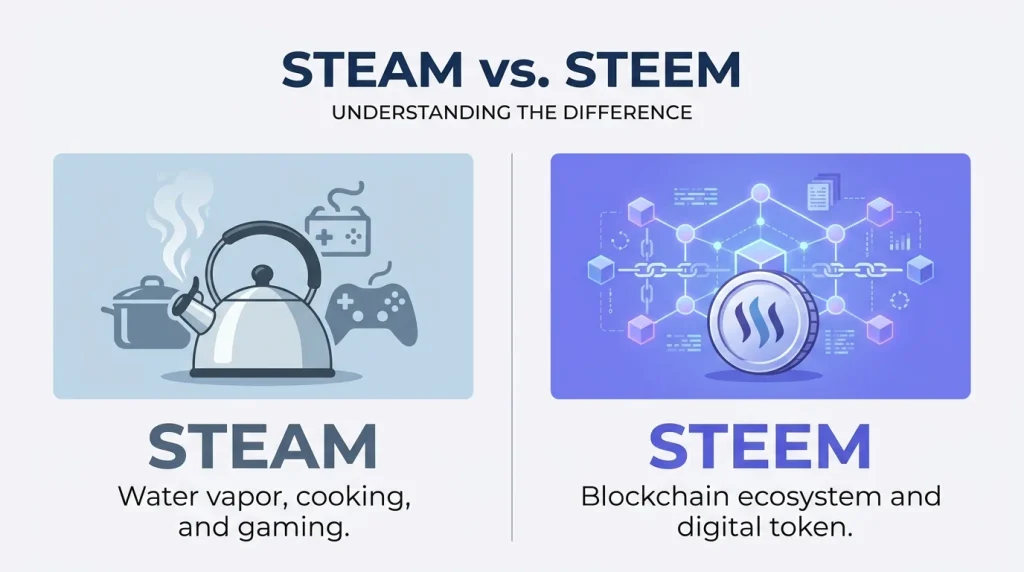
Use steam when talking about water vapor, steam-powered machinery, steaming food, or releasing steam. For example, “Steam rose from the hot soup.” The spelling steem is not standard English for these meanings. However, Steem is a proper name in certain contexts, including a blockchain and cryptocurrency ecosystem. If you are writing an ordinary English sentence, steam is almost always the word you need.
What Is the Difference Between Steem and Steam?
The difference between steem and steam is mainly spelling and context.
Steam is a standard English word that can function as a noun or a verb. As a noun, it refers to water vapor produced by heating water. As a verb, it can mean to produce steam, cook food using steam, or move with force.
Steem, on the other hand, is not the standard spelling of this everyday English word. It may appear as a proper name, brand, username, or specialized term. Capitalization and context help determine whether it is intentional.
What Does Steam Mean?
Steam commonly refers to water vapor produced when water is heated. In everyday speech, people also use the word for the visible mist rising from hot water, although the visible cloud consists largely of tiny water droplets formed as vapor cools and condenses.
The word also has several related uses:
- Cooking: Steam vegetables until they become tender.
- Machinery: A steam engine uses pressurized steam to produce motion.
- Energy: A power plant may use steam to drive a turbine.
- Expression: Someone might say, “I’m steaming,” to express anger.
- Movement: A train can steam into a station in a literary or historical description.
What Does Steem Mean?
Steem is not the standard spelling of the common English word steam. If you use it in a sentence about hot water vapor, cooking, or steam engines, readers will generally interpret it as a spelling error.
However, Steem can be an intentional proper noun. For example, it is associated with a blockchain-based ecosystem and its cryptocurrency terminology. In that setting, the spelling is deliberate rather than a mistake.
The key is to identify the context before correcting the word.
Why Does the Steem vs. Steam Confusion Happen?
1. Both Words Sound the Same
Steem and steam are homophones in ordinary English pronunciation: they sound alike but have different spellings and uses. When people speak, the listener relies on context to understand which word is intended.
For example, “The steam is rising” and “I posted on Steem” sound similar, but the subject of the conversation makes the intended meaning clear.
2. English Has Several Ways to Spell the Same Sound
English spelling does not always match pronunciation perfectly. The long “ee” sound can appear in words spelled with different letter combinations, such as team, dream, and receive.
Because steem looks plausible to someone unfamiliar with the word, it can seem like a reasonable spelling even though steam is the standard form for the everyday meaning.
3. Typing and Autocorrect Can Reinforce the Error
People often type quickly on phones or keyboards. Autocorrect may fail to identify an error when the alternative spelling resembles a name, username, or specialized term. Spellcheckers also cannot always determine what a writer intends from a word in isolation.
The best solution is to check the meaning of the sentence, rather than relying entirely on automatic corrections.
4. Online Names Use Unusual Spellings
Internet platforms, digital projects, usernames, and cryptocurrency communities sometimes use spellings that differ from ordinary English words. That is why Steem may be correct in a technology-related discussion but incorrect in a sentence about boiling water.
The Core Rule: When Should You Use Steam or Steem?
Use steam
Write steam for water vapor, cooking, steam engines, heat-related expressions, and the gaming service named Steam.
Use Steem
Write Steem when referring to the blockchain ecosystem or another specific name that intentionally uses this spelling.
Avoid steem in ordinary sentences
If you mean hot vapor or the act of producing it, steem is a spelling error.
Read More: Gleen or Glean: Which Spelling Is Correct?
How to Use Steam Correctly
The word steam has several grammatical uses. Understanding its role in a sentence makes it easier to spell and use correctly.
Steam as a Noun
A noun names a person, place, thing, or idea. As a noun, steam refers to water vapor or, more broadly, to the vapor associated with heated water.
Examples:
- Steam covered the kitchen window.
- The pressure inside the steam pipe increased.
- A cloud of steam escaped from the kettle.
- The bathroom mirror was covered in condensation from the hot shower.
- The factory uses steam to operate its equipment.
Steam as a Verb
A verb expresses an action or state. As a verb, steam can mean to produce steam, cook food using steam, or move forcefully in certain expressions.
Examples:
- We steam the broccoli for five minutes.
- The kettle began to steam.
- She steamed the wrinkles out of her jacket.
- The train steamed into the station.
- He was steaming after the disagreement.
Common Forms of Steam
| Form | Grammatical role | Example |
|---|---|---|
| Steam | Base verb or noun | Steam rose from the pot. |
| Steams | Third-person singular verb | The machine steams the fabric. |
| Steamed | Past tense or past participle | She steamed the vegetables. |
| Steaming | Present participle or adjective | The steaming soup smelled delicious. |
| Steamy | Adjective | The bathroom felt steamy. |
Notice that the correct forms preserve the spelling steam. You do not change it to steem when adding an ending.
Correct Examples of Steam and Steem
The following examples show how the two spellings work in everyday writing, professional communication, education, and online discussions.
Everyday Conversation
- Correct: The steam from my coffee fogged up my glasses.
- Correct: Please steam the rice before serving dinner.
- Correct: I need to take a walk to blow off some steam after work.
Emails and Workplace Writing
- Correct: The maintenance team inspected the steam pipes this morning.
- Correct: Please switch off the steam iron before leaving the office.
- Correct: The engineer reported a problem with the steam pressure system.
School and Academic Writing
- Correct: Steam forms when water vaporizes and may become visible as it cools and condenses.
- Correct: The students observed steam rising from the heated water during the experiment.
Social Media and Technology
- Correct: I downloaded the game through Steam.
- Correct: The developer is building an application for the Steem blockchain.
These examples illustrate why context matters. The ninth sentence refers to a gaming service, while the tenth refers to a blockchain ecosystem. Neither use is a spelling error.

Incorrect vs. Correct: Steem or Steam
The table below highlights common errors and explains why each correction is needed.
| Incorrect | Correct | Why |
|---|---|---|
| The steem from the kettle was hot. | The steam from the kettle was hot. | Steam is the standard spelling for water vapor. |
| Please steem the vegetables. | Please steam the vegetables. | The verb uses the same spelling as the noun. |
| I could see steem coming from the pot. | I could see steam coming from the pot. | The sentence describes visible vapor. |
| The steem engine was powerful. | The steam engine was powerful. | The established technical term is steam engine. |
| The bathroom was full of steem. | The bathroom was full of steam. | The sentence refers to vapor from hot water. |
| The iron releases steem. | The iron releases steam. | The machine produces steam, not “steem.” |
| The steem pipe needs repair. | The steam pipe needs repair. | Steam pipe is the correct compound noun. |
| She was steaming mad after the meeting. | She was steaming mad after the meeting. | This sentence is already correct; steaming mad is an established expression. |
| I downloaded the game on Steem. | I downloaded the game on Steam. | The gaming service is named Steam. |
| I earned rewards on Steam’s blockchain. | I earned rewards on the Steem blockchain. | Steem is the relevant proper name in this context. |
| I invested in the steem token. | I invested in the STEEM token. | The cryptocurrency ticker is conventionally written in uppercase. |
A useful distinction: not every sentence containing Steem is wrong, and not every sentence containing steam is about water. The intended meaning determines the correct choice.
Common Mistakes Checklist
Use this checklist when proofreading your writing.
- Writing steem when describing hot vapor: Replace it with steam.
- Using steem as a verb: Write steam, steams, steamed, or steaming, depending on the sentence.
- Confusing Steam with Steem online: Check whether the topic is gaming or blockchain technology.
- Assuming every unfamiliar spelling is a typo: Proper names and specialized terms can use nonstandard spellings.
- Trusting autocorrect without reviewing the sentence: Read the complete sentence to confirm that the selected word matches your meaning.
- Changing capitalization unnecessarily: Use steam for the ordinary word, Steam for the gaming service, and Steem for the blockchain name. Use STEEM when referring specifically to the token ticker.
Steem or Steam in Real English
Grammatically Correct
“The steam rose from the saucepan” is grammatically correct because steam functions as the subject of the sentence. “She steamed the vegetables” is also correct because steamed is the past-tense form of the verb. In a technology discussion, “The developer works with Steem” can be correct because Steem is a proper noun. The spelling must fit both the grammar and the intended meaning.
Grammatically Possible but Unnatural
A sentence such as “The steem came out of the kettle” is understandable, but it is not standard spelling for the intended meaning. Readers will likely infer that the writer means steam. Similarly, using an uncapitalized or altered version of a technical name may make a sentence look careless in formal writing. Understandability does not make a spelling choice standard.
Natural, Everyday English
Natural English uses steam in expressions such as “blow off steam,” “steam vegetables,” and “the steam from the shower.” These phrases are familiar and appropriate in ordinary conversation. Steem is natural only when the discussion genuinely concerns a name or term that uses that spelling. Choosing the word based on context produces clearer writing than choosing it merely because it sounds right.
American vs. British English
There is no standard American-versus-British spelling difference between steam and steem.
Both American and British English use steam for heated water vapor, steam-powered machinery, and the related verb. Neither variety normally uses steem as the spelling of this everyday word.
For example:
- American English: The vegetables are steaming in the pot.
- British English: The vegetables are steaming in the pot.
The spelling remains the same in both varieties.
Formal vs. Informal Usage
The spelling rule does not change between formal and informal English. However, the expressions you choose may vary with the situation.
| Context | Suitable usage | Example |
|---|---|---|
| Academic writing | Technical, precise wording | Steam forms as water changes into vapor. |
| Workplace email | Clear and professional wording | The steam system requires inspection. |
| Everyday conversation | Common expressions | I need to blow off some steam. |
| Online gaming | Proper name | I bought the game on Steam. |
| Blockchain discussion | Proper name and token terminology | The application uses the Steem blockchain. |
Avoid using steem as a casual alternative to steam. Informal writing allows abbreviations and conversational expressions, but it does not make an unintended spelling error correct.
Steam vs. Steem: Comparison Table
| Feature | Steam | Steem |
|---|---|---|
| Standard everyday English word | Yes | No, not with this spelling for the same meaning |
| Pronunciation | /stiːm/ | /stiːm/ |
| Refers to water vapor | Yes | No |
| Used as an ordinary verb | Yes | No |
| Used for cooking | Yes | No |
| Used in gaming | Yes, as the gaming service’s name | Not for the Steam gaming service |
| Used in blockchain terminology | Not as the name of the Steem ecosystem | Yes |
| Capitalization | Usually lowercase as a common noun | Capitalized as a proper name |
| Cryptocurrency ticker | No | STEEM |
| Correct choice | General English and gaming | The specific blockchain ecosystem |
Memory Trick: How to Remember Steam vs. Steem
Remember this simple phrase:
“Hot tea creates steam; digital communities use Steem.”
The word steam contains ea, just like tea. When you picture a hot cup of tea releasing steam, you can connect the spelling to the meaning.
For Steem, remember the capital S in the name of the blockchain ecosystem.
Another quick check is to ask yourself:
- Am I talking about heat, vapor, cooking, or a game? Use steam.
- Am I referring to the specific blockchain ecosystem? Use Steem.
- Am I writing about the cryptocurrency ticker? Use STEEM.
Real-Life Situations: Choosing the Right Spelling
Situation 1: Writing a School Assignment
A student writes, “The steem from boiling water rose into the air.”
The correct sentence is: “The steam from boiling water rose into the air.”
The student is describing a physical process, so steam is the correct spelling.
Situation 2: Sending a Workplace Email
An employee writes, “The steem pipe in the factory needs immediate attention.”
The correct sentence is: “The steam pipe in the factory needs immediate attention.”
Using the established technical term makes the message clearer and more professional.
Situation 3: Talking About Video Games
A friend asks where you bought a game.
You can say, “I bought it on Steam.”
Here, Steam is the name of the gaming service, so the capitalization is appropriate.
Situation 4: Discussing a Blockchain Project
A developer says, “Our application connects to the Steem blockchain.”
This spelling is correct because the developer is referring to the specific blockchain ecosystem, not water vapor.
Situation 5: Proofreading a Social Media Post
You write, “I need to blow off some steem after a stressful day.”
The correct sentence is: “I need to blow off some steam after a stressful day.”
The expression means releasing stress, frustration, or pent-up energy.
Expert Tips for Avoiding the Mistake
- Read for meaning, not just sound. Since the two spellings are pronounced alike, pronunciation alone cannot help you choose the correct one.
- Learn the complete word family. Remember steam, steams, steamed, and steaming together.
- Check proper names separately. Brand names and technical names do not always follow ordinary spelling patterns.
- Use spellcheck as a second opinion. Automated tools may miss errors involving valid names or specialized terminology.
- Proofread the sentence in context. Ask what the word refers to before making a correction.
- Remember that capitalization communicates meaning. Steam, Steam, and Steem may point to different contexts even when two forms share the same pronunciation.
Read More: Drunk vs. Drank: What’s the Difference?
Frequently Asked Questions
Is steem a real English word?
Steem is not the standard spelling of the ordinary English word for water vapor. It can be used as a proper name, particularly in blockchain-related contexts.
Is steam or steem correct in a sentence?
For ordinary English, steam is correct. Use Steem when referring to the specific name that uses that spelling. The sentence’s meaning determines the right choice.
Are steam and steem pronounced the same?
Yes. In standard English pronunciation, both are pronounced /stiːm/. The difference is spelling and meaning, not the usual pronunciation.
Is steem ever correct?
Yes. Steem is correct when it is the intended spelling of a proper name, such as the Steem blockchain ecosystem. It is incorrect when used as a substitute for steam in ordinary English.
What is the past tense of steam?
The past tense is steamed. For example, “We steamed the vegetables yesterday.” The spelling does not change to steemed.
Is steam a noun or a verb?
It can be both. As a noun, it refers to vapor associated with heated water. As a verb, it can mean to produce steam, cook food using steam, or move forcefully in certain expressions.
Should I write Steam or steam?
Use lowercase steam for the ordinary word. Capitalize Steam when referring to the gaming service or when capitalization is required at the beginning of a sentence. Proper names should retain their established spelling.
What is the difference between Steam and Steem in cryptocurrency?
Steem refers to the blockchain ecosystem, while STEEM is the name or ticker used for its native digital token. Steam is a different spelling and is not the name of that blockchain.
Why does my spellchecker accept steem?
A spellchecker may recognize a word as a name, allow it through a custom dictionary, or fail to flag it. Acceptance by software does not guarantee that the word is correct in a particular sentence.
How can I remember the correct spelling?
Associate steam with a hot cup of tea. Remember Steem as the name of the blockchain ecosystem. This connection helps you choose the spelling based on meaning rather than sound.
Mini Quiz: Steam or Steem?
Test your understanding with these 10 questions. Each answer includes an explanation so you can learn from any mistakes.
| No. | Question | Answer and explanation |
|---|---|---|
| 1 | The kettle released hot ___. (steam / steem) | Steam. This is the standard spelling for water vapor. |
| 2 | She ___ the vegetables for dinner. (steamed / steemed) | Steamed. It is the correct past-tense form of steam. |
| 3 | Which spelling names the gaming service? (Steam / Steem) | Steam. The gaming service uses this spelling. |
| 4 | I need to blow off some ___. (steam / steem) | Steam. The expression means to release stress or frustration. |
| 5 | True or false: Steem is always a spelling mistake. | False. It can be correct as a proper name, including the blockchain name. |
| 6 | Correct this sentence: “The steem engine was noisy.” | The steam engine was noisy. Steam engine is the standard term. |
| 7 | Which spelling is used for the blockchain ecosystem? (Steam / Steem) | Steem. This is the proper name of the blockchain ecosystem. |
| 8 | Fill in the blank: The bathroom mirror fogged up because of the ___. | Steam. The sentence refers to vapor and condensation from hot water. |
| 9 | Correct this sentence: “We steemed the broccoli yesterday.” | We steamed the broccoli yesterday. The past-tense form is steamed. |
| 10 | Choose the cryptocurrency ticker: (STEAM / STEEM) | STEEM. This is the conventional ticker spelling for the Steem ecosystem’s native token. |
Quick Summary
Steam is the correct spelling for water vapor, cooking with vapor, steam engines, and expressions such as “blow off steam.” It can also refer to the Steam gaming service when capitalized as a proper name. Steem is not the standard spelling of the everyday English word, but it is correct when referring to the Steem blockchain ecosystem. The two spellings are pronounced the same way, which explains why people confuse them. Remember the phrase “Hot tea creates steam; digital communities use Steem.” When proofreading, focus on the intended meaning, check capitalization, and use the appropriate spelling. For ordinary English sentences, choose steam.
Read More: Prepair or Prepare? The Correct Spelling Explained.



Pingback: Surprize or Surprise: Which Spelling Is Correct?