
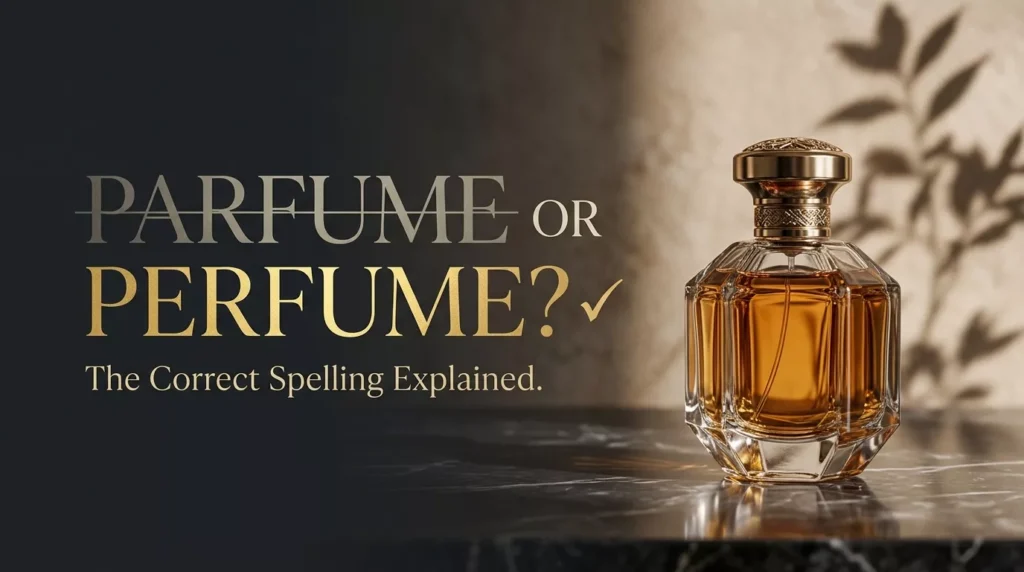

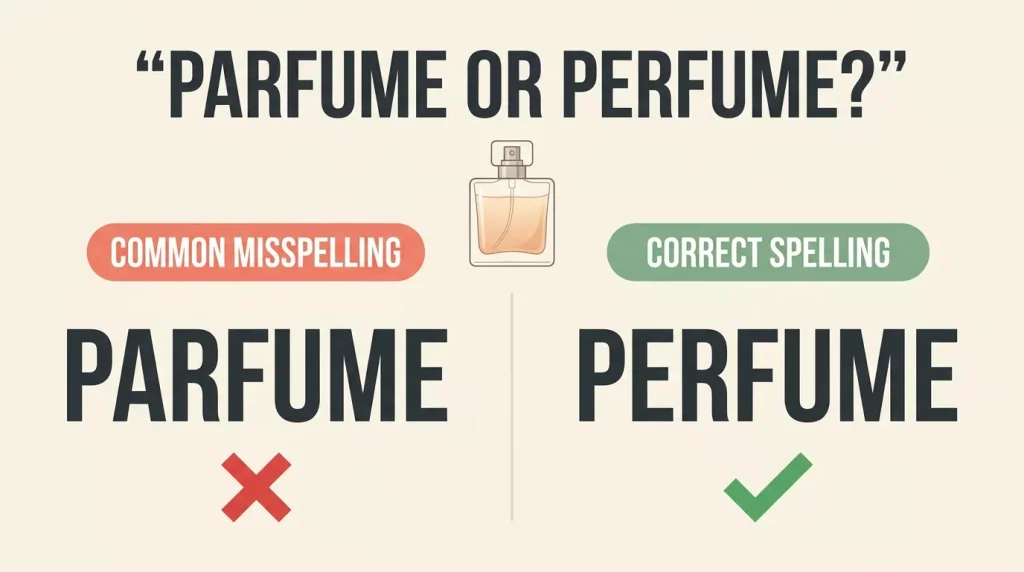
Perfume is the correct standard spelling in English when referring to a fragrant liquid or a pleasant scent. Parfume is a common misspelling and should not be used in standard English writing. Although the two spellings look similar and may sound alike, only perfume is the appropriate choice in everyday English, school assignments, professional emails, product descriptions, and articles.
What Is the Difference Between Parfume and Perfume?
The difference is spelling: perfume is the standard English word, while parfume is a misspelling in standard English.
Perfume can refer to a scented product applied to the body, a pleasant fragrance, or the act of giving something a scent. The correct spelling stays the same in American and British English.
For example:
- Correct: She bought a new perfume for her birthday.
- Incorrect: She bought a new parfume for her birthday.
The confusion is understandable because the word is associated with the French word parfum, which is commonly seen on fragrance packaging. However, parfume is not the standard English spelling.
The Core Rule: Always Spell It Perfume
Perfume — Correct
Use this spelling in ordinary English writing whenever you mean a fragrance or a scented product.
Parfume — Incorrect
Avoid this spelling in standard English sentences, formal writing, and product descriptions unless reproducing a specific name or stylized brand spelling.
What Does Perfume Mean?
Perfume is a noun that usually means a fragrant liquid made from aromatic ingredients and used to give the body a pleasant smell. It can also mean a pleasant scent itself.
The word can function as a verb, too. To perfume something means to give it a fragrance.
Examples:
- Noun: This perfume has a fresh, floral scent.
- Noun: The perfume of the roses filled the garden.
- Verb: The flowers perfumed the air.
In everyday conversation, people most often use perfume as a noun when discussing fragrances, shopping, personal care, or gifts.
Why Do People Confuse Parfume and Perfume?
Several factors make this spelling mistake easy to understand.
1. French Influence
The French word parfum means perfume or fragrance. People who see this spelling on packaging may assume that adding an e produces the English word parfume.
English uses perfume, however, so the French spelling should not be treated as a guide to standard English spelling.
2. Pronunciation
The middle vowel in perfume may not sound like a clear, obvious e to every learner. When people write a word based on how they hear it, they may choose a different vowel.
This is an example of phonetic spelling: writing a word according to its perceived sound rather than its established spelling.
3. Visual Similarity
The spellings perfume, parfume, and parfum look closely related. Seeing them in similar contexts can make it difficult to remember which form belongs in an English sentence.
4. Autocorrect and Online Shopping
A search engine may still return results for misspelled words, and a product listing may contain a spelling error. Seeing a word online does not automatically make it correct.
When writing for customers or publishing an article, check the spelling rather than relying on search results or autocomplete.
How to Use Perfume Correctly
Use perfume whenever you are writing in English about fragrance. The word works in casual conversation, business communication, schoolwork, advertising, and academic writing.
Use Perfume as a Noun
A noun names a person, place, thing, or idea. As a noun, perfume refers to a scented product or a pleasant smell.
Examples:
- I bought a new perfume yesterday.
- Her perfume has a beautiful floral fragrance.
- The shop sells perfumes from several brands.
- The perfume of fresh flowers drifted through the room.
Use Perfume as a Verb
Perfume can also describe the action of adding a scent to something.
Examples:
- The flowers perfumed the entire room.
- Manufacturers perfume some soaps with aromatic ingredients.
- A gentle fragrance perfumed the air.
This verb usage is grammatically correct, although it is less common in everyday conversation than the noun.
Use Perfumes as the Plural
When referring to multiple fragrance products or different types of fragrance, use perfumes.
Examples:
- The store sells affordable perfumes.
- She compared three perfumes before choosing one.
- These perfumes have different scent profiles.
Remember that perfume can also be an uncountable noun when referring to fragrance as a substance in general. For example, “The bottle contains perfume” does not require a plural form.
Correct Examples of Perfume in Everyday English
Here are 12 examples showing how to spell and use perfume in different situations.
- Everyday conversation: “Your perfume smells lovely. What is it called?”
- Shopping: “I’m looking for a perfume that lasts throughout the day.”
- Email: “Please confirm whether the perfume is available in stock.”
- School assignment: “Perfume is commonly used as part of personal grooming.”
- Workplace: “The store has introduced a new line of perfumes.”
- Social media: “Finally found a perfume that suits my style.”
- Product description: “This perfume features fresh citrus notes and a warm woody base.”
- Gift recommendation: “A bottle of perfume could make a thoughtful birthday gift.”
- Academic writing: “Aromatic compounds contribute to the scent of many perfumes.”
- Customer service: “Your perfume order will be processed once payment is confirmed.”
- Creative writing: “The perfume of jasmine lingered in the evening air.”
- Personal review: “I like this perfume because its fragrance is subtle rather than overpowering.”
Each example uses the standard English spelling. The wording changes with the context, but the spelling does not.
Incorrect vs. Correct: 12 Common Spelling Mistakes
The following table shows how to correct parfume and related errors in complete sentences.
| Incorrect | Correct | Why |
|---|---|---|
| I bought a new parfume. | I bought a new perfume. | Perfume is the standard English spelling. |
| This parfume smells amazing. | This perfume smells amazing. | The vowel in the first syllable is spelled e. |
| She wears expensive parfume. | She wears expensive perfume. | Use the established English spelling. |
| Which parfume do you recommend? | Which perfume do you recommend? | The question needs the correct noun spelling. |
| I ordered two parfumes. | I ordered two perfumes. | The plural is formed from perfume, not parfume. |
| The parfume is out of stock. | The perfume is out of stock. | Correct spelling matters in customer communication. |
| He gifted me a parfume bottle. | He gave me a bottle of perfume. | The spelling is corrected, and the revised sentence sounds more natural. |
| I love the smell of this parfume. | I love the smell of this perfume. | The word refers to a fragrance product. |
| Our shop sells luxury parfumes. | Our shop sells luxury perfumes. | Product descriptions should use standard English. |
| This is my favourite parfume. | This is my favourite perfume. | Favourite is British spelling, but perfume remains unchanged. |
| The parfume lasted all day. | The perfume lasted all day. | The past-tense verb lasted does not affect the noun’s spelling. |
| Please check the parfume label. | Please check the perfume label. | Use the standard form in instructions and labels. |
Why People Make This Mistake
Understanding the reason behind a spelling error makes it easier to avoid repeating it.
Pronunciation-Based Spelling
Some English learners write words as they hear them. Because the first vowel in perfume may be difficult to identify from pronunciation alone, they may write parfume instead.
How to avoid it: Learn the written form alongside the pronunciation. When uncertain, check the word in a reliable English dictionary.
Confusion With French
The French word parfum is widely used in the fragrance industry. This can influence how English speakers spell the related word.
How to avoid it: Separate the two forms in your mind: perfume is the standard English word; parfum is a French word that also appears in fragrance terminology.
Overgeneralizing Spelling Patterns
Learners sometimes assume that similar-looking words follow the same spelling pattern. English spelling is not always predictable enough for this method to work.
How to avoid it: Memorize frequently confused words individually rather than relying entirely on sound or visual similarity.
Trusting Autocorrect Too Much
Spellcheckers can miss mistakes, especially when a misspelling resembles a real word, a product name, or a specialized term.
How to avoid it: Proofread the entire sentence. For published content, product listings, and important emails, use a dictionary when a spelling is uncertain.
Translation Interference
A learner who knows French or another language may transfer that language’s spelling into English. This is called language transfer: a pattern from one language influences how someone uses another.
How to avoid it: Check the conventions of the language you are writing in. A word can be correct in one language and incorrect in another.
Perfume in Real English
Grammatically Correct
“Perfume is one of the products available at the store” is grammatically correct. The word functions as a singular noun, and the verb is agrees with it. Similarly, “These perfumes are popular” uses the plural noun with the plural verb are. Both constructions are suitable for everyday, professional, and educational writing.
Grammatically Possible but Unnatural
“The perfume product that I purchased was a perfume product” is grammatically possible, but it sounds repetitive. The repeated phrase adds no useful information. A more natural version is “The perfume I purchased was lovely.” Good English writing is not only about choosing the correct spelling; it also involves expressing the intended meaning without unnecessary repetition.
Natural, Everyday English
“I bought a new perfume” is a natural way to talk about purchasing a fragrance. “Which perfume do you wear?” is another ordinary question. In some contexts, speakers may say fragrance or scent instead, especially when discussing a product’s smell or a brand’s range. These alternatives can be useful, but they do not change the correct spelling of perfume.
American vs. British English
There is no spelling difference between American and British English for this word. Both use perfume.
| Feature | American English | British English |
|---|---|---|
| Correct spelling | Perfume | Perfume |
| Incorrect spelling | Parfume | Parfume |
| Plural | Perfumes | Perfumes |
| Common meaning | Fragrance product or scent | Fragrance product or scent |
| Example | She bought a new perfume. | She bought a new perfume. |
British English may use favourite where American English uses favorite, but neither variety changes perfume to parfume.
Formal vs. Informal Usage
The spelling perfume is appropriate in both formal and informal English.
- Formal: “The company has expanded its perfume collection.”
- Professional: “Please review the perfume product descriptions before publication.”
- Informal: “I love your perfume!”
- Academic: “The study examines consumer preferences for different perfume formulations.”
The difference between these examples is tone and vocabulary, not spelling. There is no need to choose a different spelling for a formal document or casual message.
Perfume vs. Parfume vs. Parfum: Comparison Table
These three forms are easy to confuse, but they do not serve the same purpose in English.
| Feature | Perfume | Parfume | Parfum |
|---|---|---|---|
| Standard English spelling | Yes | No | Not the usual English spelling |
| French connection | Related form | Often a mistaken blend | French word |
| Everyday English writing | Recommended | Avoid | Use when the French term is intended |
| Refers to fragrance | Yes | Intended by the writer, but misspelled | Yes, in French usage |
| Example | She bought perfume. | She bought parfume. | The label says Eau de Parfum. |
Important distinction: Parfum is not simply another misspelling of perfume. It is a French word and appears in established product terms such as Eau de Parfum. Do not confuse that legitimate usage with parfume, which is not the standard English spelling.
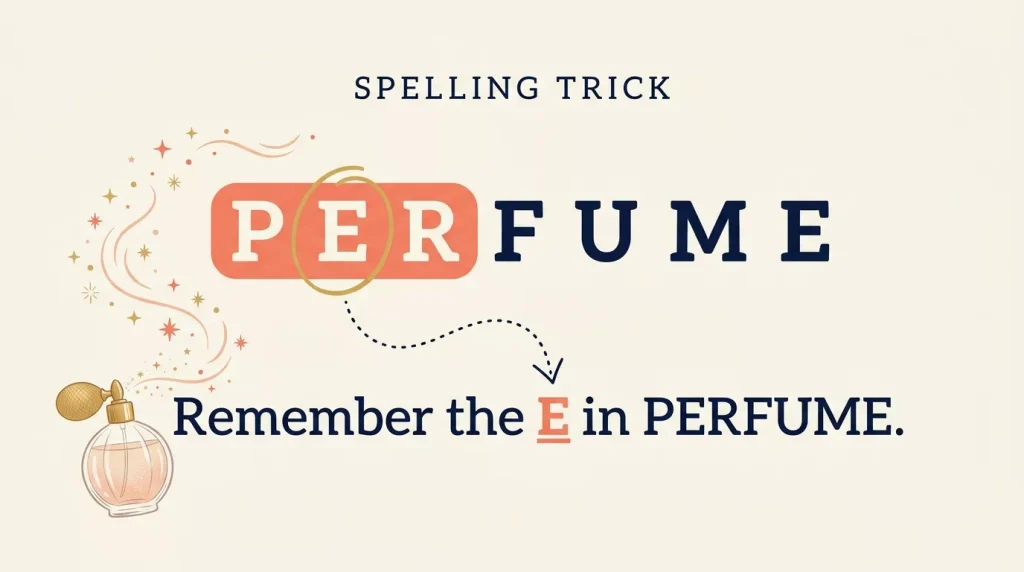
Memory Trick: Remember the E in Perfume
Use this simple mnemonic:
“Every fragrance needs an E: P-E-R-F-U-M-E.”
The word perfume begins with PER, not PAR. When you are writing an English sentence, remember the e after the first consonant sound.
Try connecting the spelling with a short sentence:
“Every perfume is spelled with E.”
The sentence is a memory aid, not a grammar rule, but it can help you recall the correct form when writing quickly.
Real-Life Situations: Which Word Should You Choose?
Situation 1: Buying a Gift
You want to ask a shop assistant for a recommendation.
Incorrect: “Can you recommend a good parfume?”
Correct: “Can you recommend a good perfume?”
Why: The standard English noun is perfume.
Situation 2: Writing a Product Listing
You manage an online store and need a product title.
Incorrect: “Luxury Parfume for Everyday Use”
Correct: “Luxury Perfume for Everyday Use”
Why: Standard spelling makes the listing clearer and more professional.
Situation 3: Sending a Work Email
You are asking a supplier about availability.
Incorrect: “Please confirm the delivery date for the parfume order.”
Correct: “Please confirm the delivery date for the perfume order.”
Why: Business writing should use conventional spelling to avoid unnecessary errors.
Situation 4: Answering an Exam Question
You need to write a sentence using the word perfume.
Incorrect: “My mother wears parfume.”
Correct: “My mother wears perfume.”
Why: Standard spelling is expected in schoolwork and examinations.
Situation 5: Reading a Fragrance Label
You see the words Eau de Parfum on a bottle.
Correct: “This fragrance is labelled Eau de Parfum.”
Why: Parfum is part of an established French product term. Do not change it to parfume or assume it must be replaced with the English word in the product’s official name.
Common Mistakes Checklist
Use this checklist before publishing an article, sending an email, or submitting an assignment.
- Writing parfume instead of perfume: Remember that perfume is the standard English spelling.
- Assuming French spelling is English spelling: Parfum is French; perfume is the standard English word.
- Using parfumes as the plural: Write perfumes when referring to multiple products.
- Trusting every online listing: A product description can contain a spelling mistake. Check the word independently.
- Changing the spelling by region: Both American and British English use perfume.
- Confusing perfume with fragrance: These words can overlap in meaning, but they are not alternative spellings of the same word.
- Ignoring spelling during proofreading: Search for parfume in your document and correct it where it is an unintended misspelling.
Expert Tips for Remembering the Correct Spelling
- Memorize the complete word: Learn perfume as a single spelling rather than trying to reconstruct it from its pronunciation.
- Use a visual association: Remember the letter sequence P-E-R at the beginning of perfume.
- Check the context: If you see parfum on a fragrance label, recognize that it may be an intentional French term.
- Proofread important content: A spelling error in a product title, advertisement, or business email can undermine the impression you want to create.
- Practice with a complete sentence: Writing “I bought a new perfume” is more useful than memorizing the word without context.
- Use a dictionary when uncertain: A quick check is more reliable than guessing from sound.
Quick Summary
Perfume is the correct standard English spelling for a fragrant product or pleasant scent. Parfume is a misspelling and should be avoided in everyday communication, schoolwork, professional emails, and online content. The confusion often comes from pronunciation and the French word parfum, which appears on fragrance packaging and in terms such as Eau de Parfum. Remember that both American and British English use perfume. The plural is perfumes, and the word can function as both a noun and a verb. An easy way to remember the spelling is to focus on the opening letters P-E-R. When writing in English, choose perfume unless you are intentionally reproducing a specific name or foreign-language term.
Frequently Asked Questions
Is parfume a real English word?
Parfume is not the standard English spelling of the fragrance word. Use perfume in ordinary English writing.
How do you spell perfume correctly?
The correct spelling is P-E-R-F-U-M-E. It begins with per, not par.
Is perfume or parfume correct in English?
Perfume is correct. Parfume is a common spelling mistake rather than an accepted alternative in standard English.
Why do some perfume bottles say parfum?
Parfum is French for perfume and is also used in fragrance terminology, including the product label Eau de Parfum. It is different from the misspelling parfume.
Is parfume the British spelling of perfume?
No. British and American English both use perfume. The spelling does not change between these varieties.
What is the plural of perfume?
The plural is perfumes. For example: “The store sells several perfumes.”
Can perfume be used as a verb?
Yes. Perfume can mean to give something a pleasant scent. For example: “The blossoms perfumed the air.”
Is fragrance the same as perfume?
The meanings overlap, but they are not identical in every context. Fragrance can refer broadly to a smell or scented quality, while perfume commonly refers to a scented product or a pleasant scent.
How can I avoid spelling perfume incorrectly?
Memorize P-E-R-F-U-M-E, use the word in example sentences, and check a dictionary whenever you are unsure.
Does perfume have the same spelling in every English-speaking country?
Yes. The standard spelling is perfume in American, British, Australian, and other varieties of English.
Mini Quiz: Parfume or Perfume?
Test your understanding with these 10 questions. Answers and explanations are included so you can check your learning.
| No. | Question | Answer | Explanation |
|---|---|---|---|
| 1 | Choose the correct spelling: parfume or perfume. | Perfume | Perfume is the standard English spelling. |
| 2 | Fill in the blank: She bought a new bottle of ___. | Perfume | The sentence refers to a fragrance product. |
| 3 | Correct the sentence: “This parfume smells wonderful.” | This perfume smells wonderful. | Replace the misspelling with the standard form. |
| 4 | True or false: Parfume is the British spelling. | False | British English uses perfume, just like American English. |
| 5 | Choose the correct plural: parfumes or perfumes. | Perfumes | Add s to the correctly spelled word perfume. |
| 6 | Fill in the blank: The flowers ___ the room. | Perfumed | Perfumed is the past-tense form of the verb perfume. |
| 7 | Correct the sentence: “Our shop sells luxury parfumes.” | Our shop sells luxury perfumes. | Both the spelling and plural form need to be correct. |
| 8 | Which word appears in the French term “Eau de ___”? | Parfum | Eau de Parfum is an established French fragrance term. |
| 9 | Choose the natural sentence: (A) I bought a new parfume. (B) I bought a new perfume. | B | Perfume is the standard English spelling. |
| 10 | Fill in the blank: Please check the ___ label before publishing the listing. | Perfume | Use the standard English spelling in product descriptions. |

Pingback: Majestic or Magestic: Which Spelling Is Correct?