
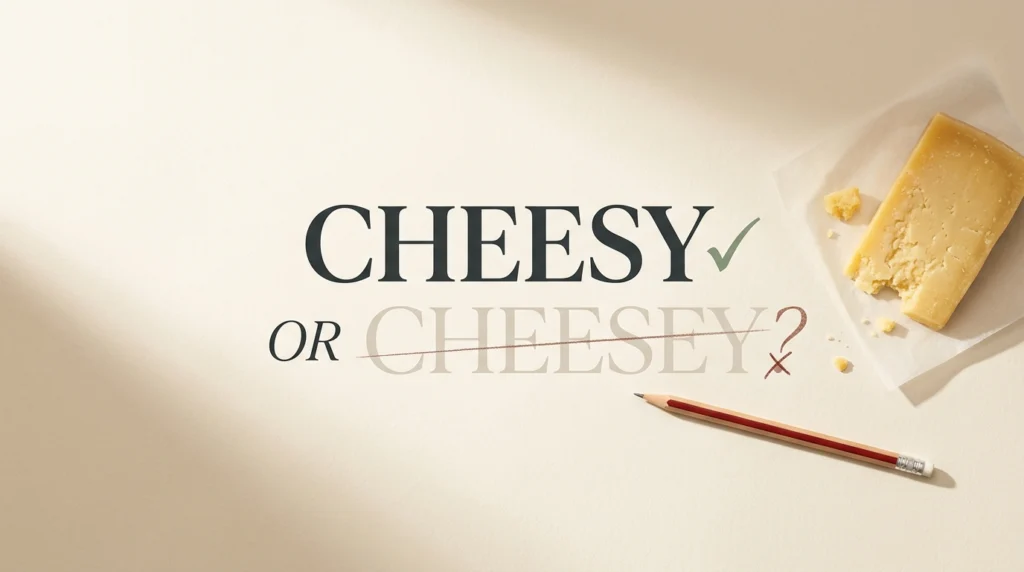

The correct spelling is cheesy. The spelling cheesey is a common misspelling and is not the standard form in modern English. Use cheesy when describing something that tastes strongly of cheese, feels overly sentimental, or seems cheap, exaggerated, or lacking in originality. For example, you would write, “That movie had a cheesy ending,” not “That movie had a cheesey ending.”
What Does Cheesy Mean?
Cheesy is an adjective formed from the noun cheese and the suffix -y. It has several meanings depending on the context.
- Containing or tasting like cheese: The restaurant serves a cheesy pasta bake.
- Cheap or low-quality: The film used cheesy special effects.
- Overly sentimental or romantic: He sent her a cheesy love message.
- Corny or unoriginal: Everyone laughed at his cheesy joke.
- Exaggerated or insincere: She gave the camera a cheesy grin.
The word is often informal when used to criticize a joke, film, romantic gesture, or smile. However, when describing food, cheesy can be completely neutral or positive.

English meaning – Cambridge Dictionary
+2
Why Does the Correct Spelling Matter?
Choosing the right spelling helps make your writing clear and professional. Although readers will often understand cheesey, the standard spelling is cheesy.
The difference matters in several situations:
- School assignments: Standard spelling helps demonstrate accuracy.
- Professional emails: Correct spelling makes your writing look polished.
- Food blogs and recipes: Cheesy is the conventional spelling in descriptions such as cheesy garlic bread.
- Social media: The standard spelling makes posts and captions easier to read and search.
- Creative writing: Correct spelling keeps dialogue, descriptions, and narration consistent.
An extra letter may seem insignificant, but consistently using standard spelling builds good writing habits.
The Core Rule: Cheesy, Not Cheesey
The spelling rule
Write cheesy when you mean something that contains or resembles cheese, or something corny, cheap, exaggerated, or overly sentimental.
- Correct: cheesy
- Nonstandard in ordinary modern writing: cheesey
Remember: Start with cheese and add -y, not -ey.
There is one useful nuance: cheesey has appeared as an alternative spelling historically and is recorded as a variant in some references. Nevertheless, cheesy is the established standard spelling for everyday contemporary English. Use cheesey only when reproducing a source’s original spelling or deliberately following a particular name or style.
Wiktionary, the free dictionary
How to Use Cheesy Correctly
1. Use cheesy to describe food
When food contains a lot of cheese or has a strong cheese flavor, cheesy is the natural adjective.
Examples:
- The children asked for cheesy fries.
- I made a cheesy sauce for the vegetables.
- This sandwich needs a more cheesy filling.
The last example is grammatically possible, but “a cheesier filling” would usually sound more natural when comparing the amount or intensity of cheese flavor.
2. Use cheesy to describe something corny
A joke, slogan, or line can be cheesy if it feels predictable, clichéd, or unoriginal.
Examples:
- That was a cheesy joke.
- His speech included several cheesy slogans.
- The advertisement relies on cheesy humor.
Depending on the situation, cheesy can be critical or affectionate. A cheesy joke might be embarrassing, but it can still make people laugh.
3. Use cheesy for exaggerated romance
The word often describes romantic expressions that seem overly sentimental or dramatic.
Examples:
- He wrote her a cheesy love poem.
- The movie ends with a cheesy romantic scene.
- She enjoys cheesy romantic comedies.
Calling something cheesy does not automatically mean it is bad. Someone might dislike sentimental dialogue while another person finds it sweet.
4. Use cheesy to describe a smile
A cheesy smile is often a broad, exaggerated, or seemingly insincere smile.
For example:
- He posed for the photograph with a cheesy grin.
- She gave a cheesy smile when the teacher caught her whispering.
The intended meaning depends on context. A cheesy grin may be playful, awkward, forced, or deliberately exaggerated.
5. Use the correct comparative and superlative forms
Cheesy follows the regular spelling pattern for many adjectives ending in a consonant plus y: change the y to i before adding -er or -est.
| Form | Correct spelling | Example |
|---|---|---|
| Base adjective | cheesy | That joke is cheesy. |
| Comparative | cheesier | This joke is cheesier. |
| Superlative | cheesiest | That was the cheesiest joke. |
| Noun | cheesiness | I enjoy the cheesiness of the film. |
| Adverb | cheesily | The scene was cheesily romantic. |
Do not write cheeseyer or cheeseyest. The standard forms are cheesier and cheesiest.
Correct Examples of Cheesy in Everyday English
Here are 12 original examples showing how to spell and use the word in different situations.
- Conversation: “That pickup line was cheesy, but it made me laugh.”
- Email: “The opening paragraph sounds a little cheesy; could we make it more direct?”
- School: “The teacher asked us to identify the cheesy slogan in the advertisement.”
- Workplace: “Let’s avoid cheesy phrases in the company presentation.”
- Social media: “A cheesy caption for a genuinely happy day.”
- Food: “We ordered a cheesy pizza with extra mozzarella.”
- Romance: “He gave her a cheesy card covered in hearts.”
- Film review: “The story was predictable, and some of the dialogue felt cheesy.”
- Photography: “The photographer asked everyone to give their cheesiest smile.”
- Marketing: “The campaign uses humor instead of cheesy sales slogans.”
- Academic discussion: “The film relies on sentimental clichés that some viewers may consider cheesy.”
- Text message: “I know this sounds cheesy, but I really miss you.”
Notice that the word can describe both a literal quality, such as cheese flavor, and a figurative quality, such as excessive sentimentality.
Cheesy vs. Cheesey: Incorrect and Correct Examples
The following table contrasts the standard spelling with the nonstandard form in ordinary contemporary writing.
| Incorrect or nonstandard | Correct standard spelling | Why |
|---|---|---|
| The pizza is cheesey. | The pizza is cheesy. | Cheesy is the standard adjective for cheese flavor. |
| That was a cheesey joke. | That was a cheesy joke. | The adjective takes the spelling -y. |
| He sent a cheesey message. | He sent a cheesy message. | The standard spelling applies to figurative meanings, too. |
| She wore a cheesey grin. | She wore a cheesy grin. | The usual expression is cheesy grin. |
| It was a cheesey movie. | It was a cheesy movie. | Use the established spelling in film descriptions. |
| I love cheesey pasta. | I love cheesy pasta. | Food descriptions use the same spelling. |
| What a cheesey slogan! | What a cheesy slogan! | The word retains its standard spelling in exclamations. |
| The scene felt cheesey. | The scene felt cheesy. | The adjective is spelled cheesy. |
| This is the cheeseyest joke. | This is the cheesiest joke. | The superlative is cheesiest. |
| The ending was cheeseyer. | The ending was cheesier. | The comparative is cheesier. |
| His cheeseyness was obvious. | His cheesiness was obvious. | The standard noun is * cheesiness* (without the space after the opening quotation, it is spelled cheesiness). |
| She smiled cheeseyly. | She smiled cheesily. | The standard adverb is cheesily. |
Important distinction: These examples teach standard spelling rather than claiming that every appearance of cheesey is impossible in every context. Historical variants, proper names, and intentional stylizations can preserve unusual spellings. For normal writing, choose cheesy.
Why Do People Write Cheesey Instead of Cheesy?
1. They follow the spelling of cheese too literally
The noun cheese ends with the letters -ee. Writers sometimes keep that entire ending and add another e before y, producing cheesey. However, the standard adjective is cheesy. The familiar spelling of the base word can make the alternative look reasonable, even though it is not the normal modern form.
2. They confuse pronunciation with spelling
In ordinary speech, cheesy and cheesey are often pronounced identically. Because the extra letter does not create a noticeable difference in pronunciation, it is easy to overlook the spelling error.
3. They overgeneralize English spelling patterns
English has many words ending in -ey, and some adjectives do end in -ey. That does not mean every word derived from a noun ending in -ee should follow the same pattern. Each word’s established spelling matters.
4. They trust autocorrect too much
Spellcheck tools may flag cheesey, but software does not always explain why a word is nonstandard. A tool may also overlook a spelling variant or accept it in a particular context. Learn the standard form rather than relying exclusively on automatic corrections.
5. They encounter informal online spelling
Social media posts, usernames, product names, and advertisements sometimes use creative spellings. Seeing cheesey online may make it appear more common or acceptable than it is in edited writing.
Common Mistakes Checklist
Use this checklist whenever you write cheesy.
- Adding an unnecessary e: Write cheesy, not cheesey, in ordinary modern English.
- Misspelling related forms: Use cheesier, cheesiest, cheesiness, and cheesily.
- Assuming the meaning is always negative: A cheesy pizza can be delicious, while a cheesy movie can be amusing or embarrassing.
- Using the word without considering tone: Calling a colleague’s presentation cheesy may sound insulting. Consider overly sentimental, predictable, or informal if you need a more diplomatic expression.
- Confusing cheese flavor with figurative meaning: A cheesy sauce describes food; a cheesy slogan describes style or originality.
- Treating every unusual spelling as a typo: A proper name or deliberate brand spelling may be intentional. Preserve it when accuracy requires it.
Cheesy in Real English
Grammatically correct and natural
“Those cheesy fries were delicious” and “That was a cheesy joke” are both natural English sentences. In the first, cheesy describes the food’s cheese content or flavor. In the second, it describes a joke that feels corny or predictable. The spelling remains the same even though the meanings differ. The surrounding words make the intended meaning clear.
Grammatically possible but less natural
“The filling is more cheesy than the sauce” is understandable and grammatically possible. However, when comparing how strongly two foods taste of cheese, many writers would prefer “The filling is cheesier than the sauce.” The comparative form cheesier is more concise and follows the standard inflection pattern. This is a question of natural phrasing, not a difference between cheesy and cheesey.
Natural everyday English
“That’s so cheesy!” is a natural informal reaction to a predictable joke, an exaggerated romantic gesture, or a sentimental line. The same word can express criticism, playful embarrassment, or affection. Tone and context determine how the listener interprets it. In professional writing, more precise terms such as sentimental, unoriginal, or low-quality may communicate the intended criticism more clearly.
American vs. British English
There is no standard American-versus-British spelling difference between cheesy and cheesey. Cheesy is the usual spelling in both varieties.
The word’s meanings overlap across the two varieties: it can describe food that tastes of cheese, poor quality, a corny joke, or an exaggerated smile. Some expressions and shades of meaning may be more common in one region, but that does not change the standard spelling.
Formal vs. Informal Usage
Cheesy is especially common in conversation, reviews, entertainment writing, and informal messages when describing something corny, sentimental, or tacky. It can also be used neutrally in food descriptions, including menus and recipes.
In formal reports or professional criticism, choose a more specific word if cheesy sounds vague or judgmental.
| Situation | Recommended wording |
|---|---|
| Casual conversation | That joke was cheesy. |
| Food description | The dish has a rich cheese flavor. |
| Formal film review | The dialogue relies on sentimental clichés. |
| Business feedback | The slogan feels predictable and overly promotional. |
| Academic writing | The scene uses exaggerated sentimentality. |
Cheesy vs. Similar Words
| Word | Meaning | Example |
|---|---|---|
| Cheesy | Corny, overly sentimental, low-quality, or like cheese | The ending was cheesy. |
| Corny | Predictable, old-fashioned, or intended to be amusing in a familiar way | He told a corny joke. |
| Tacky | Lacking taste or refinement | The decorations looked tacky. |
| Sentimental | Strongly focused on emotion or affection | The letter was sentimental. |
| Clichéd | Using an overfamiliar expression or idea | The dialogue was clichéd. |
| Sleazy | Dishonest, disreputable, or morally questionable | The company had a sleazy reputation. |
| Cheese-like | Resembling cheese in appearance, texture, or another quality | The substance had a cheese-like texture. |
These words are related in some contexts but are not interchangeable in every sentence. For example, sentimental is not necessarily negative, whereas tacky usually expresses disapproval.
Memory Trick: Remember Cheesy, Not Cheesey
Use this simple reminder:
Cheese + y = cheesy.
The word cheese supplies the base, but the standard adjective ends in -sy: C-H-E-E-S-Y.
You can also remember the pair:
- A cheesy joke.
- A cheesier joke.
- The cheesiest joke.
All three forms use i rather than adding an extra e before the ending.
Read More: Plack or Plaque: Which Spelling Is Correct?
Real-Life Situations
Situation 1: Writing a food review
You want to praise a restaurant’s pasta.
Correct: “The restaurant serves a delicious, cheesy pasta bake.”
Why it works: Cheesy describes the dish’s cheese flavor or content.
Situation 2: Giving feedback at work
A colleague writes a slogan that sounds exaggerated.
Correct: “The slogan feels a little cheesy. Could we make it more direct?”
Why it works: The spelling is correct, and the suggestion explains the concern constructively.
Situation 3: Sending a romantic text
You want to send an affectionate message without taking yourself too seriously.
Correct: “This might sound cheesy, but talking to you makes my day.”
Why it works: The word acknowledges that a statement is sentimental while keeping the tone warm and playful.
Situation 4: Answering an exam question
A student is asked to correct the sentence “The film had a cheesey ending.”
Correct: “The film had a cheesy ending.”
Why it works: Cheesy is the standard spelling in contemporary English.
Situation 5: Reviewing a comedy
You want to describe a predictable joke that still made you laugh.
Correct: “The joke was cheesy, but the audience loved it.”
Why it works: The sentence shows that cheesy does not always mean unsuccessful or unfunny.
Expert Tips for Using Cheesy Correctly
- Check the whole word, not just the base. Correctly spelling cheese does not automatically mean that cheesey is the standard adjective.
- Learn related forms together. Memorize cheesy, cheesier, cheesiest, cheesiness, and cheesily as a word family.
- Use context to determine meaning. Food, entertainment, relationships, and advertising can all use cheesy in different ways.
- Choose precise alternatives in formal writing. Instead of calling a proposal cheesy, explain whether it is overly sentimental, predictable, or poorly designed.
- Preserve intentional names. If a business, product, or quotation deliberately uses Cheesey, do not silently change its official spelling.
- Proofread high-visibility text. Check headings, page titles, captions, product descriptions, and email subject lines because spelling errors are especially noticeable in short text.
Frequently Asked Questions
Is cheesy or cheesey correct?
Cheesy is the standard spelling in modern English. Cheesey is a nonstandard variant in ordinary writing, although it has appeared historically and may occur in names or intentional stylizations.
Why is cheesy spelled with an i instead of an e?
The established spelling of the adjective is cheesy. Its spelling is not determined simply by copying the final letters of cheese. Remember the complete word rather than trying to add an ending mechanically.
Is cheesey ever acceptable?
It can appear as a historical variant, a proper name, or a deliberately creative spelling. However, use cheesy in standard schoolwork, professional documents, articles, and everyday writing.
Does cheesy mean bad?
Not necessarily. When describing a joke, movie, or romantic message, cheesy often means corny, exaggerated, or overly sentimental. When describing food, it may simply mean that something tastes of cheese or contains a lot of it.
What is the plural of cheesy?
Cheesy is an adjective, so it does not normally have a plural form. You can say a cheesy joke or several cheesy jokes. The noun following the adjective changes to show number.
What are the comparative and superlative forms of cheesy?
The comparative is cheesier, and the superlative is cheesiest. For example: “This film is cheesier than the original” and “That was the cheesiest scene in the series.”
What is the noun form of cheesy?
The standard noun is cheesiness. It describes the quality of being cheesy, whether that means a strong cheese-like quality or a corny, exaggerated, or overly sentimental style.
What is the difference between cheesy and corny?
Both can describe jokes, expressions, and familiar ideas. Corny often emphasizes predictability or old-fashioned humor, while cheesy can also suggest excessive sentimentality, tackiness, or poor quality.
Is cheesy appropriate in professional writing?
It depends on the context. Cheesy is suitable in a casual review or an informal discussion. In formal feedback, more precise words such as sentimental, unoriginal, or low-quality may be more effective.
Read More: Steem or Steam: Meaning, Spelling, and Correct Usage.
How can I remember the spelling of cheesy?
Remember cheese + y = cheesy. The standard word ends with -sy, not -sey. Practicing related forms such as cheesier and cheesiest can help reinforce the spelling.
Mini Quiz: Cheesy or Cheesey?
Test your understanding with these 10 questions. The answers and explanations are included so you can learn from each one.
| No. | Question | Answer | Explanation |
|---|---|---|---|
| 1 | Choose the standard spelling: cheesy or cheesey? | Cheesy | This is the established spelling in modern English. |
| 2 | Fill in the blank: The restaurant serves a ___ pizza. | Cheesy | The adjective describes the cheese flavor or content. |
| 3 | Correct the sentence: “That was a cheesey joke.” | That was a cheesy joke. | Use the standard spelling cheesy. |
| 4 | Choose the correct comparative: cheesier or cheeseyer? | Cheesier | Change the final y to i before adding -er. |
| 5 | Fill in the blank: That was the ___ scene in the movie. | Cheesiest | The superlative form is cheesiest. |
| 6 | Is cheesy always negative? | No | It can describe delicious food or something sentimental in an affectionate way. |
| 7 | Correct the sentence: “She gave him a cheesey smile.” | She gave him a cheesy smile. | Cheesy smile is the standard expression. |
| 8 | Which is more suitable for formal criticism: “cheesy” or “overly sentimental”? | Overly sentimental, when that is the intended meaning | The more precise expression explains the criticism clearly. |
| 9 | Fill in the blank: The ___ of the scene made the audience laugh. | Cheesiness | Cheesiness is the noun form. |
| 10 | A product’s official name deliberately uses “Cheesey.” Should you automatically change it? | No | Preserve intentional names and official branding, but use cheesy in ordinary writing. |
Quick Summary
The correct standard spelling is cheesy, not cheesey, in ordinary contemporary English. The word can describe food that tastes of cheese, a corny joke, an exaggerated smile, a low-quality production, or an overly sentimental romantic gesture. Its meaning depends on context, and it is not always negative. The related forms are cheesier, cheesiest, cheesiness, and cheesily. Although cheesey has appeared as a historical variant and may be used intentionally in names, cheesy is the safest choice for school assignments, professional writing, articles, and everyday communication. Remember the simple spelling pattern: cheese + y = cheesy.



Pingback: Cheak or Cheek? The Correct Spelling Explained.