


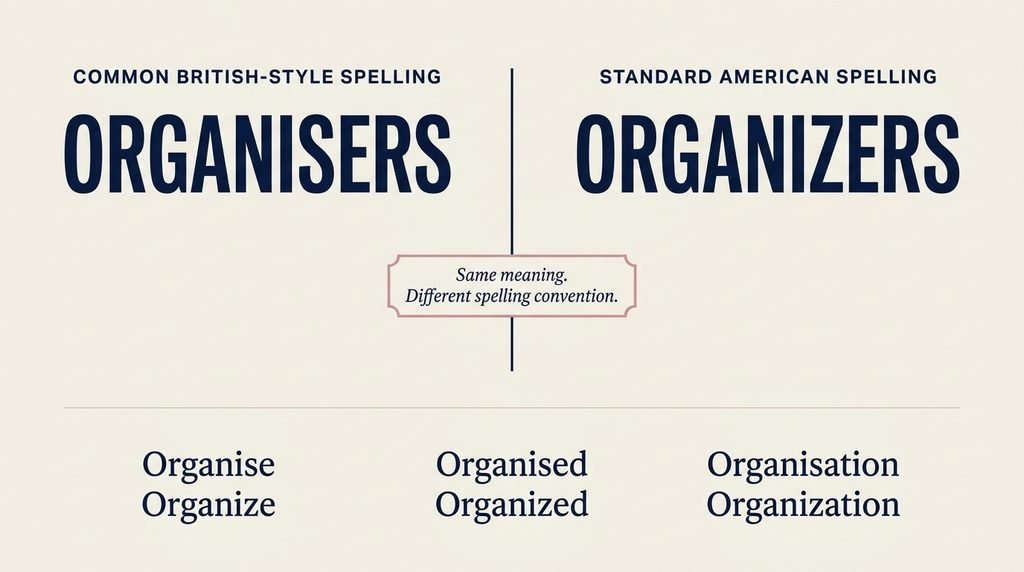
Both organisers and organizers are correct English spellings of the same plural noun. The difference is primarily a matter of regional spelling convention, not meaning or grammar.
- Organisers: Commonly preferred in British English and many British-style publications.
- Organizers: Standard in American English and also accepted by some British English dictionaries and style guides.
- Meaning: People who plan, coordinate, or manage events, activities, or projects.
If you are writing for an American audience, choose organizers. If you are following a British style guide that prefers -ise spellings, choose organisers. The most important rule is to follow your chosen spelling convention consistently.
What Does Organisers or Organizers Mean?
Organisers and organizers are plural nouns referring to people who arrange, coordinate, or manage something. They can describe event planners, community leaders, workplace coordinators, campaign volunteers, and people who bring order to tasks or activities.
Both forms come from the verb organise or organize, meaning to arrange things systematically or make the necessary plans for an activity.
For example:
- The organisers prepared the hall before the conference.
- The organizers prepared the hall before the conference.
Both sentences communicate exactly the same information. The spelling changes, but the meaning, pronunciation in ordinary use, and grammatical role remain the same.
The singular forms are organiser and organizer. When referring to more than one person, add -s to create organisers or organizers.
Why Does the Difference Matter?
Choosing between organisers and organizers matters because spelling conventions help readers recognise the variety of English you are using.
In everyday communication, readers will generally understand either form. However, in professional writing, academic assignments, websites, and published documents, consistency helps your work look carefully edited.
Consider these situations:
- American business report: Use organizers when following American English.
- British school assignment: Use organisers if the school expects the conventional British -ise spelling.
- International website: Select one spelling policy based on your main audience and apply it throughout the site.
- Academic paper: Follow the spelling requirements of your institution or publisher.
- Event announcement: Match the spelling style used in the rest of the announcement.
Neither spelling is inherently more intelligent, professional, or grammatically correct than the other. The appropriate choice depends on the English convention you are following.
The Core Rule: Organisers vs. Organizers
The simple spelling rule
Organisers
British-style spelling
Commonly preferred in British English publications that use -ise endings.
Organizers
American English spelling
The usual American form, also accepted in some British spelling systems.
Both spellings are correct. Choose the form required by your audience or style guide.
One important detail: British English does not universally reject organizers. Some British dictionaries and publishers use -ize spellings. Therefore, it is more accurate to describe organisers as a common British preference than to claim that organizers is always wrong in the UK.
How to Use Organisers and Organizers Correctly
The two spellings are interchangeable in meaning. Your decision concerns spelling style, not sentence structure.
1. Use organisers in British-style writing
Choose organisers when your document follows a British English convention that prefers -ise endings.
Examples:
- The festival organisers announced the final schedule.
- School organisers invited parents to the annual celebration.
- The organisers have arranged transport for all participants.
- Local organisers are preparing a community fundraising event.
2. Use organizers in American English
Choose organizers for American English documents and publications.
Examples:
- The event organizers confirmed the venue.
- Conference organizers sent an email to registered guests.
- The organizers are looking for additional volunteers.
- Community organizers discussed plans for the new project.
3. Match the spelling of related words
The spelling choice normally extends to related forms of the same word.
| British-style convention | American English |
|---|---|
| Organise | Organize |
| Organises | Organizes |
| Organised | Organized |
| Organising | Organizing |
| Organiser | Organizer |
| Organisers | Organizers |
| Organisation | Organization |
This table shows a common British -ise convention. Some British style guides, including Oxford-based styles, prefer the -ize forms.
4. Keep your spelling consistent
Consistency means using one spelling system throughout the same document or website unless you are quoting a source or preserving an official name.
For example, a British-style sentence could read:
The organisers organised the event and checked the organisation’s final arrangements.
An American-style version would be:
The organizers organized the event and checked the organization’s final arrangements.
Both sentences are correct within their respective styles.
Correct Examples of Organisers and Organizers
The following examples demonstrate how both spellings work across everyday, professional, educational, and public communication.
1. Everyday conversation
- British-style: The organisers are waiting outside.
- American: The organizers are waiting outside.
2. Workplace email
- British-style: The organisers have shared the meeting agenda.
- American: The organizers have shared the meeting agenda.
3. School event
- British-style: The school organisers arranged the sports competition.
- American: The school organizers arranged the sports competition.
4. Conference planning
- British-style: Conference organisers confirmed the speakers.
- American: Conference organizers confirmed the speakers.
5. Social media announcement
- British-style: A big thank-you to our event organisers!
- American: A big thank-you to our event organizers!
6. Academic writing
- British-style: The researchers contacted the workshop organisers.
- American: The researchers contacted the workshop organizers.
7. Community projects
- British-style: Local organisers invited residents to participate.
- American: Local organizers invited residents to participate.
8. Charity fundraising
- British-style: The charity organisers published the fundraising results.
- American: The charity organizers published the fundraising results.
9. Formal reports
- British-style: The organisers were responsible for coordinating the programme.
- American: The organizers were responsible for coordinating the program.
10. Public announcements
- British-style: Organisers will provide further information next week.
- American: Organizers will provide further information next week.
11. Volunteer coordination
- British-style: The organisers assigned each volunteer a specific task.
- American: The organizers assigned each volunteer a specific task.
12. Online events
- British-style: Webinar organisers sent joining instructions to attendees.
- American: Webinar organizers sent joining instructions to attendees.
Notice that some examples also use other British and American spelling differences, such as programme/program. Those differences are separate from the spelling of organisers/organizers.
Incorrect vs. Correct: Common Spelling Mistakes
Because both main forms are correct, the mistake is often not choosing the supposedly wrong word. It is applying a spelling convention inconsistently or using an incorrect variation.
| Incorrect or inconsistent usage | Corrected version | Why |
|---|---|---|
| The event organiserz arrived. | The event organisers arrived. | Organiserz is not a standard spelling. |
| The American organizers arrived. The British organisers followed. | The American organizers arrived. The British organisers followed. | This is acceptable when deliberately distinguishing national groups, but use one style if no distinction is intended. |
| The organisers organized the event. | The organisers organised the event. | Prefer consistent -ise spelling in a British-style document that follows that convention. |
| The organizers organised the event. | The organizers organized the event. | Prefer consistent American spelling in an American-style document. |
| The event organiser are here. | The event organisers are here. | The plural subject requires organisers or organizers. |
| One of the organizers are absent. | One of the organizers is absent. | The subject is one, which takes a singular verb. |
| The organizers’s plan was approved. | The organizers’ plan was approved. | A plural noun ending in s normally takes an apostrophe after the final s for possession. |
| The organiser’s have arrived. | The organisers have arrived. | Do not use an apostrophe to form an ordinary plural. |
| Our organisors confirmed the booking. | Our organisers confirmed the booking. | Organisors is not the standard spelling. |
| The event organizer confirmed their plans, and the organisers confirmed theirs. | The event organizers confirmed their plans, and the organisers confirmed theirs. | In a single American-style passage, use organizers consistently unless there is a reason to retain the other spelling. |
| The organisers has confirmed the venue. | The organisers have confirmed the venue. | The plural noun requires have, not has. |
Important: The first two main spellings are not errors in themselves. The corrections above concern misspellings, grammar, punctuation, or consistency with a chosen style.
Why People Confuse Organisers and Organizers
1. The difference is only one letter
The two words have the same basic structure and meaning. The final s in organisers is replaced by z in organizers, making the difference easy to overlook.
2. British and American spelling rules overlap
Many learners are taught that British English uses s and American English uses z in words such as organise/organize. This is a useful starting point, but it is not a universal rule for every English word or every British publication.
3. Spellcheck settings may favour one variety
A word processor configured for American English may prefer organizers. A British English checker using an -ise house style may prefer organisers. The other form may not be flagged as incorrect because it is also recognised.
4. Search results contain both spellings
A reader may encounter organisers on one website and organizers on another. This does not mean one website has necessarily made a spelling mistake. The writers may be following different regional conventions.
5. Learners may apply the rule too broadly
Knowing that organize can be written as organise in certain conventions does not mean every English word ending in a similar sound can be changed from s to z or vice versa. Words such as advise and advertise retain their standard s spelling.
Read More: Miter or Mitre: Which Spelling Is Correct?
Common Mistakes Checklist
Use this checklist when proofreading a document that contains organisers or organizers.
- Mixing spelling systems: Check whether the document uses British-style organisers or American organizers. Choose the form that matches the intended style.
- Assuming -ise is the only British form: Some British dictionaries and publishers accept or prefer -ize. Check the relevant style guide.
- Changing only the noun: Review related forms such as organise, organised, and organisation if your chosen convention requires them.
- Adding an apostrophe to make a plural: Write organisers, not organiser’s, when referring to several people.
- Using a plural verb with a singular subject: Write “One organizer is responsible,” not “One organizer are responsible.”
- Trusting spellcheck without checking its language settings: Confirm whether the document is set to the correct English variety.
- Editing quotations unnecessarily: Preserve the original spelling in direct quotations unless your publication’s editing policy requires a change.
- Ignoring a publisher’s instructions: Follow the spelling rules required by your employer, school, journal, or client.
Organisers or Organizers in Real English
Grammatically correct
Both forms are grammatically correct when used as plural nouns. For example, “The organisers have arrived” and “The organizers have arrived” are both standard sentences. The spelling does not change the noun’s number, its meaning, or the verb agreement. A writer should select the appropriate spelling convention and use it consistently.
Grammatically possible but potentially inconsistent
A sentence such as “The organisers organized the event” is understandable and can be acceptable if the writer deliberately combines conventions, quotes someone, or follows a house style with mixed preferences. However, it may look inconsistent in a document that otherwise follows British -ise spelling. Consistency is usually preferable for polished writing.
Natural, everyday English
Both spellings appear naturally in real English. British-style publications commonly use organisers, while American publications normally use organizers. Readers generally understand both without difficulty. If you are unsure which spelling to use, look at the other words in the document and follow the same convention rather than trying to determine which version sounds more natural when spoken.
American vs. British English
The main difference is a regional spelling preference, not a difference in meaning.
| Feature | British-style English | American English |
|---|---|---|
| Common plural spelling | Organisers | Organizers |
| Singular spelling | Organiser | Organizer |
| Verb form | Organise | Organize |
| Past tense | Organised | Organized |
| Present participle | Organising | Organizing |
| Related noun | Organisation | Organization |
| Meaning | People who arrange or coordinate something | People who arrange or coordinate something |
There is one qualification worth remembering: British English includes more than one spelling tradition. The -ise forms are common, but the -ize forms are also accepted by certain British dictionaries and publishers. Oxford spelling, for example, generally uses -ize for words such as organize.
Australian and New Zealand English commonly use organisers, although individual publications may set their own style. Canadian English also has variation, so a Canadian writer should follow the dictionary or style guide required for the task.
Formal vs. Informal Usage
There is no meaningful difference in formality between organisers and organizers. Neither spelling is inherently more formal or informal.
- Formal reports: Follow the organisation’s required spelling style.
- Business emails: Match the spelling convention used by your workplace or recipient.
- Academic writing: Use the university or journal’s preferred English variety.
- Social media: Either spelling is suitable; choose the one that fits your intended audience.
- Personal messages: Both are acceptable, and the regional difference rarely affects understanding.
For professional writing, consistency and adherence to the required style matter more than choosing one spelling over the other.
Comparison Table: Organiser vs. Organizer
| Feature | Organiser | Organizer |
|---|---|---|
| Correct spelling? | Yes | Yes |
| Main association | British-style English | American English |
| Singular | Organiser | Organizer |
| Plural | Organisers | Organizers |
| Refers to | A person who arranges or coordinates something | A person who arranges or coordinates something |
| Grammatical category | Noun | Noun |
| Pronunciation | Generally the same | Generally the same |
| Suitable for formal writing? | Yes | Yes |
| Suitable for informal writing? | Yes | Yes |
| Best choice | British -ise house style | American English house style |
Do not confuse organiser and organizer with organisation and organization when checking a document. These are related forms, but the noun ending and spelling convention should both be checked.
Memory Trick: How to Remember the Difference
Use this simple mnemonic:
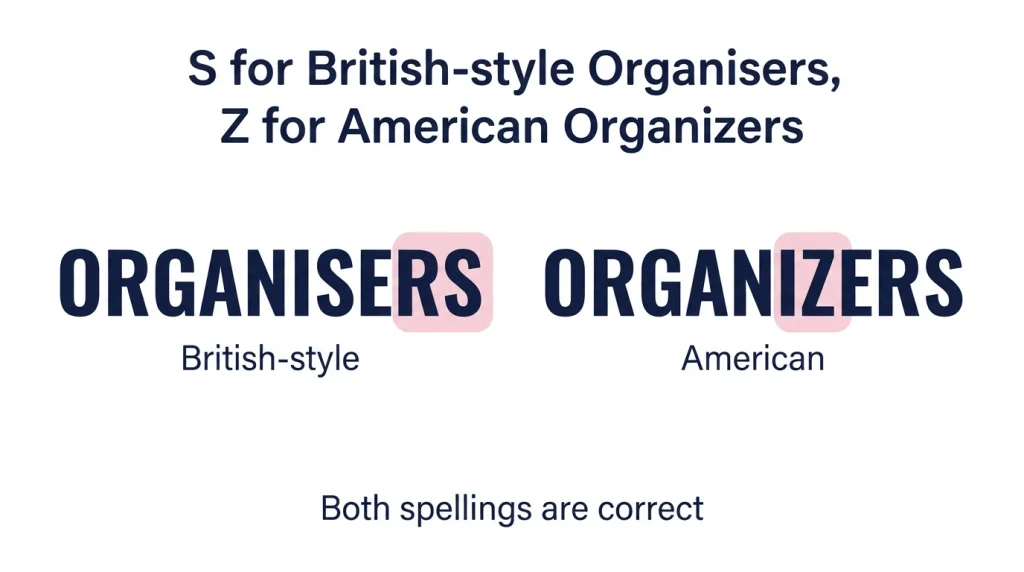
S for British-style organisers, Z for American organizers.
Think of the two words as regional spelling partners:
- Organiser: S for a British-style spelling.
- Organizer: Z for the standard American spelling.
Remember that this is a helpful shortcut, not an absolute rule for every British publication. Some British style guides use organizer.
Another easy method is to check the rest of your document. If you already use colour, organise, and centre, then organisers will generally fit that British-style pattern. If you use color, organize, and center, choose organizers.
Real-Life Situations: Which Spelling Should You Choose?
Situation 1: Writing a school assignment
You are writing about a charity event organised by your school in the United Kingdom. Your teacher expects conventional British -ise spelling.
Use: “The event organisers raised money for the local community.”
Situation 2: Sending a business email in the United States
You are contacting people who coordinate a conference in New York.
Use: “Could you please ask the conference organizers to confirm the schedule?”
Situation 3: Publishing an international blog post
Your website has readers from different English-speaking countries. You want a consistent editorial style.
Choose either spelling convention and apply it across your articles. If you publish separate American and British versions, use the appropriate spelling in each version.
Situation 4: Editing an academic paper
Your university requires a specific English style guide.
Use the spelling that the guide specifies. Do not automatically change every -ise word to -ize or vice versa without checking the rules.
Situation 5: Writing a social media caption
You are thanking the people who arranged a public event.
Either of these is correct:
- “Thank you to all the organisers who made this possible!”
- “Thank you to all the organizers who made this possible!”
The audience and spelling style determine which version is the better fit.
Expert Tips for Choosing the Right Spelling
- Check the entire word family. If you choose organisers, review organise, organised, and organisation for consistency.
- Set your proofreader’s language correctly. A spelling checker cannot reliably enforce your preferred style if it is configured for a different variety of English.
- Follow the publication’s rules first. A British publisher may require -ise, while another may use Oxford-style -ize.
- Do not confuse spelling with pronunciation. The spelling difference does not normally change the meaning or the grammatical use of the word.
- Avoid unnecessary corrections. If you see organizers in a British text, check the house style before changing it.
- Use one style sheet for a website. This is especially helpful when multiple writers contribute to the same site.
Read More: Habbit or Habit: Which Spelling Is Correct?
Quick Summary
Organisers and organizers are two correct spellings of the same plural noun. Both describe people who plan, arrange, or coordinate events, activities, or projects. Organisers is commonly preferred in British-style English, while organizers is standard in American English. However, some British dictionaries and publishers also accept or prefer the -ize spelling, so the difference is not an absolute national rule. Neither word is more formal or grammatically correct than the other. To choose the right version, follow your audience’s expectations, your publisher’s style guide, or the spelling convention already used in your document. Above all, keep related words and spellings consistent.
Read More: Copywrite or Copyright: Which Spelling Is Correct?
Frequently Asked Questions
1. Is organisers a real English word?
Yes. Organisers is a standard plural noun, commonly used in British-style English. It refers to people who plan or coordinate events, activities, and other tasks.
2. Is organizers a real English word?
Yes. Organizers is the standard American English spelling of the same plural noun. It has the same meaning as organisers.
3. Can I use organisers in an American essay?
You can, but organizers is the expected spelling in standard American English. If your essay is required to follow American spelling conventions, use organizers unless you are quoting a source or following another specified style.
4. Can British writers spell it organizers?
Yes. Some British dictionaries and style guides accept or prefer organizers. British English is not limited to -ise spellings, so check the convention required for your particular publication.
5. Is there any difference in pronunciation?
In ordinary use, the two spellings are generally pronounced the same way. The difference is primarily orthographic, meaning it concerns how the word is written rather than what it means.
6. What is the singular of organisers or organizers?
The singular forms are organiser and organizer. Use the singular when referring to one person and the plural when referring to two or more people.
- Singular: The organiser is ready.
- Plural: The organisers are ready.
7. Should I write event organisers or event organizers?
Both phrases are correct. Use event organisers in a British-style document that follows -ise spelling, and event organizers in American English.
8. Are organisers and organizers nouns or verbs?
Both are plural nouns. The related verbs are organise and organize. For example, “The organisers organise the event” uses the noun and verb forms in British-style spelling.
9. Which spelling should I use for SEO content?
Choose the spelling that matches your target audience and maintain a consistent editorial style. If your content targets American readers, organizers is generally the appropriate choice. For British-style content, organisers is often a better fit. You can mention the alternative spelling naturally where it helps readers, without repeatedly forcing both forms into the text.
10. Is organisers’ the same as organisers?
No. Organisers is a plural noun, while organisers’ is the possessive form showing that something belongs to multiple organisers.
- Plural: The organisers arrived early.
- Possessive: The organisers’ meeting starts at nine.
The equivalent American forms are organizers and organizers’.
11. Which spelling is better for international readers?
There is no single universally best spelling for every international audience. American -ize spellings are widely recognised, while -ise spellings are common in British-style English and many other English-speaking regions. Follow your audience’s preferences or your publication’s style guide.
12. Can I mix organisers and organizers on the same website?
It is possible, but usually best avoided when the articles follow the same editorial style. Choose a consistent convention for the website. If you publish content specifically tailored to different regional audiences, separate spelling conventions may be appropriate.
Mini Quiz: Organisers or Organizers?
Test your understanding with these ten questions. Each question has one clear answer.
| No. | Question | Answer and explanation |
|---|---|---|
| 1 | Which spelling is standard in American English: organisers or organizers? | Organizers. American English uses the -ize spelling. |
| 2 | Fill in the blank with a common British-style spelling: The event ___ arrived early. | Organisers. This is the conventional -ise form. |
| 3 | True or false: Organisers is always incorrect in American English. | False. It is a recognised spelling variant, although organizers is the standard American choice. |
| 4 | Correct the sentence for American English: The organizers organised the meeting. | The organizers organized the meeting. The related forms now follow American spelling. |
| 5 | Which word refers to more than one organiser: organiser or organisers? | Organisers. The -s ending forms the plural. |
| 6 | Fill in the blank: One of the organizers ___ responsible for registration. | Is. The subject is one, which takes a singular verb. |
| 7 | True or false: Both spellings have the same basic meaning. | True. The difference is spelling convention, not meaning. |
| 8 | Correct the plural: Three organiser’s confirmed the booking. | Three organisers confirmed the booking. An ordinary plural does not need an apostrophe. |
| 9 | Which spelling should you use if your publisher requires conventional British -ise spelling? | Organisers. Follow the stated house style. |
| 10 | Fill in the blank for American English: The conference ___ sent us an email. | Organizers. This is the standard American plural form. |


Pingback: Alternate or Alternative: What’s the Difference?
Pingback: Lesser or Lessor: What's the Difference?