


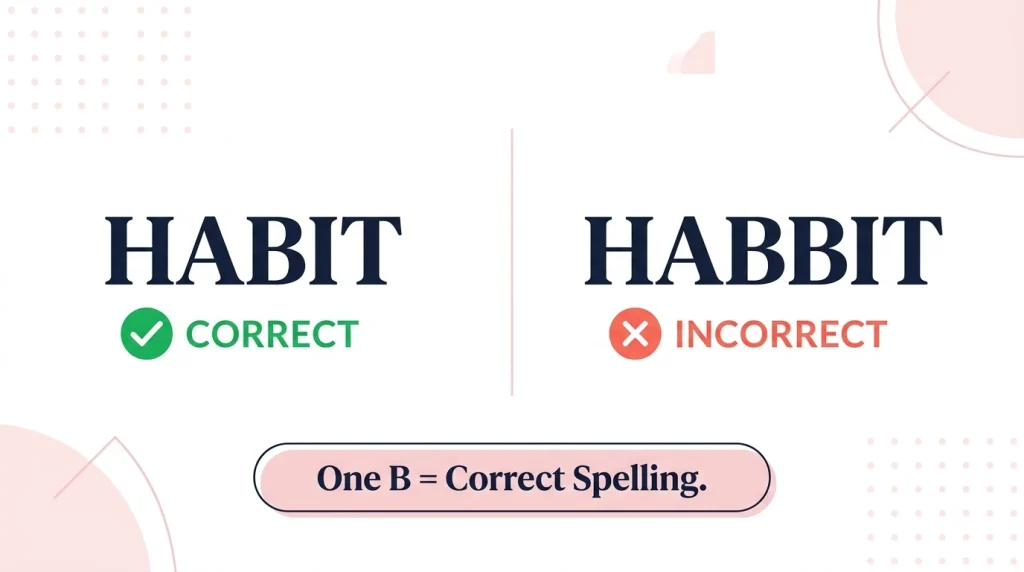
Habit is the correct spelling; habbit is a misspelling. The word habit has one b and one t and refers to a behavior that someone repeats regularly, often until it becomes automatic. For example, “Reading before bed is a good habit.” The spelling is the same in American and British English, so you should always write habit in schoolwork, professional documents, emails, and everyday messages.
What Is Habit?
A habit is a repeated action, behavior, or way of doing something that becomes familiar through practice. Some habits develop intentionally, while others form gradually without much conscious thought.
For example, brushing your teeth every morning is a habit. Checking your phone whenever you feel bored can also become a habit. The difference is not in the word itself but in the behavior and its effects.
The word habit is a noun. A noun is a word that names a person, place, thing, idea, or concept. In this case, habit names a repeated behavior or usual practice.
Consider these examples:
- Drinking water after waking up is a healthy habit.
- He has a habit of arriving early for meetings.
- She is trying to break her habit of putting off important tasks.
- Checking the weather before leaving home has become part of my daily habits.
In each sentence, the correct spelling is habit or habits, never habbit or habbits.
What Does Habbit Mean?
In ordinary English writing, habbit is a spelling error rather than a standard alternative to habit. If someone writes “I have a bad habbit,” the intended word is almost certainly habit.
You may encounter the misspelling in social media posts, online comments, informal messages, or material written by English learners. Seeing it repeatedly does not make it correct.
The safest approach is to use habit whenever you mean a repeated behavior or customary action.
Why the Correct Spelling Matters
Spelling mistakes can change how readers perceive your writing, even when they understand what you mean. Choosing habit instead of habbit helps you communicate clearly and present your work professionally.
In school and academic writing
Teachers expect standard spelling in essays, assignments, examinations, and research papers. Writing habbit instead of habit may cost you a spelling mark or make an otherwise strong answer look less polished.
Correct: Developing a consistent study habit can improve learning.
Incorrect: Developing a consistent study habbit can improve learning.
In the workplace
Professional emails, reports, presentations, and business documents benefit from accurate spelling. A single mistake may not ruin a message, but repeated errors can distract readers from its main point.
Correct: Our team is working to build a habit of reviewing reports before submission.
In online content
Blog posts, website articles, educational resources, and social media captions should use standard spelling. Correct usage improves readability and reduces the chance that readers will question the quality of the content.
Correct: Five habits that can make your mornings more productive.
In everyday communication
People will often understand habbit from context, but understanding a word is not the same as spelling it correctly. Using the standard form helps you build confidence and develop stronger writing habits of your own.
The Core Rule: Habit Has One B
The spelling rule
The correct spelling is H-A-B-I-T: habit.
- Correct: habit
- Incorrect: habbit
- Correct plural: habits
- Correct related word: habitual
Remember: Do not double the B in habit.
English spelling sometimes doubles consonants, as in rabbit, hobby, and letter. However, there is no general rule that every short word must have a double consonant. The spelling of each word must be learned according to its established form.
The correct spelling is habit, regardless of whether you are referring to one behavior or several.
Is There a Rule for Doubling the Letter B?
English does have patterns that explain why some words use double consonants. For instance, consonants are often doubled in certain forms when a short vowel is followed by a consonant and a suffix beginning with a vowel, as in run becoming running.
However, that pattern does not mean you should double a consonant whenever a word sounds short or familiar. Habit is spelled with one B in its standard base form, and adding another B does not follow from a general spelling rule.
The most reliable approach is to learn the established spelling of habit and its related forms.
How to Use Habit Correctly
Use habit when describing a repeated behavior, a usual practice, or a tendency to do something. The word can appear in many grammatical structures.
1. Use habit as a singular noun
Use habit when referring to one repeated behavior. A singular countable noun usually needs a determiner, such as a, the, my, or your, depending on the sentence.
Examples:
- Reading every evening is a good habit.
- I have a habit of checking my calendar each morning.
- This habit makes it easier to stay organized.
- Her habit of interrupting people sometimes causes problems.
Notice that we say “a habit,” not “a habbit.”
2. Use habits for more than one behavior
The plural form is habits. Add -s to the correctly spelled word habit.
Examples:
- Healthy habits can support long-term well-being.
- My weekend habits are different from my weekday habits.
- The course teaches students how to develop better study habits.
Do not double the B when making the word plural. The correct spelling is habits, not habbits.
3. Use habit in the phrase “a habit of”
The phrase a habit of introduces an action someone regularly performs. When the following action is expressed as a verb, it commonly uses the -ing form.
Examples:
- He has a habit of arriving early.
- She has a habit of leaving her keys on the table.
- I have developed a habit of reviewing my notes after class.
In standard English, “a habit of checking” is natural. “A habit of check” is incorrect in this construction because the verb form does not fit the phrase.
4. Use habit in the phrase “get into the habit of”
This phrase means to begin doing something regularly until it becomes an established practice.
Examples:
- I want to get into the habit of exercising before work.
- She got into the habit of writing down her daily goals.
- Try to get into the habit of saving your documents as you work.
The phrase is useful when talking about forming a new behavior.
5. Use habit in the phrase “break a habit”
To break a habit means to stop a repeated behavior, especially one that is undesirable or difficult to change.
Examples:
- He is trying to break his habit of procrastinating.
- I finally broke the habit of checking my phone during meals.
- Breaking an old habit may require patience and consistent effort.
The spelling remains habit in every example.
6. Use habitual as a related adjective
Habitual is an adjective that describes something done regularly or as a habit.
Examples:
- Her habitual lateness frustrated the team.
- He is a habitual note-taker.
- Habitual exercise became part of her lifestyle.
Although habitual is longer, it still contains only one B.
Correct Examples of Habit in Everyday English
The following examples show how to spell and use habit naturally in different settings.
- Everyday conversation: “I have a habit of singing while I cook.”
- Email: “I have made it a habit to review my messages before sending them.”
- School assignment: “Reading regularly is a useful habit for students.”
- Workplace meeting: “We should develop a habit of documenting important decisions.”
- Social media caption: “Small habits can make a big difference over time.”
- Academic writing: “Repeated practice can help establish a consistent study habit.”
- Text message: “You should get into the habit of drinking water throughout the day.”
- Job interview: “One of my strongest work habits is organizing my tasks before starting.”
- Personal development: “I am trying to break the habit of procrastinating.”
- Daily routine: “Making my bed has become a morning habit.”
- Business communication: “Our department follows a habit of checking figures before publishing reports.”
- Informal conversation: “It is just a habit; I do it without thinking.”
Every example uses the standard spelling. None requires habbit.
Incorrect vs. Correct: Common Spelling and Usage Mistakes
| Incorrect | Correct | Why |
|---|---|---|
| I have a bad habbit. | I have a bad habit. | Habit has one B. |
| Reading is a good habbit. | Reading is a good habit. | The double B is unnecessary. |
| She has many habbits. | She has many habits. | The plural is formed by adding -s to habit. |
| It is my daily habbit. | It is my daily habit. | The base noun retains one B. |
| I want to change this habbit. | I want to change this habit. | The spelling does not change after this. |
| He has a habbit of smoking. | He has a habit of smoking. | The phrase requires the correctly spelled noun. |
| I am building a new habbit. | I am building a new habit. | The correct noun is habit. |
| She is trying to break her habbit. | She is trying to break her habit. | The established expression is break a habit. |
| It has become a habbit for me. | It has become a habit for me. | Familiarity does not make the double-B spelling correct. |
| Good habbits take time to develop. | Good habits take time to develop. | Both the base spelling and plural form must be correct. |
| He is habbitually late. | He is habitually late. | The related adjective and adverb are spelled habitual and habitually. |
| My study habbit is improving. | My study habit is improving. | The singular noun still has one B. |
These mistakes are spelling errors rather than differences in meaning. If you see habbit in a draft, replace it with habit unless it is being quoted intentionally as an example of a misspelling.
Read More: Copywrite or Copyright: Which Spelling Is Correct?
Why People Spell Habit as Habbit
The mistake is understandable, particularly for learners who are still building confidence with English spelling. Several factors can contribute to it.
1. Confusion with double consonants
English contains many familiar words with double B, including rabbit, hobby, and bubble. Someone may incorrectly transfer that spelling pattern to habit.
The solution is to remember that English spelling is word-specific. Similar-looking words do not necessarily follow identical patterns.
2. Sound-based spelling
Some learners try to spell words by focusing mainly on how they sound. However, pronunciation alone does not always reveal whether a letter should be doubled.
The standard pronunciation of habit does not require a second B, and the correct spelling contains only one.
3. Overgeneralizing spelling rules
Overgeneralization happens when a learner applies a rule too broadly. For example, someone might learn that certain short words double a consonant before a suffix and assume that other short words also need doubled consonants.
That assumption does not apply to the base word habit. It is spelled with one B.
4. Typing and autocorrect mistakes
Typing quickly on a phone or computer can lead to repeated letters. Spellcheck may catch habbit, but a tool’s behavior depends on its dictionary, settings, and context. Never assume that an automatically suggested word is correct without checking it.
For important writing, proofread the final text rather than relying entirely on autocorrect.
5. Translation interference
People who learn English after another language may carry over spelling expectations from their first language. Some languages represent sounds and letters differently, so familiar spelling patterns may not match English conventions.
This does not mean every English learner makes this mistake. It simply explains one possible reason for spelling confusion.
6. Repeated exposure to the wrong form
Seeing a misspelling online can make it appear familiar. Familiarity, however, is not proof of correctness.
When in doubt, remember the standard form: habit.
Common Mistakes Checklist
Use this checklist when proofreading your writing.
- Doubling the B: Check whether you have written habbit. Replace it with habit.
- Misspelling the plural: Use habits, not habbits.
- Misspelling related words: Write habitual and habitually with one B.
- Trusting autocorrect without checking: Review suggested changes, especially in professional documents.
- Confusing spelling with pronunciation: Do not add a letter simply because a word resembles another word.
- Repeating a mistake throughout an article: Search your document for “habbit” to find accidental occurrences.
- Using the wrong verb form after “habit of”: Write “a habit of reading,” not “a habit of read.”
- Assuming regional spelling differences: Both American and British English use habit.
A quick proofreading search for habbit can catch accidental errors throughout a document. If the word appears because you are discussing the misspelling itself, it may be appropriate to leave it in that context.
Habit in Real English
Grammatically correct and natural
“Reading before bed is a good habit” is both grammatically correct and natural everyday English. The noun habit identifies a repeated behavior, while good describes its perceived benefit. You can use this construction in conversations, school assignments, workplace writing, and articles. Other natural expressions include “develop a habit,” “break a habit,” and “get into the habit of doing something.”
Grammatically possible but unnatural or unclear
A sentence can contain the correct spelling of habit yet still sound awkward. For example, “I perform the habit of reading at night” is understandable, but “I have a habit of reading at night” sounds more natural in ordinary conversation. The problem is not the noun’s spelling; it is the choice of verb and phrasing. Correct spelling is essential, but natural wording also matters.

Natural everyday English
English speakers commonly say “It has become a habit,” “I am trying to break that habit,” and “She has a habit of arriving early.” These expressions fit naturally into conversations about routines and behavior. In casual speech, a speaker might also say, “I do it out of habit,” meaning the action happens because it is familiar or automatic. All these expressions use habit with one B.
American vs. British English
There is no American–British spelling difference for habit. Both varieties use the same spelling and meaning.
| Feature | American English | British English |
|---|---|---|
| Correct spelling | Habit | Habit |
| Plural | Habits | Habits |
| Related adjective | Habitual | Habitual |
| Example | It is a good habit. | It is a good habit. |
You do not need to change the spelling when writing for readers in the United States, United Kingdom, Australia, or other English-speaking regions.
Formal vs. Informal Usage
The spelling habit is appropriate in both formal and informal English. The level of formality affects the surrounding sentence, not the spelling of the word.
Formal: “Establishing a consistent review habit may improve the accuracy of written reports.”
Informal: “I have a habit of checking my phone every five minutes.”
Professional: “Our team is developing the habit of reviewing all figures before publication.”
Casual message: “It is just a habit. I do it without thinking.”
Avoid habbit in every register unless you are deliberately quoting or explaining the incorrect spelling.
Habit vs. Similar and Confusing Words
Understanding related words helps you use habit accurately and avoid choosing a similar term when you mean something else.
| Word | Meaning | Example |
|---|---|---|
| Habit | A repeated behavior or practice | Walking after dinner is a habit. |
| Routine | A regular sequence of activities | My morning routine starts with breakfast. |
| Custom | An established social or cultural practice | Greeting guests warmly is a local custom. |
| Tendency | An inclination to behave in a certain way | He has a tendency to overthink decisions. |
| Practice | A repeated activity or method | Reviewing notes is a useful study practice. |
| Ritual | A repeated action with personal or symbolic significance | Journaling is her evening ritual. |
| Habitat | The natural environment of an organism | The forest is home to many species. |
| Rabbit | A small mammal | The rabbit hopped across the garden. |
| Hobby | An activity done for enjoyment | Painting is his favorite hobby. |
Notice that habitat, rabbit, and hobby are different words with different meanings and spelling patterns. Their resemblance to habit does not justify adding another B.
Memory Trick: One B in Habit
Use this simple mnemonic:
“One B builds a habit.”
The word habit has one B, and remembering that phrase can help you avoid the extra letter.
You can also picture the word in three parts:
- HA — the beginning
- B — one B only
- IT — the ending
Put the parts together: HA + B + IT = HABIT.
For additional practice, write this sentence once each day: “I am building a good habit of checking my spelling.” The repeated exposure can help reinforce the correct form.
Real-Life Situations: Using Habit Correctly
Situation 1: A school examination
A student writes, “Good study habbits help learners prepare for exams.”
The corrected sentence is: “Good study habits help learners prepare for exams.”
Why? Habits is the plural of habit and has only one B.
Situation 2: A workplace meeting
A manager says, “We need a habbit of checking our figures before sending the report.”
A more natural and correctly spelled version is: “We need to develop a habit of checking our figures before sending the report.”
Why? Habit is spelled with one B, and “develop a habit of” is a natural way to describe establishing a repeated practice.
Situation 3: A professional email
An employee writes, “I have made it a habbit to review every message before sending it.”
Corrected: “I have made it a habit to review every message before sending it.”
Why? The noun’s spelling remains the same in formal and informal writing.
Situation 4: A text message
A friend texts, “I have a habbit of staying up too late.”
Corrected: “I have a habit of staying up too late.”
Why? The intended meaning is clear, but the standard spelling is still habit.
Situation 5: A job interview
An applicant says, “One of my best work habbits is planning my day in advance.”
Corrected: “One of my best work habits is planning my day in advance.”
Why? The plural form is habits. Correct spelling helps make the answer look polished when written in an application or follow-up email.
Situation 6: A blog post
A writer drafts the heading “Seven Habbits for a Better Morning.”
Corrected heading: “Seven Habits for a Better Morning.”
Why? Headings, titles, and image captions should use the standard spelling just as body text does.
Expert Tips for Mastering the Spelling of Habit
These practical techniques can help you catch spelling mistakes before they reach your readers.
1. Learn the word family together
Instead of memorizing only habit, learn its common forms as a group:
- Habit: a repeated behavior.
- Habits: more than one repeated behavior.
- Habitual: regularly done or customary.
- Habitually: in a habitual manner.
- Habituation: the process of becoming accustomed to something through repeated exposure.
Each word contains one B. Learning them together helps you recognize the spelling pattern.
2. Separate spelling errors from grammar errors
Consider these two sentences:
- “She has a habbit of arriving late.”
- “She has a habit of arrive late.”
The first contains a spelling mistake. The second uses an incorrect verb form after “a habit of.” The correct sentence is “She has a habit of arriving late.”
This distinction matters because proofreading should check both spelling and grammar.
3. Use spellcheck as a backup
Most modern spelling tools can identify common misspellings, but their suggestions should not replace careful proofreading. A spellchecker may behave differently depending on its language settings and the context of a sentence.
For a quick check, search your draft for habbit and inspect each occurrence.
4. Practice through active recall
Active recall means trying to remember information without looking at the answer first. Cover the correct spelling, write the word from memory, and then compare your answer with habit.
Repeat the exercise with habits, habitual, and habitually. This is more useful than simply reading the correct spelling over and over without testing yourself.
Frequently Asked Questions
Is “habbit” ever correct in standard English?
No. Habbit is not the standard spelling of the noun habit. Unless you are quoting a misspelling or reproducing a name that intentionally uses that form, use habit.
Can I use “habbit” in a text message if people understand it?
People may understand what you mean, but it remains a spelling error. Use habit even in informal messages if you want to write correctly.
What is the past tense of habit?
In ordinary modern English, habit is mainly a noun, so it does not normally have a past-tense form. To describe a behavior that became regular in the past, you could say, “She developed a habit of reading every night.”
What does “out of habit” mean?
The phrase out of habit means doing something because it has become familiar or automatic, rather than because you have deliberately decided to do it.
Example: “I opened the refrigerator out of habit, even though I was not hungry.”
Is “habitual” spelled with one B or two?
Habitual is spelled with one B. It is an adjective describing something that happens regularly or is characteristic of someone’s behavior.
Example: “His habitual punctuality made him a dependable colleague.”
What is the difference between a habit and a behavior?
A behavior is an action or way of acting. A habit is a behavior that is repeated regularly and may become automatic. Not every behavior is a habit, but habits are behaviors.
Is “habit of doing” grammatically correct?
Yes. The phrase “a habit of doing something” is a standard construction. The word of is followed by a noun or an -ing verb form.
Correct: “She has a habit of writing notes during meetings.”
Incorrect: “She has a habit of write notes during meetings.”
How can I teach a child to spell habit?
Teach the word as H-A-B-I-T and emphasize that it has only one B. Ask the child to use it in a simple sentence, such as “Brushing my teeth is a habit.” Short spelling exercises and regular practice can reinforce the correct form.
Does the spelling of habit change in the plural?
The plural is habits. Add -s to the singular word without doubling the B.
What is a simple sentence using habit?
“Reading every day is a good habit.” This sentence uses the noun correctly and shows how it can describe a repeated behavior.
Quiz: Test Your Knowledge of Habit vs. Habbit
Complete the following questions to check whether you can recognize the correct spelling and use the word naturally.
| No. | Question | Answer and explanation |
|---|---|---|
| 1 | Choose the correct spelling: (A) Habbit (B) Habit | Answer: B — Habit. The standard spelling contains one B. |
| 2 | Fill in the blank: Reading daily is a good ___. | Answer: habit. The word describes a repeated behavior. |
| 3 | Correct this sentence: “I have many habbits.” | Answer: I have many habits. The plural is formed by adding -s to habit. |
| 4 | Choose the correct form: (A) Habitual (B) Habb itual | Answer: A — Habitual. The related adjective also contains one B. |
| 5 | Fill in the blank: She has a habit of ___ early. (A) arrive (B) arriving | Answer: B — arriving. The phrase “a habit of” naturally takes an -ing verb form when describing an action. |
| 6 | True or false: British English spells the word “habbit.” | Answer: False. British English uses habit, just like American English. |
| 7 | Correct this sentence: “He is habbitually late.” | Answer: He is habitually late. The correct adverb is habitually. |
| 8 | Choose the natural expression: (A) Break a habit (B) Break a habbit | Answer: A — Break a habit. The established phrase uses the correct spelling. |
| 9 | Fill in the blank: I am trying to get into the ___ of exercising. | Answer: habit. “Get into the habit of” means to begin doing something regularly. |
| 10 | Correct this sentence: “I checked my phone out of habbit.” | Answer: I checked my phone out of habit. The phrase is correctly written with one B in habit. |
Quiz Score Guide
- 9–10 correct: Excellent. You understand the spelling and common usage.
- 7–8 correct: Good work. Review the plural and related word forms.
- 4–6 correct: You are making progress. Practice the spelling and common phrases.
- 0–3 correct: Review the core rule and try the quiz again.
Quick Summary
The correct spelling is habit, not habbit. A habit is a repeated behavior or practice that may become automatic through repetition. The word contains one B, and its plural is habits. Related forms, including habitual and habitually, also use one B. There is no spelling difference between American and British English. Common expressions include “develop a habit,” “break a habit,” “get into the habit of,” and “out of habit.” To avoid mistakes, learn the spelling, practice writing it in sentences, and proofread your work. Remember the simple mnemonic: “One B builds a habit.” Use habit in academic, professional, and everyday writing.



Pingback: Dialled or Dialed: Which Spelling Is Correct?
Pingback: Miter or Mitre: Which Spelling Is Correct? - Meaning Wisdom