


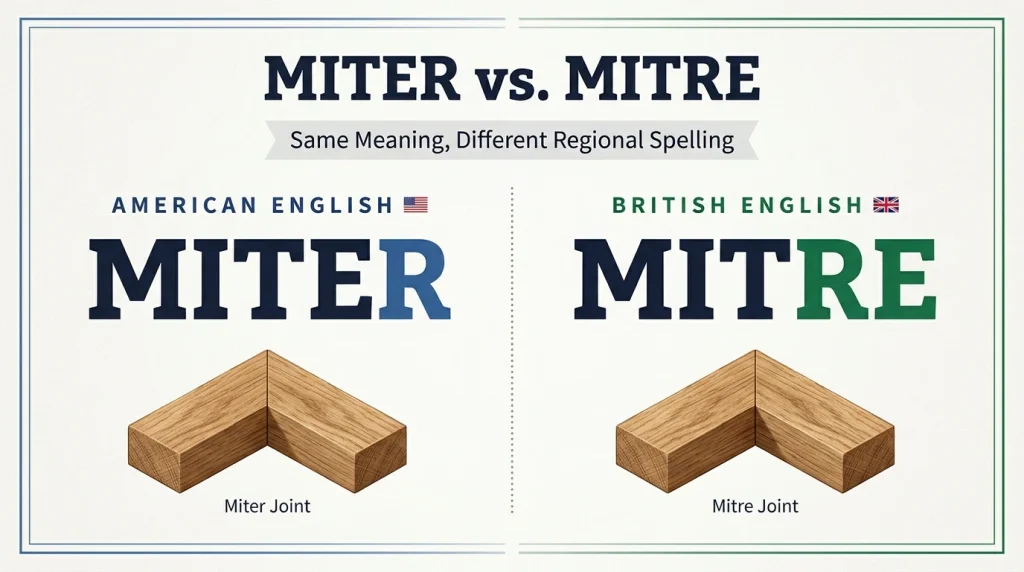
Both miter and mitre are correct spellings of the same word. The difference is primarily regional: miter is the standard American English spelling, while mitre is the standard British English spelling. The word can refer to a type of angled joint in woodworking or a ceremonial headdress worn by certain Christian bishops. Choose the spelling that matches your audience, and use it consistently throughout your writing.
What Is the Difference Between Miter and Mitre?
Miter and mitre are spelling variants of the same word. Neither is inherently more correct than the other; the appropriate choice depends on the variety of English you are using.
The distinction follows a familiar pattern in English spelling. American English often uses spellings that differ from British English, as seen in center and centre, theater and theatre, and meter and metre.
The word has two main meanings:
- Woodworking and construction: A miter or mitre is an angled cut or joint, often used to connect two pieces of material neatly at a corner.
- Religion: A miter or mitre is a tall, ceremonial headdress worn by certain Christian bishops during formal religious occasions.
The spelling changes with regional convention, but the underlying meaning remains the same.
Why the Difference Matters
Choosing between miter and mitre matters most when you are writing for a particular country, profession, or audience.
For example, an American carpenter would normally refer to a miter saw, while a British carpenter would usually write mitre saw. Similarly, an American publication might use bishop’s miter, whereas a British publication would generally use bishop’s mitre.
Using the less familiar regional spelling will not necessarily make your writing incorrect or incomprehensible. However, inconsistent spelling can make a document look less polished, particularly in technical instructions, professional reports, product descriptions, and educational materials.
The practical rule is simple: identify your intended audience before choosing a spelling.
The Core Rule: Miter vs. Mitre
US
Miter
Use this spelling in American English.
Examples: miter saw, miter joint, bishop’s miter, mitered corner.
UK
Mitre
Use this spelling in British English.
Examples: mitre saw, mitre joint, bishop’s mitre, mitred corner.
Remember: The spelling difference does not change the word’s meaning. Both forms refer to the same basic concepts, and both can function as nouns or verbs.
How to Use Miter and Mitre
1. Use Miter in American English
In American writing, miter is the standard spelling in woodworking, construction, religious contexts, and related technical descriptions.
Examples include:
- The carpenter used a miter saw to cut the trim.
- The frame has a clean miter joint at each corner.
- The bishop wore an ornate miter during the ceremony.
- She learned how to miter the corners of a wooden frame.
The spelling also applies to related words. American English normally uses mitered, mitering, and miter box.
2. Use Mitre in British English
In British writing, mitre is the standard spelling for the same meanings.
Examples include:
- The carpenter used a mitre saw to cut the skirting board.
- The picture frame has neatly joined mitre corners.
- The bishop wore a traditional mitre during the service.
- He carefully mitred the edges before assembling the frame.
British English generally uses mitred, mitring, and mitre box.
3. Understand the Woodworking Meaning
In woodworking, a miter or mitre is an angled cut or the joint formed when two angled edges meet.
For example, two pieces of trim cut at 45 degrees can form a 90-degree corner when joined. This technique is common in picture frames, decorative molding, cabinetry, and other finishing work.
A miter joint is not necessarily the strongest type of joint in every application. Its strength depends on factors such as the materials, fit, adhesive, and reinforcement.
4. Understand the Religious Meaning
A miter or mitre is also a ceremonial headdress worn by certain Christian bishops and other church officials.
The spelling depends on the publication’s regional style, not on a difference in religious meaning.
- American publication: The bishop’s miter was displayed in the museum.
- British publication: The bishop’s mitre was displayed in the museum.
In both sentences, the word refers to the same type of ceremonial headwear.
5. Apply the Same Rule to Related Words
Choosing the correct base spelling helps you spell related forms consistently.
| American English | British English |
|---|---|
| miter | mitre |
| mitered | mitred |
| mitering | mitring |
| miter joint | mitre joint |
| miter saw | mitre saw |
| miter box | mitre box |
These are the usual regional forms. In a technical document, follow the terminology used by the relevant manufacturer, specification, or industry standard when it explicitly requires a particular spelling.
Correct Examples of Miter and Mitre
The following original examples show how the two spellings work in everyday, professional, academic, and technical writing.
American English Examples
- Conversation: “Can you help me set up the miter saw before we cut the boards?”
- Workplace email: “The contractor will finish the miter joints before installing the trim.”
- School assignment: “A miter joint can create a neat corner between two pieces of wood.”
- Product description: “This miter box helps guide a hand saw when cutting accurate angles.”
- Social media: “I finally learned how to make clean mitered corners on my picture frames.”
- Technical report: “The samples were assembled with miter joints to evaluate their fit and durability.”
British English Examples
- Conversation: “Could you pass me the mitre box from the tool cupboard?”
- Workplace email: “Please inspect the mitred corners before approving the installation.”
- School assignment: “The craftsman joined the two pieces using a mitre joint.”
- Product description: “This mitre saw is designed for accurate angled cuts in suitable materials.”
- Religious writing: “The bishop’s mitre was carefully preserved as part of the collection.”
- Academic writing: “The report describes how mitred edges were used to form the corners of the display frame.”
Notice that the sentences do not require different grammar. Only the regional spelling changes.
Incorrect vs. Correct: Common Spelling Errors
The following table illustrates common mistakes involving the two spellings. Some examples are incorrect because they conflict with the chosen regional style, while others are simply grammatical or technical errors.
| Incorrect or inconsistent | Correct | Why |
|---|---|---|
| The carpenter used a mitre saw in an American-style report. | The carpenter used a miter saw. | Miter is the standard American spelling. |
| The carpenter used a miter saw in a British-style report. | The carpenter used a mitre saw. | Mitre is the standard British spelling. |
| The frame has neatly mitered corners. (British style) | The frame has neatly mitred corners. | The related word follows the regional spelling. |
| The frame has neatly mitred corners. (American style) | The frame has neatly mitered corners. | American English normally retains the -er spelling. |
| We are mitring the wood today. (American style) | We are mitering the wood today. | The American present participle is mitering. |
| We are mitering the wood today. (British style) | We are mitring the wood today. | The British form is generally mitring. |
| The two boards were joined with a miter. (British text requiring the British spelling) | The two boards were joined with a mitre. | The spelling should match the document’s regional convention. |
| The two boards were joined with a mitre. (American text requiring the American spelling) | The two boards were joined with a miter. | The American spelling is preferred in this context. |
| The carpenter mitred the corners. (American style) | The carpenter mitered the corners. | The past-tense form follows American spelling. |
| The carpenter mitered the corners. (British style) | The carpenter mitred the corners. | The past-tense form follows British spelling. |
Important distinction: Miter and mitre are both valid English spellings. An American spelling in a British publication is not automatically a grammatical error, nor is a British spelling in an American publication inherently misspelled. The issue is regional consistency and, where applicable, compliance with a required style guide.
Why People Confuse Miter and Mitre
1. The Words Sound the Same
In their usual pronunciations, miter and mitre sound alike. Because pronunciation does not help writers distinguish the spellings, people often rely on whichever form they have seen most frequently.
2. Both Spellings Look Plausible
English contains many words with different American and British spellings. A writer who already knows center and centre may recognize the same pattern in miter and mitre but forget which version belongs to which region.
3. Technical Vocabulary Can Be Unfamiliar
Someone learning woodworking terminology may encounter miter saw, mitre joint, and miter box in different manuals. Without knowing the regional convention, these forms can appear to be separate technical terms.
4. Spellcheck Does Not Always Catch Style Inconsistency
A spellchecker may accept both spellings because both are legitimate English words. It might not flag an American spelling in a British document unless the selected language settings or style rules identify the inconsistency.
5. Translation Can Add Confusion
Learners translating technical terms from another language may know the concept but not the regional spelling conventions of English. The best solution is to learn the term together with the English variant required for the intended audience.
Common Mistakes Checklist
Use this checklist when proofreading an article, report, or technical document.
- Mixing American and British spellings: Choose one variety of English before editing. Do not switch between miter and mitre without a specific reason.
- Changing only the main noun: Check related forms such as mitered, mitred, mitering, and mitring.
- Assuming one spelling is universally correct: Both are standard. The appropriate choice depends on regional convention.
- Treating the word as exclusively technical: The term also has a religious meaning, so the surrounding sentence determines its intended sense.
- Trusting autocorrect without checking context: A correction may be valid English but unsuitable for your audience.
- Changing a manufacturer’s terminology unnecessarily: When writing product specifications or instructions, follow the terminology required by the manufacturer or applicable standard.
- Using inconsistent spellings in headings and body text: Review the entire document, including image captions, product tables, and metadata.
Miter or Mitre in Real English
Grammatically Correct: Both Forms
Both miter and mitre are established English spellings. For example, “The carpenter cut a miter in the trim” and “The carpenter cut a mitre in the trim” are both understandable and grammatically possible. The choice is a spelling convention rather than a difference in sentence structure. In a finished piece of writing, the best choice is the form appropriate to the intended regional audience.
Grammatically Possible but Stylistically Inconsistent
A sentence can be grammatically sound but inconsistent with the rest of a document. For example, a British technical manual might use mitre saw in one paragraph and mitered corner in another. Readers will probably understand both expressions, but the mixture can suggest careless editing. Unless the wording comes from a quoted source or an official product name, consistent British spelling would generally be preferable.
Read More: Habbit or Habit: Which Spelling Is Correct?
Natural, Everyday English
In ordinary conversation, speakers are unlikely to notice the spelling distinction because the words are usually pronounced alike. A British carpenter might say “mitre saw,” while an American carpenter would normally say “miter saw.” When writing instructions, however, the regional convention becomes visible. The most natural written form is therefore the one that matches the audience, the publication’s language settings, and established terminology in the relevant field.
American vs. British English
The difference between miter and mitre is a genuine American–British spelling distinction.
| Feature | American English | British English |
|---|---|---|
| Standard spelling | Miter | Mitre |
| Pronunciation | Usually /ˈmaɪtər/ | Usually /ˈmaɪtə/ |
| Woodworking tool | Miter saw | Mitre saw |
| Angled joint | Miter joint | Mitre joint |
| Past tense | Mitered | Mitred |
| Present participle | Mitering | Mitring |
| Ceremonial headdress | Miter | Mitre |
Pronunciation varies by accent, and the table gives common patterns rather than a rule for every speaker.
Other English-speaking regions may follow British conventions, American conventions, or local editorial practices. For international audiences, the most important consideration is consistency.
Formal vs. Informal Usage
There is no meaningful formal-versus-informal distinction between miter and mitre. Neither spelling is more formal, polite, educated, or professional than the other.
Both are suitable for:
- Academic writing and educational materials.
- Professional emails and business reports.
- Construction instructions and woodworking guides.
- Religious publications and historical descriptions.
- Everyday conversation and social media posts.
The deciding factor is the audience, not the level of formality. An American academic paper would normally use miter, while a British academic paper would normally use mitre.
Miter vs. Mitre vs. Similar Terms
| Term | Meaning | How it differs |
|---|---|---|
| Miter | American spelling of the word | Standard in American English |
| Mitre | British spelling of the word | Standard in British English |
| Bevel | An angled surface or cut | A broader technical term; not every bevel forms a miter joint |
| Miter joint | A joint formed by joining angled edges | Names the woodworking connection |
| Miter saw | A saw designed for making angled cuts | Names the tool |
| Miter box | A guide that helps control saw cuts at selected angles | Often used with a hand saw |
| Bishop’s miter | A ceremonial headdress | Refers to religious headwear, not woodworking |
| Meter / metre | A unit of length | A different word with a different meaning |
The distinction between miter and bevel is particularly useful in technical writing. A bevel describes an angled edge or surface, while a miter commonly refers to an angled cut or the joint formed when matching angled pieces meet. In practical usage, the exact technical definition can depend on the tool and application.
Memory Trick: Remember the Final Letters
Use this simple mnemonic:
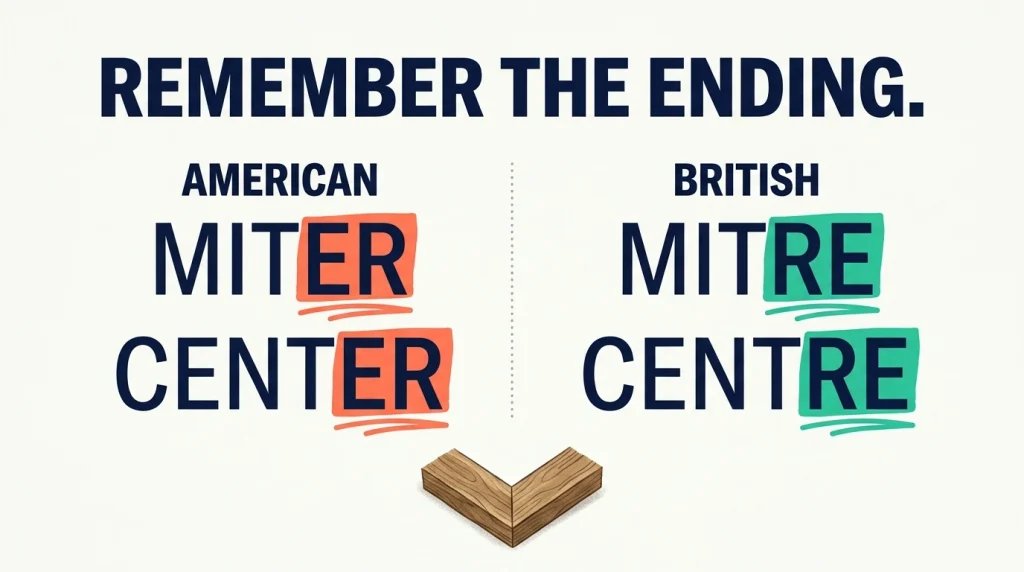
American = ER; British = RE.
- Miter ends in -er, like the American spelling of center.
- Mitre ends in -re, like the British spelling of centre.
Remember the pattern as a pair: miter/center for American English and mitre/centre for British English.
This trick helps you remember the spelling without memorizing separate rules for woodworking, construction, and religious usage.
Miter or Mitre in Real-Life Situations
Situation 1: Writing a Construction Report
You are preparing a report for a contractor working in the United States.
Use: “The carpenter used a miter saw to cut the trim.”
Why: Miter is the standard American spelling.
Situation 2: Buying Tools in the United Kingdom
You are writing a product guide for British customers.
Use: “Choose a mitre saw suitable for the material you plan to cut.”
Why: Mitre is the standard British spelling.
Situation 3: Submitting a School Assignment
Your teacher expects British English.
Use: “The frame was assembled using mitred corners.”
Why: Both the main term and its related form follow British spelling.
Situation 4: Writing a Religious Article
Your American publication is describing a bishop’s ceremonial clothing.
Use: “The bishop’s miter was an important part of the ceremonial dress.”
Why: The religious meaning uses the same regional spelling distinction.
Situation 5: Editing an International Website
Your website serves readers in several English-speaking countries.
Best approach: Decide whether the page will use American or British English, then apply that convention consistently. If separate regional pages are necessary, adapt the spelling to each audience.
Read More: Copywrite or Copyright: Which Spelling Is Correct?
Expert Tips for Choosing the Right Spelling
- Set your language variant first. Select American English or British English in your word processor or content management workflow before proofreading.
- Check compound terms together. Search for miter saw, mitre saw, miter joint, and mitre joint to identify inconsistencies.
- Use the correct related forms. Remember that mitered and mitred follow their respective regional patterns.
- Distinguish spelling from technical accuracy. Writing miter saw correctly does not guarantee that your instructions about cutting angles are technically correct.
- Keep official names intact. If a product, organization, or quoted document uses a particular spelling, do not alter its official name merely to fit your preferred variant.
- Proofread metadata too. SEO titles, meta descriptions, image alt text, and product headings should use the spelling appropriate to the page’s audience.
- Do not overcorrect valid English. If you are editing someone else’s work, change a regional variant only when consistency, audience expectations, or a specific style requirement calls for it.
Quick Summary
Miter and mitre are two correct spellings of the same English word. Miter is standard in American English, while mitre is standard in British English. Both can refer to an angled woodworking cut or joint and to a ceremonial headdress worn by certain Christian bishops. Related forms usually follow the same regional pattern: mitered and mitering in American English, compared with mitred and mitring in British English. Neither spelling is inherently better or more formal. To choose correctly, consider your readers, follow the relevant style guide, and maintain consistency throughout the document. Remember the simple pattern: American -er, British -re.
Frequently Asked Questions
Is miter or mitre the correct spelling?
Both are correct. Miter is the standard American English spelling, while mitre is the standard British English spelling.
Is a miter the same thing as a mitre?
Yes. In ordinary English usage, they are spelling variants of the same word and have the same principal meanings.
Is miter an American spelling?
Yes. Miter is the usual American spelling, including in woodworking terms such as miter saw and miter joint.
Is mitre British English?
Yes. Mitre is the standard British spelling for the same word, including expressions such as mitre saw and mitre joint.
How do you spell mitered in British English?
The usual British spelling is mitred. For example: “The carpenter mitred the edges before joining the pieces.”
How do you spell mitring in American English?
The usual American spelling is mitering. For example: “She is mitering the corners of the frame.”
Is a miter joint always cut at 45 degrees?
No. Two pieces cut at 45 degrees commonly form a 90-degree corner, but miter joints can use other angles when the design requires them.
What is the difference between a miter and a bevel?
A bevel is an angled surface or cut. A miter generally describes an angled cut used to create a joint between matching pieces. The terms are related but not interchangeable in every technical context.
Does miter have a religious meaning?
Yes. A miter is a ceremonial headdress worn by certain Christian bishops. British English generally spells it mitre.
Can I use both spellings on the same website?
You can, particularly if you publish separate pages for different regional audiences. However, a single article should normally follow one spelling convention consistently.
Will search engines treat miter and mitre as different words?
They are distinct spellings with the same principal meaning, and search engines can generally understand the relationship. Nevertheless, choose the form that best matches your intended audience and use related terminology naturally.
Which spelling should I use for an international audience?
Choose the spelling that aligns with your website’s primary audience or established editorial style. If your website uses American English throughout, choose miter. If it uses British English, choose mitre.
Mini Quiz: Miter or Mitre?
Test your understanding with these 10 questions. Each question has one intended answer.
| No. | Question | Answer and explanation |
|---|---|---|
| 1 | Which spelling is standard in American English: miter or mitre? | Miter. American English normally uses the -er ending. |
| 2 | Complete the sentence in British English: “The carpenter used a ___ saw.” | Mitre. The usual British term is mitre saw. |
| 3 | True or false: Miter and mitre have different principal meanings. | False. They are regional spellings of the same word. |
| 4 | Correct this American English sentence: “The carpenter mitred the corners.” | The carpenter mitered the corners. American English normally uses mitered. |
| 5 | Correct this British English sentence: “The frame has mitered corners.” | The frame has mitred corners. The usual British form is mitred. |
| 6 | Which word describes an angled woodworking joint: miter or meter? | Miter. A meter or metre is a unit of length. |
| 7 | Complete the American English sentence: “She is ___ the edges.” | Mitering. This is the usual American participle. |
| 8 | Is mitre acceptable in a British religious article about a bishop’s ceremonial hat? | Yes. Mitre is the standard British spelling for that object. |
| 9 | Choose the usual British spelling: miter joint or mitre joint. | Mitre joint. British English normally uses mitre. |
| 10 | Correct this sentence for American English: “The carpenter bought a mitre box.” | The carpenter bought a miter box. This follows the usual American spelling convention. |



Pingback: Organisers or Organizers: Which Spelling Is Correct?