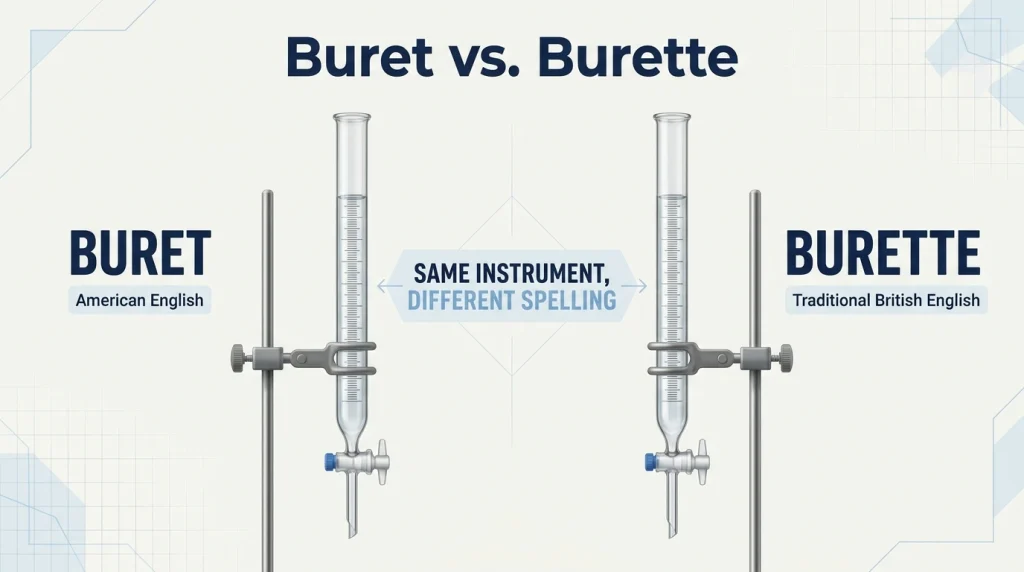
Both buret and burette are correct spellings of the same scientific instrument. The difference is mainly regional: buret is the preferred American English spelling, while burette is the traditional British English spelling. Both refer to a graduated glass tube with a stopcock that delivers precise amounts of liquid, especially during laboratory titrations. If you are writing for an American audience, use buret. For a British audience, use burette.
What Is the Difference Between Buret and Burette?
The difference between buret and burette is a spelling variation, not a difference in meaning or function.
Both words describe a laboratory instrument used to measure and dispense controlled volumes of liquid. It usually consists of a long, narrow, graduated tube with a tap or stopcock at the bottom.
The instrument is particularly important in analytical chemistry, where accurate liquid measurements are needed to determine the concentration of a solution.
The spelling you choose generally depends on your preferred English variety:
- Buret: American English.
- Burette: British English and other varieties that traditionally follow British spelling.
Neither spelling is inherently incorrect.
What Is a Buret or Burette Used For?
A buret or burette is mainly used in chemistry laboratories to deliver carefully measured, variable amounts of liquid. Its most common application is titration, a process used to determine the concentration of an unknown solution.
For example, a chemist may use a burette to add sodium hydroxide gradually to an acid solution until the reaction reaches its endpoint.
The instrument allows the chemist to control the liquid flow and record how much solution has been delivered.
Is Buret or Burette More Common in American English?
Although buret is a recognized American spelling, burette is also accepted and appears in American dictionaries and scientific writing.
For example, American laboratory textbooks and university materials frequently use buret, while burette remains widely recognized.
The safest approach is:
- Use buret when following an American scientific style guide that prefers the shorter spelling.
- Use burette when following British English conventions.
- Follow the spelling used by your university, laboratory, publisher, or examination board.
- Never switch between the two spellings unnecessarily within the same document.
Oxford identifies buret as the US English alternative, while Cambridge recognizes both forms. Oxford Learner’s Dictionaries+2
The Core Rule: Buret vs. Burette
American English variant
Buret
One final spelling ending in -t.
British English spelling
Burette
Spelling ending in -tte.
Meaning: Both words describe the same graduated laboratory instrument.
Plural: Burets / burettes.
Remember that the additional letters in burette do not indicate a different instrument, measurement system, or laboratory function.
How to Use Buret and Burette Correctly
Use either spelling as a noun when referring to the laboratory instrument.
The word can appear in different grammatical situations:
- As the subject of a sentence: The burette needs cleaning before the experiment.
- As the object of a sentence: The technician filled the buret with the prepared solution.
- After an article: A burette was placed in the laboratory stand.
- In a plural construction: Three burets were used during the experiment.
- As part of a technical phrase: The burette reading was recorded in millilitres.
The spelling does not change the grammatical role of the word.
Correct Examples of Buret and Burette
The following examples show how both spellings work in everyday academic and professional contexts.
- Chemistry laboratory: The student filled the burette with hydrochloric acid before beginning the titration.
- American university: The instructor demonstrated how to read a buret accurately.
- School assignment: Draw a labelled diagram of a burette and identify its main components.
- Laboratory report: The initial burette reading was recorded before the solution was released.
- Academic research: The researchers used a calibrated buret to dispense precise volumes of liquid.
- Workplace instruction: Please clean the burette after completing the chemical analysis.
- Chemistry examination: Explain why a buret is commonly used during acid-base titrations.
- Laboratory email: Could you please check whether the burette is available for tomorrow’s experiment?
- Scientific presentation: This diagram illustrates how a burette controls the delivery of liquid into a flask.
- Social media: Today, we learned how to use a buret during our chemistry practical.
Both spellings are correct in these sentences. The important thing is to follow the spelling convention appropriate to your audience.
Incorrect vs. Correct: Buret or Burette
Neither spelling is incorrect by itself. The following table highlights mistakes involving spelling consistency, word choice, and the scientific instrument’s name.
| Incorrect or inconsistent | Correct | Why |
|---|---|---|
| The burette was filled, and the buret was cleaned. | The burette was filled, and the burette was cleaned. | Keep one spelling consistent in the same document. |
| We used a buret to measure the temperature. | We used a buret to measure the volume of liquid. | A buret measures and delivers liquid volume, not temperature. |
| The burette were cleaned. | The burette was cleaned. | Burette is singular. |
| Two burette was prepared. | Two burettes were prepared. | A plural noun needs the plural form and plural verb. |
| The burets is ready. | The burets are ready. | Burets is plural and takes a plural verb. |
| I used an burette. | I used a burette. | Burette begins with a consonant sound. |
| The burette’s were placed on the table. | The burettes were placed on the table. | Do not use an apostrophe to form a plural. |
| The student used a burette’s for titration. | The student used a burette for titration. | The possessive apostrophe is unnecessary. |
| The burette measured the mass of the solution. | The burette delivered a measured volume of solution. | The instrument is designed for liquid-volume measurement. |
| We bought several buret. | We bought several burets. | The noun needs a plural ending. |
Important: The first example is a consistency problem, not a claim that either spelling is grammatically incorrect. Both forms are legitimate.
Why People Confuse Buret and Burette
The confusion usually comes from the fact that both words look almost identical and have exactly the same basic meaning.
Several factors contribute to the mistake.
1. Regional Spelling Differences
English has different spelling conventions across countries. Words such as color/colour and center/centre demonstrate this pattern.
Buret and burette follow a similar regional variation, although their distribution is not perfectly exclusive.
2. Scientific Vocabulary
Students often encounter scientific terms in textbooks, laboratory manuals, online lessons, and examination papers.
A student who studies using American materials may repeatedly see buret, while another studying British materials may see burette.
Both are acceptable, so seeing a different spelling does not mean the textbook is incorrect.
3. The French Origin
The spelling burette retains the French-looking ending -ette. This can make it appear more complicated to someone unfamiliar with the word.
The shorter spelling buret is an established English variant rather than a misspelling.
4. Autocorrect and Spellcheck
Spellcheck programs may prefer one spelling based on the selected language setting.
For instance, an American English dictionary may suggest buret, while a British English dictionary may favor burette.
A spelling suggestion does not automatically establish that the alternative is incorrect.
5. Translation and Language Learning
Students learning English as a second language may translate scientific vocabulary from another language.
Because the instrument has related names in several languages, learners sometimes assume that only one English spelling is acceptable.
The best solution is to learn both variants and understand when each is commonly used.
Read More: Lesser or Lessor: What’s the Difference?
Common Buret and Burette Mistakes Checklist
Here are mistakes worth avoiding when writing about this laboratory instrument.
- Treating buret as a misspelling: It is a recognized English spelling. Check your preferred English variant before correcting it.
- Treating burette as exclusively British: It is also recognized in American English. Do not automatically mark it incorrect in American writing.
- Changing spellings throughout a report: Switching between buret and burette can make scientific writing look poorly edited. Choose one form.
- Using the wrong plural: Write burets or burettes, not buret’s or burette’s when you mean more than one instrument.
- Confusing a burette with a pipette: A burette delivers measured variable volumes, whereas a volumetric pipette is generally designed to transfer a specified volume.
- Assuming both spellings describe different instruments: They are alternative spellings, not different laboratory devices.
- Ignoring institutional requirements: A university or journal may specify a particular spelling. Follow its instructions.
Buret or Burette in Real English
Understanding a spelling difference is not only about memorizing which letters to use. It is also about recognizing how technical vocabulary works in real writing.
1. Grammatically Correct
Both buret and burette are grammatically correct English nouns. You can use either spelling as a subject, object, or part of a technical phrase. For example, “The buret was filled with acid” and “The burette was filled with acid” are both correct. Neither sentence needs grammatical correction simply because it uses one spelling rather than the other.
2. Grammatically Possible but Inconsistent
A sentence or report may contain both spellings without breaking a grammar rule. For example, “The buret was cleaned before the burette was stored” is grammatically possible. However, if both words refer to the same instrument, changing spelling without a reason is poor editorial practice. Scientific writing benefits from consistent terminology, especially in laboratory instructions and research reports.
3. Natural, Everyday English
In everyday conversation, most people do not discuss burets or burettes unless they study or work in a scientific setting. In a chemistry classroom, laboratory, or academic report, both forms are natural. The more appropriate choice depends on the spelling convention used by the institution or audience. There is no meaningful difference in tone, politeness, or professionalism between the two spellings.
American vs. British English: Buret or Burette
This is the most relevant regional distinction for this keyword.
| Feature | American English | British English |
|---|---|---|
| Common spelling convention | Buret | Burette |
| Alternative spelling | Burette | Buret |
| Meaning | Laboratory instrument | Laboratory instrument |
| Pronunciation | Approximately byoo-RET | Approximately byoo-RET |
| Plural | Burets / burettes | Burettes / burets |
| Scientific context | Chemistry and titration | Chemistry and titration |
The distinction is a useful spelling preference, not an absolute rule that prohibits the alternative.
For example, American university laboratory materials use buret in scientific instructions, while British chemistry resources commonly use burette. chemistry.ucdavis.edu+2
Which Spelling Should Students Use?
Students should follow the English convention used in their course materials and examinations.
- If your chemistry textbook uses buret, use that spelling consistently.
- If your teacher uses burette, follow that convention.
- If your examination board specifies British English, burette is a sensible choice.
- If your assignment follows American scientific terminology, buret is appropriate.
Do not lose confidence in your spelling simply because another textbook uses the alternative.
Formal vs. Informal Usage
Buret and burette are technical nouns rather than casual conversational expressions.
Formal usage: Both forms are appropriate in scientific reports, laboratory manuals, research papers, chemistry textbooks, and academic assignments. The main requirement is consistency and compliance with the relevant style guide.
Informal usage: Either spelling can appear in classroom conversations, student messages, or informal explanations. For example, “Don’t forget to clean the burette after the experiment” is perfectly natural in a chemistry class.
There is no difference in formality between the two variants.
Buret vs. Burette vs. Other Laboratory Instruments
Buret and burette are alternative spellings of one instrument. However, students sometimes confuse this instrument with other laboratory equipment.
The following table explains the differences.
| Feature | Buret / Burette | Pipette | Graduated Cylinder |
|---|---|---|---|
| Main purpose | Deliver measured liquid volumes | Transfer measured liquid volumes | Measure liquid volume |
| Typical design | Long graduated tube with a tap | Narrow tube, often with a bulb or filler | Cylindrical container with markings |
| Liquid control | Stopcock or valve | Pipette filler or other dispensing mechanism | Usually poured manually |
| Common application | Titration | Accurate liquid transfer | General volume measurement |
| Spelling variation | Buret / burette | Pipette / pipet | Graduated cylinder |
These instruments serve different purposes. A burette is particularly useful when a chemist needs to add a variable volume of liquid gradually and accurately.
How Does a Burette Work?
A burette works by allowing liquid to flow through a controlled outlet while the user reads the graduated scale.
The basic process involves:
- Filling the burette with the required solution.
- Removing any air bubbles from the tip.
- Recording the initial liquid reading.
- Opening the stopcock to release the solution gradually.
- Recording the final reading.
- Calculating the volume delivered by subtracting the initial reading from the final reading.
Formula:
\[ \text{Volume delivered}= \text{Final reading}-\text{Initial reading} \]
For example:
- Initial reading: 0.00 mL
- Final reading: 24.60 mL
- Volume delivered: 24.60 mL
A burette is generally read at eye level to avoid parallax error, which occurs when the liquid level appears different because the observer views the scale from an incorrect angle.
For most clear aqueous solutions, the bottom of the meniscus (the curved liquid surface) is used when taking the reading.
Why Is a Burette Important in Titration?
A burette is important because titration requires controlled delivery of a solution.
During an acid-base titration, a solution of known concentration is gradually added to another solution until the reaction reaches its endpoint.
The volume delivered helps the chemist calculate the concentration of the unknown solution.
For example, a student may use a burette containing sodium hydroxide to determine the concentration of hydrochloric acid.
Without accurate volume measurements, the experimental result may become unreliable.
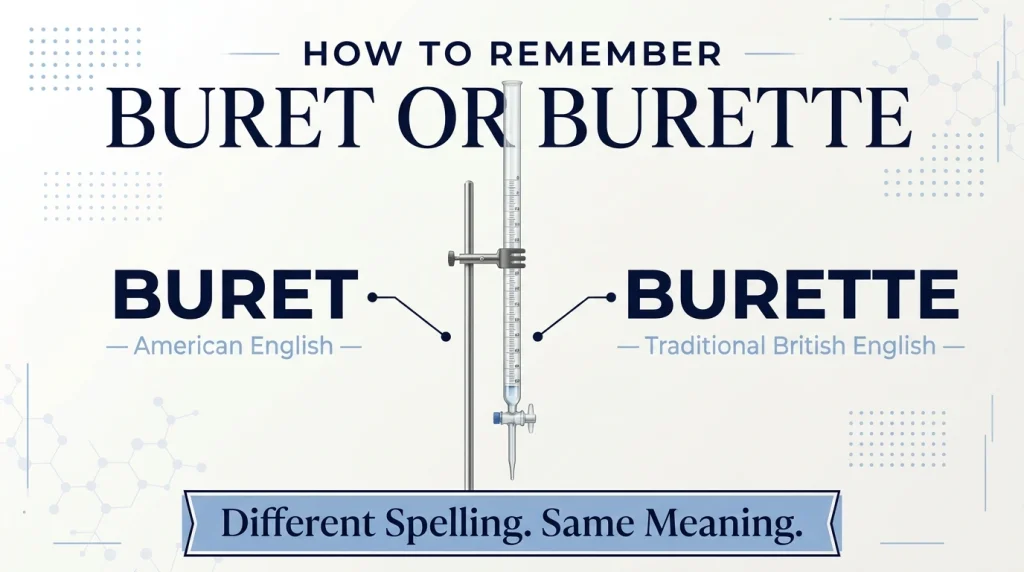
Memory Trick: How to Remember Buret or Burette
Use this simple mnemonic:
“Buret is shorter for the US; burette has an extra T and E for the traditional British spelling.”
Remember:
- Buret: Shorter American variant.
- Burette: Traditional British spelling.
- Both: Same scientific instrument.
Another way to remember it is to associate burette with the longer French-style spelling and buret with the shorter American variant.
This is a memory aid, not a strict rule governing every American or British publication.
Real-Life Situations: Buret vs. Burette
The following situations demonstrate how to select the appropriate spelling.
Situation 1: Writing a Chemistry Examination
A student is answering a chemistry examination that follows British English conventions.
Appropriate sentence: The burette is used to deliver a measured volume of solution during titration.
Situation 2: Preparing an American Laboratory Report
A university student is following an American chemistry laboratory manual.
Appropriate sentence: The buret was filled with the standard solution before the experiment began.
Situation 3: Sending a Laboratory Email
A laboratory assistant needs to remind a colleague to clean the instrument.
Appropriate sentence: Please clean the burette after completing the experiment.
Situation 4: Giving a Classroom Presentation
A student is explaining how titration works.
Appropriate sentence: A buret allows us to add a solution gradually while measuring the volume delivered.
Situation 5: Writing an Academic Research Paper
A researcher is preparing a scientific paper for an international journal.
Appropriate sentence: The solution was delivered using a calibrated burette.
The researcher should follow the journal’s spelling and terminology requirements throughout the paper.
Expert Tips for Using Buret and Burette
These practical suggestions can help improve your scientific writing.
- Choose your English variant first. Decide whether your document follows American or British English before editing.
- Check your institution’s style guide. Universities and scientific publishers may have their own terminology preferences.
- Use the correct plural. Remember that the plural of buret is burets, while the plural of burette is burettes.
- Understand the instrument. Knowing what a burette does makes it easier to use the word correctly in scientific sentences.
- Do not confuse spelling with scientific accuracy. A correctly spelled word does not guarantee that the scientific statement is correct.
- Keep technical terminology consistent. Consistency improves clarity in laboratory reports and research papers.
- Use spellcheck carefully. Check the language setting before accepting suggestions that change buret to burette or vice versa.
Read More: Organisers or Organizers: Which Spelling Is Correct?
FAQ: Buret or Burette
1. Is buret a real English word?
Yes. Buret is a recognized English spelling for a laboratory instrument used to dispense measured quantities of liquid. It is particularly associated with American English.
2. Is burette the only correct spelling?
No. Burette and buret are both correct. Burette is the traditional British spelling, while buret is a recognized American variant.
3. Do buret and burette have different meanings?
No. Both words refer to the same graduated laboratory instrument. There is no difference in their basic scientific function.
4. What is the plural of burette?
The plural of burette is burettes. For example: “The laboratory technician checked all three burettes before the experiment.”
5. What is the plural of buret?
The plural of buret is burets. For example: “The students cleaned the burets after completing their chemistry practical.”
6. Is burette accepted in American English?
Yes. American English dictionaries recognize burette as well as buret. Although buret is a common American variant, burette is not automatically incorrect in American writing.
7. How do you pronounce buret and burette?
Both spellings are generally pronounced approximately byoo-RET, with the stress on the second syllable. Regional accents can affect the exact vowel sounds.
8. Is a burette the same as a pipette?
No. Both are laboratory instruments used to handle liquid volumes, but they have different functions. A burette delivers variable measured volumes, especially during titration, while a pipette is commonly used to transfer a specified volume.
9. Why does burette have an extra -te?
Burette retains the longer spelling associated with its French origin. Buret is an established shorter English variant. The additional letters do not change the instrument’s meaning.
10. Which spelling should I use in an international scientific paper?
Follow the journal’s author guidelines. If no specific preference is given, select one recognized spelling and use it consistently throughout the manuscript.
11. Can I use burette in a chemistry laboratory report?
Yes. Burette is suitable for chemistry laboratory reports, academic assignments, and scientific explanations. It is also the conventional spelling in British English.
12. Is buret or burette more suitable for students?
Neither is universally better. Students should use the spelling adopted by their teacher, textbook, examination board, or educational institution.
Read More: Miter or Mitre: Which Spelling Is Correct?
Quick Summary: Buret or Burette
Buret and burette are two correct spellings of the same laboratory instrument. Both describe a graduated glass tube with a stopcock used to dispense accurately measured amounts of liquid, especially during chemical titrations. Buret is a recognized American English variant, while burette is the traditional British English spelling. However, both forms are also recognized in American dictionaries and scientific writing. Their pronunciation and meaning are essentially the same. The plural forms are burets and burettes. When writing a chemistry assignment, laboratory report, or research paper, choose the spelling that matches your institution’s preferred English convention and maintain consistency throughout your document.
Mini Quiz: Buret or Burette?
Test your understanding with these 10 questions.
| No. | Question | Answer and Explanation |
|---|---|---|
| 1 | Which spelling is traditionally British: (A) Buret (B) Burette? | Answer: B — Burette. It is the traditional British spelling. |
| 2 | Fill in the blank: The student filled the ______ with sodium hydroxide. | Answer: Burette or buret. Both spellings are correct. |
| 3 | Is buret an incorrect spelling? (A) Yes (B) No | Answer: B — No. It is a recognized English spelling. |
| 4 | Choose the correct plural: (A) Burette’s (B) Burettes (C) Burettees | Answer: B — Burettes. Add -s to form the plural. |
| 5 | Correct this sentence: The burette were cleaned after the experiment. | Answer: The burette was cleaned after the experiment. The singular subject requires the singular verb was. |
| 6 | What is a burette mainly used for? (A) Measuring temperature (B) Delivering measured liquid volumes (C) Measuring mass | Answer: B. It delivers controlled volumes of liquid. |
| 7 | Fill in the blank: Three ______ were used during the experiment. | Answer: Burets or burettes. Both are acceptable plural forms. |
| 8 | Do buret and burette have different scientific meanings? | Answer: No. They refer to the same instrument. |
| 9 | Correct this sentence: The laboratory bought two burette. | Answer: The laboratory bought two burettes. A plural quantity requires a plural noun. |
| 10 | Which spelling should you use in an academic report? | Answer: Follow the required English convention or institutional style guide. Consistency is essential. |
Your result: Give yourself one point for every correct answer.
Knowledge check
0/5 answered
1. Which is the traditional British spelling?
2. What is the plural of buret?
3. Do the two spellings describe different instruments?
4. What does a burette measure and deliver?
5. Which spelling should a writer use?