
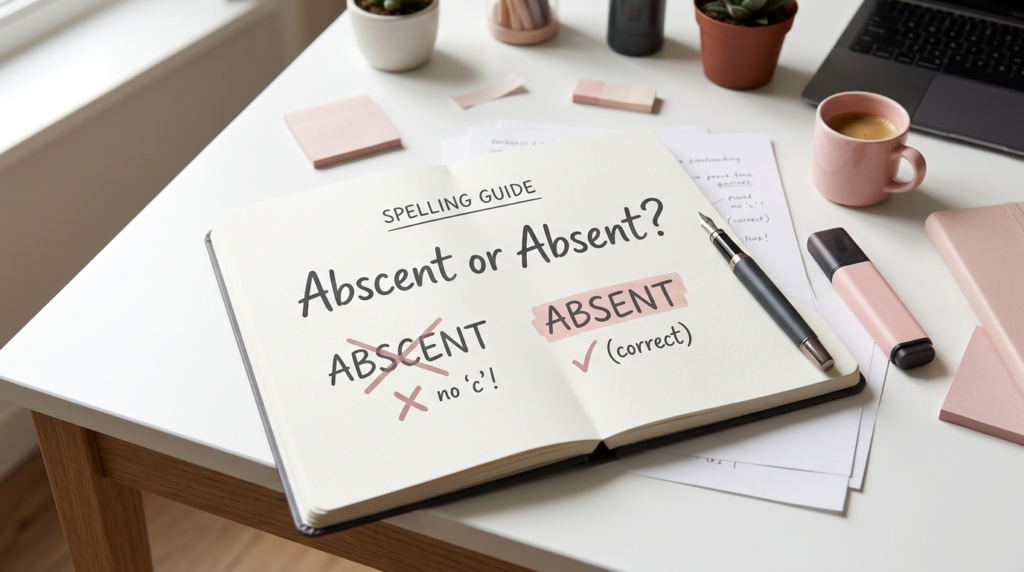

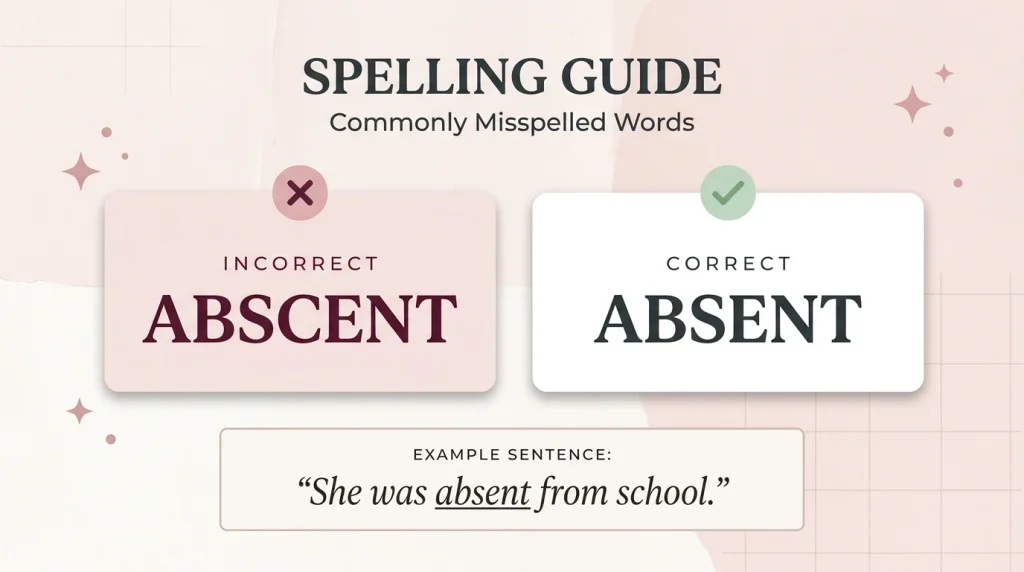
The correct spelling is absent, not abscent. The word absent means not present in a place, missing from an event, or unavailable when someone or something is expected. For example, you might say, “She was absent from school yesterday.” The spelling abscent is a common spelling mistake, not a standard alternative. If you are writing an email, completing an assignment, or documenting attendance, use absent.
What Is Absent?
Absent is an adjective that describes a person, object, quality, or thing that is not present where it is expected or needed. It can also describe someone whose attention seems to be somewhere else.
The word has several common uses:
- Not attending: “Three students were absent from class.”
- Not at a particular place: “The manager was absent from the office.”
- Missing or lacking: “The report was absent of clear evidence” is less natural than “Clear evidence was absent from the report” or “The report lacked clear evidence.”
- Not paying attention: “He gave an absent-minded nod while reading his phone.”
Absent can also function as a verb, usually in the formal expression absent oneself, meaning to deliberately stay away from a place or event. For example, “She absented herself from the meeting.” This use is correct but less common in everyday conversation.
Absent vs. Absence
These two words are related, but they do different jobs in a sentence.
- Absent is usually an adjective: “Maya was absent yesterday.”
- Absence is a noun: “Maya’s absence was unexpected.”
Remember that the correct spelling of absent does not contain a c, while absence does contain a c. The related noun’s spelling is one reason people sometimes mistakenly write abscent.
Why the Correct Spelling Matters
Spelling absent correctly helps readers understand your message without distractions. Although the intended meaning of abscent may be obvious, the misspelling can make formal or academic writing appear less carefully edited.
Correct spelling is especially important in these situations:
- School attendance: Teachers and students need accurate attendance records.
- Workplace communication: Emails about leave, absence, or meetings should be clear and professional.
- Examinations: A spelling error can affect the quality of a written answer.
- Official documents: Attendance reports and absence explanations need consistent wording.
- Everyday messages: Correct spelling makes texts and social media posts easier to read.
You do not need a complicated grammar rule to avoid this mistake. Learn the standard spelling once, then use it consistently.
The Core Rule: Absent, Not Abscent
Absent
Correct spelling
The student was absent from school.
Abscent
Incorrect spelling
The student was abscent from school.
The spelling rule is straightforward: Write absent with an s followed by an e, n, and t. Do not insert a c before the final t.
There is no standard American or British English spelling variation that makes abscent correct. Whether you are writing a casual message or a formal report, use absent.
Read More: Plack or Plaque: Which Spelling Is Correct?
How to Use Absent Correctly
1. Use Absent for Someone Who Is Not Present
This is the most common use of the word. It describes a person who is not attending a place, activity, or event.
Examples:
- Daniel was absent from class on Monday.
- Two employees were absent from the morning meeting.
- I will be absent from work next Friday.
- Several guests were absent from the ceremony.
The phrase absent from is especially common when naming the place or event someone did not attend.
2. Use Absent for Something That Is Missing
You can also use absent when a feature, quality, or object is missing.
Examples:
- The required signature was absent from the form.
- Humor was absent from the otherwise serious speech.
- The sample was absent of any visible contamination is an awkward construction; write “The sample showed no visible contamination” instead.
- The evidence was absent from the final report.
When talking about a missing quality or object, check that the sentence sounds natural. Sometimes missing, lacking, or not present is a better choice.
3. Use Absent to Describe Someone’s Attention
The adjective can describe a person who seems distracted or mentally elsewhere.
Examples:
- He wore an absent expression during the lecture.
- Her absent gaze suggested that she was thinking about something else.
- The student gave an absent nod without looking up from the book.
In these examples, absent does not necessarily mean that the person has physically left. It describes their attention or expression.
4. Use Absent as a Verb in Formal English
The verb absent usually appears in the construction absent oneself from something.
Examples:
- The director absented himself from the discussion.
- She absented herself from the proceedings.
- He has absented himself from several recent meetings.
This construction often suggests that someone chose to stay away, although context determines the exact implication. In everyday writing, “He did not attend several recent meetings” is usually simpler and more natural.
Correct Examples of Absent in Everyday English
The following original examples show how to use absent in different situations.
| Context | Correct example |
|---|---|
| School | Olivia was absent from mathematics class yesterday. |
| College | Three students were absent during the final presentation. |
| Workplace | The supervisor will be absent from the office this afternoon. |
| I will be absent from work on Thursday because of a personal appointment. | |
| Meeting | Several committee members were absent from the discussion. |
| Social media | I’ve been absent from this page lately, but I’m back now. |
| Conversation | “Why weren’t you at dinner?” “I was absent because I had another commitment.” |
| Academic writing | The study’s initial report was absent from the published appendix. |
| Official record | The attendance register shows that two participants were absent. |
| Everyday description | A sense of urgency was absent from the team’s response. |
| Family situation | Her father was absent from the family gathering. |
| Literature | The character’s absent gaze hinted at a troubled mind. |
Usage note: Some sentences are grammatically correct but can be improved for naturalness. For example, “I couldn’t attend dinner because I had another commitment” is more conversational than “I was absent because I had another commitment.”
Incorrect vs. Correct: Abscent or Absent?
Each incorrect example below uses abscent where the standard spelling absent is required.
| Incorrect | Correct | Why |
|---|---|---|
| She was abscent from school. | She was absent from school. | The correct adjective is absent. |
| I was abscent yesterday. | I was absent yesterday. | The word has no c before the final t. |
| He is abscent from work today. | He is absent from work today. | The standard spelling remains the same in present-tense sentences. |
| Two students were marked abscent. | Two students were marked absent. | Attendance records should use the correct spelling. |
| The manager will be abscent tomorrow. | The manager will be absent tomorrow. | Future-tense constructions still use absent. |
| Her name was abscent from the list. | Her name was absent from the list. | The adjective describes something missing. |
| Several members were abscent at the meeting. | Several members were absent from the meeting. | Absent from the meeting is the clearer construction. |
| The required information was abscent. | The required information was absent. | The spelling does not change when describing missing information. |
| He remained abscent for a week. | He remained absent for a week. | The word after remained is still an adjective. |
| I will be abscent from class next Monday. | I will be absent from class next Monday. | A future date does not affect the spelling. |
| The teacher recorded her as abscent. | The teacher recorded her as absent. | The correct spelling is needed in reports. |
| His abscent behavior concerned his friends. | His absent behavior concerned his friends. | Absent is correctly spelled, though distracted behavior may be more natural in this context. |
What These Corrections Teach You
Most errors are caused by inserting an unnecessary c. Other errors involve sentence construction rather than spelling.
When editing your writing, check two things:
- Is the word spelled absent?
- Does the sentence use it naturally, with the right preposition or grammatical structure?
For example, “She was absent from class” is standard. “She was absent to class” is not the usual construction. Fixing the spelling alone does not automatically fix every grammar mistake.
Why People Make the Abscent Mistake
1. The Word’s Pronunciation Can Be Misleading
The word absent is commonly pronounced approximately AB-suhnt. Its ending does not provide a clear reason to insert a c, but writers who spell quickly may add one because the letter sequence looks familiar.
English spelling cannot always be predicted from pronunciation, so it helps to memorize common words in their written form.
2. English Has Many Similar-Looking Words
Words such as abscess, absorbent, and absence contain letter patterns that can influence how someone spells absent. The brain sometimes carries a spelling pattern from one word into another even when the pattern does not belong there.
The solution is to remember the exact spelling rather than reconstruct it from related words.
3. People Overgeneralize Spelling Patterns
Overgeneralization happens when someone applies a familiar rule or pattern where it does not belong. A writer might assume that a c should appear before the final t because other words contain similar letter combinations.
However, absent is a complete word with its own established spelling. There is no rule requiring a c in it.
4. Autocorrect Does Not Replace Careful Editing
Spellcheckers can catch many misspellings, but their suggestions depend on the software, dictionary, and context. A typing tool may not explain why a word is wrong or whether the suggested replacement fits the sentence.
If you are unsure, check the word itself rather than relying only on a red underline or an automatic correction.
5. Translation Can Influence Spelling
English learners sometimes transfer spelling habits from another language into English. A familiar-looking letter pattern may seem logical even when it does not match standard English spelling.
This is a common learning challenge, not a sign of poor ability. Repeated exposure to correct examples and short spelling exercises can help build confidence.
Common Mistakes Checklist
Use this checklist when reviewing a sentence containing absent.
- Adding a c: Write absent, not abscent. Read the word letter by letter if necessary.
- Confusing absent with absence: Use absent to describe a state and absence to name the state or condition.
- Using the wrong preposition: In ordinary attendance contexts, write “absent from school” or “absent from work.”
- Using absent when a simpler word is better: In casual conversation, away, missing, or not attending may sound more natural.
- Assuming absent always means physically away: A person can have an absent expression while physically present.
- Trusting autocorrect without checking: Read the whole sentence to ensure the correction makes sense.
- Confusing spelling with grammar: A sentence can spell absent correctly but still use the word awkwardly.
The best proofreading habit is to check spelling, meaning, and sentence structure separately. Each check catches a different type of error.
Absent in Real English
Grammatically Correct and Natural
“Lena was absent from the staff meeting” is both grammatically correct and natural English. It communicates that Lena did not attend. The same structure works for school, work, appointments, and other events. In everyday conversation, people may instead say “Lena wasn’t at the meeting.” Both expressions are natural, but absent from is especially useful in attendance records and formal explanations.
Grammatically Possible but Unnatural
“The necessary details were absent of the report” is not the usual standard construction for this meaning. A more natural version is “The necessary details were absent from the report.” You could also write “The report lacked the necessary details.” The lesson is that correct spelling alone is not enough; prepositions and word combinations matter too. When something is missing, absent from and lacking are often useful choices.
Natural Everyday English
“I’ve been absent from social media lately” is correct, but it may sound more formal than necessary in a casual conversation. “I haven’t posted much lately” or “I’ve been away from social media” may better express the intended meaning. Choose absent when you want to emphasize nonattendance or a lack of presence; choose a simpler expression when you want a relaxed, conversational tone.
American vs. British English
There is no spelling difference between American and British English for this word.
| English variety | Correct spelling | Example |
|---|---|---|
| American English | Absent | He was absent from school. |
| British English | Absent | He was absent from school. |
| International English | Absent | She was absent from the meeting. |
Both American and British writers use absent and absence. Neither variety recognizes abscent as a standard alternative.
The same rule applies to academic writing, business correspondence, schoolwork, and casual messages. You do not need to change the spelling when switching between American and British English.
Formal vs. Informal Usage
The word absent works in both formal and informal contexts, but the most natural sentence may depend on the situation.
| Context | Natural wording |
|---|---|
| Formal email | I will be absent from the office on Friday. |
| School attendance | The student was absent for two days. |
| Workplace report | Four employees were absent from the scheduled meeting. |
| Casual conversation | I wasn’t at work yesterday. |
| Text message | Sorry, I’ve been away for a few days. |
| Academic writing | Several observations were absent from the final analysis. |
In formal writing, absent is a useful, concise choice. In informal speech, expressions such as wasn’t there, couldn’t make it, and was away may sound more natural.
The important distinction is not formality alone. Choose the wording that accurately describes whether someone did not attend, was unavailable, or simply was not paying attention.
Comparison Table: Absent and Similar Words
| Word | Part of speech | Meaning | Example |
|---|---|---|---|
| Absent | Adjective | Not present | She was absent from class. |
| Abscent | Nonstandard misspelling | Incorrect spelling of absent | Do not write abscent. |
| Absence | Noun | The state of not being present | His absence was unexpected. |
| Present | Adjective | In attendance or in a place | All team members were present. |
| Missing | Adjective | Not found or not available | One document was missing. |
| Away | Adjective/adverb | Not here or at a usual place | The manager is away today. |
| Absent-minded | Adjective | Forgetful or distracted | He seemed absent-minded during lunch. |
| Absentee | Noun | A person who is absent | The teacher contacted the absentee. |
These words are related in meaning, but they are not interchangeable in every sentence. Absent describes a state, absence names that state, and absentee refers to a person who is absent.
Memory Trick: Remember Absent Without the C
Use this simple mnemonic:
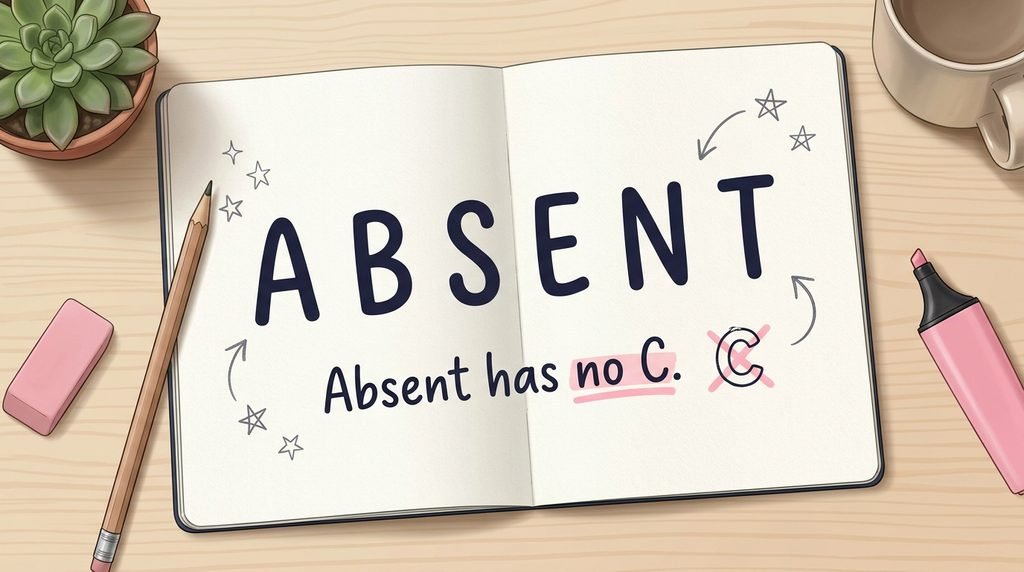
“Absent has no C; someone missing is not seen.”
Picture the word spelled out as:
A – B – S – E – N – T
There is no c anywhere in the word.
Another helpful trick is to contrast absent with absence:
- Absent: no c.
- Absence: contains c.
If you need to write the adjective meaning “not present,” use absent. If you need the noun meaning “the state of not being present,” use absence.
Practicing this contrast is more reliable than trying to guess the spelling from sound.
Read More: Steem or Steam: Meaning, Spelling, and Correct Usage.
Absent in Real-Life Situations
Situation 1: Explaining an Absence at School
A student missed class because of an appointment.
Correct: “I was absent from school yesterday because I had an appointment.”
Why it works: Absent from school is the standard construction for nonattendance.
Situation 2: Writing a Workplace Email
An employee needs to inform a supervisor about a planned day off.
Correct: “I will be absent from the office on Wednesday and will respond to outstanding messages when I return.”
Why it works: The wording is clear and suitable for a professional email.
Situation 3: Speaking in a Meeting
A colleague asks why a team member did not attend a meeting.
Correct: “Priya was absent from the meeting this morning.”
Why it works: The sentence identifies who did not attend and which event they missed.
Situation 4: Sending a Text Message
A friend notices that someone has not posted recently.
Correct: “I’ve been absent from social media for a while.”
More casual: “I haven’t been active on social media lately.”
Why it works: Both sentences are correct, but the second may sound more conversational.
Situation 5: Writing an Exam Answer
A student describes a missing element in a report.
Correct: “The final report was absent of the required evidence” should be revised to “The required evidence was absent from the final report.”
Why it works: The revised sentence uses the more natural absent from construction.
Quick Summary
The correct spelling is absent, not abscent. Absent usually describes a person or thing that is not present, attending, or available. It can also describe someone who appears distracted. Use phrases such as “absent from school,” “absent from work,” and “absent from the meeting.” The related noun is absence, as in “Her absence was unexpected.” American and British English use the same spelling, so there is no regional variation to memorize. To avoid mistakes, remember that absent contains no c, check your prepositions, and proofread your sentence for natural usage. When writing informally, expressions such as wasn’t there or was away may be more conversational.
Read More: Gleen or Glean: Which Spelling Is Correct?
Frequently Asked Questions
Is abscent a real English word?
Abscent is not a standard English spelling of the word meaning “not present.” In that context, use absent. If you encounter abscent in a message or document, it is almost certainly a misspelling of absent.
How do you spell absent correctly?
Spell it A-B-S-E-N-T. There is no c in the word. Remembering the six letters in order can help you avoid adding an unnecessary letter when writing quickly.
What does absent mean in simple English?
Absent means not being somewhere you are expected to be. For example, if you do not attend school on Monday, you are absent from school that day. It can also describe something missing or a person who seems distracted.
Is absent or absence the correct word?
Both are correct words, but they have different grammatical roles. Absent is usually an adjective, as in “He was absent from work.” Absence is a noun, as in “His absence was noticed.”
Is abscent correct in British English?
No. Standard British English uses absent, just like American English. The spelling abscent is not a recognized British alternative.
What is the opposite of absent?
The most direct opposite is present. For example, “The student was absent on Monday” contrasts with “The student was present on Monday.” Depending on the context, available or here may also express the opposite idea.
Can absent be used to describe something other than a person?
Yes. You can describe a missing object, feature, quality, or piece of information as absent. For example, “The signature was absent from the document.” You can also describe a distracted expression as absent.
Is it correct to say absent from school?
Yes. “Absent from school” is a standard and natural expression. You can use the same construction for work, class, a meeting, a ceremony, or another event someone did not attend.
Why do people write abscent instead of absent?
People may add the c because they are spelling quickly, misremembering the word, or influenced by other familiar spelling patterns. Since the mistake is visual rather than a separate standard word, learning the correct letter sequence is the simplest fix.
How can I remember the difference between absent and absence?
Remember that absent has no c, while absence does. Use absent to describe someone or something not being present, and absence to name the state of being away or missing.
Mini Quiz: Abscent or Absent?
Test your understanding with these 10 questions. Choose the correct spelling or sentence, then check the answer and explanation.
Spelling and usage practice
0 of 10 answered
1. Which spelling is correct?AbscentAbsentAbbsent
2. Complete the sentence: Maria was ___ from class.abscentabsentabsense
3. Which sentence is correct?He was abscent yesterday.He was absent yesterday.He was absance yesterday.
4. Choose the correct noun: His ___ surprised the team.absentabscentabsence
5. Fill in the blank: She was absent ___ the meeting.fromtoat
6. Which spelling is correct in American English?AbscentAbsentBoth
7. Correct this sentence: ‘The teacher marked him abscent.’The teacher marked him absence.The teacher marked him absent.The teacher marked him absense.
8. Which sentence uses absent naturally?The required signature was absent from the form.The required signature was absent to the form.The required signature was abscent the form.
9. Which word means a person who is not present?AbsenteeAbsencePresent
10. Correct the sentence: ‘I will be abscent from work tomorrow.’I will be absence from work tomorrow.I will be absent from work tomorrow.I will be abscent from work tomorrow.



Pingback: Cheesy or Cheesey: Which Spelling Is Correct?
Pingback: Cheak or Cheek? The Correct Spelling Explained.