
The correct spelling is majestic, not magestic. Majestic is an adjective that means grand, impressive, beautiful, or worthy of admiration. It is commonly used to describe mountains, palaces, buildings, landscapes, and people who appear dignified or noble. The mistake happens because the soft sound of the letter j can be easy to overlook when spelling the word. Remember that the correct form is M-A-J-E-S-T-I-C.
What Is the Difference Between Majestic and Magestic?
Majestic is the only standard spelling of this word in modern English. Magestic is a misspelling and should not be used in formal writing, school assignments, professional emails, or published content.
The word majestic describes something that inspires admiration because of its beauty, size, dignity, or impressive appearance. For example, a towering mountain range can be majestic, as can a historic palace or a magnificent waterfall.
Here is the essential distinction:
- Majestic: Correct spelling; means grand, impressive, or dignified.
- Magestic: Incorrect spelling; a common spelling mistake, not a standard English word.
Why the Correct Spelling Matters
Spelling mistakes can affect how clearly and professionally your writing communicates. Although readers will often understand magestic from context, the error can distract them from your message.
Using the correct spelling matters in several situations:
- School assignments: Correct spelling helps demonstrate attention to detail.
- Professional writing: Accurate language makes reports, presentations, and emails look polished.
- Creative writing: The right word helps you describe a scene or character effectively.
- SEO content: Correct spelling supports clear, trustworthy content and helps readers find the information they need.
- Exams and language learning: Remembering the standard form helps prevent avoidable errors.
The goal is not simply to avoid a spelling mistake. It is to express your meaning confidently and accurately.
The Core Rule: Always Spell It Majestic
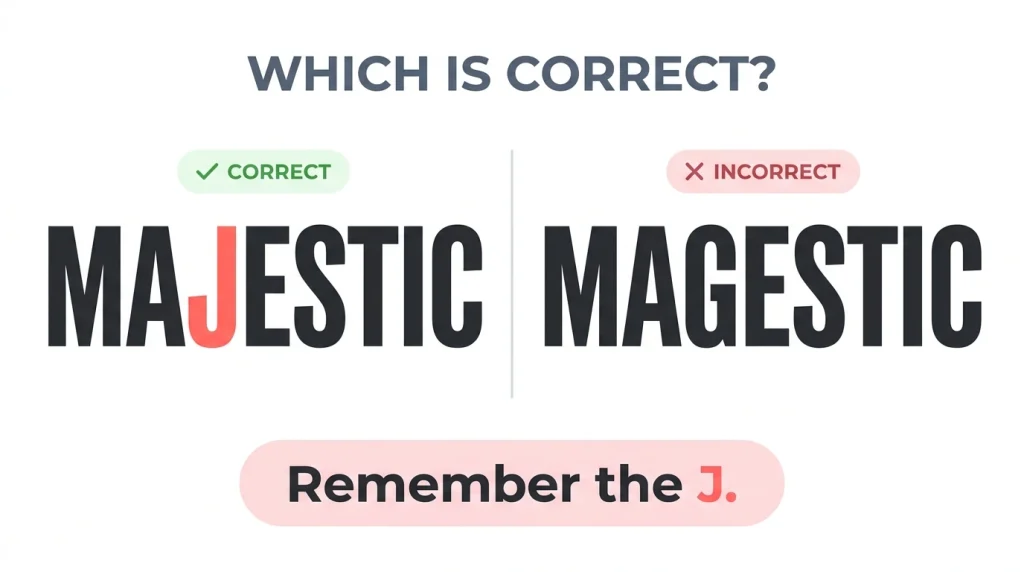
The spelling rule is straightforward: write majestic, with the letter j after the first two letters, followed by e-s-t-i-c.
CORRECT
MAJESTIC
M – A – J – E – S – T – I – C
INCORRECT
MAGESTIC
Do not replace the J with G.
There is no standard American or British English spelling difference here. Both varieties use majestic.
How to Use Majestic Correctly
Use majestic when you want to describe something that looks grand, impressive, dignified, or magnificent. It often conveys a sense of awe or admiration rather than merely saying that something is attractive.
1. Describe impressive natural scenery
The word works particularly well for natural features that appear powerful, beautiful, or enormous.
- The majestic mountains were covered in snow.
- We watched a majestic waterfall cascade into the valley.
- A majestic eagle soared above the forest.
- The sunset made the coastline look majestic.
2. Describe buildings and architecture
Use majestic for buildings that appear grand because of their size, design, history, or elegance.
- The majestic palace stood at the center of the city.
- Visitors admired the majestic architecture of the old cathedral.
- A majestic stone staircase led to the entrance.
3. Describe people and their movements
When applied to a person, majestic can suggest dignity, grace, authority, or a commanding presence.
- The queen entered the hall with a majestic air.
- The dancer moved across the stage with majestic grace.
- His calm, dignified manner gave him a majestic presence.
This usage is expressive rather than a literal statement about someone’s physical appearance.
4. Use majestic in descriptive and creative writing
Writers often choose majestic to create a vivid impression without listing every physical detail.
For example:
- The majestic forest stretched beyond the horizon.
- Under the moonlight, the ancient castle looked majestic.
- A majestic silence settled over the valley.
These sentences use the word to create a feeling of grandeur, beauty, or awe.
5. Use majestic in professional and academic writing
The word is suitable for descriptive reports, travel articles, essays, reviews, and presentations when the subject genuinely merits the description.
For example:
- The region is known for its majestic mountain landscapes.
- The report describes the majestic scale of the historic monument.
- The documentary captures the majestic movement of migrating whales.
In academic writing, use the word when it fits your purpose. If your goal is objective analysis, a more precise description of the subject’s size, structure, or visual features may be preferable.
Correct Examples of Majestic in Sentences
Here are 12 original examples showing how to use majestic in different situations.
| Context | Correct example |
|---|---|
| Everyday conversation | That mountain looks majestic from here. |
| Travel | We photographed the majestic cliffs along the coast. |
| The team selected the majestic hall for the annual ceremony. | |
| School assignment | The majestic lion walked slowly through the grassland. |
| Workplace presentation | This slide highlights the majestic scale of the new building. |
| Social media caption | A majestic view worth waking up early for. |
| Creative writing | The majestic river wound through the silent valley. |
| Academic description | The study examines the design of a majestic historic complex. |
| Nature documentary | A majestic whale surfaced beside the boat. |
| Product or interior description | Tall windows give the room a majestic appearance. |
| Formal speech | We gathered beneath the majestic dome to celebrate the occasion. |
| Personal message | You should see the majestic scenery on this hiking trail. |
Notice that majestic is an adjective. It describes a noun, such as mountain, view, hall, or scenery. It can also follow a linking verb such as is, looks, or seems: “The palace looks majestic.”
Incorrect vs. Correct: 10 Common Spelling and Usage Mistakes
The most important error is writing magestic instead of majestic. The following examples also cover related grammatical mistakes that learners may make when using the word.
| Incorrect | Correct | Why |
|---|---|---|
| The view was magestic. | The view was majestic. | The standard spelling contains j, not g. |
| We saw a magestic castle. | We saw a majestic castle. | The adjective must be spelled correctly even before a noun. |
| The mountains looked magestic. | The mountains looked majestic. | The spelling remains the same after a linking verb. |
| It was a majesty mountain. | It was a majestic mountain. | Majesty is a noun; majestic is the adjective needed here. |
| The building was majestically. | The building was majestic. | An adjective describes the building; an adverb describes an action or manner. |
| They admired the majesticly decorated hall. | They admired the majestically decorated hall. | The adverb is spelled majestically, with an additional a after the c. |
| The majestic of the palace amazed us. | The majesty of the palace amazed us. | The noun majesty is needed after the. |
| She walked in a majestic mannerly. | She walked in a majestic manner. | Manner is the appropriate noun in this phrase. |
| The scenery was more majestic than beautifulest. | The scenery was more majestic than the other view. | Beautifulest is not the normal standard comparative form; the sentence also needs a meaningful comparison. |
| The majestic building were impressive. | The majestic building was impressive. | A singular subject takes was, not were. |
The first three mistakes are direct spelling errors. The remaining examples illustrate the difference between spelling, word forms, and sentence grammar.
Why People Spell Majestic Incorrectly
There are several reasons someone might type magestic instead of majestic.
1. The spelling is not obvious from the sound
In ordinary speech, the sound of the middle consonant may not be enough to remind a learner whether the word contains a j or a g. English spelling does not always allow people to reconstruct a word reliably from pronunciation alone.
The solution is to remember the written form as a complete unit: majestic.
2. English spelling patterns can be confusing
The letters g and j can both be associated with similar sounds in English. For example, the g in giant sounds similar to the j in jungle. That similarity can contribute to uncertainty when spelling unfamiliar words.
However, the correct spelling of majestic is established by convention. It is not a word in which you can freely substitute one letter for the other.
3. The word may be unfamiliar
Someone who has heard majestic but rarely written it may remember its meaning more easily than its spelling. This is particularly common among people learning English as an additional language.
Reading the word in context and writing it in original sentences can strengthen recall.
4. Autocorrect may not catch every error
Spellcheckers and predictive keyboards are useful, but they are not perfect. Some tools may miss an error, particularly if a misspelling resembles a name or an unusual term. Others may flag it without explaining the correct form.
When in doubt, check the exact word rather than relying entirely on an automated suggestion.
5. Translation can interfere with spelling
A learner may know a translation of majestic in another language but have less experience writing the English form. That does not mean translation itself causes the error; it simply means the English spelling may need separate practice.
A practical approach is to learn the word’s spelling, meaning, and example sentence together.
Common Mistakes Checklist
Before publishing or submitting a sentence containing majestic, check the following points.
- Check the J: Confirm that the word begins maj-, not mag-.
- Choose the right word form: Use majestic to describe something and majesty to name the quality.
- Use the adverb correctly: Write majestically when describing how an action is performed.
- Check the sentence structure: Use majestic after linking verbs such as looks, seems, and is when describing a subject.
- Avoid unnecessary repetition: If you have already described a scene as majestic, consider whether grand, impressive, or a more precise description would communicate something new.
- Proofread the final text: Review the spelling even if autocorrect has not highlighted a problem.
Majestic in Real English
Grammatically correct
“The palace looks majestic” is grammatically correct and natural English. The adjective majestic describes the palace’s appearance, and looks connects the subject to that description. Similarly, “a majestic mountain,” “majestic scenery,” and “the building’s majestic entrance” are all correct constructions. These forms work in both everyday descriptions and more formal writing.
Grammatically possible but unnatural
A sentence can contain the correctly spelled word majestic and still sound awkward. For example, “The small paperclip was majestic in its ordinary appearance” is possible as an intentionally humorous or unusual description, but it would be an odd choice in a straightforward factual report. The problem is not grammar or spelling; it is the mismatch between the word’s grand associations and the subject being described.
Natural, everyday English
People commonly use majestic for striking landscapes, impressive architecture, grand ceremonies, and animals with a powerful or graceful appearance. “The mountains looked majestic at sunrise” is a natural example. The word is more expressive than a neutral adjective such as large. It suggests that the subject inspires admiration or awe, so it is most effective when that emotional impression is intended.
American vs. British English: Is There a Difference?
There is no spelling difference between American and British English for majestic. Both use the same eight-letter spelling.
| Feature | American English | British English |
|---|---|---|
| Correct spelling | Majestic | Majestic |
| Incorrect spelling | Magestic | Magestic |
| Part of speech | Adjective | Adjective |
| Core meaning | Grand, impressive, dignified | Grand, impressive, dignified |
| Adverb | Majestically | Majestically |
| Noun | Majesty | Majesty |
The choice between majestic and magestic is therefore not a regional spelling preference. Majestic is correct in both varieties.
Formal vs. Informal Usage
Majestic is suitable for both formal and informal contexts, although the effect depends on what you are describing.
- Formal: “The report documents the majestic proportions of the historic building.”
- Informal: “That waterfall is absolutely majestic!”
- Creative: “The majestic trees stood like silent guardians around the lake.”
- Professional: “The venue’s majestic interior provides an impressive setting for the ceremony.”
In casual conversation, the word can sound enthusiastic or poetic. In technical or analytical writing, use it when you intend to express an evaluative impression rather than an objective measurement.
Majestic vs. Similar Words: Comparison Table
Several English words share part of the meaning of majestic, but they are not always interchangeable.
| Word | Part of speech | Meaning | Example |
|---|---|---|---|
| Majestic | Adjective | Grand, dignified, inspiring awe | The majestic palace dominated the square. |
| Majesty | Noun | Grandeur, dignity, or royal status | The majesty of the mountains impressed us. |
| Majestically | Adverb | In a grand, dignified, or impressive manner | The swan moved majestically across the lake. |
| Magnificent | Adjective | Exceptionally beautiful, impressive, or excellent | The garden looked magnificent in spring. |
| Grand | Adjective | Large, impressive, or important | They entered through a grand doorway. |
| Regal | Adjective | Royal in appearance or manner | The horse had a regal bearing. |
| Imposing | Adjective | Impressive, often because of size or presence | An imposing tower overlooked the town. |
| Awe-inspiring | Adjective | Creating a strong feeling of wonder or admiration | The canyon was awe-inspiring. |
The best alternative depends on the emphasis you want. Use regal for a royal quality, imposing for a commanding presence, and magnificent for exceptional beauty or excellence. Choose majestic when grandeur and dignity are central to the impression.
Memory Trick: How to Remember Majestic
Use this simple mnemonic:
“A majestic mountain deserves a J in its journey to greatness.”
The unusual image of a mountain with a giant letter J on its peak can help you associate the correct spelling with the word.
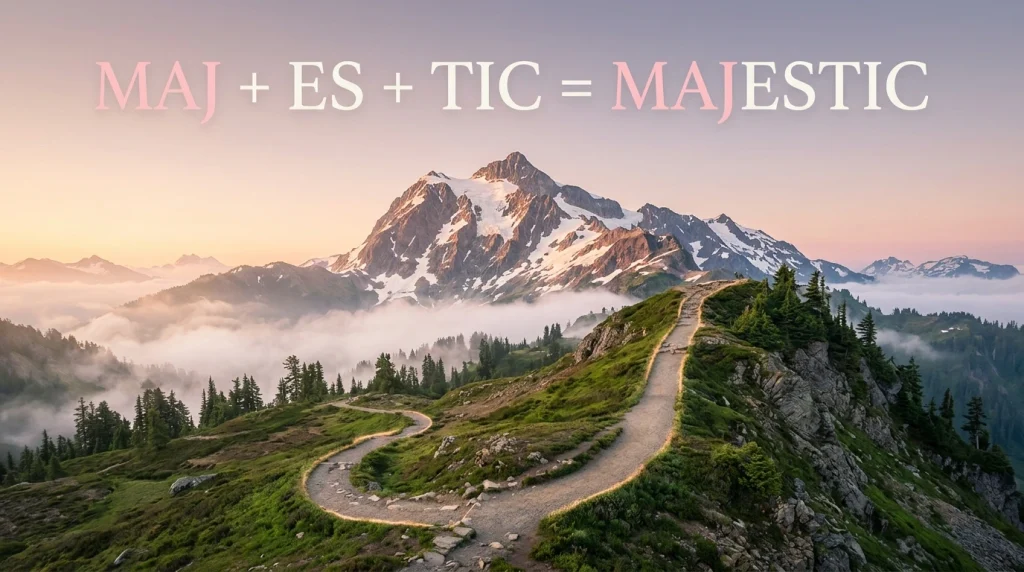
You can also memorize the word in three chunks:
- MAJ
- ES
- TIC
Put them together: MAJ + ES + TIC = MAJESTIC.
When you type the word, pause briefly after maj and check that you have used J, not G. Repeating the correct spelling a few times is more useful than repeatedly memorizing the incorrect version.
Majestic in Real-Life Situations
In a job interview
Situation: You are asked to describe a memorable place you have visited.
Good response: “I visited a mountain village last year, and the majestic scenery made the trip unforgettable.”
Why it works: The adjective communicates the impressive beauty of the landscape without requiring a long description.
In a workplace meeting
Situation: Your team is discussing a venue for an important event.
Good response: “The hotel has a majestic ballroom that would suit the awards ceremony.”
Why it works: The word conveys grandeur and helps explain why the venue might be appropriate.
In an email
Situation: You are thanking a colleague for organizing a trip.
Good response: “Thank you for arranging the visit. The majestic views from the summit were unforgettable.”
Why it works: The spelling is correct, and the adjective adds a specific, positive description.
In a text message
Situation: A friend asks how your hiking trip went.
Good response: “Amazing! The mountains looked majestic at sunset.”
Why it works: Majestic sounds natural in a casual message when the scenery genuinely inspires admiration.
In an exam
Situation: You need to complete the sentence: “The _____ castle stood above the valley.”
Correct answer: Majestic.
Why it works: The adjective describes the castle’s impressive appearance. Remember that magestic is not the correct spelling.
Expert Tips for Using Majestic Correctly
- Learn the word family together. Remember majestic (adjective), majestically (adverb), and majesty (noun). This helps you select the correct form when writing.
- Focus on meaning as well as spelling. Majestic suggests grandeur, dignity, or awe. It is not simply another word for big.
- Read your sentence aloud. This can help you notice awkward word choices, even though it cannot reliably reveal the spelling error.
- Use a visual association. Picture a majestic mountain with a large letter J at its summit.
- Proofread words that look familiar. Familiar-looking errors are easy to overlook, particularly when typing quickly.
- Prefer specific descriptions when appropriate. Instead of describing every beautiful object as majestic, explain what makes it impressive.
FAQ: Majestic or Magestic
Is magestic ever correct?
No. Magestic is not the standard English spelling of the adjective. Use majestic in formal writing, everyday communication, and published content.
Why is majestic spelled with a J instead of a G?
The standard spelling is established by English spelling conventions. Although G and J can represent similar sounds in some words, that does not make them interchangeable in majestic. The correct form must be learned as M-A-J-E-S-T-I-C.
What does majestic mean in simple words?
Majestic means grand, impressive, dignified, or beautiful in a way that inspires admiration. For example, a huge mountain range or an elegant historic palace can be described as majestic.
Is majestic an adjective or a noun?
Majestic is an adjective because it describes a person, place, animal, object, or experience. The related noun is majesty, which refers to grandeur, dignity, or royal status.
What is the adverb form of majestic?
The adverb is majestically. For example: “The eagle soared majestically above the valley.” It describes how the eagle soared.
Can I use majestic to describe a person?
Yes. You can describe a person as majestic when they have a dignified, noble, graceful, or commanding presence. The word is often used for people whose manner or appearance inspires admiration.
Is majestic a synonym for magnificent?
They have overlapping meanings, but their emphasis differs. Majestic often suggests grandeur, dignity, or awe, while magnificent can describe something exceptionally beautiful, impressive, or excellent.
Is majestic a positive word?
Generally, yes. It expresses admiration or appreciation, especially for beauty, grandeur, dignity, or impressive scale. The exact effect depends on the context and the writer’s intention.
How do you pronounce majestic?
In common English pronunciation, it is approximately muh-JES-tik, with the main stress on the second syllable. Pronunciation can vary slightly by accent, but the spelling remains the same.
Does majestic have the same spelling in the US and UK?
Yes. Both American and British English use majestic. There is no standard regional variation that makes magestic correct.
What is the easiest way to remember the spelling?
Remember the sequence MAJ-ES-TIC and associate the J with a majestic mountain. Before submitting your writing, check that you have written majestic, not magestic.
Can majestic describe an ordinary object?
Yes, if the description is intentional. A person might call a beautifully designed room or an unusually impressive sculpture majestic. Using the word for an ordinary object can sound exaggerated or humorous, so consider the context.
Quiz: Test Your Understanding of Majestic
Try these ten questions before checking the answers and explanations.
| No. | Question | Answer and explanation |
|---|---|---|
| 1 | Choose the correct spelling: (A) Magestic (B) Majestic | B — Majestic. The standard spelling contains J. |
| 2 | Fill in the blank: The _____ mountains attracted thousands of visitors. | Majestic. It describes the mountains’ impressive appearance. |
| 3 | Correct the sentence: “We saw a magestic waterfall.” | We saw a majestic waterfall. Replace G with J. |
| 4 | Which is the noun: majestic or majesty? | Majesty. It names the quality of grandeur or dignity. |
| 5 | Fill in the blank: The swan moved _____ across the lake. | Majestically. An adverb describes how the swan moved. |
| 6 | True or false: British English spells the word magestic. | False. Both British and American English use majestic. |
| 7 | Which word best emphasizes a royal appearance: majestic or regal? | Regal. It specifically suggests royal qualities, although majestic may also fit. |
| 8 | Correct the sentence: “The palace look majestic.” | The palace looks majestic. A singular subject takes looks. |
| 9 | Choose the most natural sentence: (A) The majestic mountain stood above the village. (B) The mountain majestically was a mountain. | A. It uses the adjective naturally before the noun. |
| 10 | Complete the spelling: M-A-J-___-T-I-C | E-S. The complete word is M-A-J-E-S-T-I-C. |
Quick Summary
Majestic is the correct spelling; magestic is a misspelling. The word is an adjective that describes something grand, dignified, impressive, or awe-inspiring. It commonly appears in descriptions of mountains, waterfalls, historic buildings, animals, and people with a noble presence. Remember the spelling as MAJ-ES-TIC, with a J rather than a G. The related noun is majesty, and the adverb is majestically. American and British English use the same spelling. Whether you are writing a school assignment, professional email, travel article, or social media caption, choose majestic when you want to convey grandeur or admiration. Proofread the word before publishing to avoid a simple but noticeable spelling error.