


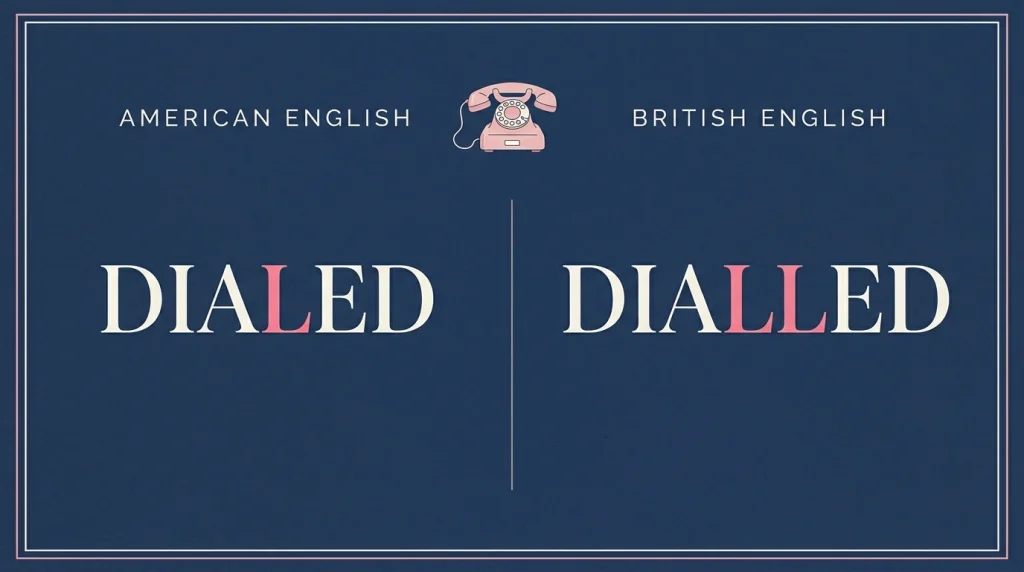
Both dialled and dialed are correct spellings of the past tense and past participle of dial. The difference is regional: dialed is the standard spelling in American English, while dialled is the standard spelling in British English. Both forms mean to enter a phone number, operate a dial, or adjust something precisely. Choose the spelling that matches your intended English variety, and use it consistently throughout your writing.
What Is the Difference Between Dialled and Dialed?
The difference between dialled and dialed is a spelling convention, not a difference in meaning or pronunciation.
- Dialed: Preferred in American English.
- Dialled: Preferred in British English and commonly used in other varieties that follow British spelling conventions.
- Meaning: Both forms are past tense and past participle forms of the verb dial.
For example:
- American English: She dialed the number and waited for an answer.
- British English: She dialled the number and waited for an answer.
Both sentences are grammatically correct. Neither spelling is inherently better than the other; the appropriate choice depends on your audience and the style of English you are following.
Why the Spelling Matters
Choosing between dialled and dialed is a small decision, but consistent spelling helps your writing look polished and professional.
The difference matters in several situations:
- School and exams: Follow the spelling conventions expected by your teacher, examination board, or course.
- Business emails: Use the spelling preferred by your organisation or target audience.
- Academic writing: Follow the required style guide and maintain consistency.
- Web content: Consider your main readership. American readers generally expect dialed, while British readers generally expect dialled.
- International communication: Either form can be understood, but consistent usage makes your writing feel more coherent.
Using dialled in an American-focused article does not automatically make the word incorrect. However, it may look inconsistent if the rest of the article follows American spelling conventions.
The Core Rule: When to Use Dialled or Dialed
The simplest rule is to match the spelling to your English variety.
American English: Dialed
Use one l before the -ed ending.
Example: He dialed the customer service number.
British English: Dialled
Use two ls before the -ed ending.
Example: He dialled the customer service number.
Both spellings are correct. The difference is regional, not grammatical.
English meaning – Cambridge Dictionary
How to Use Dialled and Dialed
1. Use Dialed for Past Actions in American English
Use dialed when describing an action that happened in the past, particularly in American English.
Examples:
- I dialed the wrong number by mistake.
- She dialed her doctor’s office yesterday.
- The technician dialed the correct extension.
- He dialed 911 when he noticed the accident.
The word describes a completed action. It follows the regular past-tense pattern of adding -ed to a verb, with the American spelling convention retaining a single l.
2. Use Dialled for Past Actions in British English
Use dialled for the same meaning when writing in British English.
Examples:
- I dialled the wrong number by mistake.
- She dialled her doctor’s surgery yesterday.
- The technician dialled the correct extension.
- He dialled 999 when he noticed the accident.
The spelling changes, but the meaning and grammatical function remain the same.
3. Use Dialed or Dialled as a Past Participle
A past participle is a verb form used with helping verbs such as have, has and had, or in some passive constructions.
American English:
- I have dialed the number already.
- She had dialed before I arrived.
- The number was dialed incorrectly.
British English:
- I have dialled the number already.
- She had dialled before I arrived.
- The number was dialled incorrectly.
In each case, choose the spelling that matches the rest of your writing.
4. Use the Same Rule When Talking About Controls
The verb dial can also mean to adjust a control, such as a temperature setting, volume level or radio frequency.
American English:
- He dialed the temperature down.
- She dialed in the radio frequency.
- The operator dialed up the pressure.
British English:
- He dialled the temperature down.
- She dialled in the radio frequency.
- The operator dialled up the pressure.
These examples use the same regional spelling pattern. The spelling does not change just because dial refers to adjusting a setting rather than making a phone call.
5. Understand Related Forms
The difference also appears in other forms of the verb.
| Verb form | American English | British English |
|---|---|---|
| Base form | dial | dial |
| Third-person singular | dials | dials |
| Present participle | dialing | dialling |
| Past tense | dialed | dialled |
| Past participle | dialed | dialled |
The same regional distinction applies to dialing and dialling. The American forms generally use one l, while the British forms use two.
Correct Examples of Dialled and Dialed
The following examples show how to use each spelling naturally in everyday and professional writing.
American English Examples
- Everyday conversation: I dialed your number twice, but you didn’t answer.
- Text message: I accidentally dialed the wrong contact.
- Workplace: The assistant dialed the manager’s extension.
- Customer service: I dialed the support line and waited for an agent.
- School assignment: The character dialed the emergency number after discovering the fire.
- Academic writing: Participants dialed the specified number to access the recorded instructions.
- Technical instructions: The operator dialed the frequency until the signal became clear.
- Personal communication: She dialed her father’s number on the way home.
- Business email: I dialed the conference number at the scheduled time.
- News reporting: The witness dialed 911 immediately after the collision.
British English Examples
- Everyday conversation: I dialled your number twice this morning.
- Text message: Sorry, I dialled you by accident.
- Workplace: The receptionist dialled the director’s extension.
- Customer service: I dialled the helpline to report the problem.
- School assignment: The character dialled 999 after seeing the smoke.
- Academic writing: Each participant dialled the assigned number.
- Technical instructions: The engineer dialled the control to the required setting.
- Personal communication: She dialled her brother before leaving home.
- Business email: I dialled into the conference call at nine o’clock.
- News reporting: The caller dialled the emergency services immediately.
These are illustrative sentences, not quotations from published sources. The important distinction is that each set follows a consistent spelling convention.
Read More: Habbit or Habit: Which Spelling Is Correct?
Incorrect vs. Correct: Common Spelling Mistakes
Because both spellings are valid, an apparent spelling error depends on the intended regional standard. The following table distinguishes genuine errors from forms that are correct but inconsistent with a particular style.
| Incorrect or inconsistent usage | Correct version | Why |
|---|---|---|
| US report: She dialled the number. | She dialed the number. | Use the standard American spelling. |
| UK report: She dialed the number. | She dialled the number. | Use the standard British spelling. |
| US email: I have dialled twice. | I have dialed twice. | Match the American spelling convention. |
| UK email: I have dialed twice. | I have dialled twice. | Match the British spelling convention. |
| US text: I am dialling now. | I am dialing now. | American English generally uses one l. |
| UK text: I am dialing now. | I am dialling now. | British English generally uses two ls. |
| US document: He had dialled already. | He had dialed already. | Keep American spelling consistent. |
| UK document: He had dialed already. | He had dialled already. | Keep British spelling consistent. |
| US manual: The number was dialled automatically. | The number was dialed automatically. | The American form uses one l. |
| UK manual: The number was dialed automatically. | The number was dialled automatically. | The British form uses two ls. |
Important: The left-hand examples are not universally incorrect English. They are inconsistent with the specified regional style. If a quotation, official title or organisation’s prescribed wording uses the other spelling, preserve it where appropriate.
Genuine Errors to Avoid
Some errors involve changing the word itself rather than choosing a regional spelling.
| Incorrect | Correct | Why |
|---|---|---|
| I dial the number yesterday. | I dialed the number yesterday. | A completed past action normally requires the past tense. |
| She has dial yesterday. | She has dialed the number already. | The present perfect requires a past participle. |
| He is dialed the number now. | He is dialing the number now. | The present continuous uses is plus the -ing form. |
| They did dialed the number. | They did dial the number. | After did, use the base form of the verb. |
| She will dialled later. | She will dial later. | A modal verb such as will takes the base form. |
These grammatical corrections apply regardless of whether you use American or British spelling.
Why People Confuse Dialled and Dialed
1. English Has Different Regional Spelling Conventions
Many English words have accepted American and British spellings. For example, American English commonly uses traveled, while British English generally uses travelled. The difference between dialed and dialled follows a related regional pattern, although English spelling rules have exceptions.
2. The Base Word Does Not Show the Difference
Both spellings start with dial. When writers add -ed, they may wonder whether the final l should be doubled. The answer depends on the spelling convention being followed.
3. Spellcheckers Follow Language Settings
A spellchecker configured for American English may flag dialled, while one configured for British English may prefer dialled over dialed. Such flags do not necessarily mean that the alternative spelling is universally wrong.
Check the document’s language setting before changing a word that appears unfamiliar.
4. Translation Can Influence Spelling Choices
English learners may study from American textbooks but communicate with British colleagues, or the reverse. This can lead to a mixture of spelling conventions.
The solution is not to memorise two unrelated words. Learn that they are regional forms of the same verb, then choose the appropriate version for each task.
5. Writers May Overgeneralise a Spelling Rule
It is tempting to assume that every verb ending in l doubles that letter before -ed in British English and never does so in American English. That is too broad. The treatment of final consonants varies across English words, so use the established spelling of each word rather than relying on a single universal rule.
Common Mistakes Checklist
Use this checklist when editing an article, email, assignment or report.
- Mixing regional spellings: Check whether the document mainly uses American or British English. Keep the choice consistent.
- Assuming one form is always wrong: Remember that both dialed and dialled are accepted spellings.
- Confusing spelling with grammar: Both forms can be used in the past tense and past participle.
- Using the wrong verb form after a helping verb: Write has dialed or has dialled, not has dial when describing a completed action.
- Ignoring the intended audience: Use the regional form expected by your readers unless a required style guide specifies otherwise.
- Trusting autocorrect without checking context: A suggested replacement may reflect a different language setting rather than a genuine error.
- Assuming the rule applies to every verb: Check other words individually because English spelling patterns contain exceptions.
A quick proofreading pass can catch most of these issues. Search your document for both dialed and dialled, then decide whether both forms are justified.
Dialled vs. Dialed in Real English
Grammatically Correct: Both Forms
Both dialed and dialled are grammatically correct past-tense forms of dial. The same is true when they function as past participles, as in I have dialed and I have dialled. Neither form changes the sentence’s meaning or grammatical structure. The spelling choice reflects regional convention, so judge it according to the English variety required for the document rather than treating one form as a universal correction.
Grammatically Possible but Inconsistent
A sentence such as She dialled the office number is grammatically correct in an American English document, but the spelling may conflict with the document’s overall style. The reverse is also true of She dialed the office number in British English writing. Readers will usually understand either sentence, but consistency matters in edited material, where spelling conventions help establish a clear and professional voice.
Natural, Everyday English
Both spellings are natural in their respective varieties of English. An American writer might say, “I dialed you earlier,” while a British writer might say, “I dialled you earlier.” Neither sentence sounds unnatural simply because of its spelling. In everyday speech, the two forms are not distinguished by their written extra l; that difference exists on the page, not as a separate meaning.
American vs. British English
The regional difference is genuine and worth remembering.
| Feature | American English | British English |
|---|---|---|
| Standard past tense | dialed | dialled |
| Standard past participle | dialed | dialled |
| Present participle | dialing | dialling |
| Typical example | I dialed the number. | I dialled the number. |
| General preference | Single l | Double l |
| Common audience | US readers | UK readers |
British English also commonly uses dialled when referring to emergency calls to 999, while American English commonly uses dialed when referring to calls to 911. The emergency number depends on the location, not the spelling rule.
What About Canadian, Australian and Other English Varieties?
Usage outside the United States and United Kingdom can vary. British-style spelling is common in several countries, including Australia and New Zealand, but spelling conventions are not identical everywhere. Canadian English also includes variation, and some organisations follow American-influenced conventions.
For international writing, follow your publisher’s, employer’s or institution’s style guide. If there is no prescribed standard, choose one form and use it consistently.
Read More: Copywrite or Copyright: Which Spelling Is Correct?
Formal vs. Informal Usage
There is no meaningful formality difference between dialed and dialled. Both are suitable for formal and informal writing when they match the intended regional convention.
| Situation | American English | British English |
|---|---|---|
| Casual text | I dialed you by mistake. | I dialled you by mistake. |
| Professional email | I dialed the conference number. | I dialled the conference number. |
| Academic report | The participant dialed the number. | The participant dialled the number. |
| Technical manual | The operator dialed the control. | The operator dialled the control. |
| Formal report | The caller had dialed the emergency number. | The caller had dialled the emergency number. |
Choose the spelling based on regional style, not on whether the writing is formal or informal.
Comparison Table: Dial, Dialed, Dialled and Related Forms
| Word | Meaning or grammatical role | Example |
|---|---|---|
| Dial | Base form of the verb | Please dial the extension. |
| Dials | Present-tense form used with he, she or it | She dials the number every morning. |
| Dialed | American past tense and past participle | He dialed the office. |
| Dialled | British past tense and past participle | He dialled the office. |
| Dialing | American present participle | He is dialing now. |
| Dialling | British present participle | He is dialling now. |
| Dialer | Common American spelling for a person or device that dials | The automatic dialer placed the call. |
| Dialler | Common British spelling for a person or device that dials | The automatic dialler placed the call. |
The related forms follow familiar regional patterns, but individual words can have exceptions. When precision matters, check the established spelling of the particular word.
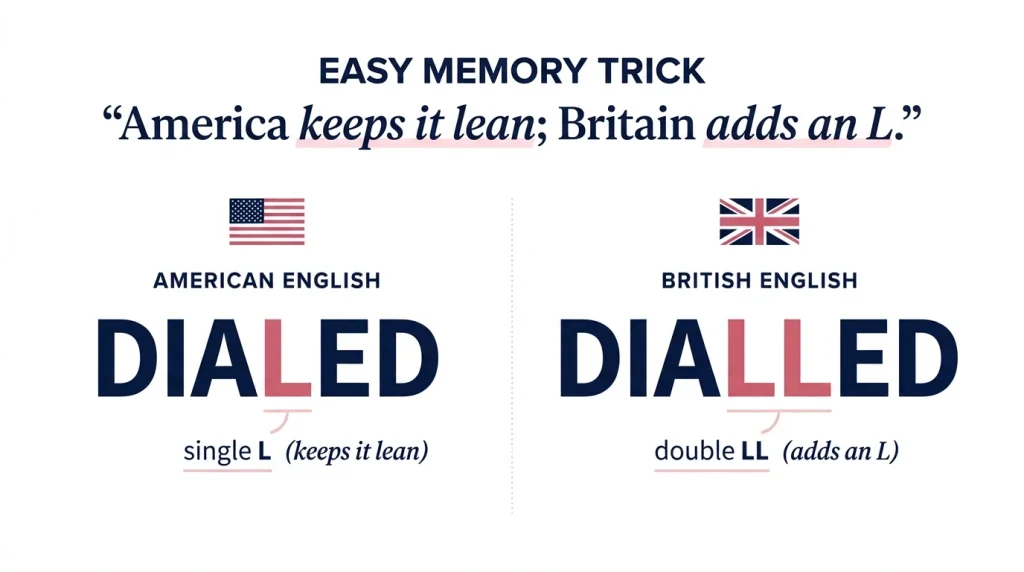
Memory Trick: One L for America, Two for Britain
Use this simple mnemonic:
America keeps it lean; Britain adds an L.
- American: dialed, dialing
- British: dialled, dialling
Think of the extra l as a reminder of the British spelling convention. The mnemonic is a practical guide for these particular forms, not a rule that applies to every English verb.
Real-Life Situations: Which Spelling Should You Choose?
Situation 1: Writing a US Business Email
You work for an American company and need to explain that you called a client.
Correct: I dialed the client’s number at 10 a.m., but there was no answer.
Why: Dialed matches standard American spelling.
Situation 2: Completing a UK School Assignment
Your teacher expects British English spelling.
Correct: The main character dialled the emergency number after hearing the alarm.
Why: Dialled matches the expected British convention.
Situation 3: Writing an International User Manual
Your product is sold in several countries, and the company has no single spelling policy.
Best approach: Choose one documented English style for the manual and use it consistently. If the manual is primarily for American customers, use dialed. If it is primarily for British customers, use dialled.
Situation 4: Sending a Casual Text
You accidentally called a friend.
American English: Sorry, I dialed you by mistake.
British English: Sorry, I dialled you by mistake.
Why: Both are natural. Your spelling preference determines which one you write.
Situation 5: Editing an Academic Paper
Your paper contains both traveled and travelled, along with dialed and dialled.
Best approach: Check the institution’s style guide and standardise the regional spelling throughout the paper. Do not change a direct quotation or official name without a good reason.
Expert Tips for Choosing the Correct Spelling
- Identify your audience first. This is more reliable than asking which spelling looks right.
- Set your spellchecker language. Use American English or British English to reduce unnecessary correction suggestions.
- Check related forms together. If you choose dialed, you will generally also choose dialing. If you choose dialled, you will generally also choose dialling.
- Don’t confuse the verb with the noun. The noun dial, as in a telephone dial or a temperature dial, is spelled the same in both varieties.
- Preserve official wording. A company’s product name, a direct quotation or a source-specific title may use a spelling that differs from your surrounding text.
- Avoid mechanical rules. Doubling a final consonant is not governed by one simple rule that covers every verb.
- Prioritise consistency over personal preference. Either spelling works when it fits the chosen convention.
Quick Summary
Dialled and dialed are both correct spellings of the past tense and past participle of dial. The main difference is regional: American English generally uses dialed, while British English generally uses dialled. Both forms have the same meaning and grammatical function, whether you are describing a telephone call or adjusting a control. The related forms follow the same pattern: dialing is standard in American English, and dialling is standard in British English. Neither spelling is inherently more correct than the other. Choose the form that matches your audience, follow any required style guide, and maintain consistency throughout your writing.
Frequently Asked Questions
Is dialled or dialed the correct spelling?
Both are correct. Dialed is the standard American English spelling, while dialled is the standard British English spelling.
Is dialled wrong in American English?
No. It is an established alternative spelling, but dialed is generally preferred in standard American English writing.
Is dialed wrong in British English?
No. Readers can understand it, but dialled is the usual British English spelling. Follow your organisation’s or publisher’s preferred style.
Does dialled mean something different from dialed?
No. Both forms have the same meaning. They can describe entering a telephone number or adjusting a control.
Is it dialling or dialing?
Use dialing in standard American English and dialling in standard British English. Both are present participles of dial.
Is dialled the past tense of dial?
Yes. Dialled is the British English past tense and past participle of dial. The corresponding American form is dialed.
Can I use dialled in an academic essay?
Yes, if British English is appropriate for your essay. If your institution requires American English, use dialed instead. Consistency is more important than personal preference.
Why does British English double the L in dialled?
British English commonly doubles the final l in this form when adding -ed or -ing. The spelling reflects a regional convention rather than a difference in meaning.
Which spelling should English learners memorise?
Learn both forms, but practise the one required by your course or target audience. If your course uses American English, start with dialed. If it uses British English, start with dialled.
Do dialled and dialed sound different?
The spelling difference does not create a separate meaning or pronunciation distinction. Actual pronunciation can vary by accent, but the extra l is primarily a written spelling difference.
Which spelling is best for a global website?
Choose according to your primary readership or the site’s established English style. If the website serves a mixed international audience, either can work, provided your spelling remains consistent.
Is it dialed in or dialled in?
Both forms are used. American English generally writes dialed in, while British English generally writes dialled in. The phrase can mean becoming focused, adjusting something precisely or configuring a setting, depending on context.
Mini Quiz: Dialled or Dialed?
Test your understanding with these ten questions.
| No. | Question | Answer and explanation |
|---|---|---|
| 1 | Which spelling is standard in American English: dialled or dialed? | Dialed. American English generally uses one l. |
| 2 | Fill in the blank for a British English sentence: She ___ the number. | Dialled. This is the standard British spelling. |
| 3 | Correct the sentence for American English: He dialled the office yesterday. | He dialed the office yesterday. The spelling now follows American convention. |
| 4 | Is dialled grammatically incorrect? | No. It is the standard British spelling and an established variant elsewhere. |
| 5 | Fill in the blank for American English: I am ___ the number now. | Dialing. American English generally uses one l in the -ing form. |
| 6 | Choose the standard British form: dialling or dialing. | Dialling. British English generally doubles the l. |
| 7 | Correct the grammar: She has dial the number already. | She has dialed the number already in American English, or She has dialled the number already in British English. The present perfect requires a past participle. |
| 8 | Fill in the blank: They did ___ the number. | Dial. After did, use the base form rather than dialed or dialled. |
| 9 | A British report uses travelled, colour and dialed. What should you check? | Spelling consistency. If the report follows British English, dialled would generally fit the established style better. |
| 10 | Do dialed and dialled have different meanings? | No. They are regional spelling variants of the same verb form. |



Pingback: Organisers or Organizers: Which Spelling Is Correct?