


Alternate and alternative are both correct English words, but they are not always interchangeable. The traditional distinction is straightforward: alternate often means happening by turns or every other, while alternative means another option or possibility. However, especially in American English, alternate is also widely used to mean an alternative choice.
Consider these examples:
- We have meetings on alternate Mondays. (Every other Monday.)
- We need an alternative plan. (A different plan.)
- The two musicians alternate during the performance. (They take turns.)
- We took an alternate route to avoid traffic. (A different route; common in American English.)
The safest approach is to use alternate for taking turns or every-other patterns and alternative for choices, especially in formal or international writing.
What Does Alternate Mean?
The word alternate has several related meanings. It can describe things that happen in turns, refer to every other item in a sequence, or identify a person or thing that can replace another.
Alternate as a verb
As a verb, alternate means to switch between two or more things or to take turns.
Examples:
- I alternate between reading and listening to audiobooks.
- The team alternates between morning and evening shifts.
- She alternated between excitement and nervousness before the interview.
The verb often appears in the pattern alternate between A and B. It can also describe two things succeeding one another.
Alternate as an adjective
As an adjective, alternate traditionally means every other in a repeating sequence.
Examples:
- The clinic opens on alternate Saturdays.
- Paint the alternate squares black.
- The students sit in alternate rows.
In the first sentence, the clinic opens every second Saturday, not every Saturday.
In American English, alternate can also mean a substitute or different option, as in alternate route, alternate plan, or alternate explanation.
Alternate as a noun
As a noun, an alternate is a person or thing that can replace another, particularly when the original person is unavailable.
Examples:
- The committee appointed an alternate to attend the meeting.
- If the main speaker is absent, the alternate will present the report.
This noun usage is especially familiar in American English.
What Does Alternative Mean?
Alternative refers to another choice, method, possibility, or course of action that can be considered instead of something else. It can be used as both a noun and an adjective.
Alternative as a noun
As a noun, alternative means another available option.
Examples:
- We need an alternative to plastic packaging.
- The alternative is to postpone the event.
- If this solution fails, we have another alternative.
A useful construction is an alternative to something.
For example:
- Walking is an alternative to driving.
- A digital textbook is an alternative to a printed book.
- The company is looking for an alternative to its current supplier.
Use to, rather than than, in the standard construction an alternative to something.
Alternative as an adjective
As an adjective, alternative describes something that can be used or considered instead of another option. It can also describe something outside conventional or mainstream practices.
Examples:
- We developed an alternative strategy.
- The school offers an alternative learning program.
- She prefers alternative music.
- The researchers investigated an alternative explanation.
In the last example, the explanation is a different possible account of the evidence.
Alternative does not always mean unconventional
Although alternative can describe nontraditional lifestyles, art, music, or treatments, it does not always have that meaning.
An alternative route can simply be a different road. An alternative solution can be a perfectly ordinary way to solve a problem.
The surrounding words and situation determine whether alternative means another option or something outside the mainstream.
Why the Difference Matters
Choosing between alternate and alternative can affect how clearly readers understand your message.
In everyday conversation, the distinction may not cause a problem because context often makes your meaning obvious. In professional, academic, or technical writing, however, the wrong choice can make a sentence less precise.
Consider the difference:
- We meet on alternate Fridays. The meetings take place every other Friday.
- We need an alternative meeting date. We need another possible date.
If you write alternative Fridays when you mean every other Friday, readers may understand your intention, but the traditional distinction is lost.
Similarly, saying that a researcher tested an alternate method is common in American English. In formal international writing, alternative method is often the clearer choice when referring to a different approach.
The goal is not to treat every overlapping usage as a serious grammatical error. It is to select the word that communicates your intended meaning most directly.
The Core Rule
Alternate = take turns or every other
Use alternate for repeated changes between things or a pattern in which every second item is involved.
Example: We work on alternate weekends.
Alternative = another choice
Use alternative when you mean a different option, method, explanation, or possibility.
Example: We need an alternative solution.
Remember that alternate can also mean another option, particularly in American English. The rule above is a reliable guide, not an absolute ban on overlapping meanings.
How to Use Alternate and Alternative Correctly
1. Use alternate for taking turns
When people or things repeatedly switch roles or positions, alternate is the natural verb.
Examples:
- The two teachers alternate responsibility for the class.
- I alternate between strength training and swimming.
- The lights alternate between red and green.
The structure alternate between A and B makes the switching pattern clear.
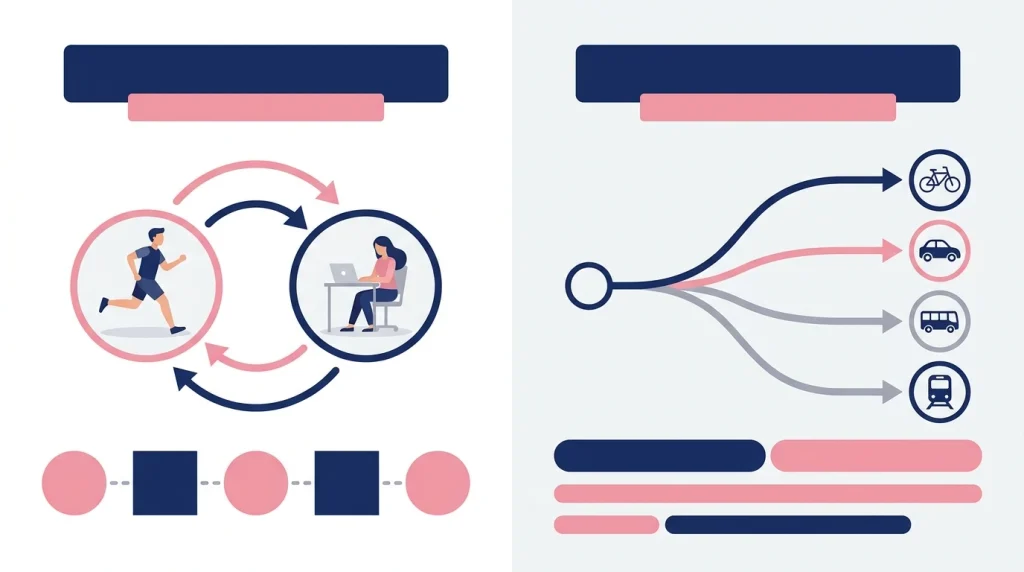
2. Use alternate for every other item
Use the adjective alternate when referring to every second day, week, row, seat, or other item in a repeating sequence.
Examples:
- The delivery service operates on alternate days.
- Please color the alternate sections blue.
- We schedule maintenance on alternate weekends.
If you want to avoid possible confusion, every other day or every other week is an equally clear alternative.
3. Use alternative for a different choice
When someone needs another way to achieve a goal, use alternative.
Examples:
- We need an alternative approach to the problem.
- The manager suggested an alternative schedule.
- Is there an alternative to this software?
This is the most reliable choice for formal writing when you mean another possibility.
4. Understand when the words overlap
In American English, expressions such as alternate route, alternate plan, and alternate explanation are widely accepted.
In British English and international writing, alternative route, alternative plan, and alternative explanation are often safer choices for the meaning “another option.” The traditional distinction is particularly useful when precision matters.
5. Choose the correct noun
Use an alternate when referring to a substitute person or representative, particularly in American English.
Use an alternative when referring to another option or possibility.
Compare:
- The alternate attended the committee meeting in place of the main representative.
- The committee considered an alternative to its original proposal.
Read More: Organisers or Organizers: Which Spelling Is Correct?
Correct Examples of Alternate and Alternative
Here are 12 original examples showing how the words work in different situations.
| Situation | Correct example | Why it works |
|---|---|---|
| Everyday conversation | We alternate cooking dinner each night. | The speakers take turns. |
| Scheduling | My appointments fall on alternate Tuesdays. | They occur every other Tuesday. |
| Could you suggest an alternative time for our call? | The writer wants another possible time. | |
| Workplace | The two supervisors alternate responsibility for opening the store. | They share the duty in turns. |
| School | Write your answers in alternate boxes. | Every second box is involved. |
| Academic writing | The experiment provides an alternative explanation for the results. | It presents another possible explanation. |
| Social media | Does anyone know an alternative app for editing videos? | The writer wants another option. |
| Travel | We took an alternative route to reach the hotel. | A different route was used. |
| Fitness | I alternate between walking and cycling during the week. | The activities change in turn. |
| Business | The company is considering an alternative supplier. | Another supplier is being considered. |
| Committee work | An alternate will attend if the elected representative cannot come. | A substitute representative is available. |
| Creative writing | The poem alternates between hope and disappointment. | Two emotional states recur in turn. |
Incorrect vs. Correct: 10 Common Usage Problems
The examples below follow the traditional distinction unless the explanation identifies an accepted regional usage.
| Incorrect or less suitable | Correct or clearer | Why |
|---|---|---|
| We meet on alternative Fridays, meaning every other Friday. | We meet on alternate Fridays. | Alternate expresses a repeating every-other pattern. |
| The students alternate every other week between two classrooms. | The students alternate between two classrooms every other week. | The revised sentence makes the switching pattern and schedule clearer. |
| We need an alternate solution for this problem. | We need an alternative solution for this problem. | Alternative is the clearest traditional choice for another solution. Alternate is also used this way in American English. |
| Please suggest an alternate to our current strategy. | Please suggest an alternative to our current strategy. | Alternative is the standard choice for another strategy. |
| She alternated a new route to avoid traffic. | She chose an alternative route to avoid traffic. | The sentence needs a word describing another route, not a verb describing a switching action. |
| The company offers alternative shifts every other day. | The company offers alternate shifts every other day. | If the intended meaning is shifts on every second day, alternate is the traditional choice. |
| The two speakers alternative during the debate. | The two speakers alternate during the debate. | Alternate is the verb meaning to take turns. |
| We need an alternative person to replace the absent delegate. | We need an alternate to replace the absent delegate. | Alternate can be a noun meaning a substitute person. |
| The weather alternative between rain and sunshine. | The weather alternates between rain and sunshine. | The verb is alternates, not alternative. |
| Please provide an alternate explanation in formal international writing. | Please provide an alternative explanation. | Alternative is generally the safer, more widely suitable choice for a different explanation. |
Important: Not every use of alternate to mean “another” is incorrect. Some sentences above are less suitable under the traditional distinction, but expressions such as alternate route and alternate explanation are accepted in American English.

Why People Confuse Alternate and Alternative
Their meanings overlap
Both words can describe a different possibility. Because alternate route and alternative route are both used, learners may assume the words are interchangeable in every context.
The overlap is real, but it does not erase the distinct meanings of alternate in expressions such as alternate days or alternate between two activities.
They share the same word root
Both words are related to the idea of being other or different. Their similar forms make them easy to confuse, particularly when a writer remembers the general meaning but not the specific usage.
Learners overgeneralize a rule
A learner might memorize that alternate means “every other” and then reject alternate plan in every context. Another might learn that the words can overlap and use alternative for a repeating pattern.
Both approaches are too rigid. The intended meaning and regional convention matter.
Spellcheck does not understand every distinction
Both words are spelled correctly, so a standard spellchecker may accept either one even when the sentence would be clearer with the other.
Grammar tools can catch some problems, but the writer still needs to consider meaning.
Read More: Miter or Mitre: Which Spelling Is Correct?
Translation can influence word choice
In multilingual writing, a single word in another language may cover the meanings of both alternate and alternative. Translating word for word can hide the English distinction between taking turns and choosing another option.
The best solution is to identify the meaning first and select the English word that expresses it.
Common Mistakes Checklist
Use this checklist when editing your writing.
- Using alternative for every-other patterns: Choose alternate when something happens every second day, week, or other interval.
- Using alternate as a verb incorrectly: Remember that the verb is alternate, as in “The teams alternate hosting duties.”
- Confusing an option with a substitute person: Use an alternative for another choice and an alternate for a substitute person, especially in American English.
- Assuming alternate is always wrong for another option: American English commonly accepts alternate route and alternate plan.
- Assuming alternative always means unusual: It can simply mean another ordinary option.
- Ignoring the intended meaning: Ask whether the sentence describes a repeating pattern or a choice.
- Using unclear time expressions: If the reader might misinterpret alternate Mondays, write every other Monday instead.
Alternate or Alternative in Real English
Grammatically correct
Both alternate and alternative can be grammatically correct when they describe another option, depending on the variety of English and the expression. “We found an alternative route” is a standard choice across varieties of English. “We found an alternate route” is also established in American English. However, “We meet on alternate Mondays” has a specific traditional meaning: the meetings take place every other Monday.
Grammatically possible but less suitable
A sentence such as “We need an alternate solution” is not necessarily ungrammatical. It is common in American English, where alternate often means “alternative.” However, a writer following the traditional distinction may prefer “We need an alternative solution.” The second version is also a dependable choice for international audiences who may be more familiar with the distinction between alternating patterns and other available options.
Natural, everyday English
In everyday conversation, people commonly use alternative when asking for another choice and alternate when describing people or activities taking turns. You might hear “Is there an alternative?” when someone wants another plan, or “We alternate cooking” when two people share a task. In American English, “Is there an alternate route?” is also natural. Context usually helps listeners understand the intended meaning.
American vs. British English
There is a genuine usage difference worth knowing.
| Expression or meaning | American English | British English |
|---|---|---|
| Another route | Alternate route or alternative route | Alternative route is generally preferred |
| Another plan | Alternate plan or alternative plan | Alternative plan is generally preferred |
| Every other week | Alternate weeks | Alternate weeks |
| Taking turns | Alternate between tasks | Alternate between tasks |
| Substitute representative | An alternate | An alternate may be understood, but usage varies |
American English more readily uses alternate as an adjective meaning “another available option.” British English more often preserves the distinction between alternate for every-other patterns and alternative for choices. These are tendencies, not absolute rules, and both words are understood in both varieties.
For international business, academic writing, or a mixed audience, choose alternative for a different option and alternate for a repeating pattern. This approach minimizes ambiguity.
Formal vs. Informal Usage
Formal writing
In reports, academic papers, business proposals, and professional correspondence, alternative is a dependable choice for another possible solution, method, or explanation.
Examples:
- The research team considered an alternative hypothesis.
- The department proposed an alternative procurement strategy.
- The authors examined an alternative interpretation of the findings.
Use alternate when you mean every other item or when describing a switching pattern.
Informal writing
In everyday speech and casual American English, alternate frequently appears in phrases such as alternate route, alternate plan, and alternate option. These expressions are understandable and widely used.
Nevertheless, informal usage does not mean that every substitution works. Alternative Fridays is still a poor choice if you mean Fridays that occur every other week.
Alternate vs. Alternative: Comparison Table
| Feature | Alternate | Alternative |
|---|---|---|
| Main traditional meaning | Taking turns or every other | Another choice or possibility |
| Part of speech | Verb, adjective, noun | Noun, adjective |
| As a verb | Yes: alternate between tasks | No, not in standard modern usage |
| As a noun | A substitute person or thing | Another option |
| Time patterns | Alternate days or weeks | Usually not used for every-other patterns |
| Different solution | Accepted in American English | Standard, broadly suitable choice |
| Main memory cue | Turns and every other | Options and choices |
| Formal international writing | Best for alternating patterns | Best for another option |
Memory Trick: Turns or Choices?
Remember this simple distinction:
Alternate = alternating turns. Alternative = another option.
Think of a relay race: runners take turns, so their actions alternate. If the team considers a different route to the finish line, that route is an alternative.
For time schedules, remember alternate Mondays means every other Monday. When asking for another plan, remember alternative plan.
This mnemonic captures the traditional distinction while leaving room for accepted American usage of alternate to mean another option.
Real-Life Situations: Which Word Should You Choose?
At a job interview
The interviewer asks whether you have experience working different shifts.
Correct: “Yes, I can alternate between morning and evening shifts.”
Why: The candidate describes switching between two schedules.
In a business meeting
A manager rejects a proposed budget.
Correct: “Let’s consider an alternative budget that reduces operating costs.”
Why: The team needs another possible plan.
In an email
Your colleague is unavailable on the proposed date.
Correct: “Could you suggest an alternative date for our meeting?”
Why: The writer is requesting another possible date.
In a text message
Two friends decide to share driving duties.
Correct: “We can alternate driving so neither of us gets too tired.”
Why: The friends will take turns.
In an exam
A grammar question asks which days a clinic opens if it operates on alternate Saturdays.
Correct interpretation: The clinic opens every other Saturday.
Why: Alternate describes the repeating schedule.
In academic writing
A researcher wants to present a different explanation of a result.
Correct: “An alternative explanation may account for the unexpected findings.”
Why: The writer is proposing another possibility.
Read More: Habbit or Habit: Which Spelling Is Correct?
Expert Tips for Choosing the Right Word
- Replace the word with its meaning. If you can substitute “every other,” alternate is usually correct. If you can substitute “another option,” alternative is usually the better choice.
- Check the word’s grammatical role. Alternate can be a verb, as in “They alternate duties.” Alternative is a noun or adjective.
- Watch the word after it. “An alternative to the current method” is a standard construction. “On alternate days” describes a schedule.
- Prefer clarity over rigid rules. American English accepts alternate in many contexts where other varieties prefer alternative. Do not label an established regional usage incorrect without considering the context.
- Use every other to remove ambiguity. Instead of “We meet on alternate Fridays,” you can write “We meet every other Friday.”
- Do not rely entirely on spellcheck. Both spellings are valid, so a spellchecker may not identify a word-choice problem.
- Read the whole sentence. The correct choice depends on what you mean, not simply which word sounds more familiar.
Quick Summary
Alternate and alternative are related words, but their traditional meanings differ. Alternate means to take turns or occur every other time, as in “We meet on alternate Fridays.” As a verb, it means to switch between activities, as in “They alternate between morning and evening shifts.” Alternative means another available choice, method, or possibility, as in “We need an alternative solution.” Both words can be adjectives, but alternate is also a verb and a noun meaning a substitute. American English frequently uses alternate to mean another option, while British English generally favors alternative in that context. For clear formal writing, use alternate for repeating patterns and alternative for choices.
Frequently Asked Questions
Is alternate or alternative correct?
Both are correct English words. Use alternate for taking turns or every-other patterns, and alternative for another choice. In American English, alternate can also mean another option.
Is an alternate route correct English?
Yes. Alternate route is common and accepted in American English. Alternative route is also correct and is generally the safer choice for international or British English audiences.
Is alternative a synonym for alternate?
Sometimes. Both can describe another available option, but alternate also means taking turns or every other. Alternative does not normally express that repeating pattern.
What does alternate mean in alternate days?
It means every other day. For example, if a service operates on alternate days beginning Monday, its schedule would include Monday, Wednesday, Friday, and so on.
Can alternate be used as a noun?
Yes. An alternate is a substitute person or thing, especially someone who can take another person’s place. For example, “The alternate attended the meeting for the absent representative.”
Can alternative be used as a verb?
No, not in standard modern English. Use alternate as the verb meaning to switch between activities or states. Use alternative as a noun or adjective.
Is alternative option grammatically correct?
Yes, alternative option is used in English, although some writers consider it redundant because an alternative is already a choice. It can be useful when the context calls for emphasis or clarification. In concise writing, alternative or another option is often enough.
Should I write alternative solution or alternate solution?
Alternative solution is the clearest choice in formal and international writing. Alternate solution is also common in American English, where alternate can mean another option.
What is the difference between alternately and alternatively?
Alternately generally means taking turns or switching between things: “The lights flashed alternately.” Alternatively means as another possibility: “We could travel by train; alternatively, we could drive.”
Is alternate the same as every other?
When alternate describes a repeating schedule or sequence, it commonly means every other. However, alternate has additional meanings, including taking turns and serving as a substitute.
Mini Quiz: Alternate or Alternative?
Test your understanding with these 10 questions. Try answering before checking the explanations.
Practice test
0 of 10 answered
1. The clinic opens on _____ Saturdays.alternativealternate
2. We need an _____ solution to the problem.alternatealternative
3. The two employees _____ responsibility for closing the store.alternatealternative
4. Which sentence is clearest for formal international writing?We found an alternate explanation.We found an alternative explanation.
5. An _____ will attend if the main representative is absent.alternatealternative
6. Correct this sentence: The weather alternative between rain and sunshine.The weather alternates between rain and sunshine.The weather alternative between rain and sunshine.
7. Which phrase describes a different way to travel?Alternative routeAlternate days
8. Fill in the blank: I _____ between reading and listening to podcasts.alternativealternate
9. Which expression means every other week?Alternative weeksAlternate weeks
10. Correct this sentence for formal writing: Please suggest an alternate to our current strategy.Please suggest an alternative to our current strategy.Please suggest an alternately to our current strategy.



Pingback: Lesser or Lessor: What's the Difference?
Pingback: Buret or Burette: Which Spelling Is Correct?