


The correct word is lesser when describing something of lower importance, quality, rank, or degree. Use lessor when referring to a person or organization that leases property, equipment, or another asset to someone else. Although the words look and sound similar, they have different meanings and grammatical roles. Remember: a lesser problem is less important, while a lessor is the party that grants a lease.
What Is the Difference Between Lesser and Lessor?
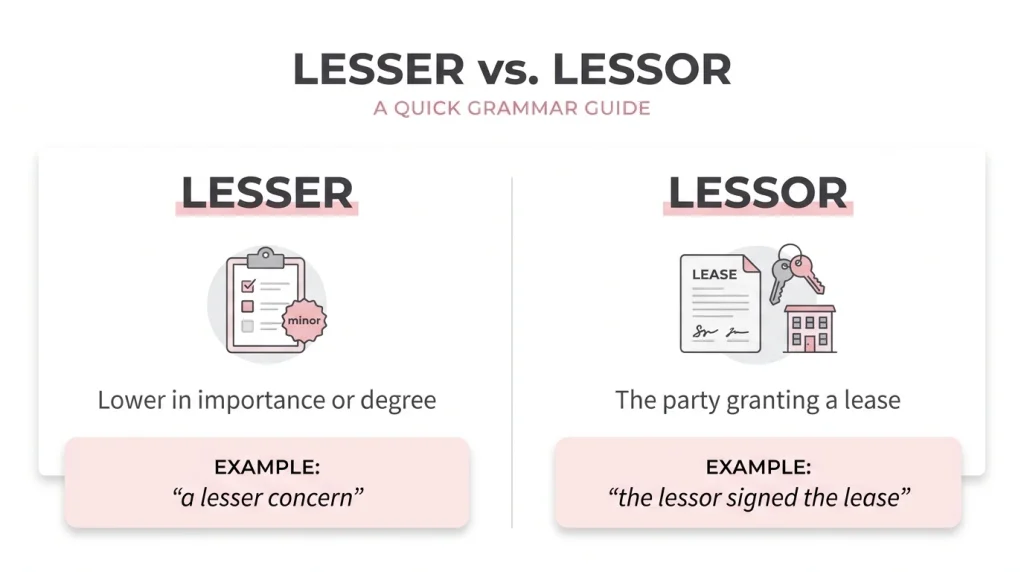
Lesser is an adjective that describes something as lower in importance, quality, rank, or degree compared with something else. For example, a lesser concern is a concern that is not as important as another one.
Lessor is a noun used mainly in legal, property, and business contexts. It means the person or organization that grants a lease, allowing another party to use an asset under an agreement.
Consider these two sentences:
- Lesser: The committee decided to address the lesser problem first.
- Lessor: The lessor agreed to rent the office space to a new business.
In the first sentence, lesser describes the relative importance of a problem. In the second, lessor identifies the party granting the lease.
The distinction matters because these words are not interchangeable. Choosing the wrong one can make a sentence confusing, especially in a rental agreement, business email, or formal document.
Why the Difference Between Lesser and Lessor Matters.
Confusing these words can create problems because one describes a comparison, while the other identifies a specific role in a leasing arrangement.
In everyday writing, using lessor instead of lesser may make a sentence appear grammatically incorrect or change its intended meaning. In a legal or business document, confusing lessor with another leasing term can also obscure who is responsible for a particular action.
For example:
- A writer discussing a minor issue should write a lesser concern, not a lessor concern.
- A rental contract should identify the party granting the lease as the lessor, not the lesser.
- A business report might describe a smaller risk as a lesser risk, while referring to the company leasing its equipment as the lessor.
Understanding the distinction helps you communicate precisely, proofread more effectively, and avoid unnecessary misunderstandings.
The Core Rule: When to Use Lesser or Lessor
Use lesser for comparison.
Choose lesser when describing something of lower importance, rank, quality, seriousness, or degree.
Example: The delay was a lesser concern than the budget problem.
Use lessor for leasing.
Choose lessor when naming the person or organization that grants a lease to another party.
Example: The lessor signed the agreement with the tenant.
A quick way to choose is to ask yourself:
- Are you comparing the importance, quality, or degree of something? Use lesser.
- Are you identifying the party that leases an asset to someone else? Use lessor.
If neither meaning fits, check whether you actually need a different word, such as less, lower, smaller, landlord, or lessee.
How to Use Lesser and Lessor Correctly
The easiest way to use these words correctly is to identify what your sentence needs: a descriptive word or the name of a person or organization.
When to Use Lesser
Use lesser when you want to express that something has less importance, a lower rank, reduced quality, or a lower degree of a particular characteristic.
It commonly appears before a noun, as in a lesser risk, a lesser role, or a lesser achievement. It also occurs in established phrases such as the lesser of two evils and to a lesser extent.
Examples:
- The financial loss was a lesser concern than the damage to the company’s reputation.
- She accepted a lesser role to gain experience in a new industry.
- The second proposal carries a lesser risk of failure.
- The new policy affected the smaller branches to a lesser extent.
Notice that lesser does not simply mean a smaller quantity of something. It usually expresses a comparison involving importance, rank, quality, seriousness, or degree.
If you mean a reduced quantity or amount, less is often the better choice.
For example:
- Correct: We spent less time on the introduction.
- Correct: The introduction was a lesser concern during the review.
The first sentence concerns the amount of time. The second compares the importance of two concerns.
When to Use Lessor
Use lessor when referring to the party that grants a lease. The term is common in property rentals, equipment leasing, vehicle agreements, and commercial transactions.
A lessor might be:
- A property owner leasing an apartment.
- A company leasing machinery to a manufacturer.
- An aircraft leasing business providing an airplane to an airline.
- A vehicle leasing company allowing a customer to use a car under a contract.
- An organization leasing office space to another business.
For example:
- The lessor provided the tenant with a copy of the lease.
- The equipment lessor agreed to extend the payment deadline.
- The airline negotiated a new agreement with the aircraft lessor.
- The lessor and lessee signed the contract after reviewing its terms.
The lessor is not necessarily a private individual. A company or other legal entity can also be the lessor.
One important distinction: the lessor generally grants the right to use the asset under the lease, while the lessee receives that right. The exact rights and responsibilities depend on the agreement and applicable law.
How to Identify the Lessor in a Contract
If you are reading a lease, ask who is granting the right to use the property or asset.
- Identify the property or asset being leased.
- Find the party granting the right to use it.
- That party is the lessor.
- Identify the party receiving that right; that party is the lessee.
For example, if a company leases a warehouse to a retailer, the company is the lessor and the retailer is the lessee.
Do not assume that the word lessor always means an individual landlord. Commercial leasing arrangements can involve companies, financial institutions, and other organizations.
Correct Examples of Lesser and Lessor
The following examples demonstrate how each word works in different situations.
Lesser Examples
- Everyday conversation: “The traffic delay is a lesser problem than missing the entire meeting.”
- Email: “The formatting issue is a lesser concern compared with the missing financial data.”
- School: “The teacher explained that the character played a lesser role in the second chapter.”
- Workplace: “The team decided to resolve the lesser issues before addressing the main technical failure.”
- Social media: “The price difference is a lesser concern when the product lasts twice as long.”
- Academic writing: “The study found that the secondary factor had a lesser influence on the final result.”
- Business report: “The company accepted a lesser profit margin to enter the new market.”
- News writing: “The storm caused lesser damage in the northern district than in the coastal area.”
- Personal decision: “Of the two available options, I chose the lesser risk.”
- Formal discussion: “The proposal addressed the main challenge and several lesser concerns.”
Lessor Examples
- Apartment rental: “The lessor provided the tenant with a written copy of the rental agreement.”
- Business email: “Please contact the lessor to discuss the proposed lease extension.”
- Office space: “The lessor agreed to make the premises available at the start of the month.”
- Equipment leasing: “The lessor supplied the factory with the required machinery.”
- Vehicle rental agreement: “The lessor outlined the payment schedule in the contract.”
- Commercial aviation: “The airline negotiated revised terms with its aircraft lessor.”
- Legal document: “The agreement identifies the lessor and lessee by their registered names.”
- Property management: “The lessor reviewed the maintenance obligations stated in the lease.”
- Business meeting: “Our finance team will discuss the renewal with the lessor.”
- Contract administration: “The lessor signed the revised agreement after both parties accepted the changes.”
These examples show that lesser belongs in comparisons, while lessor identifies a leasing party.
Incorrect vs. Correct: Lesser or Lessor
The following table covers common mistakes and explains why each correction works.
| Incorrect | Correct | Why |
|---|---|---|
| This is a lessor problem. | This is a lesser problem. | Lesser describes the problem as less important or serious. |
| The lessor concern can wait. | The lesser concern can wait. | The sentence compares the importance of concerns. |
| She played a lessor role. | She played a lesser role. | The intended meaning is a lower-level or less important role. |
| It was the lessor of two evils. | It was the lesser of two evils. | This established expression refers to the less harmful of two bad choices. |
| The report discussed lessor risks. | The report discussed lesser risks. | The writer means risks of comparatively lower importance or severity. |
| The landlord is the lesser under the lease. | The landlord is the lessor under the lease. | The landlord grants the lease and is therefore the lessor. |
| We contacted the lesser about the rent. | We contacted the lessor about the rent. | The sentence refers to the party responsible for the lease arrangement. |
| The lessor agreed to lease the office to us. | The lessor agreed to lease the office to us. | This sentence is already correct: lessor names the party granting the lease. |
| The equipment lesser signed the agreement. | The equipment lessor signed the agreement. | The person or company leasing out the equipment is the lessor. |
| The company became a lesser of commercial vehicles. | The company became a lessor of commercial vehicles. | Lessor identifies a business that leases vehicles to other parties. |
| The lessor option was more affordable. | The lesser option was more affordable. | Lesser can describe an option with lower importance, quality, or degree, although cheaper or less expensive is clearer when price is meant. |
| The lessor agreed to receive the leased equipment. | The lessee agreed to receive the leased equipment. | The lessee receives the right to use the asset under the lease. |
The eighth example is intentionally shown as correct. Not every sentence containing lessor needs correction; the goal is to recognize the word’s actual function rather than automatically replace it.
A further point: lesser is not a universal replacement for less. For example, write “We need less water,” not “We need lesser water,” when discussing a smaller quantity of water.
Why People Confuse Lesser and Lessor
Several features make these words easy to mix up, especially for learners and writers working quickly.
1. They Look Almost Identical
Both words begin with less- and differ by only one letter near the end. When typing quickly, it is easy to select the wrong form without noticing that the meaning has changed.
The solution is to remember each word through its meaning rather than through spelling alone.
2. Their Pronunciations Are Similar
Lesser is commonly pronounced approximately as “LESS-er,” while lessor is commonly pronounced “LESS-or,” with pronunciation varying somewhat by accent.
In rapid conversation, the difference between the final sounds may be subtle. Listening alone is therefore not always a reliable way to distinguish them.
3. Spellcheck Does Not Understand Every Context
Both lesser and lessor are legitimate English words. A spelling checker may accept either one even when the sentence requires the other.
For example, “The lessor concern was discussed first” may contain correctly spelled words, but it is probably incorrect if the writer means a concern of lower importance.
Always check meaning as well as spelling.
4. Writers Overgeneralize Familiar Words
Someone who knows less may assume that lesser simply means a smaller quantity in every situation. However, lesser usually expresses a lower degree, rank, importance, or quality.
Likewise, someone familiar with rental agreements may accidentally use lessor whenever a sentence involves a smaller amount.
Understanding the grammatical role prevents both errors.
5. Translation Can Create Confusion
In some languages, one word or grammatical construction can express several meanings that English separates into different words. A direct translation may therefore produce lessor where lesser is required, or the reverse.
Instead of translating word for word, identify the intended meaning first. Is the sentence comparing two things, or naming a party in a lease?
Common Mistakes Checklist
Use this checklist when proofreading your writing.
- Using lessor to mean less important: Replace it with lesser when comparing seriousness, rank, quality, or importance.
- Using lesser for a person who grants a lease: Use lessor in rental and leasing contexts.
- Confusing lessor with lessee: The lessor grants the lease; the lessee receives the right to use the asset.
- Using lesser instead of less for quantity: Write “less time,” “less money,” or “less water” when describing a reduced amount.
- Assuming a spellchecker catches every error: Both words are valid, so review the sentence’s meaning.
- Using lesser when smaller is clearer: For physical size, smaller may be more natural, depending on the sentence.
- Assuming a lessor must be a landlord: A lessor can lease equipment, vehicles, aircraft, or other assets as well as property.
- Using the word without a clear comparison: If you write lesser, make sure the sentence communicates a meaningful comparison or uses a recognized expression.
- Treating legal terms as interchangeable: Use the role specified in the agreement, and check the contract’s definitions where necessary.
The best proofreading question is simple: Am I describing a comparison, or identifying a leasing party?
Lesser or Lessor in Real English
Correct grammar is important, but choosing the most natural word for your intended meaning matters just as much.
Grammatically Correct: Lesser
“The team treated the scheduling problem as a lesser concern.”
This sentence is grammatically correct because lesser modifies the noun concern and indicates that the problem is less important than another issue. The construction is common in formal writing, business discussions, and comparisons. It works best when the reader can understand what the concern is being compared with, either from the sentence or from the surrounding context.
Grammatically Correct: Lessor
“The lessor approved the renewal of the lease.”
This sentence is grammatically correct because lessor is a noun naming the party granting the lease. The word is particularly appropriate in legal, financial, property, and commercial writing. In a casual conversation, a speaker might say landlord instead when discussing a residential rental, but lessor remains correct when describing the contractual role.
Read More: Organisers or Organizers: Which Spelling Is Correct?
Grammatically Possible but Unnatural: Lesser
“We need lesser time to complete the project.”
The intended meaning is understandable, but this wording is not the usual choice in contemporary standard English. When discussing a smaller amount of time, write “We need less time to complete the project.” The word lesser is more suitable for comparisons involving importance, quality, rank, or degree than for expressing a simple reduction in quantity.
Natural Everyday English: Lessor
“The lessor will send us the lease documents tomorrow.”
This is natural and correct in a professional conversation about a leasing agreement. However, if two friends are discussing an apartment, one might more naturally say, “The landlord will send us the rental agreement tomorrow.” The choice depends on the context: lessor emphasizes a contractual role, while landlord is familiar in ordinary residential conversations.
American vs. British English
There is no major spelling or meaning difference between lesser and lessor in American and British English. Both varieties use lesser for lower importance, quality, rank, or degree, and lessor for the party granting a lease.
Pronunciation can vary by accent, particularly in the vowel sound at the end of lessor. This does not change the spelling or the basic meaning of either word.
For writers, the practical rule is the same in both varieties:
- Use lesser for comparisons such as a lesser concern.
- Use lessor for the party granting a lease.
- Use less for a smaller amount, such as less time or less money.
Formal vs. Informal Usage
Both words are grammatically correct in formal writing, but they belong to different contexts.
| Context | Preferred word | Example |
|---|---|---|
| Everyday comparison | Lesser | That is a lesser problem. |
| Academic writing | Lesser | The secondary factor had a lesser effect. |
| Legal agreement | Lessor | The lessor grants the right to use the property. |
| Commercial leasing | Lessor | The lessor provided the equipment under contract. |
| Casual property conversation | Landlord, often | The landlord renewed our rental agreement. |
| Discussing a smaller quantity | Less | We need less time to finish. |
In formal writing, lessor is useful when precision about contractual roles matters. In informal writing, lesser can still be used naturally, especially in expressions such as the lesser of two evils.
Neither word is inherently more formal than the other in every situation. The intended meaning determines which one is appropriate.
Comparison Table: Lesser vs. Lessor vs. Less
| Feature | Lesser | Lessor | Less |
|---|---|---|---|
| Part of speech | Adjective, and sometimes a noun in established usage | Noun | Determiner, pronoun, or adverb, depending on use |
| Main meaning | Lower in importance, rank, quality, or degree | Party that grants a lease | A smaller amount or degree |
| Common context | Comparisons and descriptions | Property, equipment, and business leasing | Quantities and degrees |
| Example | A lesser concern | The lessor signed the contract. | We need less time. |
| Can identify a leasing party? | No | Yes | No |
| Can describe lower importance? | Yes | No | Sometimes, depending on construction |
| Common phrase | The lesser of two evils | The lessor and lessee | Less money |
| Common mistake | Using it for every smaller quantity | Using it to mean less important | Replacing it with lesser unnecessarily |
Related Terms You Should Know
- Lessee: The person or organization receiving the right to use an asset under a lease.
- Landlord: A person or organization that rents property to tenants.
- Tenant: A person or organization occupying or renting property under an agreement.
- Lease: An agreement granting the right to use property or another asset under specified terms.
- Smaller: A comparative adjective referring to physical size or amount in contexts where size is being compared.
- Lower: A comparative term often used for prices, levels, rankings, and measurements.
- Less: A word used to express a smaller amount, degree, or extent.
These terms are related in some contexts, but they are not all synonyms. In particular, lessor and lessee identify opposite roles in a leasing arrangement.
Read More: Miter or Mitre: Which Spelling Is Correct?
Memory Trick: How to Remember Lesser or Lessor.
Use this simple mnemonic:
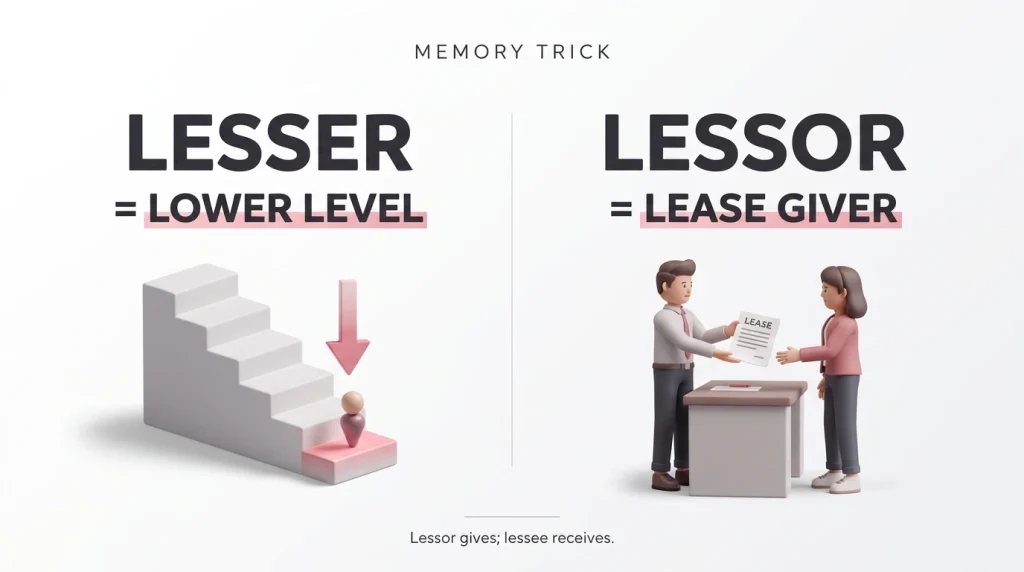
Lesser = lower level. Lessor = lease giver.
- Lesser contains the familiar ending -er, as in comparisons such as smaller and stronger. Think of something being lower in importance or degree.
- Lessor contains lessor, the word used for the party granting a lease. Connect it directly with lease and remember that the lessor lets another party use an asset.
For a rental agreement, ask: “Who gives the lease?” That is the lessor.
For a comparison, ask: “Which issue is less important?” That is the lesser concern.
A second way to remember the distinction is to pair the leasing terms: lessor gives; lessee receives.
Lesser or Lessor in Real-Life Situations
Situation 1: A Workplace Meeting
Your team has a serious security issue and a minor formatting problem.
Correct: “Let’s resolve the lesser issue after we address the security risk.”
Why: Lesser communicates that the formatting problem has lower priority or importance.
Situation 2: A Rental Agreement
Your company rents a warehouse from a property owner.
Correct: “The lessor must be identified in the lease agreement.”
Why: Lessor names the party granting the right to use the warehouse.
Situation 3: An Academic Essay
You are comparing two factors that influence a research result.
Correct: “The second factor had a lesser effect on the outcome.”
Why: Lesser describes the comparatively lower effect.
Situation 4: A Business Email
You need to discuss the renewal of leased machinery.
Correct: “Please arrange a meeting with the lessor to discuss the renewal terms.”
Why: Lessor identifies the party providing the machinery under the lease.
Situation 5: An English Exam
You must choose the correct word in this sentence: “We need ___ time to finish the assignment.”
Correct: “We need less time to finish the assignment.”
Why: The sentence refers to an amount of time, not a lower level of importance. Neither lesser nor lessor is the appropriate choice.
Frequently Asked Questions
Is lesser or lessor the correct spelling?
Both spellings are correct, but they have different meanings. Lesser describes something of lower importance, quality, rank, or degree. Lessor refers to the person or organization granting a lease.
Does lessor mean landlord?
In many property-rental situations, yes. A landlord who grants a lease is a lessor. However, lessor is broader because it can also refer to a company leasing equipment, vehicles, aircraft, or other assets.
What is the opposite of lessor?
The corresponding term is lessee. The lessor grants the lease, while the lessee receives the right to use the property or asset under the agreement.
Is lesser the same as less?
No. Less usually refers to a smaller amount, quantity, or degree. Lesser generally describes lower importance, rank, quality, or seriousness. For example, say “less money” but “a lesser concern.”
Is lesser a real English word?
Yes. Lesser is a standard English word commonly used before nouns, as in lesser importance, lesser risk, and lesser role. It also appears in established expressions such as the lesser of two evils.
Can a company be a lessor?
Yes. A lessor can be an individual, company, institution, or other organization that grants another party the right to use an asset under a lease. The term is common in commercial leasing and finance.
How do you pronounce lesser and lessor?
Lesser is commonly pronounced “LESS-er,” while lessor is commonly pronounced “LESS-or.” Exact vowel sounds vary by accent, so context is also useful when distinguishing the words in conversation.
Should I write lesser risk or lessor risk?
Write lesser risk when you mean a risk that is lower in seriousness or importance than another risk. Lessor risk is generally incorrect for that meaning because lessor identifies a leasing party.
Is the phrase the lesser of two evils correct?
Yes. The lesser of two evils is an established expression meaning the less harmful or undesirable of two bad choices. For example, “Neither proposal was ideal, so we selected the lesser of two evils.”
Can lessor be used outside real estate?
Yes. A lessor may grant a lease for equipment, vehicles, aircraft, machinery, or other assets. The term is not restricted to houses, apartments, or commercial buildings.
Is there any difference between lesser and lessor in American and British English?
Their basic meanings and spellings are the same in both varieties. Pronunciation may vary, but the distinction between a comparison and a leasing party remains unchanged.
What is the easiest way to remember lesser vs. lessor?
Remember lesser = lower level and lessor = lease giver. If you are comparing the importance of something, use lesser. If you are identifying who grants a lease, use lessor.
Read More: Habbit or Habit: Which Spelling Is Correct?
Quiz: Test Your Understanding of Lesser and Lessor.
Choose the correct answer or correct the sentence in each question. Answers and explanations are included so you can check your understanding.
| No. | Question | Answer | Explanation |
|---|---|---|---|
| 1 | The committee treated the issue as a (lesser / lessor) concern. | Lesser | The word describes the concern as lower in importance. |
| 2 | The property owner is the (lesser / lessor) under the lease. | Lessor | The lessor is the party granting the lease. |
| 3 | We need (lesser / lessor / less) time to finish the report. | Less | Time is being discussed as a quantity. |
| 4 | The aircraft (lesser / lessor) negotiated a new contract with the airline. | Lessor | The company leasing out the aircraft is the lessor. |
| 5 | Correct this sentence: “It was the lessor of two evils.” | It was the lesser of two evils. | The established expression uses lesser to compare two undesirable choices. |
| 6 | The second proposal presented a (lesser / lessor) risk. | Lesser | The sentence compares the degree of risk. |
| 7 | Who receives the right to use a leased asset: the lessor or the lessee? | The lessee | The lessee receives the right to use the asset under the lease. |
| 8 | Correct this sentence: “The lessor signed the contract to show that the problem was unimportant.” | The lesser problem was not the main concern. | Lessor names a leasing party; lesser describes lower importance. The corrected sentence expresses the intended comparison. |
| 9 | Fill in the blank: The company leased its machinery to another business, making it the ___. | Lessor | The company granting the lease is the lessor. |
| 10 | Choose the best sentence: (A) We need lesser water. (B) We need less water. (C) We need lessor water. | B: We need less water. | Less is the natural choice for a smaller quantity of water. |
Quick Summary: Lesser or Lessor
Lesser and lessor are correctly spelled English words, but they serve different purposes. Use lesser to describe something of lower importance, quality, rank, or degree, as in a lesser concern or the lesser of two evils. Use lessor to identify the person or organization that grants a lease for property, equipment, vehicles, or other assets. The party receiving the right to use the asset is called the lessee. Neither word should automatically replace less: when discussing a smaller quantity of time, money, or water, less is usually correct. Remember the distinction with this simple trick: lesser means lower level; lessor means lease giver.


Pingback: Buret or Burette: Which Spelling Is Correct?