

Glean is the correct word; gleen is usually a spelling mistake. The verb glean means to gather information, facts, or useful things gradually, often from different sources. It can also mean collecting leftover crops from a field after harvesting. Use glean in sentences such as “I gleaned valuable insights from the meeting.” Remember the spelling G-L-E-A-N, with ea rather than ee.
What Is the Difference Between Gleen and Glean?
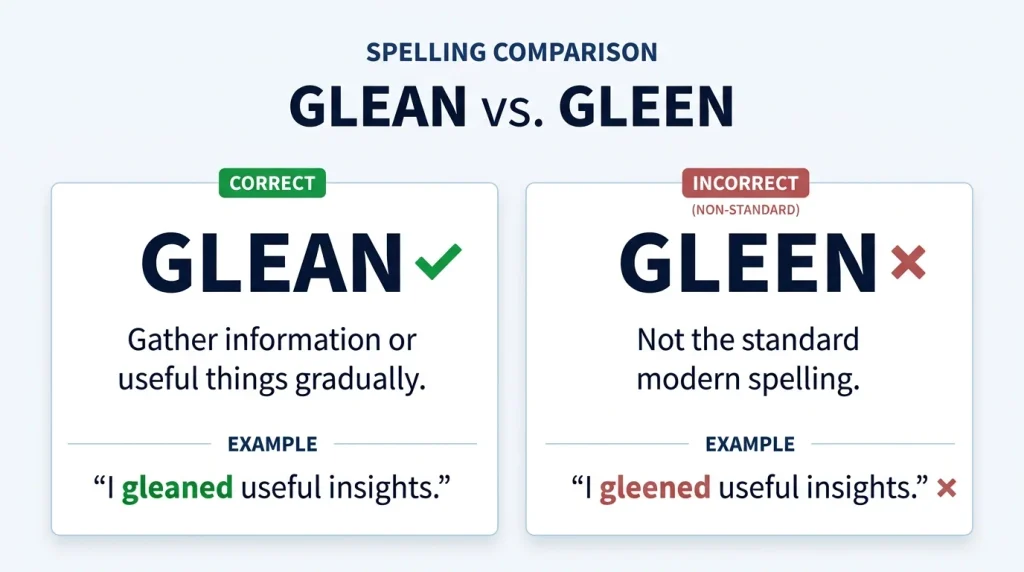
The difference between gleen and glean is primarily spelling and standard usage. Glean is an established English word with several related meanings, while gleen is not the standard spelling of that word.
People often search for gleen or glean because the words can sound similar in some accents or because English vowel combinations are difficult to remember.
Here is the essential distinction:
- Glean: A correctly spelled verb meaning to gather, discover, or learn something gradually.
- Gleen: Usually an incorrect spelling when the intended word is glean.
For example:
- Correct: We gleaned useful information from the survey.
- Incorrect: We gleened useful information from the survey.
The second sentence contains a spelling error because gleaned is the correct past-tense form.
What Does Glean Mean?
To glean means to collect useful information, knowledge, or items gradually, often from several sources or from what remains after others have taken what they need.
The word has two common applications.
Gleaning Information or Knowledge
In everyday and professional English, glean often refers to learning something by examining evidence, listening carefully, reading, or observing.
Examples include:
- Glean information from a conversation.
- Glean insights from customer feedback.
- Glean lessons from past mistakes.
- Glean clues from a person’s behavior.
- Glean details from a research report.
In these examples, the person is gathering knowledge rather than receiving every detail directly or all at once.
Gleaning Crops or Leftover Items
The word also has a more literal meaning: collecting crops left in a field after the main harvest. More broadly, it can refer to gathering useful things that remain after others have taken what they need.
For example:
“Volunteers gleaned the field after the harvest and donated the remaining produce.”
This use is especially relevant to agriculture, food recovery, and discussions about reducing waste.
The Core Rule: Use “Glean,” Not “Gleen”
The rule is simple: when you mean to collect information, discover facts gradually, or gather leftover crops, spell the word glean.
GLEAN — Correct for the intended meaning
Example: The analyst gleaned useful insights from the data.
GLEEN — Not the standard spelling for this meaning
Example: The analyst gleened useful insights from the data.
One small historical detail matters: gleen has appeared as a rare, obsolete English verb meaning to glisten or gleam. However, that old usage is not an alternative spelling of glean in modern writing. For ordinary communication, use glean when you mean to gather information or leftover items.
How to Use Glean Correctly
The verb glean usually takes an object, meaning the information or thing being collected. It often appears with the preposition from, which identifies the source.
1. Glean Something From a Source
This is one of the most useful patterns:
Subject + glean + information or insight + from + source
Examples:
- I gleaned useful advice from my mentor.
- The journalist gleaned details from public records.
- We gleaned several ideas from the discussion.
- The researchers gleaned evidence from archived documents.
You can use this construction in academic writing, workplace communication, everyday conversation, and journalism.
2. Glean That Something Is True
You can also use glean that when you gradually understand or discover a fact.
Examples:
- From his explanation, I gleaned that the deadline had changed.
- We gleaned that the company was planning a new launch.
- She gleaned from their conversation that they needed more time.
This construction emphasizes what someone worked out from the available information.
3. Use the Correct Verb Forms
Glean is a regular verb, so its main forms follow the usual English pattern for regular verbs.
| Verb form | Correct spelling | Example |
|---|---|---|
| Base form | glean | I glean information from reports. |
| Third-person singular | gleans | She gleans useful insights from interviews. |
| Simple past | gleaned | We gleaned several details yesterday. |
| Past participle | gleaned | The information was gleaned from records. |
| Present participle | gleaning | They are gleaning information from surveys. |
Notice that the spelling remains consistent: glean, gleans, gleaned, gleaning. The vowel combination ea does not change to ee when the verb is conjugated.
4. Know When Glean Is the Right Word
Use glean when the emphasis is on extracting or discovering something useful from available material.
| Situation | Natural example |
|---|---|
| Reading | I gleaned several lessons from the book. |
| Research | The team gleaned evidence from the records. |
| Conversation | I gleaned from her comments that she disagreed. |
| Business | We gleaned customer insights from the survey. |
| Agriculture | Volunteers gleaned leftover produce from the field. |
If you simply mean to acquire a skill through instruction or practice, learn may be the better word. If you mean to bring items together, gather may be more suitable.
Correct Examples of Glean in Everyday English
The following examples show how glean works across different contexts. Each sentence uses the standard spelling and a suitable meaning.
- Everyday conversation: I managed to glean a little information about the surprise party.
- Email: I gleaned the main action points from yesterday’s meeting.
- School: Students can glean important lessons from historical events.
- Workplace: Our manager gleaned several useful insights from the customer survey.
- Social media: I gleaned a helpful study tip from a post in the group.
- Academic writing: The researchers gleaned evidence from several independent studies.
- Journalism: The reporter gleaned additional details from public documents.
- Personal development: She gleaned valuable lessons from her earlier mistakes.
- Technology: Developers gleaned feedback from users who tested the new feature.
- Business planning: We gleaned useful ideas from the competitor analysis.
- Family conversation: I gleaned from Dad’s explanation that the trip might be postponed.
- Agriculture: Local volunteers gleaned the field and collected the remaining vegetables.
These examples illustrate an important point: glean can describe gathering information directly from written material, drawing conclusions from observations, or collecting physical items that remain.
Incorrect vs. Correct: 12 Common Spelling and Usage Errors
The table below shows common ways writers may misuse glean, along with corrections and explanations.
| Incorrect | Correct | Why |
|---|---|---|
| I gleened some information. | I gleaned some information. | The past tense is gleaned, not gleened. |
| She gleens facts from reports. | She gleans facts from reports. | The third-person form keeps the spelling glean. |
| We are gleening new ideas. | We are gleaning new ideas. | The -ing form is gleaning. |
| He wants to gleen more details. | He wants to glean more details. | Use glean in the base form after to. |
| They have gleened the evidence. | They have gleaned the evidence. | The past participle is gleaned. |
| The lesson was gleened from experience. | The lesson was gleaned from experience. | The passive form uses the past participle gleaned. |
| I gleaned the information on the report. | I gleaned the information from the report. | From is generally the natural preposition for identifying the source. |
| She gleaned to speak French. | She learned to speak French. | Learn is more appropriate for acquiring a language skill. |
| I gleaned the room with books. | I filled the room with books. | Glean does not normally mean to fill a space with objects. |
| He gleaned his bicycle yesterday. | He repaired his bicycle yesterday. | Glean does not mean repair. |
| We gleaned all the reports together. | We gathered all the reports together. | Gather better expresses physically bringing documents together. |
| I gleaned that advice from my teacher. | I gleaned that advice from my teacher. | The sentence is already correct; glean can describe obtaining advice from a source. |
The last row is deliberately included as a correct example. Not every sentence that looks unfamiliar is wrong; choosing the right verb depends on the meaning you want to communicate.
Why People Make the Gleen vs. Glean Mistake
There are several reasons writers confuse these spellings. Understanding them can help you avoid similar errors with other English words.
1. Pronunciation Does Not Reveal the Spelling
Glean is pronounced /ɡliːn/ in both standard American and British English. The vowel sound resembles the long ee sound in words such as green and clean.
Because English spelling does not always map one-to-one onto pronunciation, someone who hears the word without seeing it may reasonably guess gleen. However, the accepted spelling for the intended meaning is glean.
Read More: Prepair or Prepare? The Correct Spelling Explained.
2. English Has Several Vowel Patterns
English uses different letter combinations to represent similar sounds. Consider these examples:
- Clean
- Mean
- Lean
- Bean
- Glean
These words share the spelling pattern ea and the same vowel sound. Remembering this group can help you recall the spelling of glean.
3. Writers Overgeneralize Spelling Patterns
A spelling pattern that works for one word does not necessarily work for every word. Someone familiar with green or screen might assume that gleen follows the same pattern.
The problem is not pronunciation but applying a familiar spelling pattern to a word that uses a different one.
4. Spellcheck Does Not Teach Every Distinction
Spellcheck and autocorrect can identify many errors, but their behavior depends on the software, dictionary, and surrounding sentence. A tool may flag a typo without explaining why the alternative spelling is incorrect for the intended meaning.
For important writing, check the correct word and its grammatical form rather than relying entirely on automatic corrections.
5. Translation Can Influence Spelling
English learners sometimes transfer spelling habits from another language. If a familiar sound is normally represented by a particular letter combination in their first language, they may use the same combination in English.
This is a general spelling challenge, not a problem unique to glean. Reading examples and practicing the word in sentences can help build familiarity.
Common Mistakes Checklist
Use this checklist before submitting an assignment, email, article, or report.
- Check the vowel combination. Write glean, not gleen, when referring to gathering information.
- Use the correct past tense. Write gleaned, not gleened.
- Use the correct continuous form. Write gleaning, not gleening.
- Choose the verb that matches the meaning. Use learn for acquiring a skill, gather for bringing things together, and glean for extracting information or collecting leftovers.
- Identify the source clearly. In many sentences, glean something from something is the clearest construction.
- Review autocorrect suggestions. Check that the corrected word preserves your intended meaning.
- Read the whole sentence. Correct spelling is only one part of good writing; the verb must also fit the context.
Glean in Real English
Grammatically Correct
“After reviewing the interview transcripts, the researcher gleaned several important insights.”
This sentence is grammatically correct and natural. Gleaned is the simple past form of the verb, and insights is the information obtained. The phrase from the interview transcripts could be added to make the source explicit, but it is not essential if the source is already clear from the preceding context.
Grammatically Possible but Unnatural
“I gleaned how to ride a bicycle from the training session.”
Readers can understand this sentence, but it is not the most natural choice for an ordinary account of learning a physical skill. English speakers would usually say, “I learned how to ride a bicycle during the training session.” Glean tends to emphasize obtaining pieces of information or drawing conclusions rather than mastering a practical skill through instruction.
Natural, Everyday English
“I gleaned from her message that the meeting had been moved to Friday.”
This is a natural use of glean. The speaker has inferred a fact from a message, perhaps because it was implied rather than directly stated. Another common construction is “I gleaned a few details from the conversation.” In both cases, the verb emphasizes obtaining information from a source rather than simply receiving an explicit statement.
American vs. British English
There is no spelling difference between American and British English for this word. In both varieties, the standard spelling is glean, and its usual forms are gleans, gleaned, and gleaning.
| Feature | American English | British English |
|---|---|---|
| Standard spelling | glean | glean |
| Past tense | gleaned | gleaned |
| Present participle | gleaning | gleaning |
| Information meaning | Yes | Yes |
| Agricultural meaning | Yes | Yes |
Pronunciation may vary slightly between speakers and accents, but that does not change the spelling. Writers should use glean regardless of whether they are writing for an American or British audience.
Formal vs. Informal Usage
Glean is suitable for both formal and informal English, although it is especially common in contexts involving analysis, research, journalism, and careful observation.
| Context | Example | Suitability |
|---|---|---|
| Academic | The study gleaned evidence from several datasets. | Appropriate |
| Professional | We gleaned useful insights from client feedback. | Appropriate |
| Everyday conversation | I gleaned a few details from what he said. | Appropriate |
| Casual text | I gleaned a useful tip from that post. | Correct, though picked up may sound more conversational |
| Technical report | The team gleaned patterns from the collected data. | Appropriate |
In casual conversation, people may prefer got, learned, picked up, or found out. In formal writing, glean can be a concise way to emphasize that information was extracted or inferred from available evidence.
Glean vs. Similar Words
Several English verbs are related to glean, but they do not always mean exactly the same thing.
| Word | Main meaning | Best use |
|---|---|---|
| Glean | Obtain information gradually or collect leftovers | Extracting insights from sources |
| Gather | Bring things together or collect information | Collecting documents, people, or facts |
| Learn | Gain knowledge or a skill | Studying a subject or mastering a skill |
| Discover | Find something previously unknown | Finding a new fact or uncovering something |
| Infer | Reach a conclusion from evidence | Working out something not directly stated |
| Extract | Remove or obtain something from a source | Pulling specific data or information from material |
| Collect | Bring items or information together | Accumulating records, objects, or responses |
| Deduce | Reach a conclusion through reasoning | Drawing a logical conclusion from facts |
Glean vs. Gather
Gather is the broader word. You can gather a team, gather documents, or gather information. Glean emphasizes obtaining useful pieces of information or collecting what remains.
- Gather: We gathered all the survey responses.
- Glean: We gleaned three useful insights from the survey responses.
Glean vs. Learn
Learn is the better choice when referring to acquiring a skill or knowledge through study, practice, or instruction. Glean often suggests picking up details or understanding something from clues or several sources.
- Learn: She learned how to use the software.
- Glean: She gleaned useful tips from the software guide.
Read More: Drunk vs. Drank: What’s the Difference?
Glean vs. Infer
Infer focuses on reaching a conclusion based on evidence. Glean can include inference, but it also covers collecting facts without necessarily drawing a conclusion.
- Infer: We inferred that the launch would be delayed.
- Glean: We gleaned several details about the launch from the meeting.
Memory Trick: How to Remember Glean
Use this simple mnemonic:
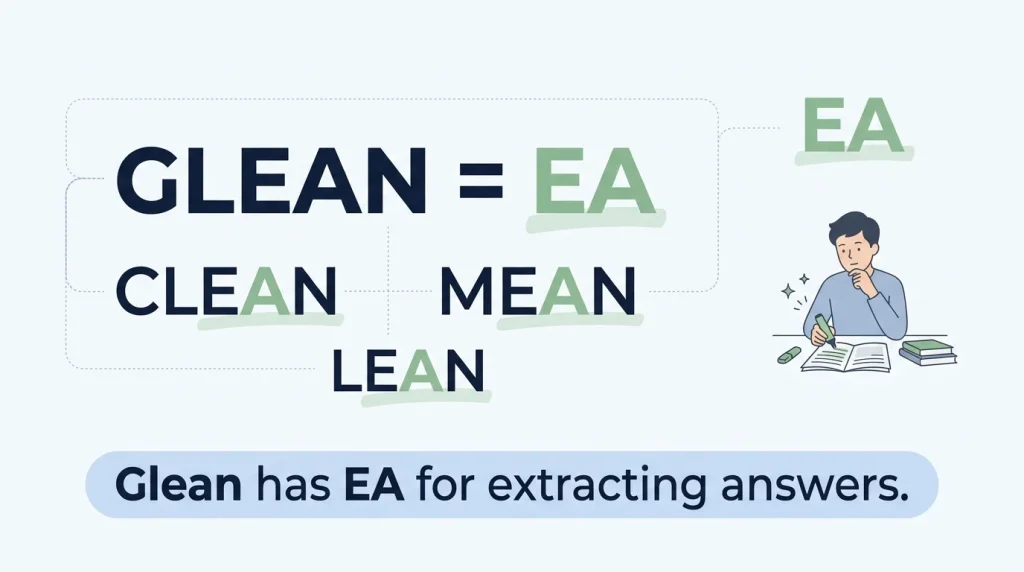
“Glean has EA for extracting answers.”
The word glean contains ea, just like clean, mean, and lean. When you need to gather information, remember to use the ea spelling.
Another way to remember it is to picture a researcher reading a report and picking out useful facts one by one. The researcher is gleaning information.
Before writing the word, ask yourself:
- Am I gathering information, insights, or leftover items?
- If yes, am I spelling it G-L-E-A-N?
- If I need the past tense, have I written gleaned?
This quick check can prevent the most common spelling error.
Glean in Real-Life Situations
Situation 1: A Job Interview
You finish an interview and want to explain what you learned about the company’s expectations.
Natural example: “I gleaned from the interview that the role requires strong communication skills.”
Why it works: You obtained an understanding from the interviewer’s comments.
Situation 2: A Workplace Meeting
Your manager asks what the team learned from customer feedback.
Natural example: “We gleaned several useful insights from the feedback forms.”
Why it works: The team extracted useful information from collected responses.
Situation 3: An Email
You want to summarize the main points from a long discussion.
Natural example: “I gleaned the key action items from the discussion and added them to the project notes.”
Why it works: Gleaned communicates that you identified the useful details within a larger amount of material.
Situation 4: A Text Message
A friend gives you a vague hint about a surprise.
Natural example: “I gleaned from your message that something exciting is happening!”
Why it works: You inferred information from what the friend wrote. In a very casual text, “I figured out from your message” may sound more relaxed.
Situation 5: An Exam
You are writing an essay about a historical document.
Natural example: “Readers can glean important information about the period from the author’s descriptions.”
Why it works: The sentence explains how readers can extract knowledge from a source.
Situation 6: A Research Project
Your team examines multiple reports before writing a conclusion.
Natural example: “The researchers gleaned several patterns from the combined results.”
Why it works: The researchers identified useful findings in the available data.
Expert Tips for Using Glean Correctly
1. Use Glean When the Source Contains More Than You Need
The word is particularly useful when a source contains many details but you extract only a few that matter.
For example, “The editor gleaned three key points from the lengthy report” emphasizes selecting useful information from a larger body of material.
Read More: Aesthetics vs Esthetics: Which Spelling Is Correct?
2. Do Not Assume Glean Always Means Guess
Gleaning information can involve careful reading, listening, research, or observation. It does not necessarily mean guessing or making an uncertain assumption.
For instance, a researcher may glean exact figures from a dataset. The information can be reliable even though it was collected from a larger source.
3. Use the Source Phrase When It Adds Clarity
Compare these sentences:
- “We gleaned several details.”
- “We gleaned several details from the interview notes.”
Both are correct. The second is more informative because it identifies where the details came from.
4. Do Not Replace Every Instance of Learn With Glean
The two words overlap in some situations, but they are not interchangeable in every sentence. Use learn for acquiring skills and knowledge broadly. Use glean when the focus is on obtaining pieces of information, often by examining a source or interpreting clues.
5. Remember That Correct Spelling Is Only the First Step
Writing glean correctly prevents a spelling error, but strong writing also requires the right meaning, verb form, and sentence structure. A correctly spelled word can still be unsuitable for the intended context.
Quick Summary
Glean is the correct spelling when you mean to gather information, discover facts gradually, or collect leftover items after a harvest. Gleen is not the standard modern spelling for these meanings, although it exists as a rare, obsolete English verb with a different meaning. The correct forms are glean, gleans, gleaned, and gleaning. Use expressions such as “glean information from a report,” “glean insights from feedback,” and “glean that something is true.” Both American and British English use the same spelling. To remember it, think of clean, mean, and lean: all contain the vowel combination ea. When in doubt, write glean, not gleen.
Frequently Asked Questions
Is gleen ever a correct English word?
Gleen has been recorded as an obsolete English verb meaning to glisten or gleam. However, it is not the standard spelling when you mean to gather information or collect leftover crops. In modern everyday writing, use glean for those meanings.
Is glean a word in both American and British English?
Yes. Glean is standard in both American and British English. Its spelling and main meanings are the same in both varieties.
What is the past tense of glean?
The simple past tense is gleaned. For example: “I gleaned several useful details from the report.” The past participle is also gleaned, as in “The information was gleaned from interviews.”
What is the difference between glean and gleaned?
Glean is the base form, while gleaned is its past-tense and past-participle form. Use glean after to or with a plural subject in the present tense, and use gleaned for completed past actions or perfect-tense constructions.
Can you glean information from a person?
Yes. You can glean information from a person’s comments, behavior, explanations, or messages. For example, “I gleaned from her remarks that she was concerned about the deadline.”
Is glean a formal word?
It is appropriate in formal writing, especially in research, business, journalism, and academic contexts. It can also appear in conversation. In very casual speech, pick up, find out, or learn may sound more natural depending on the situation.
What preposition usually follows glean?
The preposition from is common when you identify the source of information. For example, “We gleaned valuable insights from the interviews.” However, from is not required in every sentence, particularly when the source is already clear.
Can glean mean to understand something indirectly?
Yes. Glean can describe obtaining an understanding from clues, hints, observations, or indirect statements. For example, “From the tone of the email, I gleaned that the proposal needed revision.”
Is glean the same as infer?
Not exactly. Infer means to reach a conclusion from evidence, while glean can mean collecting information or insights from a source. Gleaning may involve inference, but the two verbs emphasize different aspects of the process.
How can I stop spelling glean as gleen?
Associate glean with clean, mean, and lean. These words share the ea spelling pattern and the same long vowel sound. Also, practice the related forms gleaned and gleaning so that the spelling becomes familiar.
Mini Quiz: Gleen or Glean?
Test your understanding with these 10 questions. Each answer includes an explanation so you can learn from any mistakes.
| No. | Question | Answer and explanation |
|---|---|---|
| 1 | Choose the correct spelling: “We ___ useful information from the report.” (a) gleen (b) glean | (b) glean. This is the standard spelling for collecting information. |
| 2 | Fill in the blank: “She ___ several insights from the interviews yesterday.” | Gleaned. The sentence describes a completed action in the past. |
| 3 | Correct the sentence: “I gleened some details from the email.” | I gleaned some details from the email. The past tense is gleaned. |
| 4 | True or false: Glean has a different standard spelling in British English. | False. American and British English both use glean. |
| 5 | Choose the better verb: “He ___ how to drive after months of practice.” (a) gleaned (b) learned | (b) learned. Learned is the natural choice for acquiring a practical skill. |
| 6 | Fill in the blank: “The team is ___ customer feedback from surveys.” | Gleaning. This is the present participle used in a continuous-tense construction. |
| 7 | Correct the sentence: “The researcher gleaned information on several interviews.” | The researcher gleaned information from several interviews. From naturally identifies the source. |
| 8 | Choose the correct sentence. (a) We gleaned clues from the messages. (b) We gleened clues from the messages. | (a). Gleaned is the correct past-tense spelling. |
| 9 | Fill in the blank: “From his explanation, I ___ that the schedule had changed.” | Gleaned. The speaker gradually understood a fact from the explanation. |
| 10 | Correct the sentence: “They have gleened valuable insights from the data.” | They have gleaned valuable insights from the data. The present perfect uses have plus the past participle gleaned. |



Pingback: Steem or Steam: Meaning, Spelling, and Correct Usage.
Pingback: Surprize or Surprise: Which Spelling Is Correct?