

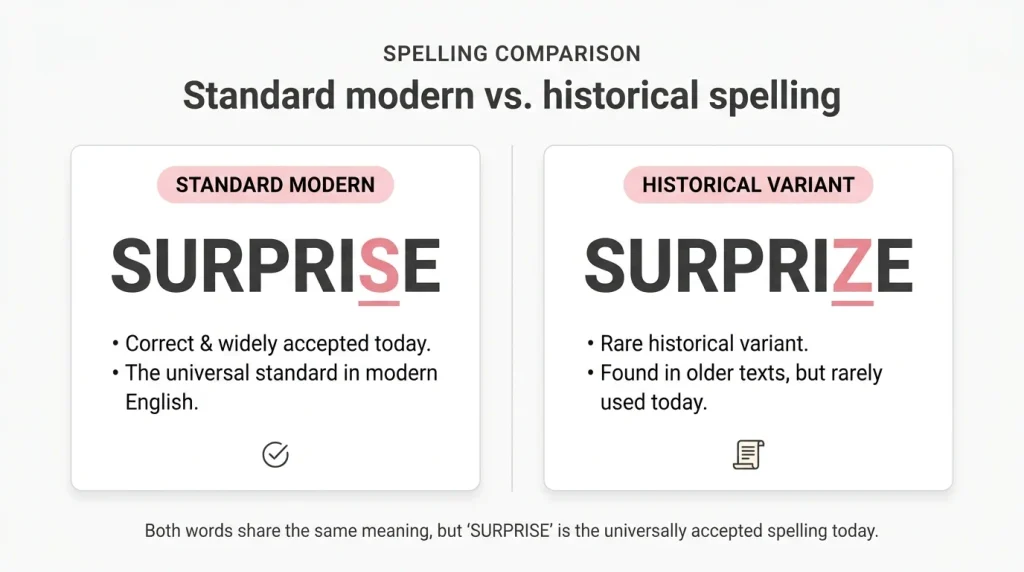
Surprise is the standard spelling in modern English. Surprize is an old, uncommon spelling variant that occasionally appears in historical texts. If you are writing for a modern audience, choose surprise.
Examples:
- Correct for modern writing: The birthday party was a wonderful surprise.
- Rare historical variant: The birthday party was a wonderful surprize.
The two spellings do not represent different meanings. The important distinction is that surprise is the established modern form, while surprize is rarely used today.
What Does Surprise Mean?
The word surprise describes something unexpected or the feeling someone experiences when something happens without warning. It can also mean causing someone to feel astonished or catching someone unprepared.
The word has several common uses:
- As a noun: An unexpected event, gift, announcement, or feeling.
- As a verb: To cause someone to feel astonishment or to encounter someone unexpectedly.
- As part of related forms: Surprised describes a person’s reaction, while surprising describes something that causes that reaction.
Examples:
- Noun: The concert tickets were a complete surprise.
- Verb: We plan to surprise our teacher with a thank-you card.
- Related adjective: Her surprising announcement changed our plans.
- Past participle: Everyone was surprised by the result.
In each case, the standard spelling begins with surpr- and retains the letter s in the middle.
Why Does the Difference Matter?
Choosing the standard spelling helps your writing look polished and makes your meaning easier to recognize. Although readers may understand surprize, the unusual spelling can distract them or make a contemporary sentence appear outdated.
Consider where the distinction matters:
- Schoolwork: Standard spelling helps you avoid unnecessary spelling errors.
- Professional emails: Conventional spelling creates a more polished impression.
- Website content: Consistent spelling supports readability and editorial quality.
- Social media: Correct spelling makes captions and announcements easier to read.
- Academic writing: The modern standard is appropriate unless you are quoting or analyzing a historical source.
The issue is not that surprize has a different meaning. It is that modern readers generally expect surprise.
Read More: Steem or Steam: Meaning, Spelling, and Correct Usage.
The Core Rule: Use Surprise in Modern English
Rule: Write surprise for ordinary modern English. Reserve surprize for a historical spelling found in a source or a deliberate stylistic choice.
Remember these points:
- Surprise: The standard modern spelling.
- Surprize: A rare historical variant, not the usual modern spelling.
- Surprised: The standard past-tense and past-participle form.
- Surprising: The standard form used to describe something that causes surprise.
- Surprisingly: The standard adverb form.
The letter s remains part of the standard spelling across the word’s common grammatical forms.
How to Use Surprise Correctly
1. Use Surprise as a Noun
A noun names a person, place, thing, event, or idea. As a noun, surprise refers to something unexpected or the feeling caused by it.
Examples:
- The announcement came as a surprise.
- We arranged a surprise for our parents.
- Her visit was a pleasant surprise.
- To my surprise, the train arrived early.
The word can be countable when referring to a particular event or thing: a surprise, two surprises. It can also describe the general feeling of astonishment.
2. Use Surprise as a Verb
A verb describes an action or state. When surprise is a verb, it means to astonish someone or catch that person off guard.
Examples:
- I want to surprise my sister on her birthday.
- The unexpected question surprised the speaker.
- Their team surprised everyone by winning.
- Please do not surprise me with last-minute changes.
The verb changes form according to the sentence:
- Present: surprise
- Third-person singular present: surprises
- Past tense: surprised
- Present participle: surprising
These forms retain the standard spelling.
3. Use Surprised to Describe a Reaction
Use surprised when describing how someone reacts to unexpected information or events.
Examples:
- I was surprised by the announcement.
- She looked surprised when the lights came on.
- They were surprised to see their old friend.
A useful distinction is that people are usually surprised, while things or events can be surprising.
For example, “I was surprised” describes your reaction. “The news was surprising” describes the news.
4. Use Surprising to Describe Something Unexpected
The adjective surprising describes something that causes surprise.
Examples:
- The results were surprising.
- It was surprising to hear that the shop had closed.
- She made a surprising discovery during her research.
Avoid writing suprising or suprizing in standard English. The standard forms preserve the initial sequence surpr-.
5. Recognize Surprise in Common Expressions
Several everyday expressions use surprise naturally:
- A pleasant surprise: Something unexpectedly enjoyable.
- A big surprise: An event or piece of news that causes considerable astonishment.
- To my surprise: A phrase introducing an unexpected result.
- Surprise party: A party arranged without the guest of honor knowing.
- Surprise visit: A visit that was not expected.
- No surprise: A phrase indicating that something is unsurprising or predictable.
Examples:
- Getting the promotion was a pleasant surprise.
- To my surprise, the application was approved.
- We are planning a surprise party for Daniel.
These expressions all use the standard spelling surprise.
Correct Examples of Surprise in Everyday Writing
The following examples show how to use the standard spelling in different situations.
- Conversation: “I have a surprise for you, but you have to wait until tonight.”
- Text message: “Your package should arrive today. Surprise!”
- Email: “We have a small surprise planned for the team after the meeting.”
- School assignment: “The ending of the story was a surprise to the main character.”
- Workplace: “The unexpected change in demand surprised our entire department.”
- Social media: “A little birthday surprise made this weekend unforgettable.”
- Academic writing: “The researchers were surprised by the difference between the two results.”
- Family conversation: “We want to surprise Grandma with a visit this weekend.”
- Customer communication: “We included a surprise gift with your order.”
- News reporting: “The announcement surprised investors who had expected a different outcome.”
- Personal writing: “To my surprise, the difficult journey turned out to be enjoyable.”
- Formal presentation: “The results were surprising because they contradicted the original prediction.”
Notice that the spelling stays the same whether the word is used casually, professionally, or academically.
Incorrect vs. Correct: 10 Common Spelling Mistakes
| Incorrect or nonstandard in modern writing | Correct standard form | Why |
|---|---|---|
| It was a surprize. | It was a surprise. | Surprise is the standard modern spelling. |
| I have a surprize for you. | I have a surprise for you. | Contemporary writing normally uses the s spelling. |
| She was surprized by the news. | She was surprised by the news. | The standard past-tense form uses -ised here, not -ized. |
| That was surprizing. | That was surprising. | The standard adjective uses -ising. |
| It was a suprize. | It was a surprise. | The first r must be retained, and the standard ending uses s. |
| I have a suprise. | I have a surprise. | Suprise leaves out the first r. |
| What a supprise! | What a surprise! | The extra p is not part of the standard spelling. |
| The result was suprising. | The result was surprising. | The incorrect form omits the first r. |
| We will suprize them. | We will surprise them. | The verb uses the standard s spelling and retains both r letters. |
| She smiled in surprize. | She smiled in surprise. | The conventional modern spelling is surprise. |
Important distinction: Some examples in the first column are not all the same kind of error. Suprise, suprize, and supprise are misspellings. Surprize, surprized, and surprizing are associated with an older spelling pattern, but they are not the normal choices for present-day standard English.
Why People Confuse Surprize and Surprise
1. The Z Sound in English Spelling
English contains many words with a written z, including organize, recognize, and realize. This can lead writers to assume that surprise should also use a z.
However, English spelling is not governed by one universal rule that makes every similar-sounding word follow the same pattern. Individual words have established spellings, and surprise is conventionally written with an s.
2. Historical Spelling Patterns
The confusion is not entirely arbitrary. Surprize was used as a spelling variant in earlier English, and readers may encounter it in older literature. Seeing the form in a historical book can make it appear equally suitable for modern writing.
The key is to distinguish historical evidence from present-day convention. An older spelling can be genuine without being the best choice for a contemporary article, email, or essay.
3. Pronunciation Does Not Always Reveal Spelling
The spoken word does not tell you with certainty whether to write s or z. English has many words whose spellings cannot be reliably reconstructed from pronunciation alone.
For this reason, learning the conventional written form is more dependable than trying to spell surprise by sound.
4. Autocorrect Can Miss the Real Issue
Spellcheck tools can help identify unusual spellings, but their behavior varies by software, dictionary, and language settings. Some tools may recognize rare variants, especially in specialized or historical contexts.
A word appearing in a spelling tool does not necessarily mean it is the most appropriate choice for everyday modern English. When in doubt, use surprise.
5. Similar Word Patterns Encourage Overgeneralization
Writers sometimes apply the spelling pattern of one word to another. For example, someone familiar with organize may assume that surprize follows the same pattern.
This is an example of overgeneralization: applying a pattern too broadly instead of learning the conventional form of each word.
Read More: Gleen or Glean: Which Spelling Is Correct?
Common Mistakes Checklist
Use this checklist when proofreading your writing.
- You wrote surprize in a modern sentence. Replace it with surprise unless you are intentionally reproducing an older spelling.
- You omitted the first r. Check that the word begins surpr-, not supr-.
- You added an extra p. Write surprise, not supprise.
- You used surprized or surprizing. In ordinary modern writing, use surprised and surprising.
- You assumed the word follows the spelling of organize. Remember that English spelling patterns are not completely consistent.
- You relied only on pronunciation. Check the written form rather than guessing from the sound.
- You changed spelling styles within a document. Use surprise consistently in contemporary writing.
- You copied an old spelling without considering context. Preserve it when quoting a historical source, but use the modern standard in your own prose.
The best prevention method is simple: memorize the standard spelling and check the complete word, not just its ending.
Surprise in Real English
Grammatically Correct
“Surprise” is a correctly spelled word in modern English and can function as both a noun and a verb. “The gift was a surprise” uses it as a noun, while “I will surprise my friend” uses it as a verb. Related forms such as surprised, surprising, and surprisingly are also standard. These forms work in casual conversation, professional writing, and academic prose whenever their meanings fit the context.
Grammatically Possible but Unusual
“Surprize” is recognizable as a historical spelling variant rather than a separate word with a different meaning. A reader may encounter it in older books, quotations, or texts that deliberately preserve historical spelling. Using it in a newly written sentence is unusual in contemporary English, however, and may look like a mistake. Unless the historical spelling itself is relevant, the standard modern form is the clearer choice.
Natural, Everyday English
In everyday English, people naturally write phrases such as “What a surprise!”, “I have a surprise for you,” and “That really surprised me.” These expressions are common and work across a wide range of situations. The spelling remains surprise regardless of whether the sentence is a casual message, a birthday announcement, or a formal report. You do not need a special spelling for American English, British English, or informal conversation.
American vs. British English
There is no standard American-versus-British spelling difference for this word.
| English variety | Standard spelling | Rare historical variant |
|---|---|---|
| American English | surprise | surprize |
| British English | surprise | surprize |
| Australian English | surprise | surprize |
| International English | surprise | surprize |
Both American and British English use surprise in contemporary writing.
Do not confuse this word with words that have recognized spelling alternatives, such as organize/organise or realize/realise. The spelling of surprise does not change according to those patterns.
Formal vs. Informal Usage
The standard spelling surprise is appropriate in both formal and informal English. You can use it in a text message, a work email, a school assignment, a novel, or a research paper.
| Context | Recommended example |
|---|---|
| Text message | “I have a surprise for you!” |
| Friendly email | “We planned a little surprise for Maya.” |
| Workplace report | “The findings surprised the research team.” |
| Academic writing | “The results were surprising given the initial hypothesis.” |
| Historical quotation | Preserve surprize if that is how it appears in the original source. |
The main exception concerns historical or editorial accuracy. If you are transcribing an old text, changing its spelling might alter the original wording. Outside that context, use surprise.
Surprise vs. Surprize: Comparison Table
| Feature | Surprise | Surprize |
|---|---|---|
| Standard in modern English | Yes | No; rare historical variant |
| Meaning | Something unexpected, or to cause astonishment | Same historical word and meaning |
| Common in current writing | Yes | Very uncommon |
| Suitable for modern professional writing | Yes | Generally avoid |
| Used in American English | Yes | May appear in historical material |
| Used in British English | Yes | May appear in historical material |
| Related form | surprised | surprized is an older spelling |
| Recommended for learners | Yes | No, except when studying historical spelling |
The practical difference is usage, not meaning. For contemporary writing, surprise is the reliable choice.
Memory Trick: Remember the S
Use this short mnemonic:
“A surprise should surprise you, not surprize you.”
The word surprise contains an s before the final e. Picture the spelling as you say it:
S-U-R-P-R-I-S-E
Then connect it to the common expression “surprise party.” If you can remember that phrase, you can remember the spelling.
A second technique is to practice the word in a short sequence:
- Surprise
- Surprised
- Surprising
- Surprisingly
Writing the word family together helps reinforce the standard pattern and reduces the temptation to substitute z.
Real-Life Situations: Which Spelling Should You Choose?
Situation 1: Sending a Birthday Message
You are planning a birthday gift and want to keep it secret.
Write: “I have a surprise for you tomorrow.”
Avoid: “I have a surprize for you tomorrow.”
The standard spelling looks natural and is appropriate for a casual message.
Situation 2: Writing a Professional Email
You are announcing an unexpected team reward.
Write: “We have a small surprise planned for everyone at Friday’s meeting.”
The spelling is standard and suitable for workplace communication.
Situation 3: Completing an English Exam
You need to finish the sentence: “The announcement was a complete _____.”
Choose surprise. It is the conventional modern spelling and is the appropriate answer in a standard English exam.
Situation 4: Writing a Research Report
Your findings contradict your original prediction.
Write: “The results were surprising because the two groups performed similarly.”
Here, surprising is the correct related form.
Situation 5: Reading a Historical Novel
You find the word surprize in an older novel.
Do not assume that the original author made a mistake. The spelling has historical precedent. If you quote the passage, preserve the spelling when accuracy requires it. In your own modern commentary, write surprise.
Expert Tips for Remembering the Correct Spelling
- Memorize the complete word. Learn surprise as a single spelling instead of guessing whether the ending needs an s or a z.
- Practice related forms together. Write surprise, surprised, and surprising in one short exercise.
- Read your sentence aloud, then proofread visually. Pronunciation helps you recognize the word, but visual checking helps you catch spelling errors.
- Use the right dictionary setting. If you work with American or British English, make sure your spelling tool is configured for the intended variety.
- Do not confuse historical validity with modern preference. A form may appear in old books without being the usual spelling today.
- Check the context before correcting a quotation. If you are preserving an author’s original words, do not silently modernize a historical spelling.
- Create a personal error list. If you repeatedly write surprize, add surprise to your proofreading checklist until the standard form becomes familiar.
These habits are more dependable than memorizing a broad rule about when English uses s or z.
Read More: Prepair or Prepare? The Correct Spelling Explained.
Quick Summary
Surprise is the standard spelling in modern English, while surprize is a rare historical variant. Both forms have been associated with the same word, but contemporary writers should normally use surprise in everyday messages, professional emails, academic assignments, and published content. The word can function as a noun meaning something unexpected or as a verb meaning to astonish someone. Its related forms include surprised, surprising, and surprisingly. There is no standard American-British spelling difference. To remember the correct form, focus on the complete spelling: S-U-R-P-R-I-S-E. Use the historical variant only when reproducing an older text or when a deliberate historical style requires it.
Frequently Asked Questions
Is surprize ever correct?
Surprize has historical usage as a variant spelling of surprise. However, it is rare today and is not the recommended spelling for contemporary writing. Use surprise unless you are preserving a historical source or deliberately using an older spelling.
Why did people spell surprise as surprize?
English spelling has changed over time, and surprize was one historical form. Modern usage settled on surprise as the conventional spelling. The existence of older printed examples explains why the variant may still appear in historical texts.
Is surprize a different word from surprise?
No. In its historical use, surprize refers to the same word and meaning. The distinction is spelling and period of use, not a separate modern definition.
Is surprise spelled with an s or a z?
The standard modern spelling uses an s: surprise. Although the word sounds similar to some words written with z, its conventional spelling is not surprize.
Is surprized correct in modern English?
Surprized is an older spelling associated with the historical surprize variant. In ordinary contemporary writing, use surprised.
Is surprizing or surprising correct?
Surprising is the standard modern form. Use it when describing something that causes astonishment, as in “The result was surprising.”
Does American English use surprize while British English uses surprise?
No. Surprise is the standard modern spelling in both American and British English. Surprize is not a standard regional alternative.
How do you spell surprise in a birthday message?
Write surprise. For example: “I have a special surprise planned for your birthday.” The same spelling applies to party invitations, greeting cards, and social media captions.
What is the difference between surprised and surprising?
Surprised usually describes the person experiencing the reaction: “We were surprised.” Surprising describes the thing causing the reaction: “The news was surprising.”
How can I stop misspelling surprise?
Practice the full sequence S-U-R-P-R-I-S-E and review related forms such as surprised and surprising. When proofreading, check that you have used the standard s spelling rather than the historical z variant.
Mini Quiz: Test Your Understanding
Choose the correct answer or complete each sentence. Answers and explanations are included so you can check your understanding.
| No. | Question | Answer | Explanation |
|---|---|---|---|
| 1 | Which spelling is standard in modern English: surprize or surprise? | Surprise | It is the conventional spelling for contemporary writing. |
| 2 | Complete the sentence: “I have a _____ for you.” | Surprise | The noun refers to something unexpected. |
| 3 | True or false: American English normally spells the word surprize. | False | American English uses surprise as the standard spelling. |
| 4 | Correct the sentence: “The news surprized everyone.” | The news surprised everyone. | Surprised is the standard past-tense form. |
| 5 | Which is correct: surprising or surprizing? | Surprising | The standard modern form uses s. |
| 6 | Complete the sentence: “To my _____, the shop was still open.” | Surprise | “To my surprise” is a common expression. |
| 7 | True or false: Surprize has never appeared in historical English. | False | It is a documented historical spelling variant. |
| 8 | Correct the sentence: “Her visit was a pleasant surprize.” | Her visit was a pleasant surprise. | The modern standard spelling is surprise. |
| 9 | Which word describes a person’s reaction: surprised or surprising? | Surprised | A person is surprised; an event can be surprising. |
| 10 | You are quoting a historical novel that uses surprize. Should you automatically change the original spelling? | No | Preserve the original form when accurate transcription or quotation requires it. |
Quiz Score Guide
- 9–10 correct: You understand the spelling distinction very well.
- 7–8 correct: You know the main rule; review the historical variant and related forms.
- 5–6 correct: Practice the standard spelling and the difference between surprised and surprising.
- 0–4 correct: Start with the core rule and repeat the spelling sequence S-U-R-P-R-I-S-E.


Pingback: Plack or Plaque: Which Spelling Is Correct?
Pingback: Abscent or Absent: Which Spelling Is Correct?